West
California Democrats 'playing dirty tricks' to keep Prop 47 reform off ballot, GOP leader says

California Democrats are playing “dirty tricks” in response to bipartisan efforts to place a measure to reform Proposition 47 on the November ballot in favor of other public safety bills, officials said.
Prop 47, a voter-approved initiative passed in 2014, loosened the penalties for drug and theft crimes in California and has been blamed for California’s rampant theft problems. Californians for Safer Communities, a bipartisan group made up of law enforcement, elected officials and businesses, said it has collected more than 900,000 signatures in support of the proposed amendment to reform Prop 47 in order to increase penalties for criminals.
However, California Gov. Gavin Newsom and some elected Democrats don’t support the effort and are pushing some public safety bills circulating through the state Capitol that attempt to address organized retail theft, car break-ins and other crimes. They prefer those bills go before voters instead of the Prop 47 reform measure.
Some Democrats plan to introduce inoperability clauses into the set of proposed public safety bills to prevent them from going into effect if voters approve the Prop 47 reforms. They contend that it’s a way to ensure there aren’t any inconsistencies in the law.
NEWSOM PROPOSES DEFUNDING LAW ENFORCEMENT, PRISONS, PUBLIC SAFETY AS CALIFORNIA FACES MASSIVE DEFICIT
A large group of 30-50 people were caught on video ransacking a Nordstrom in Los Angeles at Topanga Mall in Los Angeles. (Courtesy: Instagram / @ella_ise24.)
“The Democrats are playing dirty tricks to try and stop it,” California Assembly Republican Leader James Gallagher told Fox News Digital. “They think that Prop 47 is good policy. I think the majority of Californians disagree with them and want to change it.”
Fox News Digital has reached out to the California Democratic Party and Californians for Safer Communities.
Prop 47 made several crimes, including shoplifting, grand theft and receiving stolen property, a misdemeanor instead of a felony if the value of the property did not exceed $950. It also lowered the penalty for the personal use of most illegal drugs below a certain weight.
Many law enforcement officials have blamed the measure for the uptick in theft and smash-and-grabs that have plagued California in the years since the COVID-19 pandemic. Around the same time, California became synonymous with smash-and-grab crimes as videos of groups of thieves brazenly ransacking stores gained traction online.
Recently, Newsom has come out tougher on public safety as many Californians are voicing concerns about crime in their communities.
SACRAMENTO MASS SHOOTING SUSPECT FOUND DEAD IN JAIL CELL WHILE AWAITING TRIAL
California Gov. Gavin Newsom was recently ripped by critics for describing California as a “national model” for combatting homelessness. (California Governor Gavin Newsom YouTube channel)
“There’s a lot of moving parts, a lot of negotiations concurrently happening,” Newsom told reporters on Friday. “Prop 47 is included.”
Those bills being pushed by Democrats, however, don’t address personal theft, as opposed to smash-and-grabs, the trafficking of fentanyl and drug treatment incentives, said Gallagher.
“Those are three things that the initiative does that we need, that this (Democratic) retail package doesn’t do,” said Gallahgher.
California has some of the toughest thresholds for prosecutors to charge suspects with a felony for theft up to $950, in contrast to other states that have higher thresholds, Newsom’s office said Monday.
Last year, the Democratic governor announced more than $267 million to increase arrests and prosecutions for organized retail crime across the state. Earlier this year, Newsom recalled how he witnessed a shoplifter stealing from Target in Sacramento. He confronted a store employee moments later.
“I said, ‘why didn’t you stop him,’” Newsom said during a Zoom meeting on mental health in January. “She goes, ‘oh, the governor.’ Swear to God, true story on my mom’s grave. ‘The governor lowered the threshold, there’s no accountability.’ I said that’s just not true.”
“That’s exactly the kind of situation that happens every day that his package does nothing about,” Gallagher said.
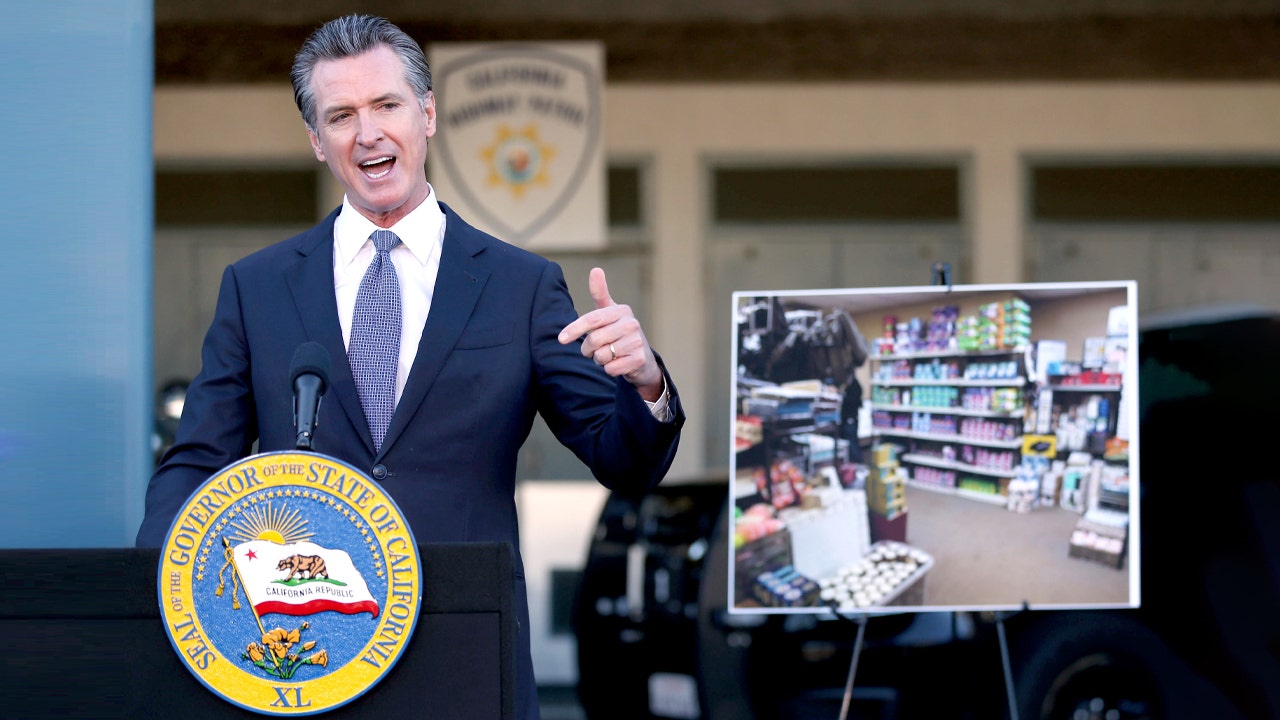
California Gov. Gavin Newsom speaks on Dec. 17, 2021, at a news conference in Dublin, Calif., about headline-grabbing smash-and-grab robberies at high-end stores. (Ray Chavez/Bay Area News Group via AP)
Regarding the possible inoperability clauses, Republicans have called it a “poison pill.”
“To combat the California crime wave, we need to strengthen our laws, both in the Legislature and at the ballot box,” Senate Minority Leader Brian Jones previously said in a statement. “It’s irresponsible to force voters into a false choice between the two. Unfortunately, some Democrat politicians are too prideful to admit their mistake with Prop 47 and they continue to deny the desperate need for reform.”
Read the full article from Here


HONOLULU (HawaiiNewsNow) – If you grew up in Hawaii, a visit to your local Crackseed shop is likely a core childhood memory.
Let’s go holoholo to one of the oldest shops in Honolulu, Kay’s Crackseed.
Any time Lanette Mahelona of Kaneohe is in Manoa, a stop at Kay’s Crackseed is a must!
“I stop by here, and I always grab two pounds of this seedless creamy ume because it’s hard to find on our end of the island, Kaneohe,” said Mahelona.
Kay’s Crackseed sits in a four-hundred-square-foot shop at Manoa Marketplace.
The original owner, Kay, opened the shop in 1978 and ran it for 18 years.
Mei Chang now runs the shop. Her family took it over in 1996. They’ve been selling an assortment of crack seed and products, which Mei says is a healthy snack in the eyes of the Chinese.
“Yeah, so like the ginger, the Chinese always say it’s Chinese medicine, so they help your motion sickness, the stomach, and even the kumquat,” said Chang. “It’s like honey lime ball, if you catch a cold, sore throat, they help a lot.”
Customers are encouraged to sample the different treats.
Now working in a crack seed shop isn’t anything new for Chang.
She said these kinds of shops are in common in Taiwan that her grandparents used to sell different kinds of li hing mui.
Chang lived right above her grandparents’ shop and was in the second grade when she started helping them with the business.
“Every day when I finish school first thing open a jar,” said Chang. “I really like the football seed, so every day I eat a football seed for my snack.”
And talk about a full circle moment, her daughter would also help around the Manoa shop.
Through Kay’s Crackseed, Chang hopes to carry on traditional recipes she learned from her grandparents.
“Crack seed for us is not only the snack, but it’s like childhood memory, yeah, the happiness, so we try to keep doing the tradition. So, all the juice we make here is from our grandpa and grandma’s recipe,” said Chang. “So, a special yeah, secret sauce, so we have some customers that live far away, the other side of the island, drive so far to come here to get the li hing one. The wet li hing mui, the rock salt palm, is really popular.”
“The li hing mui ones are not as sweet, sweet as other places, and it’s soft,” said Crystal Kaluna of Kauai.
Copyright 2026 Hawaii News Now. All rights reserved.

BOISE, Idaho — Idaho lawmakers have introduced legislation that would phase out state funding for the Idaho Commission on Hispanic Affairs while keeping the commission in place.
The proposal, introduced by Rep. Jeff Ehlers, would gradually eliminate general fund support for the commission by July 1, 2028. The commission would continue to operate but would need to rely on private funding.
Rep. Ehlers told the House Revenue and Taxation Committee on Thursday that the proposal came from recommendations by Idaho’s DOGE Task Force, which reviewed government programs and spending.
READ MORE | Idaho DOGE Task Force recommends defunding Idaho Commission on Hispanic Affairs
The bill would also eliminate the commission from a list of organizations eligible for a state income tax charitable contribution credit.
Rep. Steve Berch questioned why the legislation would remove both state funding and the tax credit option, saying it could make it more difficult for the commission to raise money.
“I hate to use this word, but I’m really offended by this specific effort to make it that much more difficult for private citizens to be able to contribute to the Hispanic commission,” Rep. Berch said in committee. “I don’t think this can be justified from a financial point of view, and quite frankly, I don’t think it can be justified from a moral point of view.”
In response, Rep. Jason Monks said that it would be more “offensive” to not allow further discussion of the bill before a final decision is made.
The proposal comes after an earlier attempt this session to eliminate the commission entirely. In January, Rep. Heather Scott presented a draft bill that would have removed all references to the commission from Idaho law and dissolved it by July 1, but that measure failed to advance out of committee.
The committee ultimately voted on Thursday to introduce the legislation, allowing it to be printed and advanced for further debate.
This story has been, in part, converted to this platform with the assistance of AI. Our editorial team verifies all reporting on all platforms for fairness and accuracy.

Although newly minted GOP candidates for the U.S. House and U.S. Senate have garnered heavyweight endorsements, the Montana Republican Party said Thursday it won’t throw its support behind any candidates for federal office in the primary.
“The Montana Republican Party (MTGOP) stands behind its deep bench of qualified candidates seeking to represent Montanans and supports a competitive primary process to let voters pick their preferred candidates,” the Montana GOP said in a news release Thursday.
Monday, U.S. Rep. Ryan Zinke announced he was retiring due to health concerns once his term ends, and he immediately tapped talk-show host Aaron Flint as his preferred successor in Congress.
Secretary of State Christi Jacobsen and Flathead County Republican Central Committee Chairperson Al Olszewski also filed for the U.S. House as Republicans, as did Ray Curtis of Bonner.
Wednesday, U.S. Sen. Steve Daines withdrew, and in a statement the same night, announced an endorsement of former U.S. Attorney Kurt Alme, who had filed the same day.
In the Senate, Lee Calhoun and Charles Walking Child also filed to run in the Republican primary.
Endorsements for Flint and Alme cascaded. U.S. President Donald Trump endorsed both candidates, and U.S. Sen. Tim Sheehy and Gov. Greg Gianforte threw their weight behind Flint and Alme.
Late on Wednesday, the Montana GOP did not immediately have comment on the news Daines, Montana’s senior U.S. senator, had resigned, but Thursday, the party thanked Zinke and Daines for their service.
A news release said the party would not endorse any candidates in the federal primary and would leave the job in the hands of voters.
“The party hopes every candidate will make their case to the public, contrasting their Republican policies and principles with those of Democrats — as well as phony ‘Independents,’” the news release said.
Former University of Montana President Seth Bodnar announced a run for the U.S. Senate as an independent this week.
A tension within the Republican party has emerged in recent years between hardline conservatives and more moderate members, and some legislative primaries illustrate the split.
This week, the state GOP said the number of primaries for state legislative seats shows a high interest from Montanans who want to serve the state and pass Republican policy, and the MTGOP “is glad to see so many Republicans being called to public service.”
In a brief call, MTGOP spokesperson Ethan Holmes said the party had not ruled out endorsements in legislative primaries.
In the news release, however, the MTGOP offered its view of the larger political debate.
“Montana voters know that beyond the primaries, there is a clear choice between Republican and Democratic governance; one path leads to lower taxes, less crime and stronger families, and the other leads to higher taxes, more crime, and social decay,” MTGOP Chairperson Art Wittich said in a statement.
The news release also said the state GOP is working “tirelessly to deliver a Bright Red Future” at both the state and federal level and looks forward to help candidates whom voters select win in November.

Kay’s Crackseed: The Manoa shop preserving Hawaii’s favorite childhood snack
Idaho lawmakers introduce bill to phase out state funding for Hispanic Affairs commission

Chicago property taxes jump — but unevenly

Heavy rain soaks central Indiana, but drought relief uneven across the state

Iowa women’s wrestling star Kylie Welker on competing for official NCAA championship

Florida High School Football Rankings: Top 25 teams – Oct. 21

Cleary's 21 help Le Moyne down Central Connecticut State 69-64 in OT

How old is Bo Nix? What to know about Oregon quarterback ahead of 2024 NFL Draft

99th annual Pony Swim held in Virginia

Indiana Members Credit Union announced as new anchor tenant at Bottleworks District

Map: 4.9-Magnitude Earthquake Shakes Louisiana

Paxton vows he’s ‘staying in this race’ even if Trump backs Cornyn in Texas GOP clash

Which Kurdish groups is the US rallying to fight Iran?

Man accused of plot to assassinate Trump testifies Iran pressured him, says Biden and Haley were other possible targets

DHS defends McLaughlin against allegations husband’s company profited millions from ad contracts: ‘Baseless’
-

 World1 week ago
Exclusive: DeepSeek withholds latest AI model from US chipmakers including Nvidia, sources say
-

 Massachusetts1 week ago
Mother and daughter injured in Taunton house explosion
-

 Wisconsin4 days ago
Setting sail on iceboats across a frozen lake in Wisconsin
-

 Maryland5 days ago
AM showers Sunday in Maryland
-

 Florida5 days ago
Florida man rescued after being stuck in shoulder-deep mud for days
-

 Denver, CO1 week ago
10 acres charred, 5 injured in Thornton grass fire, evacuation orders lifted
-

 Massachusetts3 days ago
Massachusetts man awaits word from family in Iran after attacks
-

 Oregon6 days ago
2026 OSAA Oregon Wrestling State Championship Results And Brackets – FloWrestling