West
Bay Area city pays $1.5 million after years-long fight to take down cross

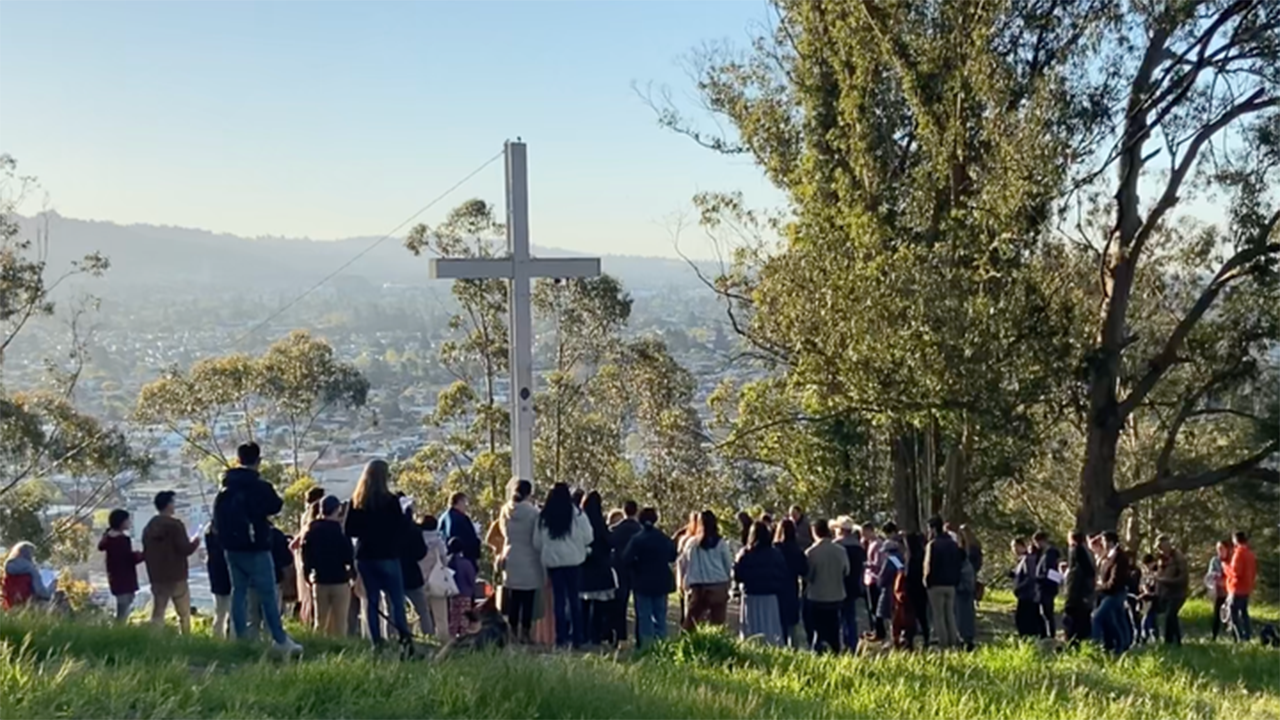
A years-long legal battle over a giant cross in a Bay Area city has finally been resolved, after the city agreed to pay over $1.5 million to settle the dispute.
The Albany Hill Cross, a 28-foot illuminated steel and plexiglass structure, stood overlooking the city of Albany and the East Bay of San Francisco for over 50 years. The cross had been installed on the original landowner’s private property for the benefit of the community, because Christians had been carrying crosses up the hill every Easter for years, according to local community service group, The Albany Lions Club. The surrounding land was later sold to the city and became part of a public park. Before selling, the original landowner created an easement granting maintenance of the cross to the Albany Lions Club.
After a local atheist group complained about the religious symbol in a public park, a federal judge ruled that the cross violated the First Amendment. The city council voted to acquire the easement by eminent domain, rather than sell it to the Albany Lions Club, and took down the cross in 2023. However, the Albany Lions Club continued to fight the city over the cross removal and easement dispute.
To end the ongoing litigation, the city announced in its October 7 city council meeting that it had agreed to settle the case, by paying over $1.5 million to the Albany Lions Club in exchange for the legal title to the entirety of the property.
BAY AREA ATHEISTS WHO FOUGHT FOR CROSS REMOVAL: CHRISTIANS SHOULDN’T HAVE ‘SPECIAL PRIVILEGE’
A past Easter service at the cross on Albany Hill. (Courtesy: Dorena Osborn) (Dorena Osborn)
“To end the ongoing litigation, the City stipulated to a judgment with the Lions Club to avoid additional litigation expenses. This judgment allows the City to condemn the easement, and remove the cross, which the City already did, that existed on Albany Hill Park for the benefit of the Lions Club. The judgment requires the City to pay the Lions Club $1,530,000 for acquisition of their property interest, $500,000 of which has already been set aside with the State Condemnation Fund,” the city of Albany announced.
“Additionally, the judgment fully resolves any and all claims the Lions Club may have had regarding the City’s removal of the cross and gives the City legal title to the entirety of the property, and completely clears title of the easement that previously existed on the Park.”
“This resolves the matter, and therefore, the Lions Club has no legal right to use the property for the easement or to maintain the cross on the property, which the City has already removed,” the statement continued.
Albany Lions Club President Kevin Pope told Fox News Digital that the city “exercised poor judgment” in how they handled the years-long dispute.
CLICK HERE FOR MORE COVERAGE OF MEDIA AND CULTURE
The city of Albany settled its dispute with the Albany Lions Club over its giant cross, which once overlooked the East Bay of San Francisco. (iStock)
“I’m sad and angry that the Albany City Council has exercised such poor judgment in spending public resources to force the permanent removal of the Christian cross from Albany Hill. It did not have to be this way,” he said.
Pope slammed the city for choosing “to pay over $1.5 million to tear down the cross,” instead of just selling a small portion of the land to The Albany Lions Club so the cross could remain on private property, and questioned if the decision was a wise use of the city’s “dwindling resources.”
“Albany is now viewed by many as a place of intolerance toward religious values. Data shows there is an ‘exodus’ of people from California for that and many other reasons,” Pope said.
Albany Lions Club President Kevin Pope criticized the Albany City Council for how they handled the easement dispute over the cross. (iStock)
“The cross means the world to those who worship Jesus Christ; it’s the symbol of the great love God has for all of us, not just Christians, all of humankind, every race, religion, ethnic group, sex, etc. All of us, whether we believe in God or not. He still loves us,” Pope said, quoting 1 Corinthians 1:18.
The Albany City Council referred to its public statement when reached for comment by Fox News Digital.
Read the full article from Here

Alaska
A frozen ground under Alaska’s tundra looks like ordinary soil from above, but scientists have put a $43 trillion price tag on what happens when it thaws

Stand on the tundra in Alaska and it looks like nothing special.
A vast, flat plain of amber grass, shallow ponds, and dark soil stretching to the horizon.
No obvious drama, no visible crisis.
But a few feet below your boots, something has been building for millennia, and scientists have finally put a dollar figure on what happens when it wakes up.
The ground beneath the Arctic has been keeping a secret for millions of years
Permafrost is frozen ground, soil and rock locked in ice for thousands of years across Alaska, Canada, Siberia, and the high Arctic.
It covers roughly a quarter of the land in the Northern Hemisphere.
Most Americans have never thought about it for a single second.
Permafrost contains about 1,700 gigatons of carbon in the form of frozen organic matter, accumulated over countless millennia of dead plants and animals that never fully decomposed.
That is roughly twice the carbon currently in the entire atmosphere above us.
Think of it as a freezer the size of a continent, stocked with centuries of biological material that simply never had the chance to rot.
For as long as the ground stayed frozen, that carbon stayed locked away, harmless and invisible.
Something is going wrong with the world’s largest freezer
The Arctic is warming roughly four times faster than the global average.
As the ground softens, the organic matter inside it begins to rot.
Permafrost releases both carbon dioxide and methane as it thaws, through rotting organic matter, collapsing terrain, and waterlogged soils where methane-producing microbes thrive.
That methane detail matters more than most people realize.
Methane is over 80 times more effective than carbon dioxide at trapping heat over a 20-year period.
Wildfires are accelerating the process further, scorching the insulating layer of moss and peat that once kept the frozen ground shielded from summer heat.
And once those gases escape, there is no putting them back.
The tundra is already changing in ways you can see from the ground
Across Alaska, roads are buckling and tilting where the ground beneath them has shifted.
Strange new lakes are appearing on the tundra, formed as the frozen ground collapses inward.
Scientists call these thermokarst lakes, and they are spreading.
In some Alaskan villages, houses are sinking and cracking as if the earth beneath them is slowly giving way.
Wooden boardwalks that once crossed stable ground now lean at odd angles, and in a handful of communities, entire buildings have been condemned.
This is not a future warning, it is already happening across the far north.
A study on permafrost and the remaining carbon budget found that including permafrost thaw in climate models meaningfully reduces the allowable carbon budget for avoiding dangerous warming targets.
Scientists ran the numbers and the total came out to $43 trillion
Greenhouse gas emissions from thawing Arctic permafrost could result in an additional $43 trillion in economic impacts by the end of the twenty-second century, according to research from the University of Cambridge and the National Snow and Ice Data Center.
That figure is not the cost of fixing permafrost.
It is the added damage thawing permafrost would layer on top of every other climate cost humans are already calculating.
To put it in scale: the University of Cambridge researchers note that the $43 trillion comes on top of more than $300 trillion in climate-change costs already projected by existing models, meaning permafrost alone could add roughly 13 percent to the total bill.
The NOAA summary of the research makes clear that most existing climate models do not yet fully account for this feedback loop.
A more recent analysis by Woodwell Climate Research Center sharpens that picture further, finding that abrupt thaw and Arctic wildfires together shrink the remaining carbon budget faster than gradual models predict.
The frozen ground was never just scenery, it was a climate vault, and it is now unlocking.
There is still time to slow the key that is turning in the lock
The picture is serious, but it is not hopeless.
Thawing is projected to affect 50 percent of near-surface permafrost at 1.5 to 2 degrees of warming, and up to 90 percent at 3 to 5 degrees.
That gap between those two numbers is the reason every fraction of a degree still matters enormously.
Scientists studying how the 2023 heat record overshot predictions are applying the same urgency to permafrost feedback, working to get these carbon costs into the models governments actually use.
Research teams are experimenting with methods to actively protect permafrost, from restoring grasslands that insulate the frozen layer to tracking thaw rates using satellites.
In places like Juneau, where a glacier burst open for the third summer in a row, residents are already living inside the feedback loops science is still racing to measure.
The ordinary-looking ground beneath the Arctic tundra turned out to be one of the most consequential things on Earth.
And the price of ignoring it was frozen in plain sight all along.

MESA, AZ — For many seniors, scam texts and phone calls can be confusing, intimidating, and costly.
One Mesa teenager believes getting help shouldn’t be.
BASIS Mesa student Shilo Karakkattu created ScamSafe after watching older family members struggle to sort through suspicious messages.
The goal is straightforward: help people avoid becoming the next victim of fraud.
For many seniors, scam texts and phone calls can be confusing, intimidating, and costly. Karakkattu saw that the problem was affecting people he loves and decided to create a solution.
Now, organizations that work with seniors are taking notice of his invention, which could soon help thousands of people across Arizona stay one step ahead of scammers.
Watch in the player above to see the remarkable student whose latest project is protecting some of Arizona’s most vulnerable residents.
Want more news in your community? Add ABC15 as a preferred source on Google below:


Activists are pushing for Black English to be legitimized in preschool as a way to build children’s literacy skills in California.
The Black Californians United for Early Care & Education (BlackECE) is part of a movement to challenge “harmful language hierarchies and affirm Black English as a legitimate, rule-governed language rooted in Black history, culture, and community.”
The movement also seeks to “address how language bias shows up in early learning spaces–and how it can be dismantled.”
“I don’t want my son to walk into any room and feel like his voice is not valued or his perspective can’t be heard because he’s not saying it one way or the other,” the co-founder of BlackECE Ashley Williams told PBS.
She also remembered how speaking Black English is full of slangs and grammatical errors so it came with a lot of embarrassment.
BlackECE is a nonprofit organization centered around a 10-point policy plan that seeks to gain reparations and help Black children, families, and workers.
California released a plan promoting early dual language learning and calling on the state’s education system to support bilingual children in their development in 2020, but the advocacy group believes that Black vernacular should be included.
“We talk about multilinguals, but we don’t include Black children who may be African-American English speakers,” the Director of the Children’s Equity Project Xigrid Soto-Boykin said.
Williams also recalled her experiences in having to “talk white” and talking in her comfortable English and feeling insecure.
Around 20% of American children and 44% of five to seventeen year-olds in California are considered to be bilingual, according to the National Library of Medicine’s research in 2020.
However, only 89% of African-Americans solely speak English at home.
-

 Austin, TX6 minutes ago
How much daylight are we losing in Texas this month?
-

 Alabama9 minutes ago
Sweet Home 250 draws thousands to Montevallo for Alabama’s o…
-

 Alaska14 minutes ago
A frozen ground under Alaska’s tundra looks like ordinary soil from above, but scientists have put a $43 trillion price tag on what happens when it thaws
-
Arizona21 minutes ago
WATCH: Mesa teen builds free scam detection tool to protect seniors from fraud
-

 Arkansas24 minutes ago
Arkansas restaurants adapt as rising food costs change menus and dining habits
-

 California29 minutes ago
Activists demand Black English be pushed on kids in California preschools
-

 Colorado36 minutes ago
Showers and thunderstorms forecast for Colorado’s high country as wildfires rage across the state
-

 Connecticut39 minutes ago
Eversource crews work to restore power nearly 48 hours after Independence Day storm

