Arizona
Federal grant could ring death knell for coal for rural Arizona power co-ops


Western Arizona gas-fired power plant proposal ignites controversy
A proposed gas-fired “peaker” power plant near Mohave Valley has sparked controversy over its environmental impact and whether it is a better option than solar.
Rural Arizona communities could drastically reduce their emissions as the state’s largest member-owned power cooperative moves to eliminate coal by 2028.
Arizona Electric Power Cooperative, which provides the large majority of power for all but one of Arizona’s rural power co-ops, has said it will eliminate the last of its dwindling coal consumption and construct four large renewable energy projects using money from the Biden Administration.
AEPCO was awarded access to $845 million in “Empowering Rural America” funds from the U.S. Department of Agriculture this month.
The cooperative uses coal in one of the six turbine units at its Apache Generating Station south of Willcox in Cochise County. AEPCO plans to eliminate coal from that turbine entirely by the end of 2027, transition the unit to natural gas and eventually reduce its use altogether as newer, cleaner natural gas units and renewable energy projects come online.
The transition will end coal’s nearly decade-long decline at AEPCO generating facilities since 2014 when it made up roughly 90% of the utility’s overall power production.
In place of coal, AEPCO has relied increasingly on natural gas and renewable power sources. Using its newly awarded grant funding and other investments from partner organizations, AEPCO plans to add more renewable power facilities, which it expects will make up more than 60% of its overall production in 2031. AEPCO believes that development will mean a 70% reduction in its greenhouse gas emissions from 2022 levels.
”(The emissions reduction) is huge. This is huge for us,” AEPCO CEO Patrick Ledger said in an interview.
Mohave power: A solar ban, a gas power plant and the rural retirees firing back at dirty energy
How rural co-ops help expand renewable power
The overall boost in power will trickle down to rural cooperatives throughout Arizona and neighboring states that buy power from AEPCO, which produces and transmits power, while member cooperatives receive and distribute it directly to customers.
Eric Hawkins, chief operating officer at Marana-based Trico Electric Cooperative, said the grant funding and new renewable projects will boost Trico’s renewable power production and help cut its 2016-2018 emissions in half by around 2027, five years earlier than its goal.
Since 2010, Trico has cut its share of coal-sourced power from 75% of its power mix to roughly 20%. Meanwhile, renewables have grown from less than 1% to 35% of its power portfolio.
Power cooperatives are member-owned non-profit electricity providers located largely in rural or semi-rural parts of Arizona. Together, cooperatives provide only a fraction of Arizona’s power, with the bulk coming from for-profit providers like Arizona Public Service and Tucson Electric Power.
Nonetheless, federal officials say rural power cooperatives are a key building block in a national transition to renewable power. Experts commonly agree that rural communities face unique challenges in transitioning to cleaner energy, including tough access to workforce and financial capital.
Rural-serving cooperatives have struggled to keep up with other power providers in transitioning to renewable sources. In 2022, coal accounted for 30% of co-ops’ power generation compared to 20% nationally.
Using $9.7 billion appropriated through the 2022 Inflation Reduction Act, the U.S. Department of Agriculture’s Empowering Rural America program (New ERA) grants are designed to overcome those difficulties and spur clean energy projects in non-urban areas. The USDA approves grant proposals based on their ability to cut carbon emissions.
Money will help overcome limits on rural power co-ops
U.S. Agriculture Secretary Tom Vilsack and local officials gathered in Marana on Sept. 12 to highlight the awards and tout other USDA programs under the Biden Administration. The town hall event took place in a warehouse at Trico’s headquarters.
Vilsack spoke at a podium in front of a banner draped over the side of a Trico service truck that read: “Project funded by the Biden-Harris Administration’s Inflation Reduction Act — Investing in clean, affordable and reliable energy.”
“We wanted to make sure, in setting this up, that it was a strong, significant investment and message to rural America,” Vilsack said.
Ledger said the New ERA award will help AEPCO overcome some of the limitations inherent to rural power co-ops. In addition to grants, the award included a low-interest loan that AEPCO will use to refinance debt on its existing coal equipment. Outstanding debt is one of the largest barriers for rural cooperatives nationally when abandoning old coal infrastructure.
“By lowering the interest rate on that asset, you lower the cost to the membership, and presumably we can shift over some of what we are capable of collecting and moving that into the new resources like (a new solar project),” Ledger said.
Ledger said the award money has also motivated other local partners to fund future renewables projects. Altogether, AEPCO maintains that the New ERA grant has catalyzed $3 billion in investment toward these renewable energy projects.
AEPCO said it will use its New ERA money to build 800 megawatts of new renewable energy generation, which is equivalent to its entire existing generation capacity. The projects will include three large solar fields that will produce a combined 730 megawatts, as well as a 70 MW wind project.
One of the solar projects — Apache Solar II — is shovel-ready. AEPCO plans to build a second solar facility at an unfinalized location in Pinal County and a third at an unfinalized location within the state. Ledger said the location for the wind project is not yet final.
Grant funding will help fund the construction of solar battery projects with a combined storage capacity of over 2,910 megawatt hours.
Not all of AEPCO’s new projects will exclusively use renewable energy. The cooperative is also working on four new natural gas units meant to operate during cloudy days when the solar facilities can’t deliver enough power.
Two of those units, planned for construction in Mohave County, have triggered controversies among locals. Some residents believe the plants are poorly sited or altogether unnecessary.
As coal-sourced power has cratered throughout the country, many utilities filled the gap with more natural gas than renewables. While coal has dropped 57% since 2013, the country’s renewable power generation has risen by only 27%, according to the U.S. Energy Information Administration. Meanwhile, natural gas-sourced power has grown 60% and now makes up a larger share of total U.S. power generation than renewables, which was not the case 10 years ago.
Power plant fight: In sunny Arizona, a relocated gas plant ignites questions over who profits and who pays
‘Vision of rural communities’
Burning natural gas emits about half the carbon dioxide as burning coal, but some climate experts worry that new natural gas production will lengthen the country’s reliance on fossil fuels and hamper progress toward a zero-emission energy economy. For some climate experts, it is better to keep coal plants running until utilities can replace them with renewables than to replace them sooner with natural gas facilities.
Although utilities are boosting their overall use of renewables, their power mixes could still change as they face new demands from strong economic growth and the urbanization of agricultural land throughout Arizona. Initially started by farmers and ranchers to provide electricity in overlooked areas, power cooperatives now count sprawling housing developments and energy-hungry industrial facilities among their customers.
“We still have some very rural areas that we serve. We also have some areas with a Ritz Carlton,” Hawkins said. “We’re also seeing a lot of interest from large commercial entities — potential data center sites and things like that — that could dramatically increase our amount to growth at any moment.”
At least for rural areas in Trico’s service area, renewables will be a strong competitor going forward. By building small solar projects and microgrids in rural communities, Hawkins explained, Trico will be able to keep those communities running if long-distance transmission lines go down in a storm.
Speaking in Marana on Sept. 12, Ledger argued that this kind of work, and the award money that could make it possible, has been the heart of rural cooperatives’ work since the beginning.
“It embodies a very democratic idea that with the right catalyst, with the right help, we can convert disadvantage — wide distances, smaller sizes, lower income — to advantage and that we can create lasting value in places that are remote,” Ledger said. “It represents an acknowledgment that our country values the vision of rural communities.”
Austin Corona covers environmental issues for The Arizona Republic and azcentral. Send tips or questions to austin.corona@arizonarepublic.com.
Environmental coverage on azcentral.com and in The Arizona Republic is supported by a grant from the Nina Mason Pulliam Charitable Trust.
Sign up for AZ Climate, our weekly environment newsletter, and follow The Republic environmental reporting team at environment.azcentral.com and @azcenvironment on Facebook, X and Instagram.



Cardinals’ Burch shares what he learned as a rookie in 2025
Arizona Cardinals second-year player Jordan Burch says his defensive line teammates have formed a bond heading into the 2026 NFL season.
Last year in early July, Cardinals edge rusher Jordan Burch was a rookie third-round draft pick out of Oregon who was looking forward to his first NFL training camp and eventual first season.
That rookie year is behind him now, and Burch has identified what he needs to improve on heading into his second season. He said he now knows what to expect and look for, and after talking with outside linebackers coach Matt Feeney, Burch built an offseason plan with which he was comfortable.
“I don’t think anything was like a surprise,” Burch said on Thursday, July 9, at the Cardinals’ Tempe headquarters. “I kind of know what to prep for, so this offseason I can look at my old plays, and then I can call my coach and tell him, from last year to this year, what does he want to see on the field.”
Burch seeks to improve his pass rush. He played in all 17 games last season and had five solo tackles with a sack, and also broke up three passes.
Much of his position was dropping into pass coverage, so Burch looks to recognize pass catchers’ routes better in 2026. He gets help from veteran Josh Sweat, who is there to answer questions about the position they share.
“Every week, every game going against somebody good,” Burch said about takeaways from last season. “The talent of the quarterbacks. We’re playing the Rams, how quickly they get the ball out.”
Burch looks forward to building a stronger bond with his teammates, having invited some of them for dinner or to watch TV. He said he was happy with his progress as a player throughout last season.
The Cardinals open training camp Wednesday, July 22, at State Farm Stadium. It’s a week earlier than most teams because Arizona plays the Carolina Panthers in the Aug. 6 Hall of Fame Game in Canton, Ohio.
Cardinals legend Larry Fitzgerald will be among those inducted into the Pro Football Hall of Fame Aug. 8.

A new study has ranked Arizona as one of the worst states to move to for two years in a row, largely due to what it calls a poor quality of life.
The study conducted by Consumer Affairs analyzed the best states to move to in the United States, putting Arizona at the bottom of the list.
Before Arizonans get too defensive about the Grand Canyon State, Consumer Affairs used factors such as affordability, safety, economic strength and education to measure each state, leaving out factors like entertainment, retirement benefits and other considerations that may be important to people living here.
Popular states such as California and New York also landed at the bottom of the list due to their lack of affordability, even though they both have some of the best health care and education in the nation, Consumer Affairs noted.
Here’s why the study says you shouldn’t move to Arizona. Do you agree?
Why you shouldn’t move to Arizona
Arizona ranked No. 10 out of the worst states to move to, scoring especially poorly in quality of life.
Quality of life was measured by the state’s Social Progress Index, average air quality, weather, environmental protection and number of national parks. Due to Arizona’s extreme summers and Phoenix’s consistently poor air quality, it’s easy to see why Arizona ranked No. 44 in quality of life out of 50 states, even though the Grand Canyon is one of the most popular national parks in the nation.
However, Arizona also ranked poorly in other categories, sitting at No. 42 in health care and education, No. 41 in safety and No. 34 in affordability out of 50 states.
There was one category Arizona did impressively well in, ranking No. 5 in economic strength even as one of the youngest states in the country. Still, Arizona’s economic power wasn’t enough to boost its ranking.
Top 10 worst states to move to
Arizona wasn’t alone; some of the biggest states in the country were also considered the worst states to move to in 2026.
- New Mexico
- Louisiana
- California
- Arkansas
- Oklahoma
- Nevada
- Alaska
- Mississippi
- Oregon
- Arizona
Top 10 best states to move to
- Utah
- New Hampshire
- Idaho
- Minnesota
- Massachusetts
- Maine
- North Dakota
- Pennsylvania
- Iowa
- South Dakota
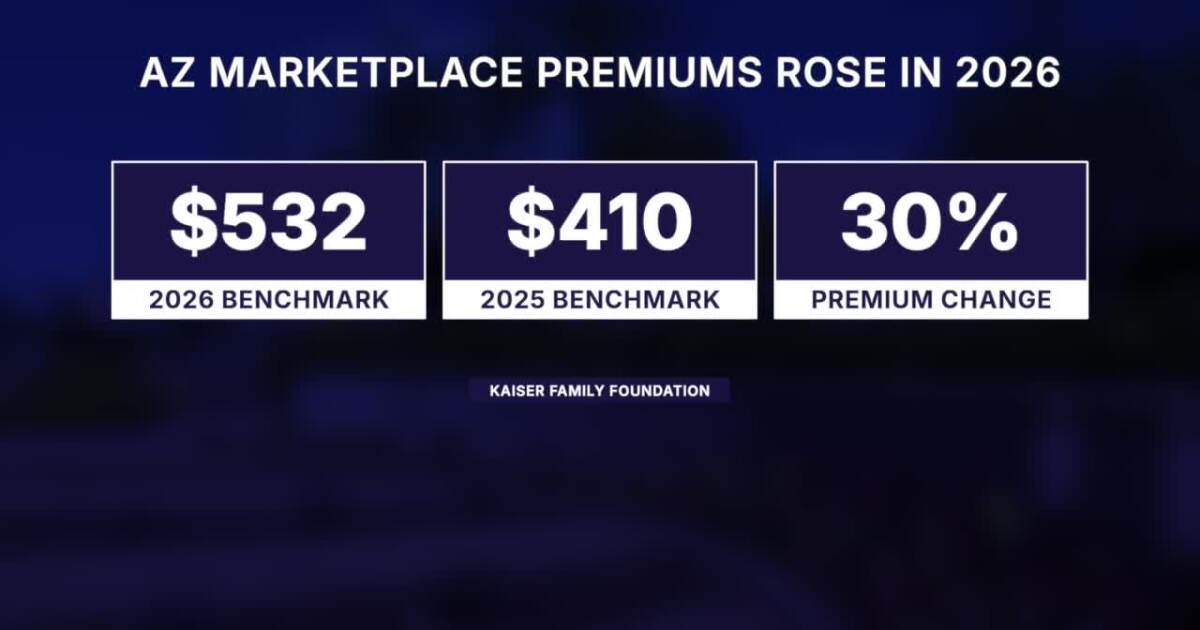
PHOENIX — Arizona’s ACA marketplace enrollment fell from 363,000 to just over 255,000 in a single year — a nearly 30% decline and the third-largest annual drop in the country.
Rising premiums and expired tax credits are driving the trend, with the average benchmark plan premium in Arizona now at $532 — up 30% from 2025.
In the player above, ABC15 Data Analyst Garrett Archer takes a look inside the numbers on how healthcare premiums are impacting health insurance enrollment.
This story was reported on-air by a journalist and has been converted to this platform with the assistance of AI. Our editorial team verifies all reporting on all platforms for fairness and accuracy.
Want more news in your community? Add ABC15 as a preferred source on Google below:

-

 Movie Reviews4 minutes ago
‘Evil Dead Burn’ Movie Review – Spotlight Report
-

 World12 minutes ago
Hoops Players’ Win Tops Big Day in NCAA Eligibility Litigation
-

 Health36 minutes ago
3 Best Peptides for Weight Loss—and the Viral One Doctors Say To Skip
-
 Lifestyle52 minutes ago
Smithsonian chief emphasizes ‘accuracy and integrity’ after White House report
-

 Technology1 hour ago
Microsoft’s carbon emissions went up 25 percent last year
-

 World1 hour ago
Jailed Catholic woman’s hunger strike highlights Iran religious persecution — US demands action
-

 Politics1 hour ago
Israel shares intelligence warning Iran plotted new assassination attempt against Trump: report
-

 Health1 hour ago
Parasitic infection causing ‘explosive’ stomach illness exceeds 1,000 cases in northern state

