Arizona
Arizona Cardinals roster, depth chart projection after free agency


The primary free agent period is over, and the Arizona Cardinals addressed precious few of their needs.
A year ago, they used this time to add a Pro Bowl edge rusher and two starting defensive tackles to build a roster that looked — on paper — capable of competing for a playoff spot. This time around, their moves have mostly been on the periphery, bolstering their depth without fixing the biggest issues.
As a result, their external perception has rarely been lower. On DraftKings, they are currently +1800 to reach the playoffs — odds twice as bad as any other team. Ten teams have better odds to win the Super Bowl than the Cardinals do to make the playoffs.
So, where does the roster stand? The Cardinals have seven draft picks, most of whom will make the team, but for now, here is our 53-man roster projection.
Offense
Quarterback (2): Jacoby Brissett, Gardner Minshew
Of the two most intriguing quarterback options on the free agent market, the Cardinals missed out on one (Malik Willis) and cut the other (Kyler Murray). Instead, they opted for a backup signing in Minshew, meaning that Brissett remains the presumptive starter heading into draft season. It’s the primary reason that oddsmakers view them as the worst team in the NFL.
Running back (4): Tyler Allgeier, James Conner, Trey Benson, Bam Knight
A week ago, this seemed as if it could be Benson’s backfield. But the Cardinals avoided cutting Conner by re-negotiating his contract, then signed Allgeier to a two-year deal. Now, Benson looks like the third back in a three-man committee. While there is plenty of experience in this room, it’s an odd mix — none of these players profiles as a third-down, pass-catching back.
Wide receiver (6): Michael Wilson, Marvin Harrison Jr., Kendrick Bourne, Jalen Brooks, Xavier Weaver, Andre Baccellia
The Cardinals’ wide receiver corps is among their better position groups, and they augmented it by signing Bourne to a two-year deal. He immediately becomes a reliable third option behind Wilson and Harrison. The issue is further down the depth chart, where none of the Cardinals’ options have any track record of note in the NFL.
Tight end (3): Trey McBride, Elijah Higgins, Tip Reiman
The Cardinals haven’t made any moves at tight end because there’s no need to. McBride is their best player and arguably the best tight end in the NFL. Higgins is a solid yards-after-catch threat who fills his role well as the second tight end. And Reiman is a blocking-first tight end who makes the run game tick. This is Arizona’s best position group.
Offensive tackle (4): Paris Johnson Jr., Elijah Wilkinson, Josh Fryar, Christian Jones
The Cardinals added Wilkinson on a two-year deal in free agency, giving themselves a viable option at right tackle if they don’t find one in the draft. He has primarily been a backup throughout his career, at both guard and tackle, but did fill in suitably as a starter for the Falcons last year. Further down the depth chart, there are some homegrown young players who have shown small flashes in their rare snaps — Fryar, Jones and Demontrey Jacobs. Those players would vie for backup spots, as the roster is currently constructed.
Interior offensive line (6): Isaac Seumalo, Hjalte Froholdt, Isaiah Adams, Jon Gaines, Matt Pryor, Hayden Conner
Seumalo’s three-year deal was the Cardinals’ biggest investment of free agency, and it shores up one guard spot. Center, meanwhile, is secure with Froholdt. The other guard spot, though, looks like a competition between Adams and Gaines. Both players showed positive signs late last season. Pryor, a one-year free agent signing, can play all across the line and will provide depth if he makes the roster.
Defense
Interior defensive line (6): Walter Nolen, Darius Robinson, Dante Stills, Roy Lopez, L.J. Collier, Jonah Williams
The Cardinals made a clear effort to improve their defensive line depth after releasing Dalvin Tomlinson. They brought back Collier on a one-year deal and added Lopez and Williams, the former of whom fills a need at nose tackle. The problem: No one other than Nolen projects as anything close to an impact player. A team can only ride serviceable depth so far.
Edge rusher (5): Josh Sweat, Zaven Collins, Baron Browning, B.J. Ojulari, Jordan Burch
The Cardinals’ edge group is untouched so far this offseason. No additions, no departures. Sweat was excellent in his first season in Arizona, but no one else here has proven to be a high-level sack threat, so the Cardinals could opt for an edge rusher with the No. 3 pick.
Linebacker (3): Mack Wilson, Cody Simon, Owen Pappoe
As expected, the Cardinals released Akeem Davis-Gaither, saving $5.2 million against the cap. But they also have not replaced him, which leaves an awfully thin group. Wilson will likely once again operate the defense as the ‘green dot’ linebacker, but Simon endured some rookie struggles last season. Entrusting him with a starting job from day one of training camp would be a risk.
Cornerback (6): Will Johnson, Starling Thomas V, Garrett Williams, Denzel Burke, Sean Murphy-Bunting, Max Melton
The cornerback room is unique in that it’s the spot where the Cardinals have abundant depth. Every player here could compete for a starting role. And yet, the second outside spot remains a major question mark. Johnson figures to start at one spot, with Williams operating as the nickel when he returns from his torn Achilles. But no one immediately jumps out as a reliable starter opposite Johnson.
Safety (5): Budda Baker, Dadrion Taylor-Demerson, Andrew Wingard, Kitan Crawford, Joey Blount
The Cardinals allowed Jalen Thompson to leave in free agency after seven seasons, then filled his spot on the roster with Wingard, who has mostly served as a backup throughout his career. That serves as a vote of confidence in Taylor-Demerson, who was the third safety over the past two years but will now step into a starting job.
Specialists
Kicker (1): Chad Ryland
Punter (1): Blake Gillikin
Long snapper (1): Casey Kreiter
The Cardinals brought back both Ryland and Gillikin, both of whom were restricted free agents. Gillikin is entrenched at punter, while Ryland will compete with Joshua Karty for the kicker spot, though he appears to have the upper hand. The lone addition to the specialists’ room is Kreiter, who spent the past five years with the Giants. He is also familiar with the new special teams coach, Michael Ghobrial, from their time together in New York.



PHOENIX (AZFamily) — A ceasefire announced Tuesday will suspend the war in Iran for two weeks and Iranian officials said they will negotiate with the United States starting Friday.
President Donald Trump agreed to a deal hours after he posted “a whole civilization will die tonight” on social media.
Before news broke about the cease-fire, Democratic Rep. Yassamin Ansari of Arizona introduced articles of impeachment Monday against Defense Secretary Pete Hegseth.
Ansari, the daughter of Iranian immigrants, is also part of a growing list of Democrats calling for Trump to be impeached.
“Iran is a country of 90 million people. Threatening them with annihilation is a monstrous war crime and puts them and American service members and Americans at grave risk,” Ansari said in a video posted Monday on social media. “As a chief enabler of this illegal war, Pete Hegseth is responsible for directing this insane military action against Iran, which has already killed thousands of civilians, led to the unnecessary deaths of American service members, and displaced over a million people in the region.”
Not everyone with strong ties to Iran agrees with her.
“I don’t see why they should be impeached,” said Amirdanial Azimi. He is the president of the Iranian Students Association at Arizona State University (ASU). He grew up in Iran and has family and friends there right now.
“Speaking to my friends and relatives, I’ve realized that they’re more scared of their own government than they are like external forces like the United States and Israel,” Azimi said.
Azimi predicted Trump would not follow through with his threat to destroy Iran.
“I do take offense, like Iranians do take offense, like they don’t want their civilizations to be wiped off,” Azimi said. “This is the fault of the Iranian regime, their government, because they’ve been chanting death to Israel, death to America for the past years.”
Hessam Rahimian is a refugee turned American citizen. He said he escaped Iran decades ago, where his uncle was murdered and his cousins remain in jail. He said schoolchildren are taught to chant “death to America” every day.
He said he has hundreds of family members and friends still in Iran. In Arizona, Rahimian organizes rallies in support of the war to raise awareness about the reality of life in Iran and the thousands of protesters killed by the Iranian government.
Before the attack was called off, Rahimian said it was challenging to process Trump’s threat to wipe out his home country.
“So he did say that, but he has also said, in the same token today, that the Iranian people are good people, and he will do his best to make sure that they’re safe. So which one you go with, again, I go back to his actions in the past year, it has been against the Islamic regime and not the Iranian people,” Rahimian said. “Would I like for him not to use that language? Of course, absolutely. But we also know that the war talk takes place and they say things to create fear.”
Daniel Rothenberg is a politics and global studies professor at ASU. He said the biggest question is why the U.S. is at war in the first place.
“This is, above all, a war of choice. The U.S. was not attacked. There was no imminent threat from Iran,” Rothenberg said.
Rothenberg said Trump has not clearly explained the point of the war that is costing billions of dollars a day and countless human lives or what a victory would look like.
“Wars tend to end through negotiations, not through military victory,” Rothenberg said. “I mean, what does it mean to wipe out a civilization? And frankly, why would you even make that sort of threat? What’s the purpose?”
See a spelling or grammatical error in our story? Please click here to report it.
Do you have a photo or video of a breaking news story? Send it to us here with a brief description.
Copyright 2026 KTVK/KPHO. All rights reserved.
Arizona
Kroger, Albertsons sued by Arizona, seven other states seeking antitrust lawsuit expense reimbursement
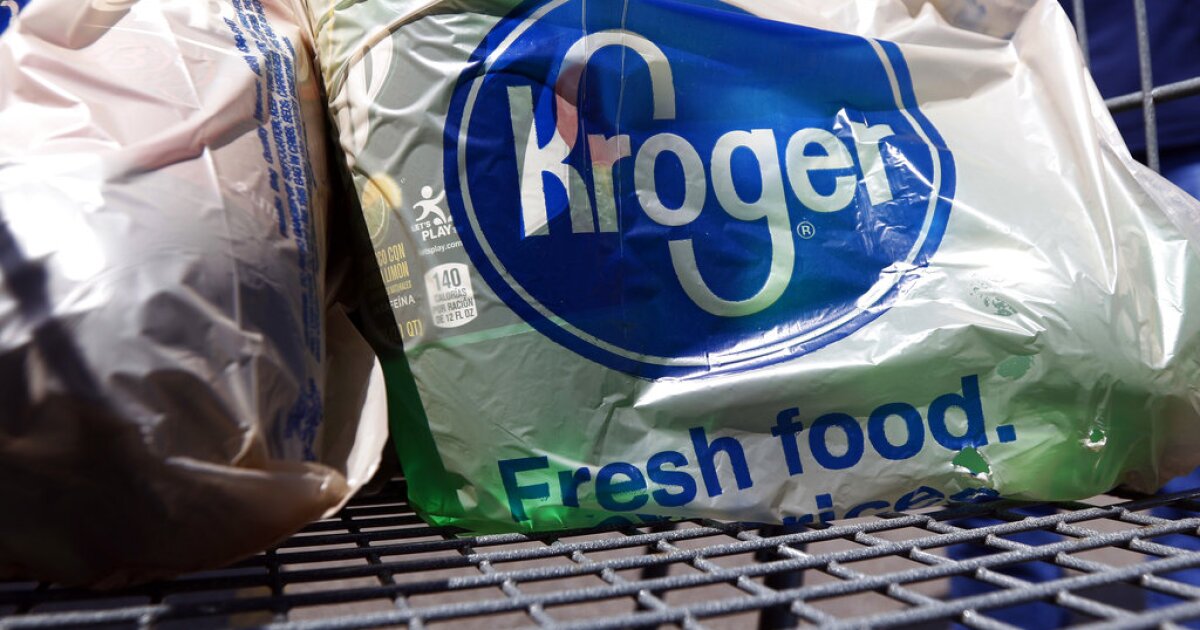
Kroger Co. and Albertsons Cos. Inc. have been sued by Arizona and seven other states and the District of Columbia, all of which are seeking to be reimbursed for costs they incurred while fighting a merger between the two grocers that later failed on antitrust grounds.
The coalition of plaintiffs, which also includes the Federal Trade Commission, is seeking $10.3 million from Cincinnati-based supermarket giant Kroger and Boise, Idaho-based grocery rival Albertsons, according to the lawsuit filed March 31 in U.S. District Court in Portland, Ore.
Kroger is the parent company of Fry’s Food Stores in the Valley, and Albertsons owns the Safeway brand in Arizona.
Read more of this story from the Business Journal.

Amid the ongoing spring heat, Arizona is in store for even hotter summer months. FOX 10’s Irene Snyder learns how Arizonans can stay safe and cool, while avoiding fire risks.

‘He’s a hero!’ Oklahoma principal shot confronting gunman

What necropsy report said about entangled whale on Oregon Coast

When is the deadline to register for the Pennsylvania primary?

Rhode Island lawmakers to consider several firearm bills

19-year-old steals 32 guns from South Carolina business, police say

Florida High School Football Rankings: Top 25 teams – Oct. 21

How old is Bo Nix? What to know about Oregon quarterback ahead of 2024 NFL Draft

Cleary's 21 help Le Moyne down Central Connecticut State 69-64 in OT

99th annual Pony Swim held in Virginia

Indiana Members Credit Union announced as new anchor tenant at Bottleworks District

AOC doubles down on call for Trump’s ouster even after ceasefire announcement

EU made ‘no diplomatic effort’ to end Iran war, says MEP Botenga

U.S. and Iran agree to 2-week ceasefire

Democrat swing candidate called Biden’s border handling ‘a huge misstep’ after backing his approach as mayor

‘Policy of abuse’: Women march in Cuba against US energy blockade
-

 Atlanta, GA3 days ago
1 teenage girl killed, another injured in shooting at Piedmont Park, police say
-

 Movie Reviews6 days ago
Vaazha 2 first half review: Hashir anchors a lively, chaos-filled teen tale
-

 Culture1 week ago
Do You Know Where These Famous Authors Are Buried?
-

 Atlanta, GA1 week ago
Fetishist ‘No Kings’ protester in mask drags ‘Trump’ and ‘JD Vance’ behind her wheelchair
-
 Entertainment6 days ago
Inside Ye’s first comeback show at SoFi Stadium
-
 Milwaukee, WI2 days ago
Potawatomi Casino Hotel evacuated after fire breaks out in rooftop HVAC system
-

 Pennsylvania2 days ago
Parents charged after toddler injured by wolf at Pennsylvania zoo
-

 Indianapolis, IN5 days ago
Fighting Illini begin Final Four preparations in Indianapolis