More than 100 years ago, a man traveled north on a mission most people thought was ridiculous — to see if crops would grow in the frozen wasteland known as the Territory of Alaska
That man, Charles C. Georgeson, was a special agent in charge of the United States Agricultural Experiment Stations. The secretary of agriculture charged Georgeson with the task of finding out if crops and farm animals could survive in the mysterious land acquired just 21 years earlier from the Russians.
When he landed at Sitka 100 years ago, Georgeson set in motion agricultural studies that are still carried on today at the University of Alaska Fairbanks’ Agricultural and Forestry Experiment Station.
Advertisement
Georgeson, a Danish immigrant, was not a man easily discouraged.
In 1898, the experimental station site in Sitka was in the middle of a swamp. Until he could clear and drain the land, he borrowed patches of land from Sitka settlers, as he explained in an interview in Sunset magazine in 1928.
“My plots were scattered all over the village and having insecure fences, or no fences at all, the local boys, cows, pigs and tame rabbits rollicked joyously through them,” he said.
“The seeds came up to become the playthings of diabolical ravens, who, with almost human malice, pulled up the little plants merely to inspect their other ends.”
From this shaky start came the federal government’s discovery that crops could indeed survive in the far north, some better than others.
Advertisement
Georgeson quickly helped establish other experimental stations: a Kodiak station in 1898, one at Rampart on the Yukon River in 1900, and another at Copper Center in 1903. The final three were at Fairbanks, which opened in 1906, the Matanuska farm station, established nine years later, and the Palmer Research Center, which opened in 1948.
Federal interest in Alaska agriculture waned during World War I and the Great Depression. By 1932, the agricultural stations at Sitka, Kenai, Rampart, Kodiak and Copper Center had all closed despite some success (for example: grain and potatoes did well at Rampart; the Sitka hybrid strawberry is among the hardiest of all breeds; and cattle and sheep thrived at the Kodiak station until the eruption of Novarupta volcano in 1912 coated the pastures with up to 18 inches of ash).
The Fairbanks and Matanuska stations have endured. Horticulturists and animal breeders today carry on the same type of experiments Georgeson did 100 years ago, finding species of plants and animals capable of adapting to the Far North’s extremes in day length and temperature.
From crossbreeding studies came first the Sitka hybrid strawberry, developed by Georgeson in 1907.
Agriculture and Forestry Experiment Station researchers have bred a few dozen other varieties that thrive in the north, including the Alaska frostless potato (1970, in the Matanuska Valley), Yukon chief corn (1974, in Fairbanks), and the Toklat strawberry (1976, in Fairbanks).
Advertisement
Today, Alaska-grown crops and animals account for less than 10% of what Alaskans consume. But the potential for more is here. Crops and animals do well in some areas of Alaska, such as the Tanana and Matanuska valleys. Someday it may not be cheaper to import foods from outside Alaska. Maybe then Georgeson’s dream of Alaska as an agricultural state will be realized.
Since the late 1970s, the University of Alaska Fairbanks’ Geophysical Institute has provided this column free in cooperation with the UAF research community. Ned Rozell ned.rozell@alaska.edu is a science writer for the Geophysical Institute. A version of this column appeared in 1998.
The largest landslide in Anchorage occurred along Knik Arm between Point Woronzof and Fish Creek, causing substantial damage to numerous homes in the Turnagain-By-The-Sea subdivision. Courtesy of Wikipedia
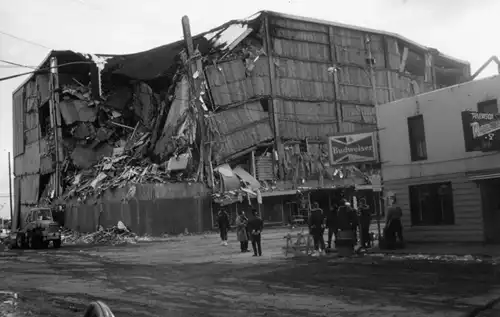
J.C. Penney Department Store at Fifth Avenue and D Street, Anchorage District, Cook Inlet Region, Alaska, 1964. Courtesy of USGS
It was on this day in 1964 that a massive 9.2 earthquake in Southcentral Alaska.
The massive quake at 5:36 pm on March 27th caused much devastation throughout the region and generated a huge tsunami that inundated many communities in the region.
The quake was the largest in the history of the United States and initially killed 15 people while the resulting tsunami killed an additional 100 people in the new state and another 13 in California as well as five in Oregon.
Advertisement
The megathrust earthquake endured for four minutes and thirty-eight seconds and ruptured over 600 miles of fault and moved up to 60 feet in places.
The deadly quake occurred 15 and a half miles deep 40 miles west of Valdez and generated a ocean floor shift that created a wave 220 feet high.
As many as 20 other smaller tsunamis were generated by submarine landslides.
I grew up greeting friends and neighbors on my walk to my neighborhood Anchorage public school, just as my kids do now. It’s an essential, and value-added, part of living in our community.
In the late 1990s, when I attended Service High School, I had amazing teachers. My AP chemistry teacher left the oil and gas industry to teach. He could have earned significantly more money in another field, but teaching was competitive enough, given pensions and compensation, that he stayed in the job he loved and gave a generation of students a solid foundation in chemistry.
Now, my kids, who are in first, third and fifth grade, face a different reality. Teachers across our state are leaving in droves. Neighborhood schools across Alaska are closing. Art and music are being combined, which is nonsensical — they are not the same and they are both valuable independently. When he was in second grade, my oldest had a cohort of more than 60 students in his grade — split between two teachers. When he enters sixth grade next year, there will be no middle school sports and he will lose out on electives. Support systems and specialists to help when kids are falling behind have been cut. I’m lucky that my children have had amazing teachers, but many excellent teachers are nearing retirement age or don’t have a pension and are pursuing other careers. What happens then?
Despite skyrocketing inflation, last year was the first time in years that our schools received a significant increase in the Base Student Allocation — and that money doesn’t begin to make up for what they have lost over the years. Even that increase had to overcome two vetoes from what a recent teacher of the year calls “possibly the most anti-public education governor in the history of Alaska.” Shockingly, my own representative, Mia Costello, despite voting for the increase, failed to join the override to support education. She has failed to explain that decision when asked.
Advertisement
State spending on corrections is up 54% since 2019; meanwhile, spending on education is up only 12% in the same timeframe. Schools are now working with 77% of the funding they had 15 years ago when accounting for inflation.
When we starve our public schools of funding, Alaska families leave. No one wants their child to suffer from a subpar education and the lower test scores and opportunities that come with it. A significant number of people are working in Alaska but choosing not to raise their families here.
To the elected officials who preach school “choice” but starve public schools: our family’s choice is our neighborhood school. It’s our community. It’s where our friends are. Neighborhood public schools, which are required to accept all children, should be the best option out there. Public schools should be a good, strong, viable option for communities and neighborhoods across our great state. Once, they were.
I am thankful for those in the Legislature working to solve these problems. This includes HB 374, which raises the BSA by $630, and HB 261, which would make education funding less volatile.
It breaks my heart that across the state, dedicated teachers keep showing up for our kids while being underpaid and undervalued. Underfunding our schools is also a violation of Alaska’s constitution, which requires “adequate funding so as to accord to schools the ability to provide instruction in the standards.”
Advertisement
Not so long ago, Alaska’s public schools were adequately funded, and they produced well-educated students and retained excellent teachers. It’s up to all of us to reach out to our elected officials and urge them to make that the case once again.
Colleen Bolling is a lifelong Alaskan and mother of three who cares deeply about Alaska’s schools.
• • •
The Anchorage Daily News welcomes a broad range of viewpoints. To submit a piece for consideration, email commentary(at)adn.com. Send submissions shorter than 200 words to letters@adn.com or click here to submit via any web browser. Read our full guidelines for letters and commentaries here.
ANCHORAGE, Alaska — Karen Burnett spends most days in the sorting room at the Food Bank of Alaska, ensuring every donated item finds its place.
The Anchorage woman dedicates her time to sorting, packing and organizing food donations.
Finding purpose after loss
Burnett’s journey at the Food Bank of Alaska began after a personal loss. Following the death of her husband, Burnett said she found herself with time on her hands and a desire to help.
“I had a friend who had talked to me about it, and it just sounded like a good thing to be out doing,” she said.
Advertisement
Burnett now volunteers between 500 and 600 hours each year.
“I started, but it got to be so fun. I spent more and more time here,” Burnett added.
Understanding community need
Burnett has witnessed the growing need in the community, particularly as more families struggle to make ends meet.
“If you took a look at the pantry and saw those empty shelves, it’s hard sometimes when you know people are coming in and looking for something, for their clients, and there’s absolutely nothing in there,” Burnett said.
Her dedication has made a lasting impact on countless families.
Advertisement
“I just feel real involvement in a way that is appreciated,” Burnett said. “You know, people need this food. They need people to put it out for them.”
See the full story by Ariane Aramburo and John Perry.
Copyright 2025 Gray Media Group, Inc. All rights reserved.