Alaska
‘Punishing’: Alaska small-business owners consider next steps amid steep rises in health care costs


Thousands of Alaskans who purchase insurance through the Affordable Care Act marketplace will see their premiums skyrocket without the extension of subsidies that are set to expire at the end of the year.
The expiration of the enhanced premium tax credits could cripple small businesses in Alaska, some owners say, as they face premiums that in some cases will triple year over year, eating away at their ability to keep their businesses afloat.
“We’re working tooth and nail every day to make our way so we don’t have to rely on any help and assistance,” said Brie Loidolt, who owns a bookkeeping business in Anchorage and is facing an increase of hundreds of dollars per month in her premium costs.
Congress is “just punishing us for being small-business owners,” said Loidolt, who has weighed closing her business in response to the rise in health insurance costs.
Extension of the tax credits was a top priority for Senate Democrats during the longest government shutdown in U.S. history. But the shutdown ended Wednesday with no deal to extend the health care subsidies or provide any other measure to lower the cost of health care.
Congress now has until the end of the year to extend the credits — which were enacted in 2022 — or watch them expire.
Alaska’s U.S. Sen. Lisa Murkowski has said she supports the extension of the tax credits, at least in the short term, to avoid the projected sharp price increase. U.S. Sen. Dan Sullivan has also said he supports an extension of the subsidies. Alaska’s U.S. Rep. Nick Begich has not spoken in favor of their extension or responded to multiple interview requests on the subject.
The agreement to end the shutdown included a promise from the Senate majority leader to hold a vote on a proposal to extend the tax credits before the end of the year, but Alaskans are already being asked to make decisions about their 2026 coverage. For them, action from Congress can’t come soon enough.
“I need my government, specifically my congressional delegation, to speak for me concerning the levers of power in this country, and I feel absolutely abandoned,” said Mark Robokoff, who owns a pet supply shop in Anchorage and is staring down a more than 300% increase in the cost of insurance.
The impact of the elimination of the tax credits depends on the income, age and family size of the enrollee. Premium increases are greatest for Alaskans nearing retirement age who earn 401% of the poverty line or higher.
Of the roughly 25,000 Alaskans enrolled in plans purchased through the Affordable Care Act marketplace, many of those who will see the sharpest increase in insurance costs are owners of small businesses who say their contributions to the Alaska economy are on the line.
‘An entirely new calculus’
Robokoff said the monthly insurance premium for him and his partner is set to triple, going from $924 in 2025 to $2,886.
“This will pull the rug out from under me,” said Robokoff. “I thought I was doing the things that a society wants its members to do — create new businesses, create new jobs, improve the life of the surrounding community.”

Robokoff said that when he was younger, he went without insurance, but he now relies on medication that would cost thousands of dollars a month without insurance, so forgoing coverage is not an option.
Given the increase in the price of premiums, he said he will have to consider what changes to make in the business.
“It’s an entirely new calculus. Everything is going to have to be looked at, from the prices I pay for merchandise, the quality that I try to stock, the amount that I pay my employees to keep the best ones — every single aspect of the store is going to have to be re-examined,” he said.
Robokoff said his mindset so far has been a “fingers-crossed hope that Congress would not put us in this ridiculous situation.” He thought, “our situation is so drastic that the government can’t help but come to our aid.”
“That hope and surety is rapidly being stripped away,” he said, as lawmakers have repeatedly punted on an extension.
‘Cut us at the knees’
Loidolt, who owns an accounting firm that employs four people, said her insurance premiums are set to go up roughly $500 per month, or $6,000 for the year, without the subsidies.
She already pays $1,347 per month in premiums. Without the extension of the subsidies, she’ll be paying more per month for her health insurance than she spends on her mortgage.
“Who can afford to live when 30% of everything you bring in just pays for insurance and deductible?” Loidolt said.
Loidolt said she has tried to purchase a company plan for her business, but she learned that insurance companies largely don’t offer plans to companies in Alaska with fewer than five participating employees.
“So our hands are kind of tied there, too. It’s not like we have options and we’re choosing this more expensive option through the marketplace,” she said.
Loidolt recently suffered an accident that has left her with ongoing medical needs that would cost thousands of dollars a month without insurance. Going without insurance is not on the table, she said.
Given rising health care costs, Loidolt said she is considering shutting down her business, laying off her employees and ending the accounting services she provides to roughly 40 small businesses.
Loidolt said she thinks she could get a salaried job that comes with benefits, but closing her business would be “heartbreaking” and devastating for her clients.
“I feel like we’re part of the solution, and this is going to make us part of the problem,” she said. “We’re the people that are actually paying our bills every month. We’re not on assistance. We’re making it work, even with these ridiculous prices. We’re offering jobs with small companies. We’re offering competition to people so that the monopolies don’t take over. And they’re just going to cut us at the knees.”
[GOP plans to replace Obamacare have failed. Here’s what lawmakers propose now.]
‘It makes me want to throw up’
Nan Schleusner, a human resources consultant in Anchorage, said she and her husband — who are both sole proprietors — have relied on insurance purchased through the Affordable Care Act since the enhanced premium tax credits kicked in.
The tax credits made marketplace plans affordable for them for the first time, just as Schleusner and her husband were getting older and encountering more health concerns.
“Thank God” they got the insurance, Schleusner said, because in 2022, she was diagnosed with cancer.
“It was really wonderful when the enhanced premium tax credits took effect, because it helped with these extreme medical bills that we ended up having,” she said. “It was just that peace of mind, like, OK, it’s still a stretch — it’s not inexpensive — but we can do it.”
But now, Schleusner is facing $37,000 in annual premium payments and a $15,000 deductible for her family of three, for the cheapest plan on offer.
Schleusner said she is considering reaching out to some of the companies she consults for and asking to become their employee so she can join their insurance plan.
“I’ve been doing this 15 years, and I feel called to do it,” she said. “So I don’t want to give it up. It’s been some sleepless nights.”
Schleusner this year paid $1,380 per month for her family of three, or $16,560 in premiums for the year. To keep the same plan she currently has next year, she’d pay more than 300% of this year’s cost, with premiums totaling over $52,000 annually.
“It makes me want to throw up every time I look at it,” she said.
“There’s the affordability part, but there’s the ‘what on Earth is going on that this is costing $50,000 a year?’ That’s not a reasonable cost,” she said.



The Anchorage Daily News caught up with some of the top track and field athletes from around the state at the annual Big C Relays. The list includes a sprinter who likes to play disc golf, a pair of Spider-Man fans, a reigning state champ who can’t get enough Macklemore, and three elite athletes whose biggest influences have been their older brothers. There were also several notable performances by perennial contenders and up-and-coming talent alike.
Here’s an introduction to six track and field athletes and the top performers from the Big C Relays.
Tyce Escott, Soldotna
The Soldotna senior sprinter was the Division I boys state runner-up in the 100 meters in 2025 by 0.01 seconds, and is the reigning state champ in the 200 meters. At the Big C Relays, he competed in the 100 and finished second in the prelims with mark of 11.34 seconds, then finished fourth in the semifinals in a time of 11.37 seconds. Escott helped the Stars Mixed Swedish Medley Relay team come in first place with a time of 2:09.55.
How did you get started in track and field? “I kind of just grew up running and decided to try it as a sport when I got to middle school, and I’ve been doing it ever since.”
What is your favorite hype music genre, song or artist before an event? “I don’t usually listen to music. I’m just in my own head and do what I want to do.”
What is the best movie or series you’ve watched in the past year? “Spider-Man Homecoming.”
Favorite fictional character of all time: “Spider-Man.”
Spider-Man follow-up: Favorite Spider-Man live action actor? “I like the Tom Holland ones the best, but I like Andrew Garfield too.”
Who is the most influential or inspirational person in your life? “I look up to my older brother. He didn’t do track but he always did sports and he was known for being fast. He did football and soccer.”
Goals for this season: “I’m hoping to come back and try to get first (at state in the 100 meters), try to improve as much as I can and do the best to my ability. My goals are to hopefully win state, beat my (personal records) and just do as best as I can.”
What is your favorite non-sports leisure activity? “I play disc golf sometimes. There’s probably three or four (courses) down in Soldotna.”

Anna Green, South
The South Anchorage senior sprinter is the reigning Division I girls state champion in the 200 meters, and she also finished third in the 100 and fourth in the 400 last year at state. At the Big C Relays, she competed in the 100 meters and clocked the top times in the prelims (12.81 seconds) and the semifinals (12.86 seconds). In the finals, she came in third place with a time of 12.83 seconds and also helped the Wolverines finish third in the girls Swedish Medley Relay 1600-meter race with a mark of 4:37.22.
How did you get started in track and field? “My middle school health teacher. I was originally a hurdler and she transitioned me to a sprinter, and I’ve stuck with it ever since.”
What is your favorite hype music genre, song or artist before an event? “Macklemore! Before every race, I listen to him.”
What is the best movie or series you’ve watched in the past year? “‘Prison Break.’ It was just thrilling.”
Favorite fictional character of all time: “Donald Duck. He’s always been my favorite since childhood.”
Who is the most influential or inspirational person in your life? “My dad. He grew up in Australia and ran (track) and played soccer. I played soccer my entire life, and I’m going to run track in college, and he was a big part of that.”
Goals for this season: “I want to (record personal bests), break another school record after I broke the 400 last year and I want to try to defend my 200-meter state title.”
What is your favorite non-sports leisure activity? “Watching movies and hanging out around my house with friends.”

Benjamin Hiestand, Chugiak
The Chugiak junior thrower is the Division I boys state champion in discus and came in fourth in the shot put at state last year. At the Big C Relays, he competed in the shot put and discus, setting a new personal best in the shot with a first-place mark of 50 feet, 3.25 inches Friday. He came back on Saturday and recorded the top mark in the discus as well, 161 feet, 1 inch.
How did you get started in track and field? “My brother (Edward). I always followed what he did when I was younger so in the third grade, I did sprints because I was just following him and then he transitioned to throws, so that’s what started getting me into throws too.”
What is your favorite hype music genre, song or artist before an event? “I usually do no music so I can stay locked in and just focus.”
What is the best movie or series you’ve watched in the past year? “My favorite show is ‘Avatar: The Last Airbender’ and for movie series it’s ‘Ip Man’ for the martial arts and John Wick.”
Favorite fictional character of all time: “Zuko from ‘Avatar: The Last Airbender.’ I just like his story of how he kind of redeemed himself at the end. He showed a lot of growth.”
Who is the most influential or inspirational person in your life? “My brother. He taught me a lot and I was really thankful to have him growing up as an example.”
Goals for this season: “This season, I’ve been seeing massive breakthroughs in both shotput and discus and I’m ready to really see what I can do. … Last year I kind of ran into a slump in shot put and I didn’t really improve at all from freshman year, but this year I’ve been really hammering down on the rotational form and I’ve been seeing breakthroughs in that, and I’m really starting to feel comfortable with the rotational form.”
What is your favorite non-sports leisure activity? “Just exploring and driving around and playing video games.”

Bella Connally, Juneau-Douglas
The Juneau-Douglas sophomore sprinter is the reigning Division I girls state champion in the 100 meters and came in fifth in the 200 meters. At the Big C Relays, she competed in the 100 meters, finishing fourth in the prelims with mark of 13.03 seconds, second in the semifinals in a time of 12.90 seconds and first in the finals in a time of 12.68 seconds. She earned the title of Fastest Alaskan on the girls side.
How did you get started in track and field? “My brother. He did track and field and I saw him running all the time and I was like, ‘Whoa, that looks really cool,’ and I thought I’d be good at that too.”
What is your favorite hype music genre, song or artist before an event? “I like to listen to Frank Ocean. I like to get in my feelings and stuff. I can’t do hype music.”
What is the best movie or series you’ve watched in the past year? “‘Modern Family’ and ‘The Office.’”
Favorite fictional character of all time: “I love ‘Spider-Man.’ The Tom Holland one is my favorite.”
Who is the most influential or inspirational person in your life? “My brother.”
Goals for this season: “I’d really like to run a (personal record), I’d like to qualify for Nike Nationals, to win state again. That’d be really cool.”
What is your favorite non-sports leisure activity? “I like to do ceramics. I have a class in my high school for it, so basically every day.”

Joshua Woko, Mountain City Christian Academy
The senior from Mountain City Christian Academy was Division II boys state runner-up in the triple jump in 2025 by about an inch, placed fifth in the long jump and was part of the state champion 4×400 relay team. At the Big C Relays, he competed in long jump and recorded the second-best mark with a new personal best of 20 feet, 8.75 inches on his first attempt, and he recorded the fifth-best mark in the high jump with 5 feet, 2 inches. He also helped the Lions Mixed Swedish Medley Relay team come in fifth place with a time of 2:19.50.
How did you get started in track and field? “I started my sophomore year. It was something I was kind of debating if I should do, but I was told, ‘Just try it out,’ and when I tried it out, I saw I was good at it and I decided to do it.”
What is your favorite hype music genre, song or artist before an event? “Rap music. Kendrick and Don Toliver.”
What is the best movie or series you’ve watched in the past year? “I’m into anime, so probably ‘Jujutsu Kaisen.’ I like the energy that each character has and the bosses they have to fight.”
Who is the most influential or inspirational person in your life? “Definitely my uncle. He’s my pastor and he’s also my spiritual leader, so he helps me with life struggles, shows me the right path to take, and he’s my counselor.”
Goals for this season: “I’m trying to make sure I do my best this year because I only have one last chance. … Try to (do well) in the 400 again and then get 43 (feet) for triple (jump) and at least 21 or 22 for long jump.”
What is your favorite non-sports leisure activity? “I love watching shows, and I also love to play games like chess, and I also draw a lot.”

Ailafo Fautanu, Dimond
The Dimond junior thrower was the Division I girls state runner-up in the shot put in 2025 and placed third in the discus. At the Big C Relays, she competed in the discus and produced the fourth-best mark at 99 feet, 6 inches, and came back on Saturday and recorded the third-best mark in the shot put with a mark of 33 feet, 9.25 inches.
How did you get started in track and field? “With volleyball being my main sport, I just thought, ‘Why not fill my free time with track and field?’ and it was really fun for me and I really liked the experience, so I just decided to keep going at it.”
What is your favorite hype music genre, song or artist before an event? “No, I’m just locked in.”
What is the best movie or series you’ve watched in the past year? “‘The Miracle Season.’ I just like how the girls had something to motivate them and push them through the season and win their state championship. It’s a volleyball movie.”
Favorite fictional character of all time: “SpongeBob.”
Who is the most influential or inspirational person in your life? “My mom. She’s been a really good role model for me, she’s a hard worker, takes time out of the day to support her kids, even when she’s busy.”
Goals for this season: “Hopefully win a state championship but first reach my goals of (setting a new personal record).”
What is your favorite non-sports leisure activity? “I like skiing and going hiking. I like to hike every once in a while to get in shape and stay in shape. I like to go on sunset drives to unwind from stressful weeks.”

Top performances
Nevaeh Watkins, a Dimond junior and reigning Division I girls 100-meter hurdles and high jump state champion, had quite the first day of action at the Big C Relays. She started by setting a new meet record for the high jump with a first-place mark of 5 feet, 2 inches, and followed it up by recording the fastest time in the 100-meter hurdle prelims and semifinals, which included a new personal best of 15.25 seconds in the semis.
Seward senior and reigning Division II boys state high jump champion Olin Liljemark was the only jumper to clear 6 feet in the event on Friday, which bested his title-winning mark of 5 feet, 10 inches from last year.
Mountain City Christian senior thrower Jieaya Siatini, who is the three-time Division II shot put state champion and reigning discus state champion, won the girls discus by a wide margin. Her mark of 128 feet, 4 inches was more than 23 feet farther than second-place finisher Mattelyn Elliott of Colony (105 feet). Siatini won the girls shot put as well with a mark of 39 feet, 10.75 inches. Runner-up Lilly Davidge, a Lathrop senior, recorded a mark of 33 feet, 11.5 inches.
Chugiak senior distance runner Hannah Shaha successfully defended her Big C title in the 3,200-meter race with a time of 11:53.92, which edged out Eagle River’s Ashlyn Paynter, who came in second at 11:56.32. Shaha, the 2023 Cross Country Gatorade Player of the Year, is also the reigning Division I girls state champion in the same event.
West Valley senior Cedar Robichaud outpaced Chugiak sophomore Frederick Millen III in the boys 100-meter finals with a first-place time of 11.26 seconds to earn the title of Fastest Alaskan.
The Chugiak quartet of Luke Poland, Ahmir Walker, Elijah Udall and Frederick Millen III set a new meet record in the boys 4×100 meter race with a first-place time of 43.44 seconds, besting the previous record of 43.74.

Big C Relays
Girls
100 Meters Varsity – Finals
1. Bella Connally 12.68, Juneau-Douglas
2. Sophia Jedlicki 12.77, Soldotna
3. Anna Green 12.83, South
4. Sienna Johnson 13.04, Chugiak
5. Farrah Gamechuk 13.18, Bartlett
6. Taylor Eddington 13.22, Tri-Valley
100 Meters Pentathlon – Finals
1. Iris Haas 13.04, Delta Junction
2. Caroline Klebs 13.69, Grace Christian
3. Katie Mackin 14.07, Bartlett
4. Kathryn DeBardelaben 14.17, Soldotna
5. Hannah Bodkin 14.21, Chugiak
6. Mari Ward 15.38, Holy Rosary Academy
200 Meters Varsity – Finals
1. Taylor Eddington 26.49, Tri-Valley
2. Farrah Gamechuk 26.92, Bartlett
3. Leila Petersen 27.17, Palmer
4. Shiloh Zichko 27.44, Soldotna
5. Annelise Larsen 27.53, Colony
6. Evonna Council 28.18, East
400 Meters Varsity – Finals
1. Kendall Barnett 1:00.07, West
2. Ellie Stull 1:00.52, Dimond
3. Leila Petersen 1:01.06, Palmer
4. Petra Knox 1:01.33, Chugiak
5. Olivia Sandoval 1:01.43, Chugiak
6. Tagan Rinner 1:01.64, Grace Christian
1 Mile Varsity – Finals
1. Kendall Barnett 5:09.70, West
2. Maddison Kukuk 5:26.60, Chugiak
3. Hannah Shaha 5:33.40, Chugiak
4. Kyra Walter 5:35.18, Chugiak
5. Fiona Selvik 5:35.79, Service
6. Ashlyn Paynter 5:40.80, Eagle River
3200 Meters Varsity – Finals
1. Hannah Shaha 11:53.92, Chugiak
2. Ashlyn Paynter 11:56.32, Eagle River
3. Maddison Kukuk 11:56.57, Chugiak
4. Kyra Walter 12:05.25, Chugiak
5. Rylee Ruggles 12:15.38, Chugiak
6. Myra Kalafut 13:05.23, Homer
100m Hurdles – 33″ / 0.838m Varsity – Finals
1. Nevaeh Watkins 15.14, Dimond
2. Emilia Zych 16.25, Service
3. Emma Mersdorf 17.21, Mountain City Christian Academy
4. Sienna Johnson 17.72, Chugiak
5. Jewel Gardner 17.79, Wasilla
6. Kelsey Momblow 18.12, Eagle River
300m Hurdles – 30″ / 0.762m Varsity – Finals
1. Taylor Eddington 46.44, Tri-Valley
2. Emilia Zych 47.74, Service
3. Katrina Baisa 50.70, Kodiak
4. Mia Bukala 51.41, Redington
5. Jewel Gardner 51.51, Wasilla
6. Vera Bates 51.52, Homer
300m Hurdles – 30″ / 0.762m Pentathlon – Finals
1. Iris Haas 49.26, Delta Junction
2. Hannah Bodkin 51.58, Chugiak
3. Kathryn DeBardelaben 52.34, Soldotna
4. Caroline Klebs 53.28, Grace Christian
5. Katie Mackin 53.45, Bartlett
6. Mari Ward 59.90a, Holy Rosary Academy
4×100 Relay Varsity – Finals
1. Tri-Valley 51.74
2. Soldotna 51.78
3. Dimond 52.00
4. South 53.15
5. Bartlett 53.64
6. Service 53.83
4×800 Relay Varsity – Finals
1. Chugiak 10:00.64
2. Soldotna 10:33.53
3. Grace Christian 10:58.86
4. Homer 11:03.64
5. Service 11:08.30
6. Su Valley 11:09.36
SMR 1600m – (200-200-400-800) Varsity – Finals
1. Dimond 4:19.43
2. Chugiak 4:30.85
3. South 4:37.22
4. Soldotna 4:39.24
5. Homer 4:47.17
6. Service 4:53.56
DMR 4000m – (1,200-400-800-1,600) Varsity – Finals
1. West 13:57.66
2. Soldotna 14:03.47
3. Service 14:21.92
4. Dimond 14:31.34
5. Su Valley 15:00.59
6. Wasilla 15:01.49
Shot Put – 4kg Pentathlon – Finals
1. Kathryn DeBardelaben 26′ 2″, Soldotna
2. Hannah Bodkin 25′ 9″, Chugiak
3. Iris Haas 22′ 11″, Delta Junction
4. Mari Ward 21′ 6″, Holy Rosary Academy
5. Katie Mackin 20′ 2″, Bartlett
6. Caroline Klebs 18′ 7″, Grace Christian
Shot Put – 4kg Varsity – Finals
1. Jieaya Siatini Williams 39′ 10.75″, Mountain City Christian Academy
2. Lilly Davidge 33′ 11.5″, Lathrop
3. Ailafo Fautanu 33′ 9.25″, Dimond
4. Emilee Anderson 33′ 7″, South
5. Loseli Ofiu 32′ 7.5″, West
6. Juliet Innes 32′ 4″, Soldotna
Discus – 1kg Varsity – Finals
1. Jieaya Siatini Williams 128′ 4″, Mountain City Christian Academy
2. Mattelyn Elliott 105′ 0″, Colony
3. Emilee Anderson 100′ 0″, South
4. Ailafo Fautanu 99′ 6″, Dimond
5. Mia Christensen 98′ 7″, Wasilla
6. Dayten VanOstrand 93′ 1″, Homer
High Jump Varsity – Finals
1. Nevaeh Watkins 5′ 2″, Dimond
2. Jessie Wentworth 5′ 0″, Su Valley
3. Autumn Larson 4′ 10″, Chugiak
4. Halie Sandstrom 4′ 10″, Colony
5. Jase Emerson 4′ 10″, Service
6. Maura McDaniel 4′ 8″, Su Valley
High Jump Pentathlon – Finals
1. Hannah Bodkin 4′ 6″, Chugiak
2. Iris Haas 4′ 4″, Delta Junction
3. Kathryn DeBardelaben 4′ 4″, Soldotna
4. Caroline Klebs 4′ 4″, Grace Christian
5. Katie Mackin 4′ 0″, Bartlett
6. Mari Ward 3′ 10″, Holy Rosary Academy
Long Jump Varsity – Finals
1. Rachael White 15′ 11.5″, South
2. Emilia Zych 15′ 8″, Service
3. Reilly Sue Baker 15′ 7″, Homer
4. Darby D’Amico 15′ 6.25″, South
5. Caroline Klebs 15′ 3.25″, Grace Christian
6. Grayson Henry 15′ 3″, Soldotna
Boys
100 Meters Varsity – Finals
1. Cedar Robichaud 11.26, West Valley
2. Frederick Millen III 11.29, Chugiak
3. Abubacar Marenah 11.40, West
4. Christopher Casey 11.43, West
5. Elijah Udall 11.67, Chugiak
6. Luke Poland 12.13, Chugiak
100 Meters Pentathlon – Finals
1. William Klein 11.93, Soldotna
2. Liam Pettit 12.03, Mountain City Christian Academy
3. Calvin Musgrave 12.07, Wasilla
4. Johannes Bynagle 12.41, Homer
5. Chris Jones 12.58 Grace Christian
6. Gideon Bedingfield 12.72, Su Valley
200 Meters Varsity – Finals
1. Cedar Robichaud 22.83, West Valley
2. Frederick Millen III 22.86, Chugiak
3. Ahmir Walker 22.90, Chugiak
4. Matthew Varney 23.13, Chugiak
5. Elijah Udall 23.38, Chugiak
6. Chrystchen Font 23.49, Service
400 Meters Varsity – Finals
1. Matthew Varney 50.73, Chugiak
2. Jack Weiss 51.50, Dimond
3. Ahmir Walker 51.51, Chugiak
4.Travis Saari 52.28, Colony
5. Reubin Williams 52.54, Service
6. Ansel Alexander 52.56, West
800 Meters Pentathlon – Finals
1. Johannes Bynagle 2:05.54, Homer
2. Liam Pettit 2:17.57, Mountain City Christian Academy
3. Gideon Bedingfield 2:18.49, Su Valley
4. Chris Jones 2:19.12, Grace Christian
5. Calvin Musgrave 2:29.08, Wasilla
6. William Klein 2:29.82, Soldotna
1 Mile Varsity – Finals
1. Arlo Jespersen 4:36.22, West
2. Kohen Galloway 4:37.53, Chugiak
3. Weston Roberts 4:38.00, Kodiak
4. Jai Badajos 4:41.57, Homer
5. Breyden Nottingham 4:44.08, Mountain City Christian Academy
6. Atlin Frederick 4:48.38, West
3200 Meters Varsity – Finals
1. Weston Roberts 10:01.27. Kodiak
2. Breyden Nottingham 10:05.74, Mountain City Christian Academy
3. Henry Pysher 10:07.41, Kodiak
4. Kohen Galloway 10:08.49, Chugiak
5. Joseph Laudermilch 10:10.90, Birchwood Christian
6. Josiah Herrick 10:11.54, Colony
110m Hurdles – 39″ / 0.991m Varsity – Finals
1. Matthew Jackson 15.29, East
2. Malachi Coski 16.58, Dimond
3. Tait Ostrom 16.64, Homer
4. Chris Jones 16.98, Grace Christian
5. Brandt Rollman 17.50, Cook Inlet Academy
6. Ethan Parker 17.72, Mountain City Christian Academy
300m Hurdles – 36″ / 0.914m Varsity – Finals
1. Christian Enriquez 43.64, Kodiak
2. Jayden Yeager 43.67, Soldotna
3. Elijah Johnson 44.49, North Pole
4. Adrienne Wales 44.90, Bartlett
5. Lucas Starck 45.01, West
6. Hunter Davis 45.81, Service
300m Hurdles – 36″ / 0.914m Pentathlon – Finals
1. Liam Pettit 43.92, Mountain City Christian Academy
2. Chris Jones 44.02, Grace Christian
3. Johannes Bynagle 45.35, Homer
4. William Klein 45.41, Soldotna
5. Calvin Musgrave 46.39, Wasilla
6. Gideon Bedingfield 47.74, Su Valley
4×100 Relay Varsity – Finals
1. Chugiak 43.44
2. Grace Christian 45.85
3. Palmer 45.94
4. Soldotna 45.99
5. Service 46.05
6. Bartlett 46.07
4×800 Relay Varsity – Finals
1. Soldotna 8:39.55
2. Kodiak 8:42.88
3. Mountain City Christian Academy 8:53.99
4. Valdez 8:54.57
5. Eagle River 8:55.46
6. Grace Christian 8:56.20
SMR 1600m – (200-200-400-800) Varsity – Finals
1. Dimond 3:43.67
2. Homer 3:49.04
3. Colony 3:49.16
4. Chugiak 3:50.21
5. Soldotna 3:53.95
6. Mountain City Christian Academy 3:53.97
DMR 4000m – (1,200-400-800-1,600) Varsity – Finals
1. West 11:07.81
2. Kodiak 11:25.56
3. Homer 11:29.80
4. Soldotna 11:33.77
5. Service 11:43.26
6. West Valley 11:45.33
Shot Put – 12lb Varsity – Finals
1. Benjamin Hiestand 50′ 3.25″, Chugiak
2. Theo Huff 47′ 2″, Soldotna
3. Grant Ousley 45′ 9″, Colony
4. Tino Timu 44′ 9.75″, Kodiak
5. Kyle Petersen 44′ 5″, Valdez
6. Ryvre Howell 42′ 9″, Chugiak
Shot Put – 12lb Pentathlon – Finals
1. Liam Pettit 40′ 1″, Mountain City Christian Academy
2. Johannes Bynagle 38′ 8″, Homer
3. William Klein 33′ 2″, Soldotna
4. Chris Jones 32′ 9″, Grace Christian
5. Calvin Musgrave 32′ 2″, Wasilla
6. Gideon Bedingfield 28′ 8″, Su Valley
Discus – 1.6kg Varsity – Finals
1. Benjamin Hiestand 161′ 1″, Chugiak
2. Nolan Garner 133′ 8″, Palmer
3. Theo Huff 132′ 1″, Soldotna
4. Curtis Forbes 129′ 1″, Lathrop
5. Grant Ousley 123′ 0″, Colony
6. Matthew Innes 121′ 4″, Soldotna
High Jump Varsity – Finals
1. Olin Liljemark 6′ 0″, Seward
2. Triton Ellis 5′ 8″, Colony
3. Ryan Gossett 5′ 6″, Su Valley
3. Julian Kiefer 5′ 6″, Kodiak
5. Christian Enriquez 5′ 6″, Kodiak
6. Corde Bates 5′ 4″, Dimond
6. Corbin Gerkin 5′ 4″, Palmer
High Jump Pentathlon – Finals
1. Johannes Bynagle 6′ 0″, Homer
2. Chris Jones 5′ 2″, Grace Christian
2. Gideon Bedingfield 5′ 2″, Su Valley
2. Calvin Musgrave 5′ 2″, Wasilla
5. Liam Pettit 5′ 2″, Mountain City Christian Academy
6. William Klein 5′ 0″, Soldotna
Long Jump Varsity – Finals
1. Corde Bates 20′ 9″, Dimond
2. Joshua Woko 20′ 8.75″, Mountain City Christian Academy
3. Wilson Lawson 20′ 3.5″, Lathrop
4. Ashton Clarkson 19′ 5.75″, Grace Christian
5. Triton Ellis 19′ 2.75″, Colony
6. Corbin Gerkin 19′ 1.75″, Palmer
Mixed Results
Mixed Swedish 100-200-300-400m Varsity – Finals
1. Soldotna 2:09.55
2. Dimond 2:12.88
3. West Valley 2:15.46
4. Kodiak 2:17.39
5. Mountain City Christian Academy 2:19.50
6. West 2:19.80

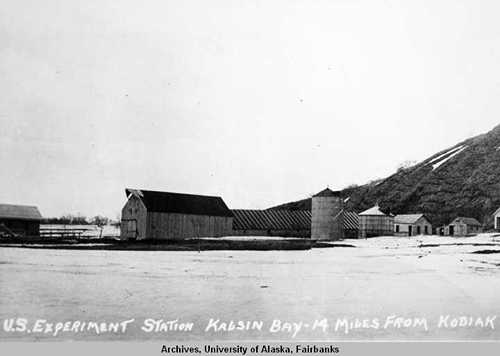 On this day in 1898, the United States Department of Agriculture would open an experimental station on Kodiak Island to experiment with cattle breeding.
The station, authorized by the 1887 Hatch Act, would open in Kalsin Bay, 14 miles to the south of present-day Kodiak
The station’s initial mission was to assess the adaptability of Galloway cattle to the island’s conditions. Different hay grains were also experimented with.
Later, Sitka Black-tailed Deer and Roosevelt Elk would be introduced to the station, deer in 1900 and elk in 1928. While initially the elk were to be released on Kodiak Island, it was determined that the possibility of competition with the cattle for winter food meant that they would instead be introduced to Afognak Island to the north.
The Kalsin Bay Station was one of several that would be established throughout Alaska.

MANLEY HOT SPRINGS — It’s so quiet in these spruce hills and tamarack swamps that 27 hours and 50 miles passed between when Forest Wagner and I said goodbye to one human being at Old Minto and hello to the next near Baker.
Space is in ample supply here on these pressed-in snow trails between towns and villages of Interior Alaska.
Forest and I are out here riding these ephemeral ribbons of blue-white moving westward, with a goal of reaching Nome.
Last Saturday, when it warmed to minus 12 degrees Fahrenheit, I lurched my loaded fat bike out of my home in Fairbanks. Saying goodbye to my wife and dogs, I rumbled eastward on a boot-packed trail that after a mile led to a plowed bike path. I then rolled through the familiar University of Alaska Fairbanks campus and onward 8 miles to Forest’s cabin.
He handed me a mug of coffee and an egg sandwich. Then we started pedaling our fat bikes down Chena Pump Road until we reached the Tanana River.

We found a trail groomed for a multi-sport winter race, turned right, and headed downstream on our home river, there half a mile wide. It was a day when the weather finally nodded toward spring. Fair-a-dise showed up with bluebird skies as the day warmed to 8 degrees Fahrenheit.
After a month of pillowy snows and crazy cold temperatures and re-telling people our new takeoff days to semi-suppressed eye rolls, we were finally unstuck from the glue of town.
If an object wasn’t hanging off our bikes, we didn’t need it. No more fiddling with the load or obsessing on the 7-day weather forecast. Just big ol’ tires humming on dry snow.
Now, five days and 145 miles later, Forest and I are digesting French toast and bacon our friend Steve O’Brien cooked for us as we wait on the dryer in the Manley washeteria. When we get a few dollar bills we will take showers.

It’s a good life here on the trail, just-add-water living at its finest. Eat everything in front of you, apply some sunblock and keep mashing on the pedals.
Steve O’Brien is one of the many people helping us move westward. In one of the most clutch moments, my wife Kristen and our friend Jen Wenrick appeared wearing headlamps on the packed snow ramp off the Tanana River in Nenana. They handed us burgers and fries from the Monderosa.
After a surprise tough day due to soft trail that had us working real hard, those burgers and Cokes were like oxygen.
There have been many other acts of kindness from Jenna and David Jonas, Steve Ketzler, Forest’s dad Joe Wagner and others. Tonic for the body and soul.

We will meet more excellent people, including some old friends, as we ratchet toward Nome.
When my satellite tracker is on, you can see our arrow creeping across the landscape here: https://share.garmin.com/NedRozell.

Goodwill Central Texas launches “Swap Your Shop” Challenge

Auburn vs Alabama live score updates, highlights from Saturday’s game

6 Alaska high school track and field athletes to watch, plus top Big C Relays performances

Jenae Berry’s strongest outing as a Wildcat secures Arizona softball’s series win over Baylor

Renegade wins 2026 Arkansas Derby

Florida High School Football Rankings: Top 25 teams – Oct. 21

How old is Bo Nix? What to know about Oregon quarterback ahead of 2024 NFL Draft

Cleary's 21 help Le Moyne down Central Connecticut State 69-64 in OT

99th annual Pony Swim held in Virginia

Indiana Members Credit Union announced as new anchor tenant at Bottleworks District

Jeffries declines to break with indicted Democrat after ethics panel’s guilty verdict

Hundreds of thousands march through London in stand against the far right

2 students killed, 7 other people injured in Tennessee bus crash during school field trip

Dem senators dodge crucial question on illegal alien accused of killing Chicago college student

EU Parliament unblocks key political hurdle in digital euro talks
-

 Movie Reviews1 week ago
‘Youth’ Twitter review: Ken Karunaas impresses audiences; Suraj Venjaramoodu adds charm; music wins praise | – The Times of India
-

 Sports1 week ago
IOC addresses execution of 19-year-old Iranian wrestler Saleh Mohammadi
-

 New Mexico6 days ago
Clovis shooting leaves one dead, four injured
-
 Business1 week ago
Disney’s new CEO says his focus is on storytelling and creativity
-

 Tennessee5 days ago
Tennessee Police Investigating Alleged Assault Involving ‘Reacher’ Star Alan Ritchson
-

 Technology6 days ago
YouTube job scam text: How to spot it fast
-

 Texas1 week ago
How to buy Houston vs. Texas A&M 2026 March Madness tickets
-

 Minneapolis, MN2 days ago
Boy who shielded classmate during school shooting receives Medal of Honor