Alaska lawmakers, Gov. Mike Dunleavy, staffers, pages, families and more gathered in the Capitol in Juneau for the start of the session.
By Marc Lester
Updated: 16 minutes ago Published: 28 minutes ago
Sens. Scott Kawasaki (D-Fairbanks), George Rauscher (R-Sutton), Robert Yundt (R-Wasilla), and Elvi Gray-Jackson (D-Anchorage) talk in the entryway to the Senate floor. The Alaska Legislature began its session at the Alaska State Capitol in Juneau on Tuesday, January 20, 2026. (Marc Lester / ADN)
JUNEAU — The Alaska Legislature began its session at the Alaska State Capitol in Juneau on Tuesday. Here’s a look inside the halls and chambers in photos.
[ Legislative session begins with planned vote on overriding Gov. Dunleavy’s veto of revenue bill]
Advertisement
Reps. Donna Mears, D-Anchorage, left, and Mike Prax, R-North Pole, right, deliver the ceremonial news that the House is ready for official business to Alaska Gov. Mike Dunleavy, center. (Marc Lester / ADN) Sen. Löki Tobin, D-Anchorage, right, speaks at a Senate Majority news conference. (Marc Lester / ADN) Senate page Megan Harden carries a glockenspiel to several floors of the Alaska State Capitol, a signal for the body to convene. (Marc Lester / ADN) Members of the House Minority gather for a photo. (Marc Lester / ADN) Jeff Turner, spokesperson for Gov. Mike Dunleavy, speaks with Sen. Bert Stedman, R-Sitka, in a hall of the Alaska State Capitol. (Marc Lester / ADN) Bindi Nelson, 1, is held up by her mother, Sierra Nelson, during introductions in the Alaska House. Bindi is the daughter of new House Rep. Garret Nelson, R-Sutton, and Sierra is his wife. (Marc Lester / ADN) Rep. Alyse Galvin, of Anchorage, ducks under a conversation between Reps. Calvin Schrage of Anchorage, left, and Jeremy Bynum, R-Ketchikan. (Marc Lester / ADN) House Speaker Bryce Edgmon, I-Dillingham, answers question from media members before the session officially begins. (Marc Lester / ADN) Reps. Nellie Unangiq Jimmie, D-Toksook Bay, and Robyn Niayuq Frier, D-Utqiagvik, talk in front of House Speaker Bryce Edgmon, I-Dillingham. (Marc Lester / ADN) Reps. Sara Hannan, D-Juneau, and Donna Mears, D-Anchorage, speak on the House floor during an at-ease. (Marc Lester / ADN) Reps. Ashley Carrick, D-Fairbanks, Jamie Allard, R-Eagle River, and Kevin McCabe, R-Big Lake, talk on the House floor. (Marc Lester / ADN) Sen. George Rauscher, R-Sutton, receives a flower before entering the Senate Chamber. (Marc Lester / ADN) House Speaker Bryce Edgmon, I-Dillingham, talks with Sens. Matt Claman, D-Anchorage, and Cathy Tilton, R-Anchorage, in a Capitol hallway. (Marc Lester / ADN) Reps. Dan Saddler, R-Eagle River, and Louise Stutes, R-Kodiak, talk during a break in the House. (Marc Lester / ADN) Senate Majority Leader Cathy Giessel, R-Anchorage, laughs during a news conference. (Marc Lester / ADN) Afternoon light brightens the Butrovich Room at the Alaska State Capitol. (Marc Lester / ADN) Reps. Genevieve Mina, D-Anchorage, and Rebecca Himschoot of Sitka, talk on the way to a House Majority caucus meeting. (Marc Lester / ADN) Senate page Isabell Braun places flowers at the front of the Senate Chamber before the session officially begins. (Marc Lester / ADN) Sen. Bill Wielechowski, D-Anchorage, speaks with colleagues at a Senate Majority news conference. (Marc Lester / ADN) Rep. Justin Ruffridge, R-Soldotna, left, listens in the House. (Marc Lester / ADN) Rep. Elexie Moore, R-Wasilla, talks with Minority Leader DeLena Johnson, R-Palmer, on the House floor. (Marc Lester / ADN) Sen. Jesse Bjorkman, R-Nikiski, walks out of the Senate chamber with his son, Blake, 10, who served as a guest page for the first day of the session. (Marc Lester / ADN)
Marc Lester
Marc Lester is a multimedia journalist for Anchorage Daily News. Contact him at mlester@adn.com.
The largest landslide in Anchorage occurred along Knik Arm between Point Woronzof and Fish Creek, causing substantial damage to numerous homes in the Turnagain-By-The-Sea subdivision. Courtesy of Wikipedia
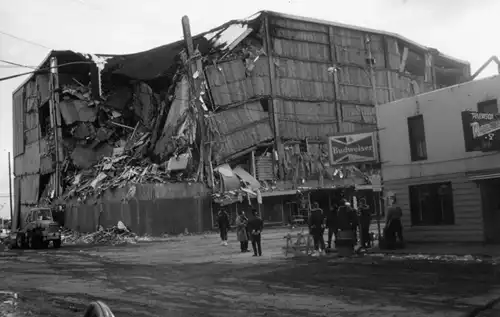
J.C. Penney Department Store at Fifth Avenue and D Street, Anchorage District, Cook Inlet Region, Alaska, 1964. Courtesy of USGS
It was on this day in 1964 that a massive 9.2 earthquake in Southcentral Alaska.
The massive quake at 5:36 pm on March 27th caused much devastation throughout the region and generated a huge tsunami that inundated many communities in the region.
The quake was the largest in the history of the United States and initially killed 15 people while the resulting tsunami killed an additional 100 people in the new state and another 13 in California as well as five in Oregon.
Advertisement
The megathrust earthquake endured for four minutes and thirty-eight seconds and ruptured over 600 miles of fault and moved up to 60 feet in places.
The deadly quake occurred 15 and a half miles deep 40 miles west of Valdez and generated a ocean floor shift that created a wave 220 feet high.
As many as 20 other smaller tsunamis were generated by submarine landslides.
I grew up greeting friends and neighbors on my walk to my neighborhood Anchorage public school, just as my kids do now. It’s an essential, and value-added, part of living in our community.
In the late 1990s, when I attended Service High School, I had amazing teachers. My AP chemistry teacher left the oil and gas industry to teach. He could have earned significantly more money in another field, but teaching was competitive enough, given pensions and compensation, that he stayed in the job he loved and gave a generation of students a solid foundation in chemistry.
Now, my kids, who are in first, third and fifth grade, face a different reality. Teachers across our state are leaving in droves. Neighborhood schools across Alaska are closing. Art and music are being combined, which is nonsensical — they are not the same and they are both valuable independently. When he was in second grade, my oldest had a cohort of more than 60 students in his grade — split between two teachers. When he enters sixth grade next year, there will be no middle school sports and he will lose out on electives. Support systems and specialists to help when kids are falling behind have been cut. I’m lucky that my children have had amazing teachers, but many excellent teachers are nearing retirement age or don’t have a pension and are pursuing other careers. What happens then?
Despite skyrocketing inflation, last year was the first time in years that our schools received a significant increase in the Base Student Allocation — and that money doesn’t begin to make up for what they have lost over the years. Even that increase had to overcome two vetoes from what a recent teacher of the year calls “possibly the most anti-public education governor in the history of Alaska.” Shockingly, my own representative, Mia Costello, despite voting for the increase, failed to join the override to support education. She has failed to explain that decision when asked.
Advertisement
State spending on corrections is up 54% since 2019; meanwhile, spending on education is up only 12% in the same timeframe. Schools are now working with 77% of the funding they had 15 years ago when accounting for inflation.
When we starve our public schools of funding, Alaska families leave. No one wants their child to suffer from a subpar education and the lower test scores and opportunities that come with it. A significant number of people are working in Alaska but choosing not to raise their families here.
To the elected officials who preach school “choice” but starve public schools: our family’s choice is our neighborhood school. It’s our community. It’s where our friends are. Neighborhood public schools, which are required to accept all children, should be the best option out there. Public schools should be a good, strong, viable option for communities and neighborhoods across our great state. Once, they were.
I am thankful for those in the Legislature working to solve these problems. This includes HB 374, which raises the BSA by $630, and HB 261, which would make education funding less volatile.
It breaks my heart that across the state, dedicated teachers keep showing up for our kids while being underpaid and undervalued. Underfunding our schools is also a violation of Alaska’s constitution, which requires “adequate funding so as to accord to schools the ability to provide instruction in the standards.”
Advertisement
Not so long ago, Alaska’s public schools were adequately funded, and they produced well-educated students and retained excellent teachers. It’s up to all of us to reach out to our elected officials and urge them to make that the case once again.
Colleen Bolling is a lifelong Alaskan and mother of three who cares deeply about Alaska’s schools.
• • •
The Anchorage Daily News welcomes a broad range of viewpoints. To submit a piece for consideration, email commentary(at)adn.com. Send submissions shorter than 200 words to letters@adn.com or click here to submit via any web browser. Read our full guidelines for letters and commentaries here.
ANCHORAGE, Alaska — Karen Burnett spends most days in the sorting room at the Food Bank of Alaska, ensuring every donated item finds its place.
The Anchorage woman dedicates her time to sorting, packing and organizing food donations.
Finding purpose after loss
Burnett’s journey at the Food Bank of Alaska began after a personal loss. Following the death of her husband, Burnett said she found herself with time on her hands and a desire to help.
“I had a friend who had talked to me about it, and it just sounded like a good thing to be out doing,” she said.
Advertisement
Burnett now volunteers between 500 and 600 hours each year.
“I started, but it got to be so fun. I spent more and more time here,” Burnett added.
Understanding community need
Burnett has witnessed the growing need in the community, particularly as more families struggle to make ends meet.
“If you took a look at the pantry and saw those empty shelves, it’s hard sometimes when you know people are coming in and looking for something, for their clients, and there’s absolutely nothing in there,” Burnett said.
Her dedication has made a lasting impact on countless families.
Advertisement
“I just feel real involvement in a way that is appreciated,” Burnett said. “You know, people need this food. They need people to put it out for them.”
See the full story by Ariane Aramburo and John Perry.
Copyright 2025 Gray Media Group, Inc. All rights reserved.