Sports
Where’s the March Madness? Making sense of the NCAA Tournament’s Cinderella shortage


The Athletic has live coverage of 2025 Men’s March Madness
CLEVELAND — Trailing by one with less than eight minutes remaining, Robert Morris guard Amarion Dickerson swatted a shot attempt by Alabama guard Mark Sears, sending the first-team All-American to the floor and the ball caroming out of bounds. Then Dickerson, the suddenly not-so-anonymous Horizon League defensive player of the year who scored 25 points on Friday, stepped over Sears, a la Allen Iverson over Tyronn Lue, and flexed for the crowd.
Thousands roared back their approval, a throng of Robert Morris diehards who made the trek from Pittsburgh buoyed by an arena of new fans who had adopted the underdog.
Seconds later, the 15-seed Colonials harnessed that momentum, taking a one-point lead over the 2-seed Crimson Tide. And for a moment, the game felt destined for a classic David-over-Goliath upset, the stuff March Madness montages are made of.
Instead, Alabama ripped off a quick 6-0 run and never looked back, muscling its way to a nine-point victory.
It was the story of the round of 64 in this year’s NCAA Tournament. For the first time since 2017, no team seeded lower than No. 12 made it to the Saturday of the first weekend.
Only five double-digit seeds advanced over the past two days: two No. 10s, one No. 11 and two No. 12s. (And of those 12-seeds, Colorado State was a betting favorite.) That ties for the fewest first-round wins by double-digit seeds since 2007. The 2023 tournament produced the same number, but that first weekend featured No. 16 Fairleigh Dickinson toppling No. 1 Purdue and No. 15 Princeton reaching the Sweet 16. Prior to that were similarly chalky first rounds in ’17 and ’15.
The fact that most of the games weren’t particularly close didn’t help this year’s early shortage of March magic, either: Only four of the 32 first-round games were decided by two possessions or less, the fewest since 1997. We did get a couple thrillers at the First Four in Dayton, but Thursday and Friday were noticeably light on madness.
So what’s the deal? Is it a one-year, one-round aberration? Or is it — like everything else in college sports these days — a referendum on the power-hungry power conferences, or the pernicious impact of name, image and likeness money and the transfer portal fully taking hold?
The Athletic’s own C.J. Moore and Brendan Marks actually predicted this could happen in their bracket picks earlier this week, getting out in front of any commenters looking to skewer them for playing it safe. As both explained, the advanced metrics pointed to a top-heavy group of No. 1s and other high seeds, which manifested on the court.
This could end up being a good omen for the second and third weekends, setting up some high-wattage matchups. And recent history, including a comparably top-heavy 2015, suggest this is simply a product of the natural cycles of college basketball. But it’s still kind of a bummer.
The joy and beauty of the NCAA Tournament lie in those unpredictable early-round upsets, the ones we can all rattle off from memory. FDU over Purdue. UMBC over Virginia. Lehigh over Duke. Saint Peter’s over Kentucky. Bucknell over Kansas. Cinderella is what makes March so special, making this one feel a tad hollow in the early going.
“Sometimes I hate them,” said Michigan State coach Tom Izzo, who lost to 15-seed Middle Tennessee in 2016. “But most of the time, I love them. … Everybody loves Cinderella. Everybody loves the underdog. Everybody loves the small school. This is the difference with the NCAA basketball tournament compared to just about any other tournament there is.”
Minutes after the clock struck midnight, literally and metaphorically, on the first round, Izzo avoided another of those memorable moments he’d rather forget. His 2-seed Spartans turned a narrow five-point halftime lead over 15-seed Bryant into a 25-point blowout, a fitting capper to the round of 64. Asked afterward about the predictability of the first round overall, Izzo, coaching in his 27th straight tournament, mostly shrugged, and pointed to those 12 seeds that prevailed over 5 seeds. The man has seen it all this time of year, and he’s not ready to sound any alarms just yet.
He’s probably right. March Madness remains one of sports greatest gifts, even if the glass slippers didn’t quite fit this time around. Perhaps the rest of the bracket will make up for it, too.
But it won’t change the fact that one of this tournament’s most electrifying moments came a few hours before Michigan State took the court in Cleveland, when Robert Morris — America’s new favorite team — had mighty Alabama on the ropes.
And almost something more.
(Photo: Nick Cammett / Getty Images)



Sports
Pirates star pitcher makes unfortunate history after being taken out in middle of perfect game bid

NEWYou can now listen to Fox News articles!
Jared Jones was flirting with Major League Baseball history on Wednesday night — he got it, but it was not what he originally envisioned.
The Pittsburgh Pirates pitcher retired the first 18 batters he faced, but he was taken out in the middle of his perfect game bid after six innings.
Now, the Pirates certainly have their reasons — the 24-year-old Jones hasn’t thrown more than 81 pitches in eight starts since returning May 20 after missing all of last season while undergoing ulnar collateral ligament internal brace surgery on May 21, 2025. He was yanked with 77 pitches and likely would have needed more than 100 pitches to record the 25th perfect game in MLB history.
Jared Jones of the Pittsburgh Pirates pitches during the first inning against the Atlanta Braves at PNC Park on July 8, 2026, in Pittsburgh, Pennsylvania. (Photo by Joe Sargent/Getty Images)
However, Jones left the game after getting zero run support, so when the Atlanta Braves tacked on three runs late for a 3-0 victory, Jones instead found himself in the wrong chapter of the history books.
According to Opta Stats, Jones became the first pitcher in the modern era (since 1920) to pitch at least six perfect innings and not record a win.
“It does suck. Something’s cool coming on, but I’m on what? My eighth start off of surgery? I completely understand it, and it is what it is,” Jones told reporters after the game.
Pittsburgh Pirates starting pitcher Jared Jones (17) makes his way to the field to warm up before pitching against the Atlanta Braves at PNC Park. (Charles LeClaire/Imagn Images)
JUSTIN VERLANDER ANNOUNCES HE WILL RETIRE AFTER THIS SEASON: ‘I’VE REALIZED THAT TIME HAS COME’
Jones said he didn’t entertain attempting to complete the perfect game.
“Not with the pitch count,” he said. “Not really ever expecting to go nine right now, so that was never in my head.”
Joey Bart, traded to the Braves from the Pirates on June 18, followed a double by Mike Yastrzemski with a 422-foot, two-run homer to left-center field off a slider from Dennis Santana. Drake Baldwin added an RBI single to center in the ninth for good measure.
It was the second time in less than a week that a pitcher was taken out of the game with a perfect bid through six innings — the Miami Marlins took Eury Perez out after seven innings in which he had 92 pitches. Perez, too, is in the midst of returning from injury and has surprisingly found himself right in the postseason mix.
He was pulled for Lake Bachar to start the eighth, and the Marlins allowed eight runs to the Athletics in the final two innings, but held on to win 9-8.
Jared Jones (17) of the Pittsburgh Pirates delivers a pitch during a MLB game against the Cincinnati Reds on June 27, 2026, at PNC Park in Pittsburgh, Pennsylvania. (Joe Robbins/Icon Sportswire via Getty Images)
CLICK HERE TO DOWNLOAD THE FOX NEWS APP
The Pirates are 4.0 games out of the final wild card spot, which is held by the Marlins.
The Associated Press contributed to this report.
Follow Fox News Digital’s sports coverage on X, and subscribe to the Fox News Sports Huddle newsletter.
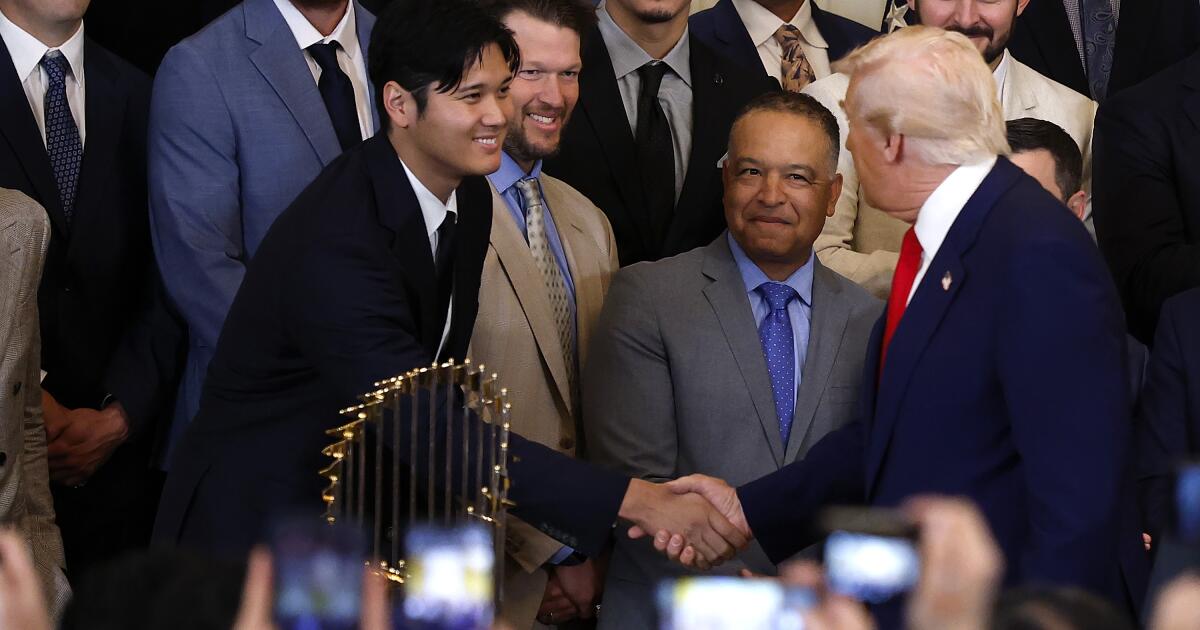
WASHINGTON — The Dodgers are scheduled to visit the White House on July 23 to celebrate their latest World Series title.
“President Trump is excited to welcome the Los Angeles Dodgers BACK to the White House to celebrate their World Series championship!,” White House spokesperson Taylor Rogers said in a statement to The Times.
The date falls on a scheduled off day in the middle of a nine-game East Coast road trip for the Dodgers. The team will play three games in Philadelphia against the Phillies July 20-22 before ending the trip with a three-game series against the New York Mets July 24 to 26.
The visit continues a tradition from the Dodgers’ two previous World Series championships. They were hosted by President Biden in 2021 and President Trump in April 2025.
After the Dodgers claimed their second consecutive World Series title with a dramatic Game 7 victory over the Toronto Blue Jays, a visit to the White House was planned, but it wasn’t until Thursday that a date was officially booked and confirmed.
Questions swirled around whether players would decline the visit this year after it did not happen during a scheduled visit to Washington in April.
Kiké Hernández said in 2018 he was unsure he would have gone had the Dodgers won the World Series the previous year. Mookie Betts said he was undecided and needed to talk it over with his family when last year’s visit was announced. After winning his first World Series with the Boston Red Sox in 2018, Betts skipped their trip to the White House the following year during Trump’s first term.
Both players, along with every returning member of the 2024 team who was with the team during its road trip, participated in the visit. The only notable absence was first baseman Freddie Freeman, who remained in Los Angeles to nurse an ankle injury.
Manager Dave Roberts, who indicated in comments to The Times in 2019 he might not go to the White House if Trump was president, also participated in last year’s ceremony.
Asked at the Dodgers’ fan festival in January about the possibility of returning to the White House, Roberts told The Times’ Bill Shaikin: “For me, I stand by: I’m a baseball manager. That’s my job.”
“I was raised — by a man who served our country for 30 years — to respect the highest office in our country,” Roberts said. “For me, it doesn’t matter who is in the office, I’m going to go to the White House. I’ve never tried to be political. … For me, I am going to continue to try to do what tradition says and not try to make political statements, because I am not a politician.”
Clayton Kershaw, who retired after last season but was on Team USA for this year’s World Baseball Classic, told The Times in the spring that he was aware Dodgers fans are split over whether the team should visit the White House again this year, but he said he is looking forward to it.
“I went when President Biden was in office. I’m going to go when President Trump is in office,” Kershaw said. “To me, it’s just about getting to go to the White House. You don’t get that opportunity every day, so I’m excited to go.”
Times deputy sports editor Ed Guzman contributed to this report.

NEWYou can now listen to Fox News articles!
All eyes were on Caitlin Clark on Wednesday night as she made her anticipated return from injury in a road matchup in Los Angeles.
But instead of a triumphant comeback, the Fever spent the entire night chasing the Sparks as Clark’s rough return fueled a 106-92 rout.
The superstar never found a groove, looking completely out of sync in her return from a back injury.
STEPHANIE WHITE GIVES CAITLIN CLARK STATUS UPDATE AHEAD OF FEVER-SPARKS, BUT HER NEXT MOVE RAISES QUESTIONS
Caitlin Clark huddles with teammates as the Indiana Fever battle the Sparks. (Photo by Katelyn Mulcahy/Getty Images) ((Photo by Katelyn Mulcahy/Getty Images))
Much of that disjointed performance falls squarely on head coach Stephanie White, who kept Clark on a ridiculously tight leash by limiting her to just 16 minutes. The stop-and-go approach could have sabotaged any chance for the phenom to establish a rhythm.
Clark finished with just 9 points, 4 rebounds and 3 assists. Her minus-16 plus-minus told the story.
The Los Angeles Sparks were severely shorthanded, taking the floor without stars Kelsey Plum and Cameron Brink.
MERCURY’S NOW-DELETED SOCIAL MEDIA POST MOCKING CAITLIN CLARK DRAWS SCRUTINY AFTER STAR’S INJURY
Yet while a depleted Sparks roster played to win, Indiana spent the night over-managing its biggest asset.
With Clark on a minutes restriction and Aliyah Boston out of the lineup, Kelsey Mitchell was forced to shoulder the entire offensive burden.
Mitchell did her part, pouring in 29 points while shooting 5-of-9 from beyond the arc.
Caitlin Clark orchestrates the Fever offense as Indiana battles the Los Angeles Sparks in primetime action. (Photo by Katelyn Mulcahy/Getty Images) ((Photo by Katelyn Mulcahy/Getty Images))
But one hot hand couldn’t stop an efficient LA squad.
The Sparks shot 45% from three-point range, going 9-of-20 from deep to cruise to the 106-92 victory.
White’s next move is to sit Clark against the Mercury on Thursday while Boston returns.
CLICK HERE TO DOWNLOAD THE FOX NEWS APP
After Wednesday’s loss to a shorthanded Sparks team, it’s fair to question whether Indiana’s cautious approach is working. The Fever dropped to 12-9.
Caitlin Clark and Dearica Hamby face off as Fever and Sparks battle at Crypto.com Arena in Los Angeles. (Photo by Tyler Ross/NBAE via Getty Images) ((Photo by Tyler Ross/NBAE via Getty Images))
Send us your thoughts: alejandro.avila@outkick.com / Follow along on X: @alejandroaveela
-

 Los Angeles, Ca22 minutes ago
California teen e-biker baiting police to chase tracked by drone, arrested
-

 Detroit, MI42 minutes ago
Our picks for state\nSenate from Wayne Co. | Endorsements
-

 San Francisco, CA52 minutes ago
Man reported missing in San Francisco
-

 Dallas, TX57 minutes ago
How to buy France World Cup semifinal soccer tickets in Dallas
-

 Miami, FL1 hour ago
Miami-Dade Schools names six semifinalists for superintendent
-

 Boston, MA1 hour ago
Lawsuit: ICE detained East Boston father despite legal status
-

 Denver, CO1 hour ago
Victor Marx wins GOP primary for Colorado governor, defeating veteran lawmaker after unorthodox campaign
-

 Seattle, WA1 hour ago
Widower of pregnant woman who was shot to death in Seattle sues homelessness authority

