Sports
The art of hitting in women’s hockey: How are PWHL players adapting to a more physical game?


The Professional Women’s Hockey League, hoping to educate players on the art of taking a hit, brought in a big name.
Ex-NHL player Ryan Getzlaf was one of his generation’s best combinations of skill and physicality. He was an elite playmaking center — who won a Stanley Cup and two Olympic gold medals — and a punishing 6-foot-3, 220-pound presence.
The former Anaheim Ducks captain now works in the NHL’s department of player safety, which hands out suspensions or fines for on-ice incidents in the league. It was in that capacity that he spoke to PWHL players during the league’s November preseason camps.
Since the launch of the PWHL in January, women’s hockey has become more physical than ever before. And while the increased contact has largely been celebrated — by both players and fans — there have been some concerns about injuries and ambiguity about how to interpret the PWHL’s rulebook. Getzlaf’s goal was to teach players how to better protect themselves on the ice.
“Through no fault of their own, a lot of them never played contact hockey before, so they’re learning a whole new set of rules and a whole new style of play,” Getzlaf told The Athletic. “(The league) saw the benefit for me to go in and talk about spacing on the ice, how to use your body properly along the boards (when) defending against contact, as opposed to putting yourself in some tough spots.”
Over 1,157 NHL games, Ryan Getzlaf was no stranger to making and taking hits. (Bruce Bennett / Getty Images)
Women’s hockey has been played the same way for decades. But now athletes are having to adjust to a new style of play once they hit the professional ranks. Navigating that change is going to take time for many players, league officials and executives.
“It’s unprecedented to have your first professional game be the first time you’re allowed to be physical,” said Toronto Sceptres coach Troy Ryan. “You’re going from 0 to 100.”
Physicality has been a hot topic in women’s hockey for years, especially among players.
In April 2023, The Athletic conducted an anonymous poll in which the majority of players said that if they could change one rule in women’s hockey, it would be to allow more contact.
According to the International Ice Hockey Federation rulebook, “bodychecking” in women’s hockey is allowed when there is a clear intent to play the puck. What that typically meant in practice, however, was players being penalized for making contact. That has made women’s hockey conspicuously different from the NHL, where hitting — and fighting — is very much a part of the game.
Women’s hockey players have long believed they should be able to get away with more contact, particularly at the net front and along the boards — not so much in open ice, where hits get more dangerous.
Before the PWHL launched, league leaders were deciding what PWHL games should look like; making the games more physical was an easy change.
“The players want this,” said Jayna Hefford, the PWHL’s senior vice president of hockey operations, who played 17 years for the Canadian women’s national team. “We think it’s a great brand of hockey. (The players) are strong, they’re fast, they can play this way.”
The PWHL’s initial rules around bodychecking were written similar to the IIHF’s — where gaining possession of the puck was a requirement to make contact — but it was clear early on that the interpretation of the rules and the way games were officiated was going to be different. There were more hits on the boards, and more contact was allowed in puck battles.
There were injuries last season, but according to Hefford, the number of injuries did not hit an alarming level. If at any point the increased physicality was creating more injuries, the league’s chief medical officer, Tina Atkinson, was instructed to flag her concerns with hockey operations. Over a number of check-ins, Hefford said that was never the case.
But there was inconsistency in how games were called last season. And for many players, the increase in contact was a first in their career.
Some players grew up playing boys hockey, where bodychecking is introduced at the under-14 level. Those players would have learned how to absorb contact, or how to throw a good hit — albeit years ago, especially for veteran players. Bodychecking has never been permitted in youth girls hockey, which means those skills are not typically taught.
“We’re figuring it out as players,” said Toronto defender Renata Fast. “There’s going to be bad hits because players are learning how to play physically. Not only are you learning how to take a hit, you’re learning how to give it and there’s going to be instances of doing it at the wrong time.
“I think for our league it’s been a work in progress.”

Defenders like the Sceptres’ Renata Fast can now add physicality to their arsenal, but it’s a learning process. (Troy Parla / Getty Images)
That work has taken on a few different forms.
Before the start of the 2024-25 season, the PWHL announced several rule clarifications regarding bodychecking.
The rulebook now more clearly states that bodychecking is permitted when players are moving in the same direction and that hitting an opponent straight on — with “opposite-directional force” — is prohibited. The league also introduced strict guidelines around head contact; any illegal checks to the head will result in a major penalty and a game misconduct, pending a video review.
Hefford said the league sent out multiple educational videos to officials, players and team staff on things like boarding (which many around the league found to be inconsistently penalized last season), hits to the head and bodychecking, with examples on what is permitted and what should be penalized heading into the season.
“We’re all adapting to this new standard,” said Hefford. “After season one, we felt the need to really try to clarify where those lines are.”
Getzlaf was brought in to help players better protect themselves on the ice for the times when an opponent might cross those very lines the league is trying to make less blurred. He hosted two short video sessions in Toronto and Montreal, where the league’s six teams were split up for preseason.
The main areas of concern Getzlaf identified in clips was player awareness and positioning. With no contact in women’s hockey for so long, players were accustomed to turning their backs to opponents along the walls to protect the puck. Now, that could put a player in a vulnerable position.
“If somebody is coming to make a hit and you turn your back at the last second, you’re going into the boards head-first,” Getzlaf explained. “Those are certain things we have to get out of the game.”
Getzlaf also told players he’d like to see them stop either five feet from the boards, or right up against them.
“When you’re standing at three feet, you can go in pretty hard on your head,” he said. “If you get closer to the boards, your shoulders and the boards can absorb some of the hit and it allows you to be safer.”
The importance of being more aware of their surroundings on the ice — and where contact might be coming from — was perhaps the biggest takeaway for players.
“It was interesting to have someone with an outside perspective and I totally agree with it,” said Minnesota forward Taylor Heise. “In this league (players sometimes) get away with being complacently not aware of what’s going on. Whereas in the NHL, your life is at stake at that point. You’re not going to turn and not know where you’re going because you’re going to get your ass laid out.”

Player awareness on the ice was a big takeaway for the Minnesota Frost’s Taylor Heise. (Michael Chisholm / Getty Images)
Some teams had already taken the onus on themselves to help teach players how to safely get hit. The Ottawa Charge brought in former NHL defender Marc Methot to run a hitting clinic ahead of the inaugural season. Minnesota coach Ken Klee, who played 934 games in the NHL, instructed players himself.
“I don’t want anyone to get hurt,” Klee said. “I’m more concerned with can we absorb checks, can we get out of the way, can we protect ourselves, rather than us being the big bad (Philadelphia) Flyers.”
And while protecting yourself is important, Klee has also emphasized to players the lines that should not be crossed, particularly when it comes to dangerous boarding penalties, which are called when a player hits an opponent violently into the boards.
“If you see numbers (on the back of their jersey) you have to let up,” he said. “If you see numbers, you can’t go finish them and say it’s on her because she didn’t look.”
At a recent Toronto Sceptres practice, Ryan spent most of the skate working with players on angling while on the defensive side of the puck. Having a good angle, he said, is critical for proper defensive positioning, but it also allows for safer contact versus going straight at an opponent.
“I want physicality. I think it’s a big part of the game, but I don’t want it to be reckless,” he said. “It’s our job to make as many adjustments as we can to get athletes ready for physical play – it’s no different than helping an athlete get ready for our power play or penalty kill.”
With more contact looming, many players took a different approach to training in the summer to prepare for the 2024-25 season.
Around 20 PWHL players spent the summer at Shield Athletics — a facility in Burlington, Ont., 35 miles from downtown Toronto — with a more holistic training plan that included rehab, mobility, strength training and on-ice sessions.
“Last year opened a lot of players’ and trainers’ eyes into all those little rehab exercises that needed to be implemented in our programming,” said Fast.
At Shield, players spent several weeks working on their mobility and any nagging injuries or weaknesses in their body before moving onto any heavy lifting.
“If you’re not dealing with these minor weaknesses, when there’s contact, all of a sudden they catch up to you and they catch up to you very fast,” said Shield founder Brandon Coccimiglio, who worked with the PWHL players.
In the gym, players focused on building strength more than they’d done in previous offseasons, especially in their upper body. On the ice, Coccimiglio ran drills that simulated the kind of in-game contact situations players are most likely to be in, like escaping pressure while carrying the puck or taking a hit and making a pass.
“When you build that confidence in that body with that athlete,” Coccimiglio said, “all of a sudden they’re going into the boards and it’s not even fazing them.”
Despite all the adjustments, there have already been controversial hits this season.
Fast was boarded hard in Toronto’s first game of the season. Sarah Fillier, the No. 1 pick in this year’s draft, was needlessly hit into New York’s open bench door in a game against Boston. Last week, Minnesota defender Maggie Flaherty was suspended for two games after what the league’s player safety committee called an “unsafe and dangerous” hit on Boston forward Alina Müller.
Flaherty was initially given a major penalty and game misconduct for an illegal hit to the head, which was downgraded to a minor after a video review. The officials believed Müller’s own stick hit her in the head, not Flaherty.
But the league still handed down a suspension for multiple infractions: a north-south hit with no intent to play the puck, an extended elbow and avoidable head contact.
“We just went over this with players,” said Hefford, who is on the player safety committee. “All of those things cannot be part of the game. And we wanted to make sure we didn’t allow any sort of gray area.”
The hope for many stakeholders in the women’s game is that some form of body contact is introduced at lower levels so players are more prepared as they move up the ranks and eventually get to professional hockey. Nobody wants dangerous bodychecks in girls youth hockey. Instead, the focus would be on teaching players how to use their body safely and how to defend against contact. That way, when they get to the PWHL, it’s a more seamless transition into contact hockey.
“I think it has to be addressed at younger ages,” said Coccimiglio, who said he’s been working with some youth female hockey players on controlled contact scenarios. “The game is getting more physical and they have to be prepared for that.”
While it’s still a work in progress, most players ultimately see this increased physicality as a good thing for the game.
“It allows for the game to be played at a higher level,” said Fast. “It brings more fan engagement. There’s a lot of benefits to it.”
(Illustration: Dan Goldfarb / The Athletic. Photos: Chris Young / The Canadian Press via AP, Bailey Hillesheim Icon Sportswire via Getty)



Lawmakers face off in congressional baseball game
Fox News correspondent Chad Pergram previews the annual Congressional Baseball Game, where Republican lawmakers aim to extend their five-year winning streak against Democrats. The report highlights the competitive spirit, challenges faced by both teams during early morning practices, and the game’s significant fundraising efforts for DC nonprofits.
NEWYou can now listen to Fox News articles!
I mentioned how humbling baseball can be in yesterday’s article. I was certainly humbled last night. Humbled might not even be the right word – instead, it probably should be incredibly frustrated. I had under 10.5 in the Royals and Padres game, and through nine innings, there were exactly six runs scored. Unfortunately, three were on each side, so it went to a 10th inning. In the top of the 10th, three runs crossed the plate. That pushed the total to 9, but I was still alive. In the bottom of the inning, the Royals scored four runs. A seven-run 10th inning, and the game goes over. About as brutal as it gets. Luckily, I won on the Reds, but that… was something. Let’s try to dodge that luck as the Rays take on the Red Sox.
Tampa Bay is one of the best teams in baseball, which isn’t all that shocking when you consider their franchise as a whole. They are 56-40 for the season with sole possession of first place in the division. The Rays have been hot all year, but I’d challenge almost any casual fan to name more than three players on the team. Junior Caminero is probably the most well-known, partially because he is an All-Star, and partially because he was almost injured in the All-Star Game.
Tampa Bay Rays’ Junior Caminero celebrates his solo home run off Cincinnati Reds pitcher Brandon Williamson during the third inning of a baseball game in St. Petersburg, Fla., on April 22, 2026. (Chris O’Meara/AP)
You might be familiar with some of the starting pitchers for the staff, but I wouldn’t be surprised if you weren’t. The Rays are a bit unconventional at times with their rotation and arms. Today, they are sending out Ian Seymour to start the game, or maybe we should consider calling it opening the game? Seymour has 33 appearances and just six starts. It is normal for a guy to get stretched out and move from the bullpen to the rotation, but some are better left in the bullpen, and it seems like that might be the case for him. As a starter, he has allowed teams to hit .242 against him compared to just .197 as a reliever. The encouraging sign for the Rays is that in 18 at-bats against him, the Red Sox have not recorded a hit and struck out seven times.
RED SOX HAD A NIGHTMARE TRAVEL DAY FOR THE AGES, YET STILL FOUND A WAY TO BEAT THE METS IN NEW YORK
The Boston Red Sox looked like they were dead in the water just about a month ago. They were in last place in the division and looked like they were probably going to be sellers at the trade deadline. Perhaps it was just a very bad start. Maybe this team is better than we expected. Or, it is possible this was just a hot stretch, and they will end up falling back down the standings. A lot is still to be determined, but the club is finally clicking, and I know they are looking to ride that success as long as possible.
CHICAGO, ILLINOIS – JULY 7: Ceddanne Rafaela #3 of the Boston Red Sox celebrates hitting a two-run home run during the second inning against the Chicago White Sox at Rate Field on July 7, 2026 in Chicago, Illinois. (Photo by Geoff Stellfox/Getty Images) (Getty Images)
The Red Sox will send Patrick Sandoval to the hill today. This is just his second start of the season for the Red Sox, and he has no record with a 2.08 ERA and a 1.38 WHIP. He has just 4.1 innings under his belt, so I’d be very surprised if I see him go deep into this game. It is possible, since yesterday was a doubleheader, that they need Sandoval to eat innings even if he pitches poorly. Rays hitters have faced him 28 times, but 17 of those have come from Yandy Diaz, who is just 3-for-17 against him. The other three players that have seen Sandoval before are a combined 2-for-11.
SIGN UP TO GET THE LATEST SPORTS NEWS
I think this might be a game where you see some runs from both teams. Neither starter is going to strike fear into their opponent, exactly. However, I will at least give them credit for showing success against their opponent in the limited exposure. I do lean to the over at 9.5 for this game, but I think there is a better play.
Tampa Bay Rays’ Yandy Diaz, center, is congratulated on his two-run home run against the Atlanta Braves during the fourth inning of a baseball game, Sunday, July 9, 2023, in St. Petersburg, Fla. (AP Photo/Mike Carlson)
CLICK HERE TO DOWNLOAD THE FOX NEWS APP
The Red Sox have won 11 straight games, but I don’t see them getting to 12. Boston should be very happy they’ve gotten all the way back to .500, but Tampa Bay is a very good team, and I actually think Seymour is more reliable than Sandoval in just his second start. Combine that with the Red Sox winning both games yesterday, and I think the Rays take this one. Give me Tampa Bay on the moneyline.
CLICK HERE FOR MORE SPORTS COVERAGE ON FOXNEWS.COM
For more sports betting information and plays, follow David on X/Twitter: @futureprez2024
Sports
Commentary: LAFC star Son Heung-Min proves life after the World Cup can offer hope and redemption
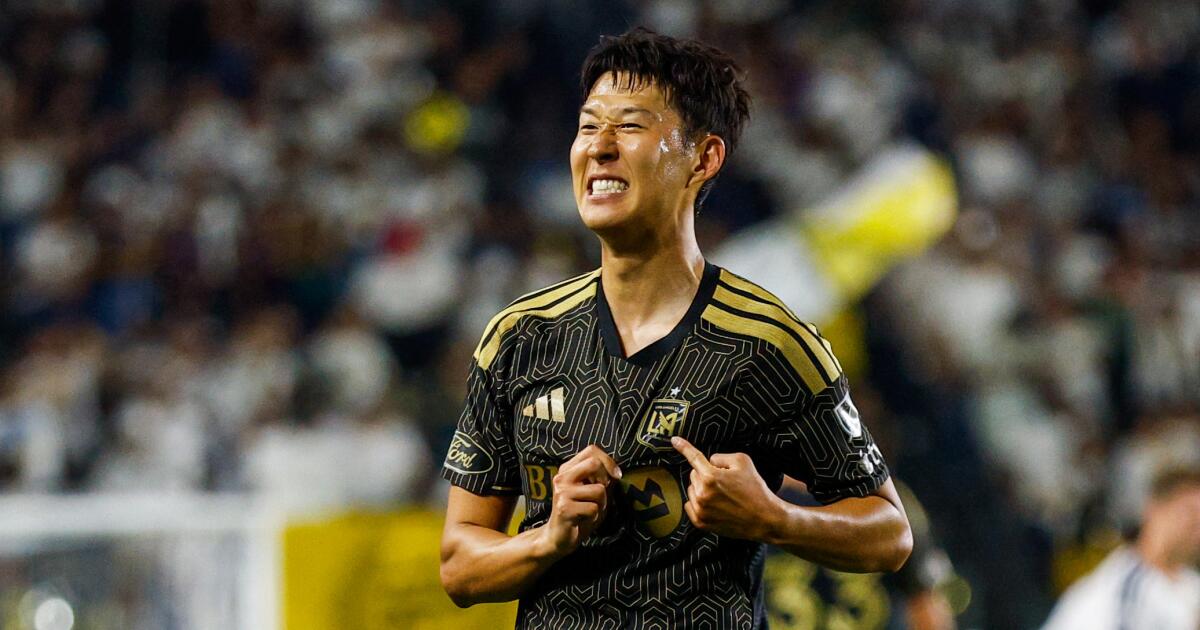
The Son, as they say, will come out tomorrow.
Bet your bottom dollar that Son Heung-min, LAFC’s $26 million man — the record MLS fee for an incoming player — would peel himself off the mat and clear away the cobwebs and sorrows of the past few weeks and months.
He did it with a sizzling, right-footed goal in the 57th minute of LAFC’s 3-0 victory Friday over the Galaxy in the 27th rendition of El Tráfico and the first this year. Also, the first crosstown showdown of Son’s so-far, so-so tenure in L.A.
His arrival last August from Tottenham Hotspur in England’s Premier League was met with uncommon fanfare. Here came another global soccer icon to Major League Soccer — and to L.A., where the South Korean sensation was welcomed enthusiastically by a Korean diaspora that’s about 250,000 strong.
LAFC forward Son Heung-Min celebrates after scoring a goal against the Galaxy at Dignity Health Sports Park in Carson on Friday.
(Ronaldo Bolanos/Los Angeles Times)
The first Asian player to win the Premier League Golden Boot, Mayor Karen Bass spoke at Son’s introductory news conference. The Dodgers invited him to throw out the first pitch on Shohei Ohtani’s bobblehead night (and turned around this season and produced a bobblehead of Son throwing that pitch).
His first LAFC goal — a free kick over the wall in a 1-1 draw with FC Dallas — was named the MLS’s goal of the year. After notching 173 goals across all competitions with Tottenham Hotspur, he finished with nine goals in his first 10 regular-season appearances for LAFC.

Then the scoring stopped. As if someone turned off the spigot.
Before Friday, Son recorded nine assists but no goals over 13 unlucky matches this season. He went 44 shots without striking a goal. And 237 days between goals, according to The Chosun Daily’s tally.
Yeah, just a bit of what his LAFC teammate Mark Delgado described as “a drought.”
Most painfully, Son also was shut out in South Korea’s disastrously short World Cup stay.
South Korea entered the tournament with the expectation that its “golden generation” – led by Son – would reach the knockout stage. But after it opened Group A with a 2-1 win over Czechia, the Koreans lost 1-0 to Mexico and 1-0 to South Africa and failed to qualify for the round of 32 as one of the eight best third-placed teams.
The uproar in South Korea that followed included the country’s president demanding an investigation.

Mexico’s Julián Quiñones and South Korea’s Son Heung-min vie for the ball during a World Cup match on June 18 in Guadalajara, Mexico.
(Ricardo Mazalan / Ap Photo/ricardo Mazalan)
For his part, a heartbroken Son shared a statement on Instagram: “I don’t dare to convey the disappointment and hurt of the fans with a single word ‘sorry.’ So even saying those words feels insufficient.”
It was impossible not to wonder: What the heck?
Where was the version of Son that everyone was celebrating a year ago?
How did the 34-year-old’s game decline so suddenly?
Was this a classic case of overpromising and underdelivering?
It still might be. LAFC — now 8-5-3 and third in MLS’s Western Conference — is going to face tougher competition in the days ahead than the work-in-progress Galaxy.
But on Friday, the center-forward was aggressive and in control. He took two shots in the first seven minutes, both blocked by defenders. He toyed with the Galaxy just before halftime, lining up to take a penalty before turning it over to Denis Bouanga, who scored to make it 2-0.
Then he and Delgado exchanged passes in the second half to set up Son’s first goal in darn near forever.
LAFC coach Marc Dos Santos gave Son 10 days off after the World Cup, but Son said he was eager to return to L.A., because he so enjoys the camaraderie of this club.
Those good vibes were on display when Son’s shot whizzed between two defenders and the outstretched arms of Galaxy goalkeeper Novak Micovic.
Son put his finger to his lips in the universal “shhh” sign and then did his patented camera celebration — click! — miming a snapshot. Because every goal is precious, and let’s be real, you never know when another will come.

LAFC’s Son Heung-Min celebrates after scoring what could be a breakthough goal against the rival Galaxy at Dignity Health Sports Park in Carson on Friday.
(Ronaldo Bolanos/Los Angeles Times)
Around him, the crowd and his colleagues went wild.
Dos Santos did some vein-popping flexing on the sideline. Mathieu Choinière pumped his fists as though he were operating a handcrank. Jacob Shaffelburg and Ryan Hollingshead flanked him on either side as though posing for a family photo. Son’s hair got tousled and nobody wearing black and gold could stop smiling.
“He deserves it, coming back from an emotional World Cup, and joining us right away,” Dos Santos said.
“He’s a great guy,” Delgado said. “He’s been in a bit of a goal drought, and, you know, we all want him to score. We all, he’s always smiling, and in training, he’s always scoring.
“And we’re like, ‘yeah, we need that, we need that!’ Trying to give him confidence,” Delgado continued. “And in games, he finally is getting that confidence back. So to see him score and put the ball in the net and just see his face light up with a smile is awesome. We all want to see him succeed here. We all want him to lead this club like we know he can.”
Now the goal is to keep the goals coming.
“Scoring the first goal of this season, I think it [will] help me,” Son said. “I think, definitely, going forward through the second part of the season. So, let’s keep going, and hope Wednesday [against Salt Lake] I can score another goal.”
Sports
Raising Cane’s owner Todd Graves on how viral Tom Brady-Rob Gronkowski dunk tank came to be at Fanatics Fest

Tom Brady, LeBron, Jeter UNITE at Fanatics Fest
FOX Business’ Madison Alworth reports live from Fanatics Fest in New York City, detailing the immense gathering of sports fans and athletes. CEO Lance Fensterman reveals that mega-stars such as Serena Williams and David Beckham are attending. The festival anticipates 200,000 attendees over its four-day run, showcasing its significant growth since 2022.
NEWYou can now listen to Fox News articles!
Fanatics Fest is a viral moment waiting to happen considering the plethora of superstars under one Manhattan roof, and perhaps the first one came on Thursday’s opening day at the Javits Center in the Raising Cane’s activation.
It was a legendary combination of Tom Brady, Rob Gronkowski and 500 gallons of Raising Cane’s famous sauce filled in a dunk tank. Brady, whose accuracy with a football is still unmatched, didn’t miss his target.
Gronkowski went splashing into the sauce, as Brady and Raising Cane’s owner Todd Graves joined the masses in celebrating one of the coolest moments to kick off Fanatics Fest.
Todd Graves, Rob Gronkowski and Tom Brady attend Fanatics Fest NYC 2026 at Jacob Javits Center in New York City on July 16, 2026. (Dave Kotinsky/Getty Images for Fanatics)
Before Brady’s toss pulled the seat out from under his favorite tight end when they were both in the NFL, Fox News Digital caught up with Graves to find out how a dunk tank filled with his brand’s famous sauce came to be.
“I never thought of a Cane’s Sauce dunk tank, but partnering with Fanatics and Fanatics Fest, which is great,” Graves explained. “They’re amazing partners. One, Michael Rubin and I have been friends, and talk about business, help each other out in many different ways. A rising tide lifts all boats. Before we started partnering with Fanatics, I loved what he was doing, I loved the fanfare, I loved having sports and entertainment figure heads – everybody from Tom Brady to Kevin Hart , right? All that together, I was like, ‘Man, let’s partner. Let’s do this deal.’
TOM BRADY DRAWS INSPIRATION AFTER MEETING WITH MAKE-A-WISH TEAN HEART TRANSPLANT RECIPIENT AT FANATICS FEST
“With Fanatics Fest, partnering with them wasn’t just like, ‘Here, come, do whatever you think of.’ No, it was, ‘Let’s put our minds together and do what we can.’ So, they came up with the idea. Actually [CEO of OBB Media] Michael Ratner was like, ‘Let’s do a Cane’s Sauce dunk tank.’ I was like, ‘Yes!’ And he was like, ‘Let’s do Brady dunking Gronk.’ Oh my God, I couldn’t think of two better people doing it.”
Graves believed the moment was going to be “legendary” and “going to be something in Cane’s lore” forever. And when the brand opened its first doors in Baton Rouge, Louisiana on Aug. 28, 1996, Graves wasn’t thinking 30 years down the road two of the most recognizable athletes in the country would be making this happen.
“The crews are already so excited about it. The fans will love it. What better guy like Gronk, and to have Brady hit the target. It’s ideal,” Graves added.
Tom Brady throws football during Raising Cane’s dunk tank event, where Rob Gronkowski fell into 500 gallons of Cane’s Sauce. (Raising Cane’s)
Brady and Gronkowski got the crowd going with a little chicken Hail Mary moment, with the quarterback tossing some Cane’s chicken fingers into a cup of sauce the tight end was holding. But then, the moment of truth.
In classic Gronkowski fashion, he was chirping Brady from his seat, but the FOX Sports NFL colleagues knew what the end result was going to be with that. Brady toyed with Gronkowski at first, hitting a Cane’s logo just above the target on purpose, and did so again with a different one.
Then, on his third throw, Brady struck true, and all of the 6-foot-6, 265-pound Gronkowski caused a Cane’s Sauce explosion when he fell in. There was a splash zone if you were close enough, and it was a moment fans, media and everyone else who witnessed it couldn’t stop talking about.
As Gronkowski wiped the sauce from his eyes, and Brady calmed down from all the laughter he caused, Graves was right there to thank them both for the epic moment he’ll never forget.
Todd Graves, Rob Gronkowski and Tom Brady attend the Cane’s Sauce Dunk Tank Showdown hosted by Graves at Fanatics Fest at the Javits Center in New York City on July 16, 2026. (Phillip Faraone/Getty Images for Raising Cane’s)
CLICK HERE TO DOWNLOAD THE FOX NEWS APP
“Through growth, I have 100,000 crew members now, and we have 1,000 locations and we’re about to turn 30. For me to walk in here and see our logos up here and see people that want to come and be a part of Cane’s, it’s a dream come true. To do a dunk tank, and Tom Brady and Gronk want to do that, I built a brand that’s special to my crew and customers. So, an absolute dream. I always have to pinch myself and part of my job is doing things like this, which is great,” Graves said.
“We love what we do. I love my company, I love my crew and customers. This is just something I think we can do some fun for them, because I know how much I’m going to enjoy it.”
Follow Fox News Digital’s sports coverage on X and subscribe to the Fox News Sports Huddle newsletter.
-

 Colorado5 minutes ago
Urban Grocer opens in downtown Colorado Springs
-
Connecticut11 minutes ago
Connecticut woman charged with sexual coercion of 13-year-old Long Island boy
-

 Delaware17 minutes ago
Delaware Cancels After Fourth Race July 18 Due to Heat
-

 Florida23 minutes ago
Florida Lotto numbers for Saturday, July 18, $2.75 million jackpot
-

 Georgia29 minutes ago
Vintage WWII aircraft makes emergency landing on Georgia highway
-

 Hawaii35 minutes ago
Ballet Hawaii marks 50 years, next generation prepares to take the stage
-
 Idaho41 minutes ago
Black Ridge Fire 2 burns estimated 15,000 acres in Lincoln County
-

 Illinois47 minutes ago
4 shot in Rockford, suspect in custody; police ask public to avoid area


