Sports
Tennis Briefing: What did the French Open mean for tennis? What will grass-court season hold?


Welcome back to the Monday Tennis Briefing, where The Athletic will explain the stories from the past week on-court.
This week, the French Open in Paris drew to a close, with the second Grand Slam of the season playing out at Roland Garros. Iga Swiatek and Carlos Alcaraz won the singles titles, in a fortnight of five-setters, Hawk-Eye drama, raucous crowds and much, much more.
For a special edition of the Tennis Briefing, the writers at The Athletic look back on the tournament, and ahead to the coming of grass-court season.
If you’d like to follow our fantastic tennis coverage, click here.
How many kinds of five-set thriller are there?
The 2024 French Open was a tournament for the five-set advocates and the sceptics.
There was high drama in Carlos Alcaraz’s semi-final win over Jannik Sinner and his Sunday defeat of Alexander Zverev in the final, both of which went to five sets, and both of which were electric, jittery, at times uncomfortable matches, as that drama appeared to take over. Novak Djokovic’s gruelling, and ultimately hugely damaging, win over Francisco Cerundolo in the fourth round was less than sparkling on the quality index; ditto Zverev edging past Tallon Griekspoor in the third round.
The crucial and final moments were made even more dramatic by the spells when those matches were simmering, and the five-set format retains a uniqueness of tension and endurance that a three-set match arguably can’t. Sceptics would say that some of those matches were long on time and low on quality. Both things are true; it’s possible for there to be bad, indifferent and brilliant five-set matches.
Lorenzo Musetti strikes a backhand during his remarkable match with Djokovic (Clive Brunskill / Getty Images)
We saw all of the above at this French Open, including genuine thrillers like the late-night barnstormer on court 14 when Holger Rune edged past Flavio Cobolli in a final-set tiebreak, Djokovic and Lorenzo Musetti’s latest-ever finish at Roland Garros, and Dusan Lajovic and Roman Safiullin’s epic in the early rounds.

GO DEEPER
What’s the one thing you would change about tennis?
Is Coco Gauff a multiple Grand Slam doubles champion in waiting?
It wasn’t the title Coco Gauff came to Paris for, but it was one she really wanted.
Gauff didn’t even think she was going to be playing doubles here, because her usual partner at Grand Slams, Jessica Pegula, is still recovering from an injury. Then another American, Taylor Townsend got injured. That left Katerina Siniakova — who, along with Gauff, is one of the world’s top doubles players — without a partner.
Townsend gave Gauff’s phone number to Siniakova. There was a text, and two days before the tournament began, the French Open had a very formidable new doubles team: an elite singles player and an elite doubles one, with plenty of experience in the biggest events: Siniakova was a seven-time Grand Slam doubles champion even before this tournament, Gauff a two-time Grand Slam doubles semi-finalist.
The results were both surprising and predictable. Gauff and Siniakova basically winged their way to the title, like two great jazz musicians playing a series of gigs together after little to no practice, ending with a 7-6(5), 6-3 win over Jasmine Paolini and Sara Errani in the final.

Gauff and Siniakova had never played together before this year’s French Open (Mateo Villalba/Getty Images)
It wasn’t flawless.
Siniakova pegged Gauff in the back of the head in one match. Sometimes they didn’t know which direction the other one was heading in. Giggling apologies between points were not infrequent. Talent is talent though, and Gauff’s 125mph serves also helped plenty.
When it was over, Gauff said there was a larger lesson to cull from the experience. “I think it’s just one of those things that when you least expect it to happen, it happens,” she said.
“Same thing (with the) U.S. Open, when I won it (last September). I didn’t expect to win. I was having a really bad year. Then here, I didn’t even expect to play (doubles).”
GO DEEPER
Why Coco Gauff is so tough to face – told by those who have
Can the wisdom of crowds prevail?
It already feels like it was about 10 years ago, but the first week of this French Open was dominated by stories of bad crowd behaviour. Raucous fans were making life hard for some of the players, and David Goffin reported he had been spat at by a supporter when the atmosphere was particularly feverish during his first-round win over home favourite Giovanni Mpetshi Perricard.
Tournament director Amelie Mauresmo announced a site-wide ban on drinking in the stands a couple of days later, in what straight away felt like a heavy-handed response.
In her tournament review on Sunday, Maursemo accepted organisers may have jumped the gun, while also rejecting the idea that the ban contributed to the numerous empty seats seen on the main courts at Roland Garros.

Raucous crowds have brought passion to the tournament. (Emmanuel Dunand / AFP via Getty Images)
“Honestly, in my opinion, the alcohol, maybe it wasn’t necessary, and I don’t think it was the reason why the stadium at some point was empty,” she said.
The lesson here is that tennis needs to take a step back and not try to stamp out all behaviour it finds a little too much. Something like the Goffin incident clearly oversteps the mark, but having passionate, engaged fans is hardly a bad thing.
There are plenty of tennis players who would love to have this kind of raucousness more often, with many tour events grappling with empty seats and a lack of atmosphere that is, in a wider sense, a far bigger problem for the sport.
GO DEEPER
The wisdom of crowds: Tricolores, trumpets, and truculence at Roland Garros
What will it take for the French Open to accept Hawk-Eye?
Apparently, the people who run the French Open needed yet another reminder:
High-speed cameras and the computer technology that allows them to make line calls with the tiniest margin for error are better than the human eye — and better for humans.
Little has moved the needle so far, but costing a finalist a Grand Slam title may make the FFT (France’s tennis federation, which organizes the French Open) reconsider staying loyal to umpires coming down from their chair to inspect ball marks on the red clay to estimate whether the edge of a tiny ball nicked or missed a painted line, with millions of dollars riding on the decision.
Last year, Wimbledon’s obstinance may very well have cost home favourite Andy Murray a chance to win his match against Stefanos Tsitsipas. But that was in the second round.
On Sunday, in the fifth set of the men’s final, a similarly mistaken line call prevented Alexander Zverev from breaking Carlos Alcaraz’s serve and knotting the set at two games each. Everyone watching on television or with access to social media knew very quickly that Alcaraz double-faulted and that chair umpire Renaud Lichtenstein should not have overruled the original line judge’s call.

The crucial line call helped keep the momentum with Alcaraz in the final’s fifth set (Emmanuel Dunand / AFP)
Once again, the wider world had access to the correct information, but the people who really needed it, and should have been protected by it, did not.
“There’s a difference whether you’re down 3-1 in the fifth set or you’re back to two-all — that’s a deciding difference,” said Zverev, after he had learned that the final call had been wrong. “It’s frustrating in the end, but it is what it is. Umpires make mistakes. They’re also human, and that’s OK. But of course, in a situation like that, you wish there wouldn’t be mistakes.”
Pascal Maria, the assistant referee for the French Open, said earlier in the tournament that officials are not considering moving to fully electronic line calling, which will be ubiquitous on the ATP Tour next year.
Officials used to argue that the Hawk-Eye system was not as effective on clay because of the raised lines. Supporters of the technology say that is no longer an issue, and regardless, the computer was always better than a human anyway for this task.
The ruling against Zverev fell within the error tolerance of 3mm (just under an eighth of an inch), so it may never have been called out by an electronic system — but there would have been no person being asked to track a minuscule distance at high speed under severe pressure. Tennis needs to save its officials, and itself, from the vitriol that comes with mistakes.
GO DEEPER
Welcome to ‘Ump-Head’: The tiny camera thrilling fans and embarrassing players in Paris
Can Iga Swiatek emulate Rafael Nadal in yet another way?
Iga Swiatek has long idolised Rafael Nadal — and similarities between the two have become increasingly hard to ignore.
So here’s another one: it was after Nadal’s fourth Roland Garros title that he won his first Wimbledon, in 2008. So could this be the year, after Swiatek’s fourth French Open, that she too breaks her duck in south-west London?
When The Athletic put this to Swiatek on Saturday, she responded with typical modesty.
“I think the biggest progress I can make on grass right now is using my serve that is better, but also I don’t expect a lot at Wimbledon next month),” she said.

Iga Swiatek will return to Wimbledon as world No 1, but not necessarily a favourite. (Julian Finney / Getty Images)
“The balls are different. Overall, tennis is different on grass. I’ll just see and I’ll work hard to play better there.”
Swiatek also explained that she has been happy with her progress on grass, saying that she feels “like, every year, it’s easier for me to adapt to grass”.
Whether Swiatek can complete the fiendishly difficult French Open-Wimbledon double this time — as with every year she wins at Roland Garros — will be one of the key sub-plots as the surfaces switch for the early summer.
GO DEEPER
‘I get better every match’: How Iga Swiatek learned to be inevitable
Will the grass provide a soft landing for stars on the comeback trail?
It’s impossible to have witnessed this French Open and not feel very encouraged about the prospects for a few stars on the comeback trail from injury or, in Naomi Osaka’s case, maternity leave.
Canadians Denis Shapovalov and Bianca Andreescu both made the third round at Roland Garros on a surface neither of them particularly enjoys. Shapovalov has been working through an injured knee. Andreescu has spent eight months recovering from a stress fracture in her back.
Both are now moving on towards Wimbledon.
Shapovalov could not be more thrilled. Grass is his favorite surface, and if he can beat quality opponents on the clay, he’s someone that players and fans alike will want to circle on their draw sheets.

Andreescu married power and craft in her return to Roland Garros, and could be formidable on the grass (Robert Prange / Getty Images)
The same goes for Andreescu, the 2019 U.S. Open champion. She showed every bit of her competitive fire and nearly unmatched creativity in Paris, and though she’s hardly a grass court specialist, her athletic talent and experience on the surface should make her a very good watch at the All England Club.
And then there’s Osaka, the furthest thing from a clay lover, pushing Iga Swiatek, the reigning and ultimate champion, to within a point of elimination in the second round. Osaka has never been much for grass either, but if that is what she is capable of on a surface she doesn’t like, there’s no reason she can’t perform even better at Wimbledon, where the grass will give her all sorts of love that the clay does not.
GO DEEPER
Naomi Osaka, The Comeback Interview: A tale of pregnancy, fear and a ballerina
Shot of the week
This was CINEMA pic.twitter.com/s7NY23uR6c
— Served with Andy Roddick (@Served_Podcast) June 9, 2024
Passing shot de esquerda a uma mão. Carlos Alcaraz.pic.twitter.com/AqM0NRPE65
— B24 (@B24PT) June 9, 2024
Recommended reading:
🏆 The winners of the week
🎾 ATP:
🏆 Carlos Alcaraz def. Alexander Zverev 6-3, 2-6, 5-7, 6-1, 6-2 to win the French Open at Roland Garros in Paris. It is Alcaraz’s first French Open title.
🏆 Lloyd Harris def. Leandro Riedi 7-6(8), 7-5 to win the Lexus Surbiton Trophy (Challenger 125) in Surbiton, England. It is Harris’ first ATP title.
🎾 WTA:
🏆 Iga Swiatek def. Jasmine Paolini 6-2, 6-1 to win the French Open at Roland Garros in Paris. It is her fifth Grand Slam title and third French Open in a row.
🏆 Anca Todoni def. Panna Udvardy 6-4, 6-0 to win the Puglia Open (125) in Bari, Italy. It is Todoni’s first WTA title.
🏆 Katie Volynets def. Mayar Sherif 3-6, 6-2, 6-1 to win the Makarska Open (125) in Makarska, Croatia. It is Volynets’ first WTA title.
📈📉 On the rise / Down the line
📈 Jannik Sinner and Carlos Alcaraz both move up one place, to No 1 and No 2 respectively. It is Sinner’s first time at world No 1.
📈 Coco Gauff ascends one spot from No 3 to No 2. It is her highest career ranking to date.
📈 Jasmine Paolini moves up eight positions from No 15 to No 7. It is her highest career ranking to date.
📉 Novak Djokovic falls two places from No 1 to No 3. It is his lowest ranking since the summer of 2022.
📉 Aryna Sabalenka drops one position from No 2 to No 3 after Gauff surpassed her at the French Open.
📉 Andy Murray tumbles 25 spots from No 71 to No 96.
📅 Coming up
🎾 ATP:
📍Stuttgart, Germany, Boss Open (250) featuring Andy Murray, Alexander Zverev, Frances Tiafoe and Ben Shelton.
📍Hertogenbosch, Netherlands, Libema Open (250) featuring Alex de Minaur, Sebastian Korda, Arthur Fils and Tommy Paul.
📺 UK: Sky Sports; U.S.: Tennis Channel 💻 Tennis TV
🎾 WTA:
📍Hertogenbosch, Netherlands, Libema Open (250) featuring Jessica Pegula, Naomi Osaka, Clara Tauson and Bianca Andreescu.
📍Nottingham, England, Rothesay Open (250) featuring Ons Jabeur, Emma Raducanu, Marta Kostyuk and Katie Boulter.
📺 UK: Sky Sports; U.S.: Tennis Channel
Tell us what you noticed this week in the comments below as the men’s and women’s tours continue.
(Top photo: Glenn Gervot/Icon Sportswire via Getty Images; design: Eamonn Dalton)



Sports
Golf star records lowest round in LPGA major history with astounding performance at Evian Championship

NEWYou can now listen to Fox News articles!
There are good days on the golf course, and then there is what Haeran Ryu just did on Saturday.
Ryu, 25, recorded the lowest round in LPGA major history on Saturday with an 11-under 60 at the Evian Championship. With the South Korean golfer’s historic round, she holds a three-stroke lead.
Ryu’s round comes just two weeks after winning her first major at the Women’s PGA Championship. On the 18th hole, Ryu left a 30-foot eagle putt a few inches short, and instead settled for a birdie.
CLICK HERE FOR MORE SPORTS COVERAGE ON FOXNEWS.COM
Haeran Ryu of South Korea reacts on the 18th green after the third round of The Amundi Evian Championship at Evian Resort Golf Club in Evian-les-Bains, France, on July 11, 2026. (Stuart Franklin/Getty Images)
She said after the round that she had no idea what she had done until she counted up her scorecard.
“But after the putt and I counted my score with my caddie,” she said. “Oh my God, it’s 11-under par today. It was so amazing. My caddie says, ‘Yep.’ I’m so happy right now.”
If Ryu had made the eagle putt on the 18th hole, she would have been just the second player to shoot a 59 in LPGA history.
ZERO BS. JUST DAKICH. TAKE THE DON’T @ ME PODCAST ON THE ROAD. DOWNLOAD NOW!
Haeran Ryu of South Korea celebrates a birdie on the 15th green during the third round of The Amundi Evian Championship at Evian Resort Golf Club on July 11, 2026, in Evian-les-Bains, France. (Stuart Franklin/Getty Images)
Her 60 broke the record for the lowest round in an LPGA major by one shot. Leona Maguire and Jeungeun Lee6 in 2021, and Hyo Joo Kim in 2014, each shot 61 at the Evian Championship, which was designated as an LPGA major in 2013.
The lowest round in a men’s major is 62, which is shared by four players — Branden Grace at Royal Birkdale in the 2017 British Open, Xander Schauffele and Rickie Fowler in the 2023 U.S. Open at Los Angeles Country Club, and Schauffele and Shane Lowry in the 2024 PGA Championship at Valhalla.
CLICK HERE TO DOWNLOAD THE FOX NEWS APP
Haeran Ryu of South Korea and Lottie Woad of England interact after their round on the 18th green during the third round of the Amundi Evian Championship at Evian Resort Golf Club in Evian-les-Bains, France, on July 11, 2026. (Stuart Franklin/Getty Images)
Ryu hopes her historic third round can help propel her to a second major win in three weeks.
“That is amazing, amazing dream,” Ryu said. “So I just want that one to come true, but we have one more day.”
The Associated Press contributed to this report.
Follow Fox News Digital’s sports coverage on X, and subscribe to the Fox News Sports Huddle newsletter.
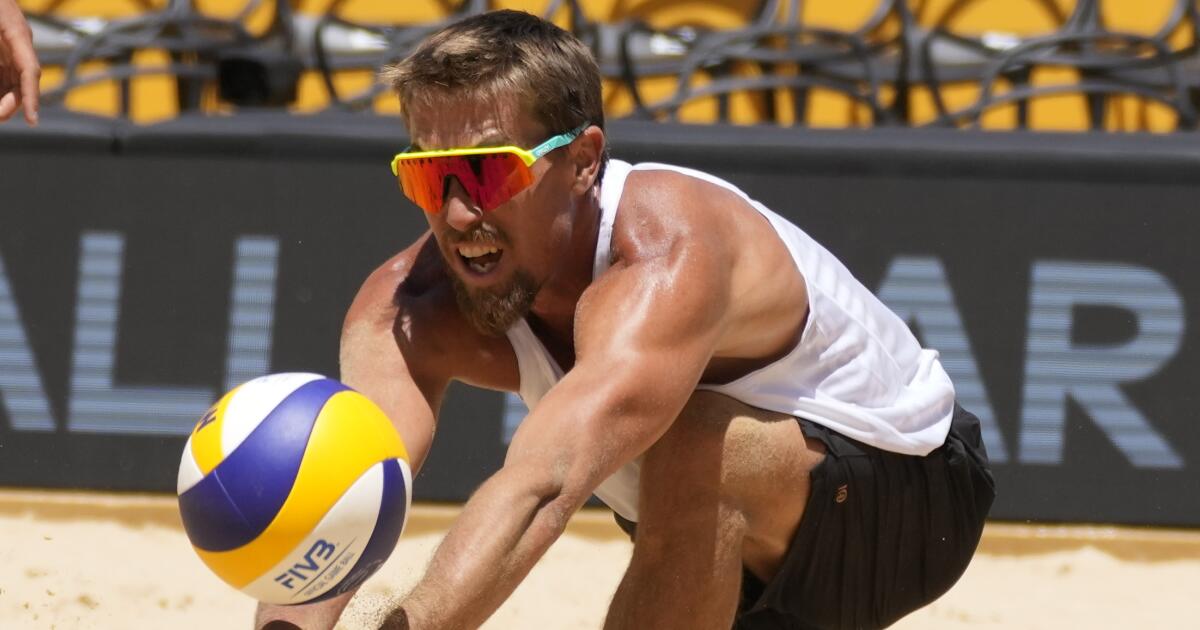
Taylor Crabb is no stranger to South California beaches. The Long Beach State alum returns home this weekend to compete in AVP League matches.
It marks the first time AVP will compete in Long Beach since 2020 and allows players to compete at the 2028 Olympics beach volleyball venue.
Crabb, 34, made his AVP debut in 2013 with his brother, Trevor, and advanced from the qualifier in Manhattan Beach before finishing 25th in his first tournament.
After years of competing with various different partners, Taylor Crabb and Andy Benesh have delivered the top performances this AVP season.
The following interview with Crabb has been edited for clarity and length.
Are you excited to compete in this weekend’s event at Long Beach?
Crabb: Very excited. A lot of my college teammates and part of the school have reached out, saying that they’re gonna come. So I’m excited to get a chance to play in front of them again.
When was the last time you were in Long Beach?
Crabb: I always try to go down there for alumni events or any big games they have. I went to UCLA against Long Beach last year, when it was No. 1 versus No. 2, so I always try to get down there and support them.
You missed out on the chance to compete in the 2020 Olympics because of COVID-19 restrictions and chose not to pursue a spot at the 2024 Olympics. Are you fired up to try to compete in the 2028 Olympics, knowing that Long Beach will host the competition?
Crabb: Yeah, it’s definitely an exciting time having the Olympics in Long Beach, and we kind of get to break it in this weekend. As you said, Tokyo didn’t go the way I wanted, but I’m going full force now. I have a great partner in Andy Benesh, who obviously went to the Paris Olympics, and if it weren’t for the Olympics being in Long Beach, and me getting a partner like Andy, I’m not even sure I’d be going for it, but because of those two things, I want to make the most of it.
You mentioned that if it wasn’t for a partner like Andy, you wouldn’t be going for it. What do you mean by that?
Crabb: I didn’t feel motivated by playing in all the international events, but now, I think, sitting out kind of lit the fire under me, and I’m really motivated now.
You’ve had different partners throughout your time. What other motivation does Andy give you?
Crabb: He’s been, in my mind, the top blocker for the U.S. the last four or five years. Seeing the professionalism he brings every day to practice, on and off the court, while traveling and when showing up to tournaments, it rubs off on you and that’s really motivating to see. And I just want to make him proud.
Why do you love volleyball?
Crabb: A lot of reasons, but it’s just a feeling I have when I’m out there on the court. It feels natural. It feels like home. I was born into a volleyball family. I had a volleyball in my hands my entire life, so I’ve always just enjoyed it.

NEWYou can now listen to Fox News articles!
CM Punk appeared on “Friday Night SmackDown” ready to take on any challenger that was ready to step to him after winning the Undisputed WWE Championship against Sami Zayn.
Punk entered the ring in Oklahoma City and called back to the “Monday Night Raw” after WrestleMania 42 when he told Cody Rhodes he’d be ready to deliver if a championship opportunity fell “out of the sky.”
COMPLETE PRO WRESTLING COVERAGE ON FOX NEWS DIGITAL
Cody Rhodes and CM Punk face off during SmackDown at Paycom Center in Oklahoma City, Okla. (Craig Ambrosio/WWE via Getty Images)
“When championship opportunities fall out of the sky, CM Punk catches them,” he said.
Punk named potential SmackDown superstars he’d think might come for the title, including Gunther, Finn Balor, Royce Keys, Damian Priest and Trick Williams. He even said that Zayn could come back around and get his rematch if he wanted. He didn’t mention Rhodes’ name, but the “American Nightmare” came out uncalled and marched his way down to the ring.
“I don’t think you and I can run away from each other anymore,” Punk told Rhodes.
Cody Rhodes looks on during SmackDown at Paycom Center in Oklahoma City, Okla., on July 10, 2026. (Craig Ambrosio/WWE via Getty Images)
Rhodes agreed and mentioned that Punk would want a match with him, just “say when.” It was a quick retort from Punk, who said, “when.” SmackDown general manager Nick Aldis, who was in the ring for the segment, booked the match for SummerSlam.
Punk will defend the Undisputed WWE Championship at SummerSlam, which takes place Aug. 1 and 2 at U.S. Bank Stadium in Minneapolis.
First, however, Punk and Rhodes will be involved in a tag team match at Saturday Night’s Main Event in New York City next week. Aldis made the match after Gunther demanded that Aldis put him in a match against Punk. Gunther was hoping it would be for the championship. Instead, Gunther will tag with Zayn.
Gunther didn’t take too kindly to that and attacked Aldis. Rhodes came back out to break up the calamity. He wanted to take on Gunther after the show went off air but Gunther walked away.
Gunther makes his entrance during SmackDown at Paycom Center in Oklahoma City, Okla., on July 10, 2026. (Rich Wade/WWE via Getty Images)
CLICK HERE TO DOWNLOAD THE FOX NEWS APP
Punk definitely has his hands full as he moves to SmackDown to become a fighting champion.
-

 Los Angeles, Ca1 hour ago
19-year-old arrested, accused of distributing marijuana to minors across Riverside County
-

 Detroit, MI1 hour ago
Phillies end the Tigers’ winning streak at 6 with a 4-2 victory
-

 San Francisco, CA2 hours ago
Giants select Barry Bonds’ nephew Peyton in third round
-

 Dallas, TX2 hours ago
Mark Cuban takes legal action against the Dallas Mavericks ownership over proposed arena deal
-

 Miami, FL2 hours ago
South Florida businesses report economic boom, as FIFA officials estimate a billion dollar economic impact
-

 Boston, MA2 hours ago
Forecast: Looking ahead to toasty temps next week
-

 Denver, CO2 hours ago
Denver weather: Warming trend continues this weekend and into next week
-

 Seattle, WA2 hours ago
Tech Investor Vinod Khosla to Acquire the NFL’s Seattle Seahawks for $9.6 Billion

