California
$6 gas and refinery fears collide with California’s climate ambitions


By Alejandro Lazo, CalMatters
This story was originally published by CalMatters. Sign up for their newsletters.
California is considering handing oil refineries and other major polluters billions of dollars in free emission allowances just as the state says carbon reductions need to come faster than ever.
In the last six months, two refineries have closed and gas prices have topped an average of $6 a gallon as the Iran-Israel war sent oil markets into turmoil. The oil and gas sector spent $10.3 million lobbying Sacramento in the first three months of the year, according to lobbying filings, with the Western States Petroleum Association and Chevron accounting for the bulk of it.
The result is a new proposal before the California Air Resources Board that would provide as much as $4 billion in new free emission permits to companies with half slated for the fossil fuel industry in exchange for commitments to invest in clean energy.
Environmentalists warn the proposal is a giveaway to Big Oil that would weaken California’s “cap-and-invest” program just as the state is relying on it to cut emissions and fund climate, housing and other programs. Anthony Martinez, a spokesman for Gov. Gavin Newsom, said the changes are necessary to keep the state’s carbon market “durable” and “affordable” amid mounting refinery closures.
The fight over California’s carbon market has exposed the political tensions at the heart of Newsom’s energy transition agenda. California is trying to preserve its climate ambitions while keeping gasoline affordable for drivers already facing the highest prices in the country. Critics say the air board’s proposal accomplishes neither goal.
“We are really concerned that this would significantly kneecap the program,” said Chloe Ames, a policy adviser with NextGen Policy.
Weakening the backstop
Through California’s 13-year-old carbon market, major polluting companies must buy permits for every ton of greenhouse gases they emit, with the state capping total emissions year by year. Each permit is worth real money and companies can sell the ones they don’t use. The program is considered California’s climate backstop — the only state policy that sets a firm limit on greenhouse gas emissions.
At the heart of the dispute with environmentalists is a proposed subsidy program carved out of that carbon market. The air board, if it approves the proposal on May 28, would create a new pool of free pollution permits for refineries, cement plants and other big companies that pledge to invest in clean energy and efficiency projects.
The pool would be capped at 118.3 million permits — the same number the air board has said must come off the market for California to hit its 2030 climate target. Environmentalists say the proposal risks wiping out those reductions.
Berkeley energy economist Meredith Fowlie, who chairs an independent committee that oversees the carbon market, wrote in a recent analysis that the design would give qualifying refineries more free permits than they need to cover their emissions.
“One could use the word generous,” Fowlie said.
Rajinder Sahota, the air board official overseeing the program, said the proposal would ensure emissions reductions. The new permits, she said, would only go to companies undertaking clean energy and efficiency projects and would be limited, temporary and rescinded if companies misuse them. The plan is meant to help keep refineries operating in California at a time of uncertainty, she added.
“We want to make sure that there’s reliable, affordable fuel for California consumers while the demand persists,” Sahota said.
But environmentalists say the air board has built in almost no accountability for how companies invest in those projects. Katelyn Roedner Sutter, state director for the Environmental Defense Fund, said the proposal “is based on proposed investment, not any guaranteed reduction.”
“That’s a red flag,” she said.
A climate money crunch
Quarterly auction revenue for state programs could drop from roughly $4 billion a year to about $2 billion under the proposal, according to the Legislative Analyst’s Office.
Sen. John Laird, the state Senate budget chair and a co-author of California’s original 2006 climate law, warned at a May 6 hearing that the proposal “flies against many things we negotiated just last fall” with the governor and could put the carbon market deal “back on the table.”
Not all lawmakers are critical. Assemblymembers Jacqui Irwin and Cottie Petrie-Norris, who respectively chair climate and energy committees, said the proposal “reflects the Legislature’s focus on affordability,” and urged the board to proceed “without delay.”
They pointed to an increase in the Climate Credit, the twice-yearly rebate that the carbon market funds on Californians’ utility bills; a UC Santa Barbara analysis, however, found the new subsidy could shrink the credit by as much as $1.7 billion under the proposal.
A separate, bipartisan group including Assemblymember David Alvarez, a Democrat, and Senator Suzette Valladares, a Republican, argues the purpose of the carbon market is to cut emissions, not raise money for programs.
Newsom struck an eleventh-hour deal with lawmakers last year that extended the state’s carbon market through 2045 and set the order of which state programs get auction money first.
Under that plan, California’s high-speed rail project receives $1 billion a year before many other programs. Lawmakers also carved out a $1 billion annual pool for priorities they control themselves, but Newsom in January proposed committing that money to wildfire spending and other programs.
Last in line are programs lawmakers have spent years building into California’s climate agenda: affordable housing and transit-oriented development meant to reduce driving and climate pollution, rail and bus service, wildfire resilience, clean drinking water in poor communities and neighborhood pollution monitoring.
Newsom unveiled a revised state budget on May 14 that did not reflect the potential drop in carbon market revenue. Laird, in an interview, said the administration told him the revenue drop wouldn’t show up in the coming fiscal year.
Laird said he planned to “ground truth” that assessment in the weeks ahead. The hit “would still be a big hit the year after this budget year,” he added.
Big Oil’s biggest target
California’s carbon market became a central focus of the oil industry’s lobbying efforts after the air board released a January proposal sharply reducing free pollution permits for industry.
Seven of the 10 highest-spending oil and gas lobbying groups in California pushed state officials on the proposal, state filings show. The petroleum association and Chevron mounted some of the industry’s most aggressive lobbying, pressing lawmakers, the governor’s office, the air board and the California Energy Commission on the plan.
The April plan raised free permits for most industries through 2030 above the January version, but deferred decisions on permits after 2030 to a future rulemaking.
Jim Stanley, a spokesman for the petroleum association, said the group has been pressing lawmakers, regulators and the governor’s office about “the potential consequences of a poorly structured cap-and-invest program.”
Chevron spokesman Ross Allen declined to comment beyond letters Chevron filed with the air board. Chevron initially warned the proposal threatened refinery survival in California. After last month’s revisions, the company is continuing to push for additional protections.
Zach Leary, a lobbyist for the petroleum association, said California needs to go further than even its latest proposal. He wants California to lock in a higher level of free permits permanently.
“The state is acknowledging that affordability and ambition are not getting along very well right now,” Leary said.
Eddie Ahn, executive director of Brightline Defense, oversees community air sensors in San Francisco’s Tenderloin, Mission and South of Market neighborhoods funded through the state’s community air protection program. That program is among those that could lose state money if carbon market auctions decline under the proposal.
“If the funding is cut off, then convening groups of people on a monthly basis — that goes away,” Ahn said. “It means frontline communities get disconnected from environmental policy.”
This article was originally published on CalMatters and was republished under the Creative Commons Attribution-NonCommercial-NoDerivatives license.



California
Forest Service workers held hostage at gunpoint by father, son in CA forest for hours: Authorities

SISKIYOU COUNTY, Calif. — Law enforcement in far Northern California’s Siskiyou County announced the arrests of a father and his adult son in the alleged kidnapping of two U.S. Forest Service workers, who are now safe and free.
The sheriff says they got a call around 10:55 a.m. Thursday from the Forest Service that a man had taken two Forest Service employees hostage in a very remote area.
The 49-year-old suspect had zip-tied the two Forest Service workers, holding them at gunpoint for nearly 15 hours in a trailer near Gumboot Lake in the Shasta-Trinity National Forest, officials said.
The suspect indicated he wanted to speak with the FBI, but it remains unclear why. Officials are still investigating motives for the kidnapping.
A huge contingent of law enforcement moved into the area. The FBI’s Hostage Rescue Team arrived on a Boeing 757 from Quantico as snipers, SWAT teams, bomb units, and drones were deployed.
Dashcam footage shows armed officers in tactical gear hitching a ride from a passing pickup truck.
Eventually, after many hours of negotiating, the two Forest Service workers were released just before 2 a.m. and are now safe at home.
The suspect and his adult son came out and were arrested at around 2:30 a.m.
The father will be charged with kidnapping a federal employee. In the trailer, he had an AR-15, knives, and claimed to have grenades.
It’s unclear if the trailer was his, but it did not belong to the Forest Service.
ABC7 Eyewitness News contributed to this story.
Copyright © 2026 ABC News Internet Ventures.
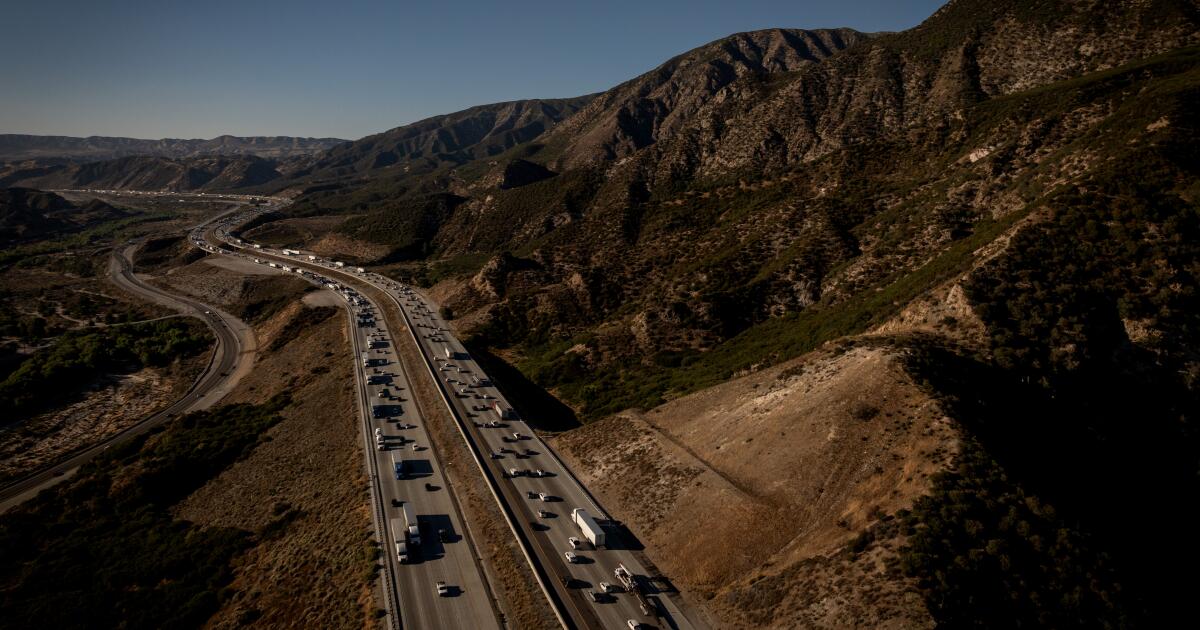
It lurks ominously beneath California’s many natural wonders, a reminder that nothing in this landscape is truly permanent.
It’s been described as “the mother of all earthquake faults,” the source of both our geological birth and, perhaps, our ultimate undoing.
But the most unnerving thing about the San Andreas fault these days may be its silence. It’s a mystery scientists are still trying to unlock.
The San Andreas is central to any discussion of California. It’s the massive 800-mile spine of the state, trundling up the Coachella Valley to the San Gabriel Mountains, and pushing along the edge of Silicon Valley to beyond the Golden Gate.
There is no simple answer for why California’s longest fault, responsible for some of America’s most powerful earthquakes, has produced so few in the last century.
But it is clear that the quiet period is only increasing strain on the San Andreas, as well as on the state’s second-longest fault, the San Jacinto.
A new study underscores the concern. Researchers estimated that key sections of the fault in Southern California are at their highest level of tectonic strain in the last 1,000 years.
The San Andreas, in other words, is locked, loaded and inevitable.
A red-hot San Andreas
Tectonic stress on these sections of the San Andreas and San Jacinto faults is high — shown in red — a product of no significant quakes on them for more than a century. At the Cajon Pass, sections of the faults are at their highest strain in 1,000 years, calculations suggest.
Average tectonic stress, in megapascals

Liliane Burkhard / University of Bern / University of Hawai’i at Manoa; Statewide California Earthquake Center Community Fault Model
Sean Greene LOS ANGELES TIMES
Ticking tectonics
There are generations of Californians who have never experienced the fury of the San Andreas.
The fault was responsible for a megaquake that ripped through the then-sparsely populated state in 1857 — an event that, if repeated today, would reap mass destruction.
In 1906, “a crack in the edge of the world,” as author Simon Winchester described it, flattened San Francisco.
Modern Californians have been forced to make do with Hollywood’s CGI versions of the fault, which cast it as one of our state’s darkest villains.
But sooner or later, scientists say, California’s earthquake faults will rupture in a way not seen in the modern era. While California has seen sizable temblors since the great San Francisco quake of 1906, the state’s faults are capable of producing intense shaking over a much larger area than seen during more modern events such as the Sylmar, Loma Prieta or Northridge quakes.
“We keep accumulating that earthquake energy, and it has to be released. And the only way it gets released is through large earthquakes,” said U.S. Geological Survey geologist Kate Scharer, one of the new study’s co-authors. “The small ones don’t really do it.”

A section of the California Aqueduct crisscrosses the San Andreas fault dozens of times.

-
Share via
The latest study, published last month in the Journal of Geophysical Research: Solid Earth, set out to create a model that calculated the seismic strain on three key segments of the San Andreas and San Jacinto faults where they intersect at the Cajon Pass in San Bernardino County.
The model is based on a number of factors: the estimated timing of earthquakes on the faults over a record of the last 1,000 years; satellite observations of how fast tectonic plates are moving; and estimates of how rigid Earth’s crust is, which determines how much stress can be accommodated and then released, Scharer said.
The computer model “found that tectonic stress has now reached higher levels than at any point in that entire record. From the model, we see that the conditions that historically preceded large joint ruptures crossing both fault systems are now approaching,” said Liliane Burkhard, the lead author of the study and a scientist at the University of Bern in Switzerland and the Hawaii Institute of Geophysics and Planetology at the University of Hawaii.
The last major temblor to strike urban Southern California, the magnitude 6.7 Northridge earthquake of 1994, resulted in severe damage and the deaths of about 60 people. But it was also mostly limited to a relatively small area of Los Angeles County.
By comparison, a hypothetical magnitude 7.8 earthquake on the southern San Andreas would simultaneously bring violent shaking to L.A., Orange, Riverside, San Bernardino, Ventura and Imperial counties and could result in 1,800 deaths, according to a U.S. Geological Survey estimate published in 2008.
The findings of the latest study don’t change the overall expectation of a big earthquake hitting Southern California. But they underscore the persistent risk — as well as the possible scale of the disaster.
There’s a 60% chance of a magnitude 6.7 or greater earthquake striking the Los Angeles region by 2045, according to USGS estimates published in 2015. There’s about a 1 in 5 chance of such a quake striking on the San Andreas fault within L.A. County and the Inland Empire.
Why the drought?
The decades-long relative earthquake drought “is an unusually long interseismic period, and stress has been accumulating continuously throughout,” Burkhard said.
The authors created a 28-second animation, showing how tectonic strain increased along the faults over the last 1,000 years. Big earthquakes then release that strain, before the cycle starts again.

This animation condenses 1,000 years of the Cajon Pass’s earthquake history into 28 seconds. Tectonic stress, shown in shades of orange and red, builds up along three fault segments. Following an earthquake, that stress is released. (Liliane Burkhard / University of Bern / University of Hawai’i at Manoa)
The study calculated that the San Andreas fault just northwest of the Cajon Pass and the San Jacinto fault just southeast of the pass are at their highest tectonic strain since the year 1100.


The pass, located roughly 50 miles northeast of downtown Los Angeles, marks the dividing line between the San Gabriel Mountains to the west and the San Bernardino Mountains to the east.
Specifically, the study’s authors calculated that the current tectonic stress was 2.8 megapascals on the San Andreas northwest of the pass, surpassing the previous highs of 2.7 just before big quakes in 1469 and 1691.
For the San Jacinto, the authors calculated a current seismic stress of 3.6 megapascals, surpassing the previous high of 2.9 before an earthquake in the year 1249.
The study noted that it has been an unusually long time since a megaquakes has hit Southern California. The San Andreas fault northwest of the Cajon Pass usually has big quakes every 100 to 150 years, Scharer said, though intervals of about 200 years are not unheard of.
On the San Andreas southeast of the pass, big quakes usually happen every 200 to 250 years. But the most recent quake on the San Andreas along the Salton Sea, close to the Mexican border, was about 300 years ago.
There are some limitations to the study’s model, scientists acknowledge. For instance, the model presumes that when large earthquakes hit, all the tectonic stress that had been accumulated in the fault gets released, “so you start at a ground state of zero and then you accumulate back up until you have that next big event,” Scharer said.
But whether all that stress actually gets released during a big quake is not definitively known.

The Mormon Rocks in Phelan, Calif.
Tectonic risks
Whenever it strikes, a supersized earthquake on the southern San Andreas would be like no earthquake seen in living memory in California.
The 1857 quake, estimated to be a magnitude 7.9, produced 63 times more shaking energy than the 1994 Northridge earthquake, and across a much larger swath of the state.
In 1994, “violent shaking,” or Level 9 on the Modified Mercalli Intensity Scale, causing great damage in substantial buildings, affected only part of the San Fernando Valley.

But a magnitude 7.8 San Andreas quake hypothesized by the USGS in its 2008 ShakeOut scenario would cause that kind of shaking across Southern California.
In 1994, emergency responders from across Southern California were able to focus the bulk of their efforts on especially hard-hit areas. That wouldn’t be possible in a regionwide disaster.


It might be tempting for Californians to tune out talk of the “Big One” after hearing about it for most of their lives. But generational catastrophes do strike — be they an earthquake in San Francisco in 1906, a hurricane in New Orleans in 2005 or tsunamis in the Indian Ocean in 2004 or Japan in 2011.
Tectonic rewards
Earthquakes are part of the bargain of living in California, a product of the same forces that allow people to ski and surf on the same day. The same tectonics that drive earthquakes act as the state’s landscape artists, said Julian Lozos, associate professor of geological sciences at Cal State Northridge.
“Because we are on the edge of the continent, we’re on a plate boundary, and have been a plate boundary for a couple hundred million years. There’s constantly been stuff crashing into North America, and getting stuck to it, and getting uplifted, and erupted through, and slid around,” Lozos said.
The Sierra Nevada, California’s mightiest mountain range, “are the guts of the volcanoes that used to be there when there was a subduction zone … and then when those volcanoes stopped erupting, the guts of them lifted up through the crust,” Lozos said.

Big Pines Highway rises out of a valley to ride a ridge created by the tectonic forces of the San Andreas fault, two miles southeast of the unincorporated Mojave Desert community of Valyermo, home to about 450 residents.
The same forces that produce earthquakes are also what led gold to form in the Sierra foothills, inciting the state’s famous rush.
Tectonic movement also created today’s Central Valley, a highly productive agricultural area that was once part of the ocean, then an inland sea, and then a freshwater lake, Lozos said.
“Everything about what we see here is stuff that formed because of that plate boundary then, and it’s getting moved around by the plate boundary now,” Lozos said. “And so if we didn’t have anything like that, we would be Nebraska.”
But the risks, like the rewards, are significant. The San Andreas runs right through cities in the Inland Empire. The Los Angeles Basin is also at risk.
If an earthquake on the San Andreas comes from the south and heads north, it would shuttle all that shaking energy “right into downtown,” Lozos said, causing shaking that could last two to three minutes.
“Geologically, L.A. is a bowl of Jell-O. It is a hard rock bowl full of really soft, squishy stuff that shakes very easily,” Lozos said.

It is business as usual at the Wrightwood Inn on a recent Tuesday night. According to a recent study, seismic pressure has been gradually building in the area for more than a century.
It’s not certain why it’s been so quiet between earthquakes, said Scharer. Another study, published in 2023, suggested the lack of sudden, major floodwaters funneling into Lake Cahuilla, the larger historical predecessor to the Salton Sea, may have something to do with it.
Scharer said the study’s results are a good reminder to prepare for the next big earthquake.
To be sure, the computer model’s results are not a prediction, and all models have their limitations and uncertainties. Still, its suggestion that the fault systems are “more loaded than at any point in the 1,000-year record,” Burkhard said, “is a finding worth taking seriously.”
“In the end, the most important message is a simple one: Let’s make sure we are prepared,” she said.

A new poll in the race for California Governor shows Democrat Xavier Becerra is leading Republican Steve Hilton by a wide margin — 61% to 36%.
Becerra leads Hilton across several demographics: age, gender, homeownership, income, racial/ethnic groups and across the state’s major regions.
The poll also found 85% of likely voters say that the gubernatorial candidates’ positions on the environment are important — 60% of Democrats call it “very important,” compared to 29% of Republicans.
The poll surveyed 1,578 California adults from June 29 through July 6 and was conducted by the Public Policy Institute of California. The poll was conducted in English and Spanish, and 1,003 of those who were polled were likely voters.
The same poll found that a large majority of Californians do not want new data centers built in their area. Only about a quarter of those surveyed are in favor of the construction of data centers.
The PPIC survey focused on Californians and the environment.
Another key finding was that Californians are most likely to name wildfires as the top environmental issue facing the state today, followed by climate change, government overregulation and water supply. Of those polled, about six in 10 think that the state and local governments are not doing enough to address wildfires.
The California General Election will be held on Nov. 3, 2026.
Copyright © 2026 KABC Television, LLC. All rights reserved.
-

 Seattle, WA44 seconds ago
Seattle real estate owner sentenced to prison for $4.7 million tax evasion scheme – MyNorthwest.com
-
San Diego, CA7 minutes ago
San Diego’s 6-month streak of a falling jobless rate comes to an end
-

 Milwaukee, WI13 minutes ago
12-year-old injured in Milwaukee shooting, police seek information
-

 Atlanta, GA19 minutes ago
You can watch the Atlanta United vs Nashville MLS match live for free tonight – Here’s how
-

 Minneapolis, MN25 minutes ago
Minneapolis man charged for driving at 2 Washington County campground workers
-

 Indianapolis, IN31 minutes ago
Canada wildfire smoke leads to air quality alerts for Sunday, Monday
-

 Pittsburg, PA37 minutes ago
Abandoned mini golf course in Westmoreland County getting new life
-

 Augusta, GA43 minutes ago
Richmond County traffic stop attempt leads to chase, rollover crash

