Sports
Plaschke: With the help of Dodgers history, team historian Mark Langill battles brain cancer

He was struggling to walk, battling to talk, fighting to think.
But he never forgot the Dodgers. He couldn’t forget the Dodgers.
In the first days following surgery to remove two brain tumors, Dodgers team historian Mark Langill was having trouble recalling everything but the legacy that lives permanently in the deepest blue part of his soul.
“The strangest thing,” Langill said. “Ninety percent of my brain was temporarily affected, but the Dodger part never went away.”
During a walk around the Huntington Hospital hallway, an orderly asked him his room number and, thanks to the Dodgers, he remembered.
It was Ted Sizemore’s Dodger rookie number, combined with Sizemore’s number when he returned to the Dodgers seven seasons later.
4105
As he continued his recovery, every day melting into the next, nurses would try to keep him alert by writing each new date on a grease board.
Thanks to the Dodgers, he never lost track.
Somebody wrote, May 1, and Langill immediately said, “Brooklyn Robins against the Boston Braves, 26 innings in 1920, longest game in major league history.”
On May 5 he said, “Russell Martin’s debut in 2006.”
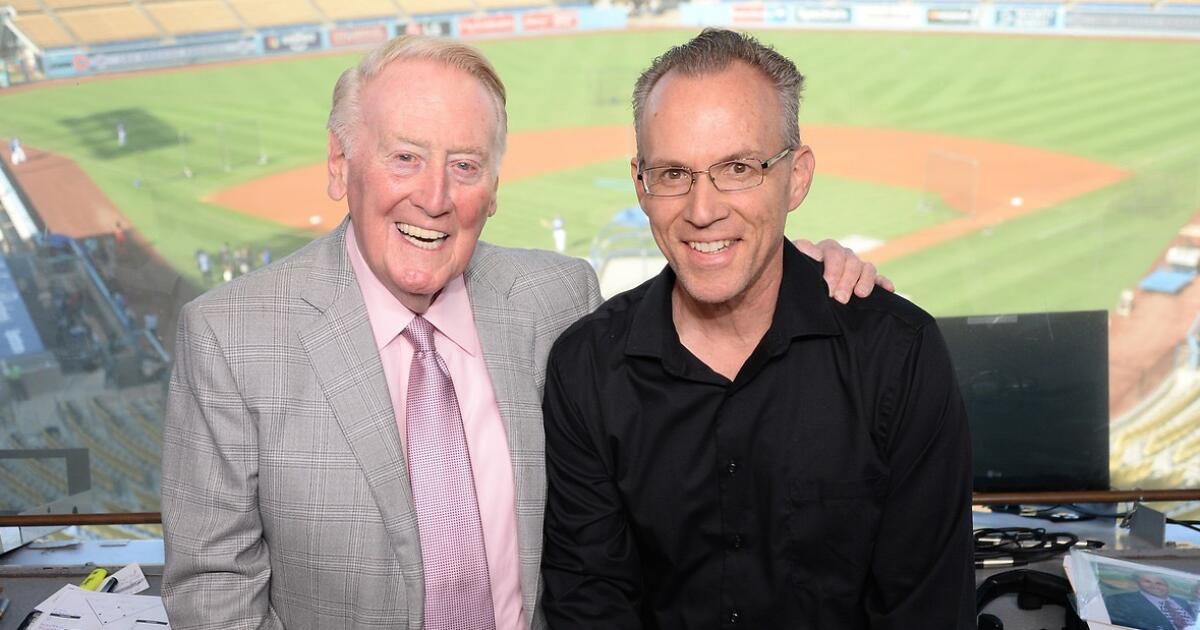
Dodgers historian Mark Langill was rushed to the hospital and had surgery to remove two brain tumors in late April after appearing unsteady at Dodger Stadium. He returned to work last week.
(Brian DeCloux / Spectrum SportsNet LA)
On May 7 he said, “Russell Martin’s first home run against the Milwaukee Brewers in 2006.”
Nearly two months later, Langill is out of the hospital and fighting to beat brain cancer with the staunchest of allies.
His sword is Dodger memories. His shield is Dodger highlights. He knows more about Dodger history than any living human, and that history is carrying him through the rocky ground where everything else is uncertain.
“All this obscure Dodger stuff stayed in my head,” said Langill, 59. “Whatever they cut out, they didn’t cut that.”
This reliance on Dodger landmarks actually began on April 25, the day he was rushed to the hospital after behaving unsteadily at Dodger Stadium.
As he lay in the speeding ambulance, all he could think about was, it was flag day!
“Who can forget that?” he said. “April 25, 1976, the most famous play in the history of Dodger Stadium was made by an opposing player, Rick Monday saving the American flag.”

Later that day, while being inserted into the MRI machine, he assured the technicians that he was being calmed by the memory of … Andy Etchebarren?
“The 1966 World Series, he played for the Baltimore Orioles, he was the last man to bat against Sandy Koufax, and…he won the starting job in the spring because Dick Brown had a brain tumor,” Langill explained. “I survived the MRI by playing baseball brain tumor trivia.”
And when he learned that his surgeon would be Dr. Celene Mulholland? He never again forgot that name because, of course, Terry Mulholland pitched for the Dodgers in 2001 and 2002.
Only Langill, it seems, would remember a celebrated neurosurgeon because of a pitcher who graced the Dodgers with a 1-1 record and 6.60 ERA.
“I can’t help it,” he said with a chuckle. “It’s who I am.”
It’s what he’s been for the last 30 years, a delightful human trove of information that constantly shares with players and fans alike. A former sports writer, Langill began working in the team’s publications department before spending the last 22 years as baseball’s first official team historian, a role which puts him at the forefront of the team’s powerful connection between its present and past.
“Mark can talk about something that happened in 1965 as easily as something that happened yesterday,” said Lon Rosen, Dodgers executive vice president and chief operating officer. “He brings great comfort to everyone because you can ask him anything and he always has the right answer.”
If a former player wants to relive glory days, he calls Langill, who derives joy from assisting Dodgers both famous and anonymous, from the day of their retirement until their death. He has provided memories and memorabilia for many memorial services and even served as an impromptu eulogizer at Willie Davis’ funeral.
“Mark has always been my number-one asset to continue to understand the greatness of the Dodgers,” said Orel Hershiser, former pitcher and current broadcaster. “He brings another level of expertise and passion with the details he remembers at a moment’s notice.”
If a fan wants to embrace a special memory, they are also directed to Langill, who loves to print out ancient remnants to remind folks of their happiest Dodger moments.
“He is everybody’s brother, father, cousin, a trusted family member who remembers everything and is happy to share this knowledge with everyone,” said Rosen.
In fact, in his last game at Dodger Stadium before falling ill, Langill hosted an 80-year-old woman whose first game was at Ebbets Field in 1954 when Don Newcombe was pitching.
Langill surprised her by printing out the box score from that actual game, handing it to her, then they both basked in her wonder at reliving her childhood.
“Suddenly she’s 10 years old again and sitting with her grandfather,” Langill recalled. “She said it was raining that day, and she talked about what it was like to be a 10-year-old at her first game and … to actually see her relive all that was priceless.”
A few days later Langill was spinning more great tales for new Dodger employees during a stadium tour when he became unsteady. He ended up at Huntington Hospital, where several days later Mulholland pitched a perfect game in removing two tumors the combined size of a lemon.
Before the surgery, Langill prepared himself by watching a laptop video of Game 2 of the 1974 World Series between the Dodgers and the Oakland Athletics.
“That’s the one game in that series that the Dodgers won, and it was won by my first favorite Dodgers team with my all-time favorite Dodger Jimmy Wynn,” Langill said. “I figured, if I’m going to go out, I’m going to go out my way.”
He also remembered that it was the World Series where manager Tom Lasorda wore two different cleats because he had two different shoe contracts.
“Those are the little stories that make Dodger history so special,” Langill said.
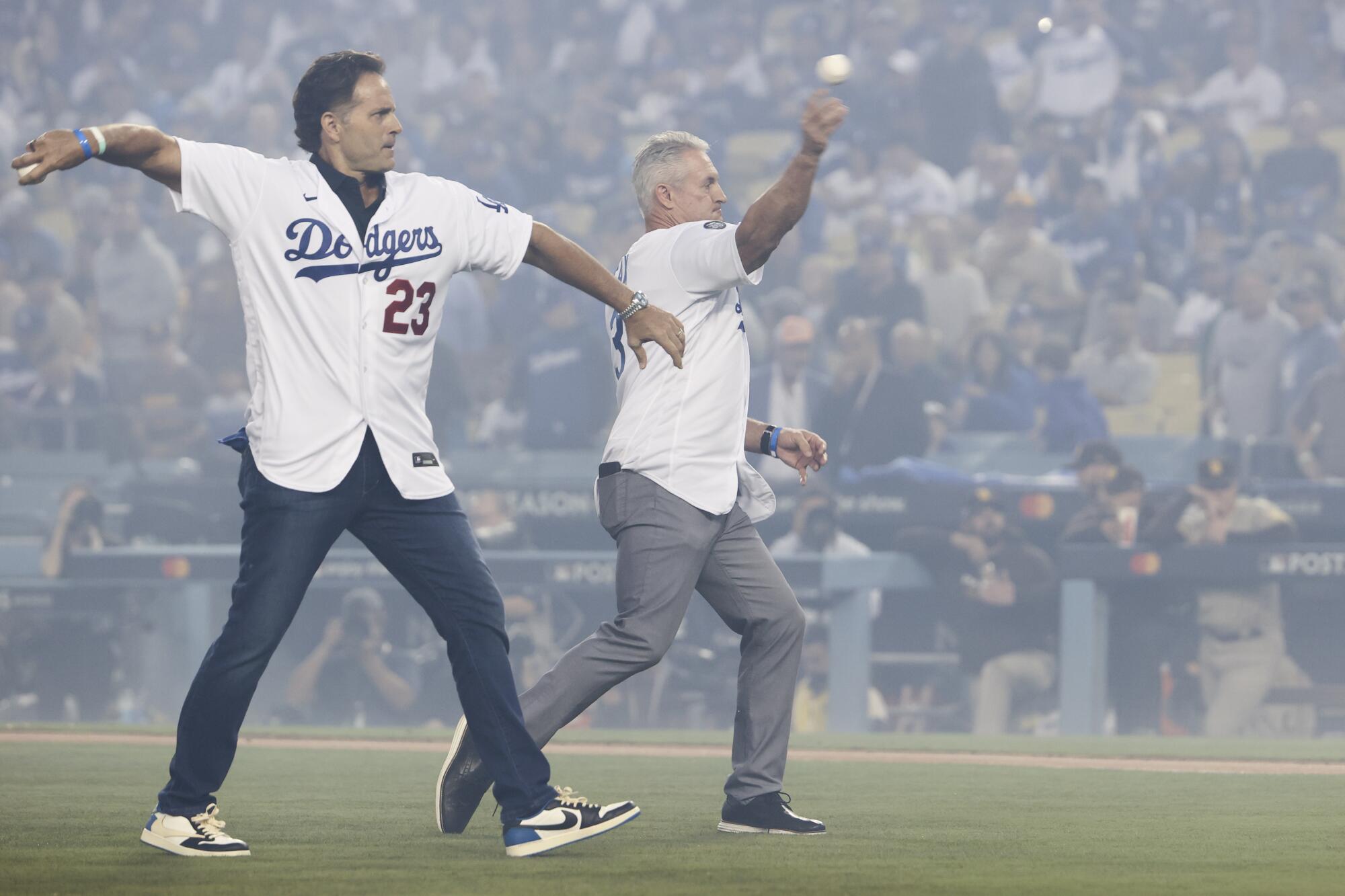
Eric Karros, left, with Steve Sax throwing out the ceremonial first pitch before Game 1 of the 2022 NLDS at Dodger Stadium, considers Mark Langill “the caretaker of Dodger history.”
(Robert Gauthier / Los Angeles Times)
As the surgery approached and it came time to seek peace, Langill kept thinking about Gary Cooper’s quote while portraying Lou Gehrig, “All the arguing in the world can’t change the decision of the umpire.”
He explained, “Some people in that situation rely on Scripture. I also rely on ‘Pride of the Yankees’.”
Throughout the ordeal, his recovery buoyed by his longtime partner, Patty Hirata, and registered nurse nephew Michael Rayala, Langill quickly bonded with various hospital workers through the Dodgers. He doesn’t remember much about the physical details of his stay, but he remembers discussing Shohei Ohtani with one orderly and then traveling back down memory lane with his first physical therapist.
“Mark has always been my No. 1 asset to continue to understand the greatness of the Dodgers.”
— Orel Hershiser
“He said his earliest Dodger memory was when he was 4 years old and his mom took him to LAX and I knew exactly what he was talking about,” Langill said. “Oct. 23, 1957, Red Patterson arranged for a pep rally to welcome the team to Los Angeles.”
During his rehabilitation, while initially struggling with everything but his Dodger knowledge, Langill was strengthened by the way it connected him with his uncomfortable surroundings.
“It’s like knowing 100 languages,” he said. “You can talk to anybody at any age if it involves the Dodgers.”
During his many years with the Dodgers, he had made many of those unique connections, his constant outreach making him arguably the franchise’s most important public representative.
There was the longtime Brooklyn Dodgers fan who was on his deathbed and wanted to hear one more Dodger story before he passed. His daughter handed the phone to Langill, who proceeded to take the man on an audio tour of all the Brooklyn Dodger memorabilia spread around the stadium.
“I told him, ‘We’re here for you,’” Langill recalled.
Then there is his annual reminder to Eric Karros every May 23.
“Happy Stan Belinda Day,” he will tell him because, on that day in 1992, Karros established himself as a future star by hitting a three-run walk-off homer against the Pirates’ Stan Belinda.
You can look it up. Langill’s memory of Dodger history is bulletproof.
“With him, we never need a fact checker,” said Rosen. “He’s right every time.”
“He’s basically become the caretaker of Dodger history,” said Karros of Langill. “Anything you want to know, he’s your guy.”
Then there was the story of Roy Gleason, a former outfielder who doubled in his only major-league plate appearance for the Dodgers in 1963. After that season Gleason was sent to Vietnam and never played major league baseball again, ending his career with that one at-bat, always wondering if anybody on the Dodgers remembered.
Langill remembered. Langill always remembers. And when he heard that Gleason was feeling disconnected from an organization that indeed had seemingly forgotten him, Langill invited Gleason to Dodger Stadium in the summer of 2003.
Once there, Langill accompanied Gleason to a wall that contains most of the names on the Dodgers’ all-time roster. In a scene that brought both men to the verge of tears, Gleason’s name was there.
“I was surprised that anyone in the organization even remembered my name,” said Gleason recently. “But Mark took the time to go into the Dodger archives and research my history.”
Later that season, Gleason threw out the first pitch and was surprised with a 1963 World Series ring.
“The best night of my life…a night I will never forget,” said Gleason. ‘And it all happened because of Mark Langill.”
This season Dodger history will have a new entry, a new landmark, a new hero, the date of June 17.
“That’s the anniversary of the first regular season ‘Freeway Series’ game between Dodgers and Angels,” Langill recalled. “Dodgers won on Todd Zeile’s walk-off home run against Troy Percival.”
Well, yes, but this is about something bigger.
June 17 should be forever known as the day Mark Langill not only recorded Dodger history, but made it.
It is the day he returned to work.

Sports
Pirates star pitcher makes unfortunate history after being taken out in middle of perfect game bid

NEWYou can now listen to Fox News articles!
Jared Jones was flirting with Major League Baseball history on Wednesday night — he got it, but it was not what he originally envisioned.
The Pittsburgh Pirates pitcher retired the first 18 batters he faced, but he was taken out in the middle of his perfect game bid after six innings.
Now, the Pirates certainly have their reasons — the 24-year-old Jones hasn’t thrown more than 81 pitches in eight starts since returning May 20 after missing all of last season while undergoing ulnar collateral ligament internal brace surgery on May 21, 2025. He was yanked with 77 pitches and likely would have needed more than 100 pitches to record the 25th perfect game in MLB history.
Jared Jones of the Pittsburgh Pirates pitches during the first inning against the Atlanta Braves at PNC Park on July 8, 2026, in Pittsburgh, Pennsylvania. (Photo by Joe Sargent/Getty Images)
However, Jones left the game after getting zero run support, so when the Atlanta Braves tacked on three runs late for a 3-0 victory, Jones instead found himself in the wrong chapter of the history books.
According to Opta Stats, Jones became the first pitcher in the modern era (since 1920) to pitch at least six perfect innings and not record a win.
“It does suck. Something’s cool coming on, but I’m on what? My eighth start off of surgery? I completely understand it, and it is what it is,” Jones told reporters after the game.
Pittsburgh Pirates starting pitcher Jared Jones (17) makes his way to the field to warm up before pitching against the Atlanta Braves at PNC Park. (Charles LeClaire/Imagn Images)
JUSTIN VERLANDER ANNOUNCES HE WILL RETIRE AFTER THIS SEASON: ‘I’VE REALIZED THAT TIME HAS COME’
Jones said he didn’t entertain attempting to complete the perfect game.
“Not with the pitch count,” he said. “Not really ever expecting to go nine right now, so that was never in my head.”
Joey Bart, traded to the Braves from the Pirates on June 18, followed a double by Mike Yastrzemski with a 422-foot, two-run homer to left-center field off a slider from Dennis Santana. Drake Baldwin added an RBI single to center in the ninth for good measure.
It was the second time in less than a week that a pitcher was taken out of the game with a perfect bid through six innings — the Miami Marlins took Eury Perez out after seven innings in which he had 92 pitches. Perez, too, is in the midst of returning from injury and has surprisingly found himself right in the postseason mix.
He was pulled for Lake Bachar to start the eighth, and the Marlins allowed eight runs to the Athletics in the final two innings, but held on to win 9-8.
Jared Jones (17) of the Pittsburgh Pirates delivers a pitch during a MLB game against the Cincinnati Reds on June 27, 2026, at PNC Park in Pittsburgh, Pennsylvania. (Joe Robbins/Icon Sportswire via Getty Images)
CLICK HERE TO DOWNLOAD THE FOX NEWS APP
The Pirates are 4.0 games out of the final wild card spot, which is held by the Marlins.
The Associated Press contributed to this report.
Follow Fox News Digital’s sports coverage on X, and subscribe to the Fox News Sports Huddle newsletter.
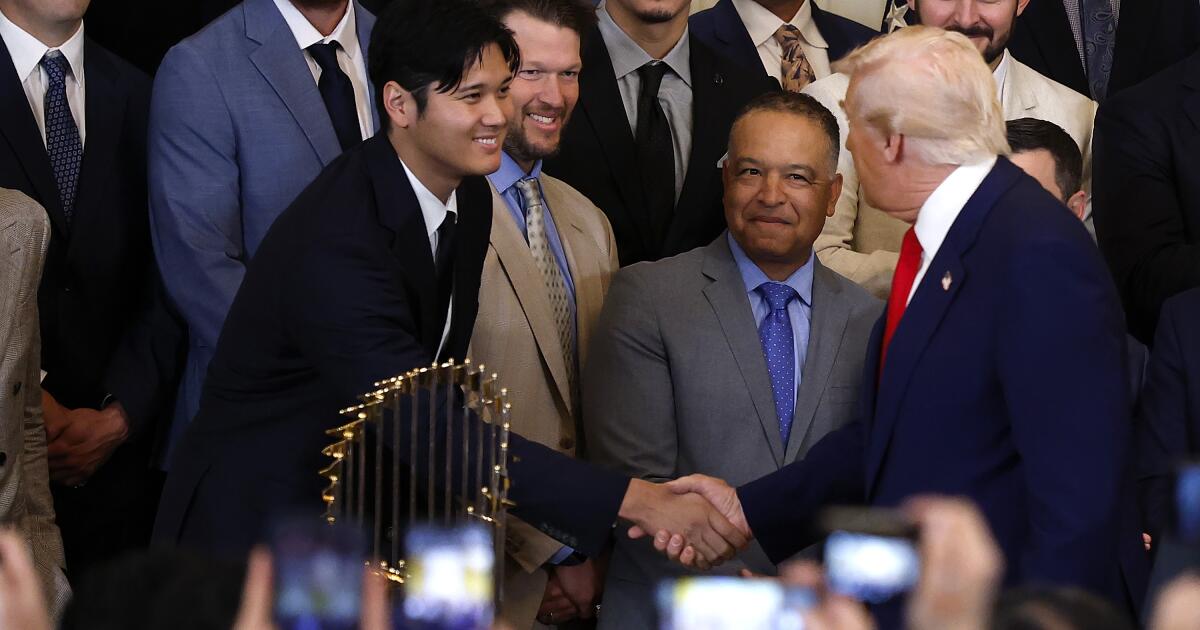
WASHINGTON — The Dodgers are scheduled to visit the White House on July 23 to celebrate their latest World Series title.
“President Trump is excited to welcome the Los Angeles Dodgers BACK to the White House to celebrate their World Series championship!,” White House spokesperson Taylor Rogers said in a statement to The Times.
The date falls on a scheduled off day in the middle of a nine-game East Coast road trip for the Dodgers. The team will play three games in Philadelphia against the Phillies July 20-22 before ending the trip with a three-game series against the New York Mets July 24 to 26.
The visit continues a tradition from the Dodgers’ two previous World Series championships. They were hosted by President Biden in 2021 and President Trump in April 2025.
After the Dodgers claimed their second consecutive World Series title with a dramatic Game 7 victory over the Toronto Blue Jays, a visit to the White House was planned, but it wasn’t until Thursday that a date was officially booked and confirmed.
Questions swirled around whether players would decline the visit this year after it did not happen during a scheduled visit to Washington in April.
Kiké Hernández said in 2018 he was unsure he would have gone had the Dodgers won the World Series the previous year. Mookie Betts said he was undecided and needed to talk it over with his family when last year’s visit was announced. After winning his first World Series with the Boston Red Sox in 2018, Betts skipped their trip to the White House the following year during Trump’s first term.
Both players, along with every returning member of the 2024 team who was with the team during its road trip, participated in the visit. The only notable absence was first baseman Freddie Freeman, who remained in Los Angeles to nurse an ankle injury.
Manager Dave Roberts, who indicated in comments to The Times in 2019 he might not go to the White House if Trump was president, also participated in last year’s ceremony.
Asked at the Dodgers’ fan festival in January about the possibility of returning to the White House, Roberts told The Times’ Bill Shaikin: “For me, I stand by: I’m a baseball manager. That’s my job.”
“I was raised — by a man who served our country for 30 years — to respect the highest office in our country,” Roberts said. “For me, it doesn’t matter who is in the office, I’m going to go to the White House. I’ve never tried to be political. … For me, I am going to continue to try to do what tradition says and not try to make political statements, because I am not a politician.”
Clayton Kershaw, who retired after last season but was on Team USA for this year’s World Baseball Classic, told The Times in the spring that he was aware Dodgers fans are split over whether the team should visit the White House again this year, but he said he is looking forward to it.
“I went when President Biden was in office. I’m going to go when President Trump is in office,” Kershaw said. “To me, it’s just about getting to go to the White House. You don’t get that opportunity every day, so I’m excited to go.”
Times deputy sports editor Ed Guzman contributed to this report.

NEWYou can now listen to Fox News articles!
All eyes were on Caitlin Clark on Wednesday night as she made her anticipated return from injury in a road matchup in Los Angeles.
But instead of a triumphant comeback, the Fever spent the entire night chasing the Sparks as Clark’s rough return fueled a 106-92 rout.
The superstar never found a groove, looking completely out of sync in her return from a back injury.
STEPHANIE WHITE GIVES CAITLIN CLARK STATUS UPDATE AHEAD OF FEVER-SPARKS, BUT HER NEXT MOVE RAISES QUESTIONS
Caitlin Clark huddles with teammates as the Indiana Fever battle the Sparks. (Photo by Katelyn Mulcahy/Getty Images) ((Photo by Katelyn Mulcahy/Getty Images))
Much of that disjointed performance falls squarely on head coach Stephanie White, who kept Clark on a ridiculously tight leash by limiting her to just 16 minutes. The stop-and-go approach could have sabotaged any chance for the phenom to establish a rhythm.
Clark finished with just 9 points, 4 rebounds and 3 assists. Her minus-16 plus-minus told the story.
The Los Angeles Sparks were severely shorthanded, taking the floor without stars Kelsey Plum and Cameron Brink.
MERCURY’S NOW-DELETED SOCIAL MEDIA POST MOCKING CAITLIN CLARK DRAWS SCRUTINY AFTER STAR’S INJURY
Yet while a depleted Sparks roster played to win, Indiana spent the night over-managing its biggest asset.
With Clark on a minutes restriction and Aliyah Boston out of the lineup, Kelsey Mitchell was forced to shoulder the entire offensive burden.
Mitchell did her part, pouring in 29 points while shooting 5-of-9 from beyond the arc.
Caitlin Clark orchestrates the Fever offense as Indiana battles the Los Angeles Sparks in primetime action. (Photo by Katelyn Mulcahy/Getty Images) ((Photo by Katelyn Mulcahy/Getty Images))
But one hot hand couldn’t stop an efficient LA squad.
The Sparks shot 45% from three-point range, going 9-of-20 from deep to cruise to the 106-92 victory.
White’s next move is to sit Clark against the Mercury on Thursday while Boston returns.
CLICK HERE TO DOWNLOAD THE FOX NEWS APP
After Wednesday’s loss to a shorthanded Sparks team, it’s fair to question whether Indiana’s cautious approach is working. The Fever dropped to 12-9.
Caitlin Clark and Dearica Hamby face off as Fever and Sparks battle at Crypto.com Arena in Los Angeles. (Photo by Tyler Ross/NBAE via Getty Images) ((Photo by Tyler Ross/NBAE via Getty Images))
Send us your thoughts: alejandro.avila@outkick.com / Follow along on X: @alejandroaveela
-

 Utah6 minutes ago
Man suspected in 2006 Utah murder left suicide note in Las Vegas jail cell: police
-
 Vermont9 minutes ago
OUTDOOR ACCESS FOR DISABLED IN VERMONT
-
 Virginia14 minutes ago
4 indicted in Virginia double homicide; second victim ID’d as grandmother of 6
-

 Washington21 minutes ago
Washington Commanders are retiring Hall of Famer John Riggins’ No. 44
-

 Wisconsin24 minutes ago
Wisconsin State Patrol rides with truck and bus drivers to spot violations in five areas
-

 West Virginia29 minutes ago
West Virginia town fires entire police force after chief resigns, sergeant alleges evidence room break-in
-

 Wyoming36 minutes ago
WHP: July 5 single-vehicle rollover north of Riverton resulted in one death, one injury
-

 Crypto39 minutes ago
British Airline Jet2 Shares Jump 9% After $536M Fuel Hedge Gain Offsets Middle East Travel Fears

