Sports
Parnelli Jones, hard-charging race driver who won the controversial Indianapolis 500 in 1963, has died

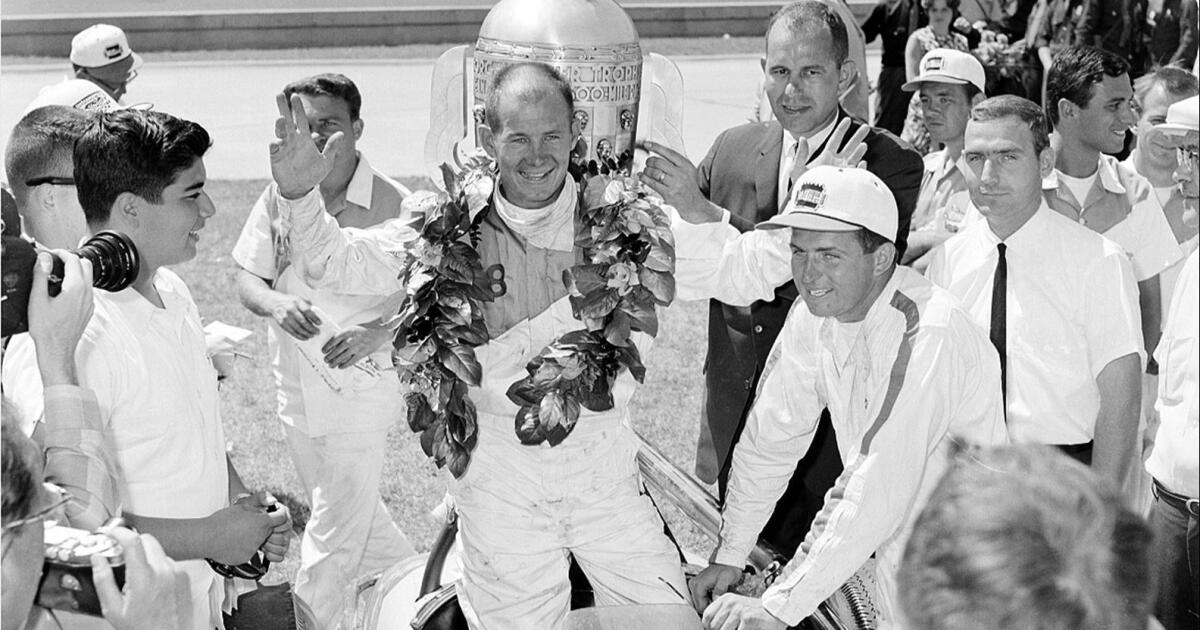
Parnelli Jones, a hard-bitten, hard-charging race driver who came out of Torrance and won the controversial Indianapolis 500 in 1963, then was the hard-luck loser four years later, died Tuesday at Torrance Memorial Medical Center after a battle with Parkinson’s disease. He was 90.
At the time of his death, Jones was the oldest living winner of the Indy 500. And although he won the race at Indy — then unquestionably the biggest motor sports event in the world — only once and ran in it only seven times, he stands as one of the dominant figures of his driving era, an era that also produced A.J. Foyt, Jim Clark, Dan Gurney and Richard Petty. Indeed, Jones raced against — and beat — all of them at some point in his career.
And a busy career it was, for Jones liked to drive anything that could be raced. He won in midget cars and sprint cars, Indy cars and stock cars, sports cars and, after deciding that the demands of track racing were getting in the way of his burgeoning business interests, off-road racers.
It was at Indianapolis, though, that Jones made his name and grew his fame.
Jones got there in 1961, driving for the late San Pedro promoter/character/businessman J.C. Agajanian. He qualified fifth, finished 12th and was named co-rookie of the year with Bobby Marshman. In a portent of things to come, Australian Jack Brabham finished ninth in a Cooper Climax, a modified version of the car he drove in European Formula One races. The Cooper’s engine was mounted behind the driver.
In 1962, Jones electrified the Indy crowds, becoming the first driver to break 150 mph and winning the pole with a qualifying speed of 150.137. He was running away with the race when his car’s brakes failed at about 300 miles, but he kept going, eventually finishing seventh.
By 1963, things had changed at Indy. Gurney, at the time a Formula One regular from Costa Mesa, had convinced English car builder Colin Chapman that a rear-engine car could win the 500 if only it had a stronger power plant than the one that had been in Brabham’s Cooper. Chapman persuaded Ford Motor Co. to fulfill his V-8 engine requirements and built the first of what were to become revolutionary Lotus-Fords, pencil-thin cars that looked like spiders capering through the turns. There was one for Gurney and another for Clark.
Against these stood the traditional Indy roadsters, long-snouted brutes in which drivers sat bolt-upright behind the engines, most of them the growling four-cylinder Offenhausers that had ruled the speedway since the end of World War II. They made the rear-engine cars look almost dainty and were driven by the traditional Indy regulars — Foyt, Jones, Jim Hurtubise, Rodger Ward and others.
The Lotus-Fords were the talk of the town but Jones, in his four-year-old No. 98, “Ol’ Calhoun,” dominated the monthlong speed derby, again sitting on the pole with a qualifying speed of 151.153 mph. He dominated the race too, leading for 167 of the 200 laps around the 2.5-mile Indianapolis Motor Speedway, and was comfortably ahead when the second-running Clark made his move with 30 laps left.
Clark cut Jones’ lead to 4 1/2 seconds and Jones’ car was exuding ominous puffs of black smoke, the result of a leaking oil reservoir. According to Jones, oil was spraying onto the engine and hot exhaust pipe, causing the smoke.
Some of that oil, though, was also going onto the track, creating a safety hazard.
Chapman scrambled to the officials’ stand, pleading with Chief Steward Harlan Fengler to put out a black flag for Jones, calling him to the pits. Agajanian, unmistakable in his trademark cowboy hat, urged Fengler to let Jones ride out the crisis.
Parnelli Jones smiles after he won the pole for the Yankee 300 stock car race at Indianapolis Raceway Park in April 1963.
(Associated Press)
While the argument raged, fourth-running Eddie Sachs spun, bringing out the yellow flag briefly, then spun again and crashed nine laps later. During the caution period that followed, Jones somehow gained two seconds back on Clark. And somehow, too, his oil problem stopped, the level in his car’s oil tank having fallen below the area of the leak. Jones set sail again and won easily as Clark backed off.
Said a crushed Clark, “I saw what Sachs did and I didn’t want to do the same thing. I’d skidded a bit myself.” He added, “I got beat by the yellow light. The yellow and the oil … I reduced my speed [during the caution period] and held my position. Other people went right on by, though, and Parnelli actually increased his lead.”
Jones maintained that he was simply trying to protect himself in a dangerous situation. “I saw an opening and I just gunned it and got out of there,” he said.
Even so, many considered Clark the rightful winner, arguing that the decision was simply the Indianapolis Establishment taking care of one of its own. Sachs, in fact, said on national TV that he’d spun in Jones’ oil and that Jones’ victory was “tainted.” The next day, at a gathering in a nearby motel, Jones asked Sachs to repeat what he’d said on TV. Sachs did, an argument ensued and Jones punched Sachs in the mouth, drawing blood.
By 1967, things had again changed at Indy. Jones had quietly retired from Indy car racing, Europeans Clark and Graham Hill had won the previous two races in rear-engine machines and nearly everyone else was driving them as well. But flamboyant car owner Andy Granatelli had another idea.
He came with a four-wheel-drive car that was as radical a departure as the old Brickyard had ever seen. For one thing, it made practically no noise. For another, the driver sat neither in front of nor behind the engine, but beside it. And the engine? It was a Pratt & Whitney turbine — basically a jet — similar to those used in many aircraft. The car, quickly dubbed “the Whooshmobile,” was born amid instant controversy. According to the rules, though, it was legal.
Granatelli talked Jones out of his brief retirement, but the car was like nothing Jones had ever driven. The gearbox was too fragile to handle the engine’s power and on qualifying day, after having gone through four of them in practice, the crew installed the last one on hand.
Jones eased to a qualifying spot, at 166.098 mph, on the outside of the second row, but on race day, there was no question where the speed lay. With a beefed-up gearbox, Jones quickly staked the turbine car to the lead when rain interrupted after 18 laps.
It was more of the same when the race was resumed the next day, and Jones was whooshing along with a 54-second lead, just short of a lap, with only four laps left.
Then, suddenly, a bearing in the gearbox failed, Jones dropped back and Foyt, threading his way through a multi-car accident on the final lap, scored the third of his four Indy victories.
And, although he would win twice more at Indy as a car owner — with Al Unser in 1970 and 71 — that was it for Jones as an Indy car driver.
Rufus Parnell Jones was born Aug. 12, 1933, in Texarkana, Ark., but lived most of his life in the Los Angeles area. As a successful driver-businessman, he resided in Rolling Hills on the Palos Verdes Peninsula.
And how did Rufus Parnell become Parnelli? According to one explanation, Parnelli was an aunt’s pet name for her young nephew. According to another, a boyhood friend teasingly called Jones Parnellie, after the girl’s name, Nellie. When an underage Jones wanted to go racing, and didn’t want his family to know about it, he dropped the “e” from Parnellie, put the name on a phony ID card and became famous as Parnelli Jones.
“Parnelli will forever be one of the best we have ever seen behind the wheel,” said Dave Allen, president of the West Region of NASCAR and the Auto Club Speedway. “It didn’t matter what he drove, he was fast! He will be missed as a friend and a true legend. My thoughts and well wishes go out to the Jones family and all the people Rufus impacted in his amazing life. Stay on the gas my friend.”
Had Jones not chosen Indy cars, he might well have become famous in stock cars. In 1963 and ’64, he was the terror of the U.S. Auto Club’s stock car division, then on a par with a fledgling NASCAR. He won seven consecutive races in that span at the Milwaukee Mile, then USAC stock car’s main track with four races a season. He ran sparingly in NASCAR’s premier Grand National division — now the NASCAR Cup Series — but still won four times.
After his retirement from Indy car racing, Jones turned to the Sports Car Club of America’s Trans-Am sedan series, won a championship there to go with his previous USAC midget, sprint car and stock car titles, and formed, with the late Vel Miletich, his longtime business partner, an Indy car team. With Andretti, Unser and Joe Leonard driving, it quickly became known as “Superteam,” dominating Indy car racing for several seasons. In off-road racing, he was a multiple winner of the Baja 1000.
His real estate and car-related businesses flourished, but not everything he touched turned to gold. When the Ontario Motor Speedway, built as “the Indianapolis Speedway of the West,” fell on hard times, he and Miletich tried to save it but couldn’t. And a Formula One team he set up for Andretti went under when Jones couldn’t attract sponsors.
A member of various racing halls of fame, Jones once said, “Indy is the World Series of auto racing. In the seven years I drove, I had a good chance at winning five times. I had some God-given talent, a will to win and a can’t-stand-to-lose attitude. Race car driving is dangerous, but you can’t be afraid. You have to rely on your own ability.”
Jones is survived by his wife, Judy, and sons PJ and Page, both of whom followed him into racing.

Sports
Thekla embarrasses Stardom’s Starlight Kid after retaining AEW World Women’s Championship at Forbidden Door

NEWYou can now listen to Fox News articles!
Thekla has had every reason to talk as much trash as she’s done.
She made her debut in All Elite Wrestling (AEW) last year and quickly moved up the ladder to win the AEW Women’s World Championship in a strap match against Kris Statlander in February. She’s continued to hold the title even when three opponents were thrown her way at Double or Nothing.
COMPLETE PRO WRESTLING COVERAGE ON FOX NEWS DIGITAL
Thekla enters the ring during the women’s pro-wrestling event “Stardom” at Korakuen Hall in Tokyo, Japan, on Jan. 13, 2025. (Etsuo Hara/Getty Images)
Thekla declared war on Stardom and New Japan Pro-Wrestling (NJPW) in the buildup to Forbidden Door. She demanded that Stardom send its best to challenge her at Forbidden Door, and they obliged. Starlight Kid stepped up against the “Toxic Spider” and the two put on a great match in front of the pro wrestling audience at the SAP Center in San Jose, California.
Thekla taunted Starlight Kid throughout the match and it appeared she got more than she bargained for at points during the match.
Starlight Kid wouldn’t stay down and gave every effort to bring the AEW Women’s World Championship back to Japan with her. Starlight Kid worked on Thekla’s knee toward the end of the match. But the champion would not quit.
Starlight Kid enters the ring during the Women’s Pro-Wrestling “Stardom” 15th Anniversary at Edion Arena Osaka in Osaka, Japan, on Feb. 7, 2026. (Etsuo Hara/Getty Images)
Thekla got out of the submission hold and avoided being pinned by mere seconds. Thekla was put to the test more than any other opponent she’s faced since becoming the champion.
The “Toxic Spider” hit two stomps and finally put away Starlight Kid to retain the title.
With Stardom president Taro Okada in attendance, Thekla continued her assault against Starlight Kid. Skye Blue and Julia Hart came out to support Thekla. Hart handed Thekla a pair of scissors and the champion ripped the mask off Starlight Kid’s head and spit in it.
Thekla taunted Okada with the mask and hit the wrestling executive with it.
Thekla enters the ring during the women’s pro-wrestling event Stardom at Yokohama Budokan in Yokohama, Kanagawa, Japan, on March 8, 2025. (Etsuo Hara/Getty Images)
CLICK HERE TO DOWNLOAD THE FOX NEWS APP
Thekla stayed the champion and added a trophy to her mantel.
Remember when we were sure the World Cup would suffer from all the issues that had everyone seeing red before the first ball was kicked?
And remember when we were certain soccer could never catch on in this country?
Despite controversies over visas and ticket prices and transportation, and in spite of consternation over expansion and new rules, the game has, as usual, proved too good to fail.
And we, the American people, have become unusually engrossed in it.
We’ve been tuning in on TV in record numbers and, even at exorbitant prices, helping to sell out our 70,000-some-capacity stadiums. Before group play was even finished, this tournament — staged also in Mexico and Canada — already outdrew the 1994 World Cup, which was hosted by the United States and set an attendance record of nearly 3.6 million.
We’ve been loving the healthy cultural exchange, and we’re being reminded that cultural barriers of traditional sports fandom can be breached.
So now, to keep our interest from drying out like a pitch on a hot summer day, the goal should be to keep the market saturated with soccer. That will take Major League Soccer tearing down all the walls.
It’s already turned the page on its calendar, adopting a summer-to-spring season format that will better blend with the global game.
Now MLS needs to make its games easier to watch, and to do its part to make the sport easier to play.
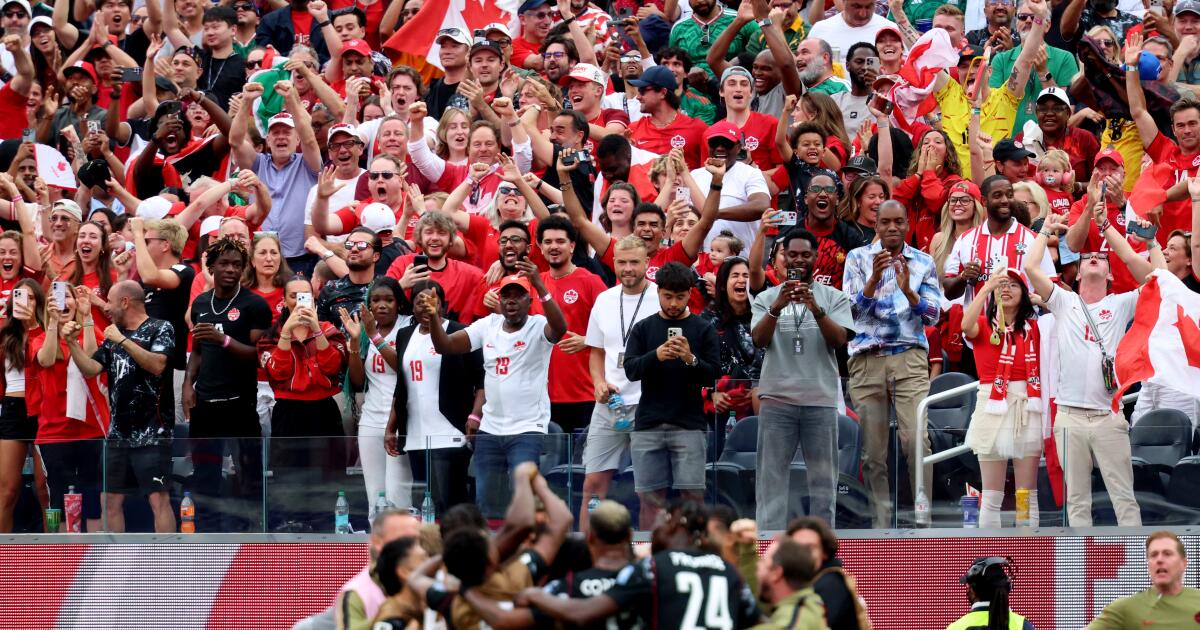
Canada goalkeeper Maxime Crépeau, left, celebrates with teammate Jonathan David after a 1-0 win over South Africa at the World Cup on Sunday.
(Kelvin Kuo / Los Angeles Times)
While the proverbial iron is hot, it needs a strike like Stephen Eustáquio’s winning rocket in the 92nd minute of Canada’s 1-0 victory against South Africa on Sunday at SoFi Stadium.
Eleven players on the two teams were MLS representatives — including Eustáquio, who spent the last six months in LAFC’s midfield.
Goalkeeper Maxime Crépeau, who played two seasons with LAFC and now plays for Orlando City, stopped the only shot he saw for his second clean sheet this World Cup, which saw the Canadians succeed in their first knockout stage appearance.
There’s been no avoiding MLS players in this World Cup. The greatest of them is piling up goals for Argentina: Lionel Messi, the Inter Miami superstar, is now the all-time World Cup goal-scorer (with 19).
MLS has set an attendance record too, with 45 players participating. It ranks as the league with the second-most players apart from the top five European leagues. LAFC had three current players in the mix.
But wait. Record skip. Before you celebrate the MLS’s contributions to this soccer spectacle, check with the VAR. Yep, without the 13 MLS players representing nations that rank 40th or lower in FIFA’s world ranking, there actually would be fewer than the 37 MLS participants at the World Cup four years ago.
A baby’s first steps are for celebrating, but three decades after the league’s formation, MLS is still searching for a giant leap. It’s still having a mean time of trying to make “fetch” happen for real.

It would help to make its games more readily available — not to the already converted, but to fans who didn’t even know what they didn’t know about soccer until the World Cup began in their backyards.
MLS has already brought MLS from behind Apple’s season pass paywall. And the league and streaming service also reportedly have agreed to a revised media rights deal that will end at the end of the 2028-29 season, three and a half years earlier than expected.
But the hat trick would be to remove the need to subscribe to streaming service to watch MLS games altogether, and then get those matches onto the networks people know to tune into for their sports.
Normalize watching American soccer.
And stop gatekeeping. MLS’s developmental programs are too restrictive and exclusive — they’re not developing more soccer players, they’re curtailing who can play.
It’s in the league’s interests, and the sport’s in this country, to encourage as many players to play as much as they can — including for their high school teams, which MLS Next bars.
They’ve got people in the tent; the goal should be to make them want to stay.
To make them want to join the world’s circus, not to let it pack up and move on, out of sight and out of mind, until it swings back through years from now.

NEWYou can now listen to Fox News articles!
Golf humbles many, including those who are the best in the world.
Just ask J.T. Poston at the Travelers Championship on Sunday.
What started out as a chance to put a low score on the card at the 13th hole after getting greenside in two shots, Poston, the world No. 32 in the Official World Golf Ranking, posted a 12 in an absolute meltdown that derailed his entire day.
J.T. Poston plays a shot from the first tee during the first round of the Travelers Championship at TPC River Highlands in Cromwell, Conn., on June 25, 2026. (Jordan Bank/Getty Images)
While Poston may not have been in contention, he wasn’t picturing himself at the bottom of the leaderboard by the end of the tournament, but the 12 was the main reason behind finishing 6-over and 1-over on the tournament for 69th place out of the remaining 72 that made the cut.
So, what exactly happened to Poston?
MICROPHONE ENDURES GOLFER SHANE LOWRY’S WRATH DURING MELTDOWN AT US OPEN
Well, the 13th hole began with a perfect tee shot that found the middle of the fairway. Then, his second shot found a greenside bunker, but professionals sometimes don’t mind finding those bunkers because of how great their short game is. A good bunker shot and Poston has a chance at birdie on the par-5.
But things went awry from there, as the bunker shot came out quite short, leaving him with a chipping situation. Again, professionals understand that’s not the end of the world, with a chance at par after a solid chip.
The nightmare was just beginning for Poston, though, as his fourth shot went clear across the green and ended up in the water on the other side.
From there, Poston had to drop not once, but three separate times because he couldn’t get his ball back on the green. On his 10th stroke, he finally got the ball into a putting position.
J.T. Poston stands on the first tee box during the second round of the Travelers Championship at TPC River Highlands in Cromwell, Conn., on June 26, 2026. (Ben Jared/PGA Tour)
Poston still had to keep going, putting his 11th stroke and missing it before a tap-in 12 and ending the meltdown in front of the fans.
Poston spoke about the multiple drop balls near the water that continued to roll back into the drink.
“It’s not really rough, where you can kind of blast it out,” Poston said, per Golfweek. “It’s into the grain, but it looks like you can get enough golf ball on it, which is why I kept trying to hit a good chip.”
Poston was asked if he even thought about putting it out of the greenside rough with his chips clearly not working out.
“I feel like it’s just going to hop and that takes all the speed out of it,” he responded. “And you’ve got this big false front you got to get it over. So my worry with trying to putt it was it would not have enough speed to really get there.”
J.T. Poston plays a tee shot on the first hole during the second round of the Travelers Championship at TPC River Highlands in Cromwell, Conn., on June 26, 2026. (Ben Jared/PGA Tour)
CLICK HERE TO DOWNLOAD THE FOX NEWS APP
Poston didn’t bounce back on the 14th hole either, as he posted a double bogey on the par-4 to put himself down even more. In the end, Poston posted a 76 on the day to finish off his tournament.
Meanwhile, the Travelers Championship will come down to a playoff that must be played on Monday after Viktor Hovland and Scottie Scheffler found themselves deadlocked at 21-under after the latter sank a putt to force it. Hovland’s putt to win it all just missed and Scheffler took advantage of the open opportunity.
Follow Fox News Digital’s sports coverage on X and subscribe to the Fox News Sports Huddle newsletter.
-

 Fitness1 minute ago
Business News: Stock and Share Market News, Economy and Finance News, Sensex, Nifty, Global Market, NSE, BSE Live IPO News – Moneycontrol.com
-

 Movie Reviews13 minutes ago
Movie Review: ‘Supergirl’ – Catholic Review
-

 World21 minutes ago
Clockenflap’s Justin Sweeting and Woozi Studio’s Mia Min Yen on Asia’s Live Music Boom at Golden Melody Festival: ‘No Longer Is a Fan Just Buying a Ticket, But Investing in a Memory’
-
 Lifestyle1 hour ago
3 World Cup rivals find ‘Common Ground’ in a cross-border beer
-

 Technology1 hour ago
The Flipper Zero creators’ Busy Bar productivity display will go on sale next month
-

 World1 hour ago
Families watch in horror as skydiving plane crashes in France, killing all 11 aboard
-

 Politics1 hour ago
DOJ launches grand jury probe into Marxist mogul Neville Roy Singham’s funding of leftist groups
-

 Health1 hour ago
America’s lifespan has doubled since 1776 — experts reveal what changed

