Sports
Lionel Messi and Argentina rejoice in their greatest national team of all time


Follow live coverage of Uruguay vs Colombia in the Copa America 2024 semifinal today
Lionel Messi was all smiles. Argentina had just seen off Canada to force passage into another major final, their team’s relentless form of the past five years maintained and conviction bolstered that they will retain the Copa America title won four years ago.
“This is so beautiful, and it’s something we should value,” Messi said. “I’ve been saying that to play in another final, to play in four straight finals… what this group of players is doing is something to be proud of. We should value it and recognize it.”
There is little doubt now that this group of players — led by Messi, their venerable captain — are the best Argentina team of all time.
The Copa’s defending champions have lost just twice in 61 matches, a sequence stretching back half a decade. In that time they have won the 2021 Copa America, the 2022 World Cup and the inaugural Finalissima against European champions Italy in 2023. Beating Canada 2-0 on Tuesday night at MetLife Stadium in New Jersey, already confirmed as the venue for the 2026 World Cup final, leaves Argentina 90 minutes away from another major tournament trophy.
MetLife Stadium witnesses Argentina’s greatest-ever team (Stephen Nadler/ISI Photos/Getty Images)
Messi has now led his national team to seven finals. But before lifting the Copa America trophy in 2021, he had only suffered crushing defeats on the grandest stages, which clouded his legacy with Argentina.
The 2014 team that lost to Germany in a World Cup final that went to extra time featured many of the same players who then lost the 2015 and 2016 Copa America finals. In recent years, Messi has made an effort to honor the teams and players deemed losers by Argentina’s fanatical footballing culture. Today, Argentina’s players are national heroes who have shown an unrelenting hunger to win.
The stadiums in which they have played in the United States over the three weeks of this tournament so far have been filled to the brim with fans clad in blue and white. Back in Buenos Aires, the country is eager to celebrate another title. There is a belief that this team have fortune on their side, unlike those sides who faltered in their biggest moments before 2021.
“We’ve done this before and it wasn’t valued, maybe because we weren’t lucky enough to win,” said Messi. “Those teams also played in Copa America and World Cup finals. But now we need to enjoy this moment.

Messi was all smiles in New Jersey on Tuesday night (Elsa/Getty Images)
“The people (of Argentina) deserve to stick their chests out and enjoy this Argentina national team and all its accomplishments. We’re in another final and we’re still competing.”
Messi scored Argentina’s second goal against Canada, taking his tally at international level to 109 — the second-most of all time behind Cristiano Ronaldo’s 130 for Portugal. It was actually his first goal of the tournament, a reflection that this has been a nondescript Copa America for Argentina’s talisman.

GO DEEPER
Could Messi catch Ronaldo at top of international scoring charts?
An adductor (groin) injury suffered in Argentina’s second game of the group stage forced him to miss one match. Argentina, though, carried on without him, easily winning their group. That is what makes this Argentina team special. They are deep in nearly every position.
A player such as Julian Alvarez can be swapped with Serie A’s leading goalscorer Lautaro Martinez if necessary. The back line is as stout as any group of defenders in the world, led by Tottenham’s Cristian Romero. They have full-backs with different profiles; Nahuel Molina and Marcos Acuna are sure-footed defenders, while Gonzalo Montiel and Nicolas Tagliafico are man-marking bulldogs.
Argentina’s midfield is the strength of the team. Rodrigo De Paul, in tears after the final whistle due to the physical sacrifice the Canada match required, plays alongside two Premier League No 8s in Alexis Mac Allister and Enzo Fernandez. Both players attack and defend persistently, which allows Messi and Angel Di Maria to pick their moments to press and focus on chance creation.

Di Maria will retire after this tournament (Pablo Morano/BSR Agency/Getty Images)
Since head coach Lionel Scaloni took over in 2019, Argentina has been defined by their depth and tactical flexibility, while maintaining an identity centered on dominating possession and controlling matches from beginning to end. Di Maria has said publicly that he will retire from international football after this Copa America. The 36-year-old will now have a unique opportunity to walk away after winning yet another trophy.
“I don’t think I’d be able to have dreamt this,” Di Maria said. “I’m so grateful to this generation of players, because it’s thanks to them I’ve been able to accomplish all of this. It’s thanks to them that my last game with the national team will be a final.
“There have been some bad times — sometimes you have to get walked over. But this is how it had to end. With me lifting the (World Cup) trophy and playing in another final with this shirt.”
Messi, who turned 37 last month, referred to this moment in his career, and that of Di Maria and veteran defender Nicolas Otamendi, also 36, as “our last battles”. On Tuesday, he stressed that the road to continued success has been difficult. Argentina is not a team that routs its opponents. Every match is filled with tension and anxiety, followed by a celebratory roar when Argentina’s goals find the opponents’ net.
At the other end of the field, Argentina has a goalkeeper who has become nearly impossible to beat. Aston Villa’s Emiliano Martinez gives the current world champions an edge that makes them easy to dislike. Villainy in sport is a sign of success. But as he grinned widely in the bowels of the MetLife Stadium post-match, Martinez seemed in awe of his team’s ascendancy.
“I can’t believe it, I can’t believe this,” he said. “You have to believe but keep your feet on the ground, with the mentality that all of this is possible.”
Asked if he felt Argentina was the tournament’s best team, Martinez shook his head humbly. “There are a lot of good teams,” said Martinez. “Look at Brazil (out in the quarterfinals). The pitches (being used for this Copa) are f***ed and any team can challenge you. Uruguay looks really good and Colombia hasn’t lost in almost 30 games. (Those two sides meet in the second semifinal on Wednesday night). It’s going to be tough.”
GO DEEPER
Emiliano Martinez: Hated by opponents, loved by Argentina, endlessly entertaining
Scaloni himself has teetered on the edge of despair even as Argentina continued to win. He nearly walked away from the national team last November, after a historic World Cup qualifying win over Brazil in Rio de Janeiro. “I need to stop the ball and start thinking — I have a lot of things to think about during this time,” Scaloni said then.
After last night’s win over Canada, Scaloni looked like a coach who had regained his purpose. He was visibly elated. “We’re coming from a lot of success and that makes everything more difficult — it costs so much more,” he said. Scaloni deflected all questions about Argentina’s impressive run of three consecutive finals wins. “We’re focused on winning this final.”

Scaloni has been re-energised (Stephen Nadler/ISI Photos/Getty Images)
Scaloni told reporters that Messi’s future will be determined by the player. He and his staff will never close the door on the veteran. In fact, Scaloni stressed Messi can remain a part of the national team for as long as he wishes. “I’ll take him with me if I go somewhere else,” Scaloni said. “He’d be a great help to me, but it’ll be up to him.”
A few steps away, surrounded by hordes of reporters from around the world, Messi continued to enjoy the limelight.
It must be incredibly hard for him to consider walking away from this. He adores this group of players and they, in turn, idolize him. A win in the Copa America final on Sunday (early Monday UK time) in Miami, where he now plays his club football with Inter Miami of MLS, could be the catalyst that prolongs Messi’s international career through to the 2026 World Cup, co-hosted by the United States, Canada and Mexico. Alternatively, a fourth straight trophy might prompt him to hang up his boots as a hero.
For now, Messi is as happy as he has ever been, and so is the country of Argentina.
“Argentines are crazy about this national team and crazy about football,” Messi added. “This group (of players) has been fostering that relationship for a long time now. We’ve won important things and these players continue to compete game after game. We don’t always play well, but our willingness to compete is spectacular.
“Let’s enjoy this moment, but also appreciate what began eight years ago.”
GO DEEPER
Argentina 2-0 Canada takeaways: Messi scores, Argentina heads to Copa America final
(Top photo: Sarah Stier/Getty Images)



NEWYou can now listen to Fox News articles!
Toronto Maple Leafs No. 1 draft pick Gavin McKenna has already been on the ice with the team as it held its development camp this week, but the highly-touted rookie is going to have to make a big change for this fall.
His number.
When he was playing for the Western Hockey League’s Medicine Hat Tigers and then again at Penn State this past season, McKenna wore the No. 72.
THE TALLEST PLAYER EVER SELECTED IN THE NHL BLEW MINDS IN HIS DEBUT WITH THE SAN JOSE SHARKS
Toronto Maple Leafs top pick Gavin McKenna has revealed that he’ll be opting for a new number for his rookie campaign. (Photo by Brian Babineau/NHLI via Getty Images)
The expectation was that McKenna would wear No. 72 with the Maple Leafs, and he did so this week at development camp. Plenty of fans have also already ordered No. 72 jerseys with his name on the back.
On most rosters, No. 72 is unique enough that he wouldn’t run into any issues wearing it. However, on July 1, the Leafs signed two-time Stanley Cup champion goaltender Sergei Bobrovsky, who has worn No. 72 for most of his career, except during his first two seasons with the Philadelphia Flyers, when he wore No. 35.
So, some were wondering how this would work out. Would the Leafs want their new franchise player to get his pick of the number litter, or would they defer to a two-time Vezina winner?
FLYERS MAKE STUNNING OFFER SHEET FOR DUCKS STAR LEO CARLSSON IN BLOCKBUSTER NHL MOVE
Gavin McKenna wore No. 72 in juniors, as well as last season at Penn State. (Photo by Richard T Gagnon/Getty Images)
Well, it turns out that McKenna will be the one swapping numbers, and he’ll be switching to No. 92 this season.
McKenna had to get creative here because the obvious number changes were a no-go in Toronto. Adding 7 and 2 would be 9, but that was retired in honor of Charlie Conacher and Ted Kennedy.
Another option would’ve been to flip the digits and go with No. 27, but that was retired in honor of Frank Mahovlich and Darryl Sittler.
ALEX OVECHKIN SIGNS A ONE-YEAR DEAL TO RETURN FOR ANOTHER NHL SEASON WITH THE CAPITALS
So, 92 it is.
However, McKenna reached out to one of the three previous players to wear the number, Jeff O’Neill, to ask whether he was comfortable with him using it.
It’s fair to say he was down with the idea.
CLICK HERE TO DOWNLOAD THE FOX NEWS APP
McKenna will be a key piece of a Maple Leafs team that is looking to bounce back after a nightmare 2025-26 campaign that saw them finish last in the Atlantic Division.
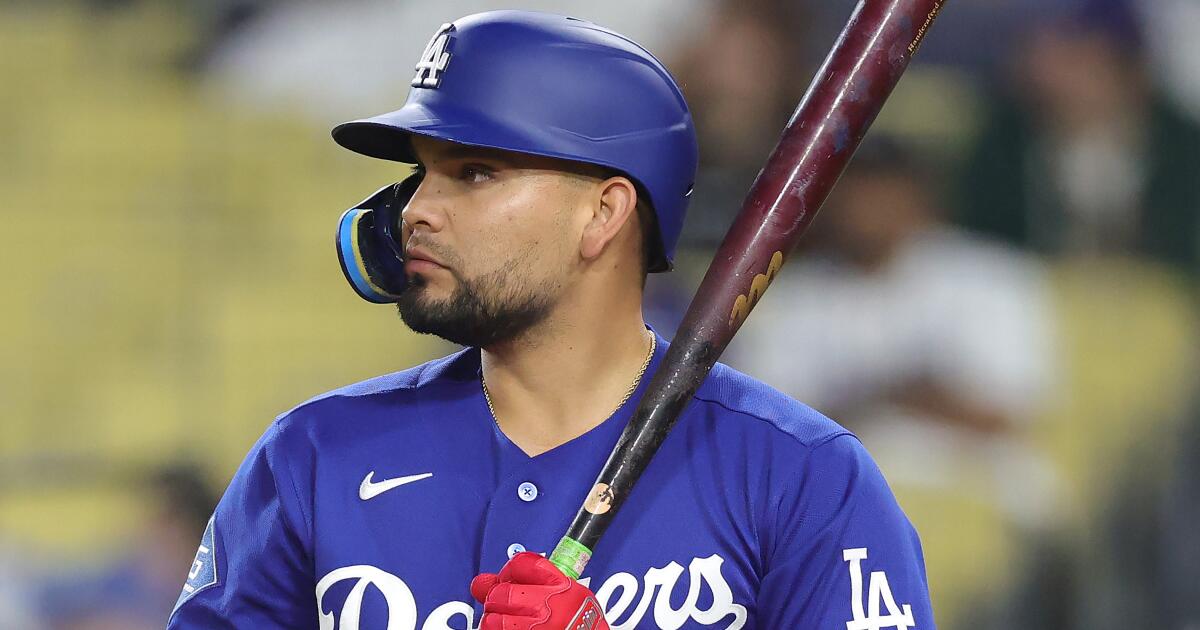
It’ll be the culmination of nine minor-league seasons. But Eliezer Alfonzo‘s major-league debut on Sunday won’t include his family watching from Dodger Stadium.
Alfonzo’s younger sister, Eliana, and stepmother, Patricia, have been missing since last month when earthquakes caused widespread devastation in his home country of Venezuela.
“I’ve been trying to support my dad a lot, every day talking to him, trying to be with him,” Alfonzo said of the elder Eliezer Alfonzo, a retired major-league catcher. “It’s a little tough from here because I would like to be there with him, supporting him every day.”
His father, of course, would love to be in attendance for his son’s debut. He told him as much when he heard the Dodgers were calling him up.
The Dodgers switched their backup catchers Saturday, optioning Chuckie Robinson. They saw an opportunity to give Alfonzo some runway behind Dalton Rushing, with starting catcher Will Smith’s stay on the injured list expected to extend through the All-Star break.
The elder Eliezer Alfonzo, however, is doing whatever he can to locate his wife and daughter. Their dog was found alive, which gave the younger Eliezer Alfonzo hope.
“We’ve just gotta stay together as a family, as a country,” Alfonzo said. “Because I feel like we’re a beautiful country, we’re a really beautiful people over there. It’s not just about my family, it’s all families that have lost people already. But we’ve got hope. We just pray, we ask God to give them back to us alive.”
Alfonzo’s locker in the clubhouse is next to countryman Miguel Rojas’ stall. Rojas’ wife, Mariana, and their two children were in Venezuela, planning to renew Mariana’s passport and seek Venezuelan citizenship for their children, when the earthquakes hit. They managed to stay safe and have returned to the U.S.
“I just want to be here for him,” Rojas said. “At the end of the day, that’s the best thing I can do for him, is being a good teammate and being a friend for him. Because I know there’s going to be ups and downs. He’s going to have a lot of time to be caught [up] in baseball, and that’s going to probably take his mind away from stuff. But sometimes he’s probably going to feel weak, and he’s going to start thinking about his family. So I’m going to be here, I’m right next to him. And that’s what I told him.”
Rojas, who played against the elder Eliezer Alfonzo for years in Venezuela, reached out Saturday morning and promised him he’d save the ball from his son’s first major-league hit.
Sports
Kylian Mbappé’s seventh goal of the World Cup lifts France past Paraguay in physical Round of 16 match

NEWYou can now listen to Fox News articles!
The United States may not have been in action on Independence Day, but France — who fittingly played an important role in the Revolutionary War — was on the pitch in Philadelphia against Paraguay in a massive Round of 16 clash for a trip to the quarterfinals.
It was a hot day in the birthplace of our nation, and that made things difficult for both teams in more ways than one.
While Paraguay is a great squad, they were significant underdogs against a heavily favored French team led by superstar Kylian Mbappé, who has been lighting it up this tournament.
THIS ‘AMERICA THE BEAUTIFUL’ RENDITION BEFORE THE FRANCE VS PARAGUAY MATCH WILL GIVE YOU GOOSEBUMPS
French and Paraguayan players get into a shoving match during their Round of 16 match on Saturday in Philadelphia. (Kyle Ross-Imagn Images)
Obviously, the heat itself is a factor, but it also made for a slower pitch, something that was believed to play into the hands of Paraguay.
However, most of the action in the first half was played on their end as France put the pressure on through the first half hour of the match.
It was intense, and that intensity boiled over in the 35th minute with some pushing and shoving after Mbappé and Paraguay’s Andrés Cubas started a wild shoving match.
VAR DENIES CROATIA’S GAME-TYING GOAL AS CRISTIANO RONALDO LEADS PORTUGAL TO ROUND OF 16
But while the intensity ramped up — and stayed high for pretty much the entire game — Paraguay weathered the storm and had every reason to feel good about reaching halftime with the game scoreless.
France got some more scoring opportunities in the early part of the second half, including a near-breakaway for Mbappé.
France’s Kylian Mbappe scored the go-ahead and ultimately game-winning goal against Paraguay on a penalty kick. (James Lang-Imagn Images)
In the 67th minute, France was awarded a penalty kick for a foul against Desire Doue that had to go to VAR for review, and it was Mbappé who took it.
MESSI, ARGENTINA AVOID A SHOCKING UPSET IN WILD KNOCKOUT STAGE MATCH AGAINST CAPE VERDE
Mbappé has tended to do most of his damage in the second half, and that trend continued here with him drilling the penalty past Paraguay goaltender Orlando Gill.
That was his 19th career World Cup goal, and his seventh of this tournament alone, tying him with Argentina’s Lionel Messi for the tournament lead.
Paraguay seemed to fade after the Mbappé goal, but turned it on again late, forcing Mike Maignan to make his first save of the day about 89 and a half minutes into the match.
CLICK HERE TO DOWNLOAD THE FOX NEWS APP
It seemed like Paraguay’s plan was to try and get a rise out of the French, and they succeeded in drawing three yellow cards. In fact, they even tried to keep that going after the match with players meeting near midfield for some more pushing and shoving.
But France is moving on, and they will take on Morocco in a quarterfinal match on Thursday in Boston.
-

 Mississippi4 minutes ago
Oldest Mississippi businesses. These institutions have survived at least a century
-

 Missouri11 minutes ago
Tracking sunnier, milder conditions returning to Mid-Missouri
-

 Montana14 minutes ago
1 dead in vehicle vs. motorcycle crash in Bozeman
-

 Nebraska19 minutes ago
Nebraska True Freshman Running Back Jamal Rule Arrives at the Right Time
-

 Nevada26 minutes ago
These Nevada state parks might be the state’s best-kept secret
-
 New Hampshire29 minutes ago
Concord celebrates 250 years of American Independence – Concord Monitor
-

 New Jersey34 minutes ago
More NJ Power Outages After 2nd Storm As More Severe Storms, Flood Threat Looms
-
 New Mexico41 minutes ago
N.M. search and rescue teams face fewer missions despite increase in calls

