Sports
Language barriers, culture shock, isolation: How NHL's loneliest players cope


Alexandre Carrier looked over at the stone-faced new guy to his left on the Gatineau Olympiques bench and noticed that he had another teammate’s stick in his hands. Ever the helpful sort, Carrier politely pointed out Yakov Trenin’s mistake. Trenin turned his head, stared at Carrier for a moment, and responded.
“Yes.”
Confused but also curious, Carrier then asked Trenin another question, one in which “no” was the only possible answer. Trenin again eyed him, expressionless.
“Yes.”
“I’m like, OK, he has no clue what I’m saying,” Carrier recalled with a laugh. “This was going to be a work in progress.”
Trenin was 17 years old when he left Russia to pursue his hockey dreams halfway around the world in North America. He had done his homework, too, taking classes to learn some rudimentary English so he at least could have a hope of understanding his coaches and fitting in with his teammates. The whole situation was terrifying.
Then he showed up in Quebec.
“I didn’t know they only speak French there,” Trenin said. “I was preparing for English and I get there and they all speak French.”
Trenin can laugh about it now, nearly a decade later. His English is excellent, and he’s in his fifth season with the Nashville Predators, with perpetual teammate Carrier owning the stall just across the Bridgestone Arena locker room. But when Trenin first showed up in Gatineau, he was the only Russian on the team — quite literally a stranger in a strange land. He knew nobody. He didn’t understand anybody. It was hard to make out the words the coaches were saying in team meetings. It was hard to communicate with his teammates on the ice. It was hard to fit in, to make friends, to hang out with the guys.
Carrier and the other Olympiques did their best to make Trenin feel welcome. They coaxed him into a volleyball match after a practice. They invited him to the movies “even though he didn’t understand a thing,” Carrier said. They spoke to him in their own sometimes-broken English, and Trenin — who was still new to that language and not very comfortable in it — found it easier to understand them than native English speakers because he found their accents similar to his own.
“You can’t really have a big conversation with him, so you try to just do stuff with him to make him feel part of the team,” Carrier said. “Just get him out of the house.”
Hockey is a global sport, and every time you walk into an NHL locker room, you’re liable to hear three, four, five different languages being spoken at once. Inevitable cliques form, too. The Russian players will have their locker stalls clustered together. The Czech guys on every team will all hang out away from the rink, piling into Bistro Praha for a taste of home when they roll into Edmonton. The Swedes and Finns are taught English throughout their childhoods and are usually at or near fluency, but they still congregate together and hide their conversations from prying ears by speaking their native tongue.
But not everybody has that social safety net. Sometimes, you’re the only Russian in the room, the only Czech, the only Finn, the only native French speaker. And whether you’re a teenager in juniors with no command of English or a 30-something trilingual NHL veteran, it can be difficult to be the only one from your country in the room. It’s isolating. Lonely, even.
“Sometimes, you just want to talk in your native language,” said 34-year-old Evgenii Dadonov, a 10-year NHL vet and the only Russian in the Dallas Stars room. “I can talk English, but I act a little different in Russian. I’m myself more. I’m not thinking too much when I talk and relax. In English, I’m always thinking and it’s harder to relax. It’s just something you deal with over here.”
Few players command a locker room the way Pierre-Édouard Bellemare does. He’s a big personality with a big voice, a big smile and a big laugh, and he’s everybody’s favorite teammate. As one of just two NHLers from France (Columbus’ Alexandre Texier is the other), he speaks flawless French and English, and he is fully conversant in Swedish, too. Teammates headed for summer vacations in Paris pepper him with questions and requests for restaurant recommendations. Others regularly chirp him about how “bougie” and “arrogant” the French are, and he gleefully gives it right back.
Approaching his 39th birthday and on his fifth NHL team, the Seattle Kraken, there isn’t a room in the hockey world in which Bellemare couldn’t fit in.
“I can come into a team really easily, talking to the Swedish guys or talking to the French-speaking guys or talking to the English-speaking guys,” he said. “It’s been my superpower.”
But back in 2006, Bellemare was a scared 21-year-old on the phone with his mom back in France, trying to hold back the tears because he hated walking through those doors. He had left France to play in Sweden’s second-tier league, one of the first Frenchmen to do so, and the transition had been soul-crushing. He had the skills and he had the work ethic, but he couldn’t communicate with anyone. He didn’t speak a lick of Swedish or English at the time. About the only Swedish word he knew was the one for French people, and he heard it often, usually under his new teammates’ breath as they laughed among themselves about the new guy.
The team in Leksand sent Bellemare and some of the Finnish imports to a professor’s house a few times for some basic lessons, but it was pointless, because, “At that time, I didn’t understand s—.”
“My first couple of months in Sweden were terrible,” Bellemare said. “Everybody was like, ‘Why are we bringing in a French guy? France has nothing to bring in hockey.’ This is how they saw me.”
If not for Bellemare’s mom, Frederique, his hockey career might have ended right there. But Frederique told him to embrace the challenge, that he was in Sweden not just to further his hockey career but to broaden his cultural horizons. So Bellemare broke through the language barrier like he was the Kool-Aid Homme. He learned both English and Swedish simultaneously, and shockingly fast — mostly through subtitles on movies and TV shows, as so many other international players do to hone their English once they get to the NHL.
“I was kind of in a panic mode to learn the languages,” Bellemare said. “I learned both languages really fast because I had no choice. The brain is such a wonderful thing. When you’re in a panic mode, he knows, he recognizes and suddenly you get abilities to learn a little bit faster. Nobody spoke my language, right? So I had to learn fast.”
Bellemare had to overcome more than just the language gap, though. The French had that “bougie” reputation in Sweden, too, and he had to overcome that resentment. The funny thing was that the Swedish league was the bougie one compared to what Bellemare had in France, where he was one of the country’s top players but was hardly making any money. In Sweden, he had free gear and free food. He had three hours of ice time every day instead of one. It was a hockey paradise compared to what he had in France.
So that became Mom’s advice: “Show those guys that they’re the ones who are all spoiled.”
“Once I started learning the language, they saw and said, ‘OK, this kid is trying,’” Bellemare said. “I became the hardest-working kid, and the happiest kid because I was in a sick locker room every day, with all this stuff I didn’t have back home in France. And all along, my mom was like, ‘How cool is it that a year from now, you’ll be trilingual?’ I was like, ‘That ain’t gonna happen.’ But it did happen!”
All these years later, Bellemare’s wife is Swedish and his kids, ages 6 and 4, already are bilingual, and “really close” to adding French to their repertoire.
“Like I said, it’s been a superpower,” Bellemare said, beaming. “Even though it was terrible at first.”
Unlocking the human brain’s massive potential isn’t the only silver lining that emerges from that kind of isolation. Rookie center Waltteri Merelä is the only Finn on the Tampa Bay Lightning roster, and while he admitted that he’d love to have one or two more in the room, it’s forced him to go beyond his comfort zone and make friends he might otherwise never have made.
Early in the season, Merelä and his wife learned that they live in the same neighborhood as goalies Jonas Johansson and Matt Tomkins, so they started hanging out. Now their wives and girlfriends have become close, too.
“When it’s just you, you kind of need to go find the guys that you’re going to hang out with,” Merelä said. “You don’t have that one guy you’re always hanging out with.”
Bellemare says he hasn’t experienced the animosity, othering and xenophobia in the NHL that he faced in Sweden. In his experience, the European players in the NHL typically bond over their cultural overlaps rather than focus on the divisions. There are Finns who played in Sweden, Czechs who played in Finland, Slovaks who played in Russia, Russians who played in Germany, and on and on. By the time they get to the NHL, many Europeans have a history with their new teammates, or at least some shared heritage to bond over. Which leads to a lot of good-natured chirping, particularly when a tournament like the World Junior Championship is going on.
The Swedish-Finnish rivalry is as heated as it gets, and that allows a rookie like Merelä to walk into the room and start giving it to a future Hall of Famer like Victor Hedman.
“Yeah, I can talk s— with him,” Merelä said. “But he’s always talking s— to me about Finland. It’s fun, it’s just a normal thing. It helps make you a part of everything.”
English is the universal language in hockey, the skeleton key to communication between nations. Many Europeans come to North America fluent, but nearly all can speak the language a little.
“The first few years, you just hang out with the Europeans,” said Buffalo’s Zemgus Girgensons, the only Latvian on the Sabres roster. “If you all don’t talk that great of English, you can talk to each other and help each other learn. You just manage, and try to learn English as fast as you can.”
In the rare instance when a player doesn’t speak any English at all, teams will sometimes go to great lengths to help them feel comfortable — especially for a potential star player. When the Blackhawks signed Artemi Panarin and brought him over from Russia for the 2015-16 season, they also signed Panarin’s buddy and SKA Saint Petersburg teammate Viktor Tikhonov, who grew up in San Jose, Calif., and speaks perfect English and Russian. Tikhonov could play, but he was brought over more to be Panarin’s friend and guide to America than he was to provide scoring depth. Once Panarin had his feet underneath him, Tikhonov was rather coldly traded to Arizona.
Some friends of the SKA Saint Petersburg program went so far as to set up Panarin with an interpreter, Andrew Aksyonov, who, along with his wife, Yulia Mikhaylova, were Saint Petersburg natives who had been living in Chicago. The couple picked Panarin up at the airport, took him into their home and showed him where to get groceries and the like. It was supposed to be just until Tikhonov arrived, but they became close, and the Blackhawks even hired Aksyonov to serve as Panarin’s interpreter.
Anything to make a player feel more comfortable because anxiety off the ice easily can spill onto the ice.
And that anxiety is real. Defenseman Nikita Zaitsev, now the only Russian in the Blackhawks room, said the hardest thing when he first came to North America, leaving Moscow in the KHL for Toronto in the NHL at age 25, was English slang and hockey vernacular. His English was quite good, but he kept hearing words he had never heard before, lingo that’s commonplace in the NHL but gets lost in translation. So he leaned heavily on the other Russian in the room, winger Nikita Soshnikov.
“You just want to confirm something, make sure you’re hearing the right thing,” Zaitsev said. “It can be hard. Sometimes you just want to talk to somebody in Russian. You need that. It’s always going to be hard, especially that first year.”
The culture shock, of course, goes beyond the language. If you come from a small town in Russia or Czechia or wherever and you land in, say, New York or Los Angeles or Toronto, it can be overwhelming. Merelä, for one, is grateful he ended up in Tampa — a real city, yes, but a more manageable one, with a laidback vibe.
“We don’t have really big cities in Finland,” he said. “There are a couple of OK ones, a couple hundred thousand people, but nothing like (North America). So this is probably one of the best places to play. You can figure it out pretty fast and it’s not that big. It’s easy to live here and the weather’s good and all the people are nice. Maybe if I went to some other place, it wouldn’t have been as good.”
Joining a new team is never easy. Joining a new continent is something else entirely. There’s so much to navigate, so much to absorb, so much to learn. And doing it while feeling isolated and alone is almost hard to fathom. So, in Girgensons’ words, “You manage. You figure it out.” Eventually, your new home becomes simply home, and teammates and friendships transcend borders and languages.
But still, even after fully assimilating into North American life, it’s always nice to have someone from back home at your side.
“It’s less of an issue now that I’ve been here a while, but it’s still easier to talk to somebody that speaks your language, and who you can talk to about the news going on in Russia,” Trenin said. “When (the team) brings someone from your country, it’s exciting. You stick together.”
Then he smiled.
“Even if you don’t really like them.”
(Illustration: Sean Reilly / The Athletic; Photos: John Russell, Bill Wippert, Christopher Mast / NHLI via Getty Images)



Sports
Conor McGregor’s long-awaited Octagon return cut short by apparent knee injury seconds into UFC 329

NEWYou can now listen to Fox News articles!
Nearly five years after his last walk to the Octagon, Conor McGregor made his long-awaited UFC return Saturday night against fellow MMA star Max Holloway in the main event of UFC 329 in Las Vegas.
McGregor opened aggressively, attempting a running kick before throwing a head kick moments later. He appeared to slip on both tries. Holloway quickly capitalized after the second, taking top position and landing a right hand before McGregor was able to work his way back to his feet.
Moments later, McGregor hit the canvas again after trying to throw a kick with his right leg, which appeared to buckle underneath him.
CLICK HERE FOR MORE SPORTS COVERAGE ON FOXNEWS.COM
Conor McGregor of Ireland participates in the walkout before facing Max Holloway of the United States in their welterweight bout during UFC 329 at T-Mobile Arena in Las Vegas. (Ian Maule/Getty Images)
The official inside the Octagon waved off the fight moments later, giving Holloway a TKO victory.
During the broadcast, UFC CEO Dana White pointed to a first-round replay that appeared to show the moment McGregor suffered the injury. The apparent injury was not to the same leg McGregor broke during his 2021 fight against Dustin Poirier, which led to a lengthy absence from the Octagon.
The loss extended McGregor’s long winless drought, with his last UFC victory coming by first-round TKO against Donald “Cowboy” Cerrone in January 2020.
JAKE PAUL’S BUSINESS PARTNER GIVES TIMELINE ON RETURN TO RING AFTER CAREER-THREATENING INJURY
McGregor earned a unanimous decision over Holloway in a featherweight clash in 2013, when neither was an MMA megastar. In the blink of an eye, McGregor’s star rose.
Conor McGregor and Max Holloway face off during the UFC 329 ceremonial weigh-in at T-Mobile Arena in Las Vegas, Nevada, on July 10, 2026. (Chris Unger/Zuffa LLC)
On Wednesday, he admitted he got caught up in his own stardom after winning UFC belts in two weight classes and becoming one of the biggest names in combat sports.
“I launched an Irish whiskey,” McGregor said. “I didn’t drink heavily, if at all, at that time of my life. I was an athlete at the top of my game. Next thing you know, thousands upon thousands of bottles (are) in my garage.
RONDA ROUSEY REVEALS WHAT INSPIRED HER TO END NINE-YEAR MMA HIATUS FOR ONE FINAL FIGHT
“‘Sell this, Conor.’ OK, I’d leave my property with two bottles under my arm, and that was it. I was caught. And I wasn’t used to it. And that’s it. God gave me these lessons. That’s it. I was trapped and caught, and it is what it is.”
Conor McGregor jumps into the air for a kick as he fights Max Holloway in a welterweight bout at UFC 329 in Las Vegas, Nevada. (John Locher/AP)
CLICK HERE TO DOWNLOAD THE FOX NEWS APP
Easier said than done, perhaps, as the controversial former champion has been embroiled in multiple controversies and legal issues over the past several years.
The Associated Press contributed to this report.
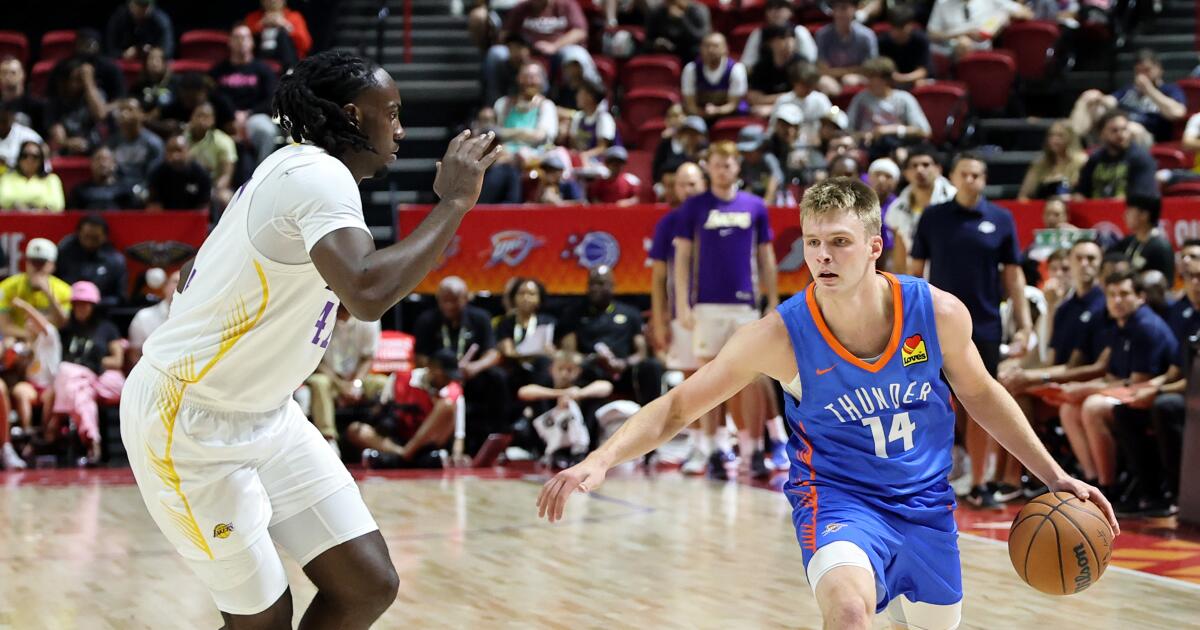
LAS VEGAS — The door opened for Arthur Kaluma to show his worth for the Lakers in the NBA Summer League on Saturday night.
He did so in a big way.
Kaluma had 34 points and five rebounds during the Lakers’ 91-70 win over the Dallas Mavericks at the Thomas & Mack Center.
He was 11 for 16 from the field and six for 10 from three-point range.
With Lakers rookie guard Cameron Carr unable to play because of a right thumb contusion, Kaluma took over the scoring role. Carr, the 24th pick in the NBA draft, is averaging 17 points per game.
“Cam doesn’t play tonight, so he gets a little bit more minutes, gets a couple more touches,” said Lakers Summer League coach Ty Abbott about Kaluma. “But he’s done a really good job of making the most of it when he doesn’t have actions run for him. So the way that he’s been able to stay ready, find windows for himself has kept him in a rhythm. So, on a night like tonight, when we can run some actions for him, he knocks them down and just plays out of his mind. It was great.”
Kaluma said he was “a little nervous” but his three-point shooting said otherwise.
“When [teammate] Jon Elmore came down and he pitched it back to me for a three … I just knew when it came off my hand it was cash,” Kaluma said. “So I said, ‘Yeah, I’m hot.’ It went on from there.”
Late in the fourth quarter, Kaluma lined up a three-pointer, setting his feet and scoring from 29 feet out. He flashed three fingers and smiled. His teammates on the bench stood and cheered, as did the fans.
“We have such a great group of guys this year at Summer League and going through this it’s hard to get that camaraderie with a group,” Kaluma said. “But I feel like everybody wants to see everybody succeed and I felt that tonight. I’m not going to lie to you. They tell me to shoot the ball. I passed up a couple of shots and they were mad at me the other day.”
Kaluma played for the South Bay Lakers in the G League last season. He averaged 14.6 points per game, 4.9 rebounds and shot 55% from the field, 37% from three-point range.
“The G can get grimey, you know what I’m saying? It’s a time where everybody is trying to fight for a position and there is a certain hunger that you have to have in order to be successful in the G,” Kaluma said. “And I feel like that drive that I had my first year in it pushed me into this summer to really get better and work on my game and come here and have the opportunity to perform.”
Kaluma wasn’t alone in helping the Lakers improve to 2-0 in Summer League play.
Adou Thiero ran the court, took a lob pass from Chris Mañon and threw down a two-handed dunk. He had another solid outing with 15 points and four rebounds. He shot just four for 12 from the field, but was a plus-15.
But the night belonged to Kaluma.
“I pride myself on the defensive end,” he said. “I know I got hot offensively, but the shot was just falling today, you know what I’m saying? My game is three-and-D. I lock-up on defense and I know I can hit open shots. I just got hot today and I’m not going to try to let it get to my head.”
Sports
Golf star records lowest round in LPGA major history with astounding performance at Evian Championship

NEWYou can now listen to Fox News articles!
There are good days on the golf course, and then there is what Haeran Ryu just did on Saturday.
Ryu, 25, recorded the lowest round in LPGA major history on Saturday with an 11-under 60 at the Evian Championship. With the South Korean golfer’s historic round, she holds a three-stroke lead.
Ryu’s round comes just two weeks after winning her first major at the Women’s PGA Championship. On the 18th hole, Ryu left a 30-foot eagle putt a few inches short, and instead settled for a birdie.
CLICK HERE FOR MORE SPORTS COVERAGE ON FOXNEWS.COM
Haeran Ryu of South Korea reacts on the 18th green after the third round of The Amundi Evian Championship at Evian Resort Golf Club in Evian-les-Bains, France, on July 11, 2026. (Stuart Franklin/Getty Images)
She said after the round that she had no idea what she had done until she counted up her scorecard.
“But after the putt and I counted my score with my caddie,” she said. “Oh my God, it’s 11-under par today. It was so amazing. My caddie says, ‘Yep.’ I’m so happy right now.”
If Ryu had made the eagle putt on the 18th hole, she would have been just the second player to shoot a 59 in LPGA history.
ZERO BS. JUST DAKICH. TAKE THE DON’T @ ME PODCAST ON THE ROAD. DOWNLOAD NOW!
Haeran Ryu of South Korea celebrates a birdie on the 15th green during the third round of The Amundi Evian Championship at Evian Resort Golf Club on July 11, 2026, in Evian-les-Bains, France. (Stuart Franklin/Getty Images)
Her 60 broke the record for the lowest round in an LPGA major by one shot. Leona Maguire and Jeungeun Lee6 in 2021, and Hyo Joo Kim in 2014, each shot 61 at the Evian Championship, which was designated as an LPGA major in 2013.
The lowest round in a men’s major is 62, which is shared by four players — Branden Grace at Royal Birkdale in the 2017 British Open, Xander Schauffele and Rickie Fowler in the 2023 U.S. Open at Los Angeles Country Club, and Schauffele and Shane Lowry in the 2024 PGA Championship at Valhalla.
CLICK HERE TO DOWNLOAD THE FOX NEWS APP
Haeran Ryu of South Korea and Lottie Woad of England interact after their round on the 18th green during the third round of the Amundi Evian Championship at Evian Resort Golf Club in Evian-les-Bains, France, on July 11, 2026. (Stuart Franklin/Getty Images)
Ryu hopes her historic third round can help propel her to a second major win in three weeks.
“That is amazing, amazing dream,” Ryu said. “So I just want that one to come true, but we have one more day.”
The Associated Press contributed to this report.
Follow Fox News Digital’s sports coverage on X, and subscribe to the Fox News Sports Huddle newsletter.
-

 Augusta, GA4 minutes ago
Augusta urgent care gives away 300 backpacks for back to school
-

 Washington, D.C11 minutes ago
Why a road trip is the best way to see the US Capital Region
-

 Cleveland, OH14 minutes ago
PAUL ANTHONY FORTUNATO Obituary – Cleveland, OH (1941-2026)
-

 Austin, TX19 minutes ago
Suspect killed in officer-involved shooting in downtown Austin
-

 Alabama26 minutes ago
Cullman’s Alabama Strawberry Festival adds another statewide award
-
 Alaska29 minutes ago
Commentary: What’s in a name? A confounding U.S. Senate race
-

 Arizona34 minutes ago
Arizona firefighter killed in wildfire remembered as brainy, ‘goofy’
-

 Arkansas41 minutes ago
Bentonville’s Dave Peel Park to become new downtown entertainment space | Arkansas Democrat Gazette

