Sports
Joe 'Jellybean' Bryant, father of late Lakers legend Kobe Bryant, dies

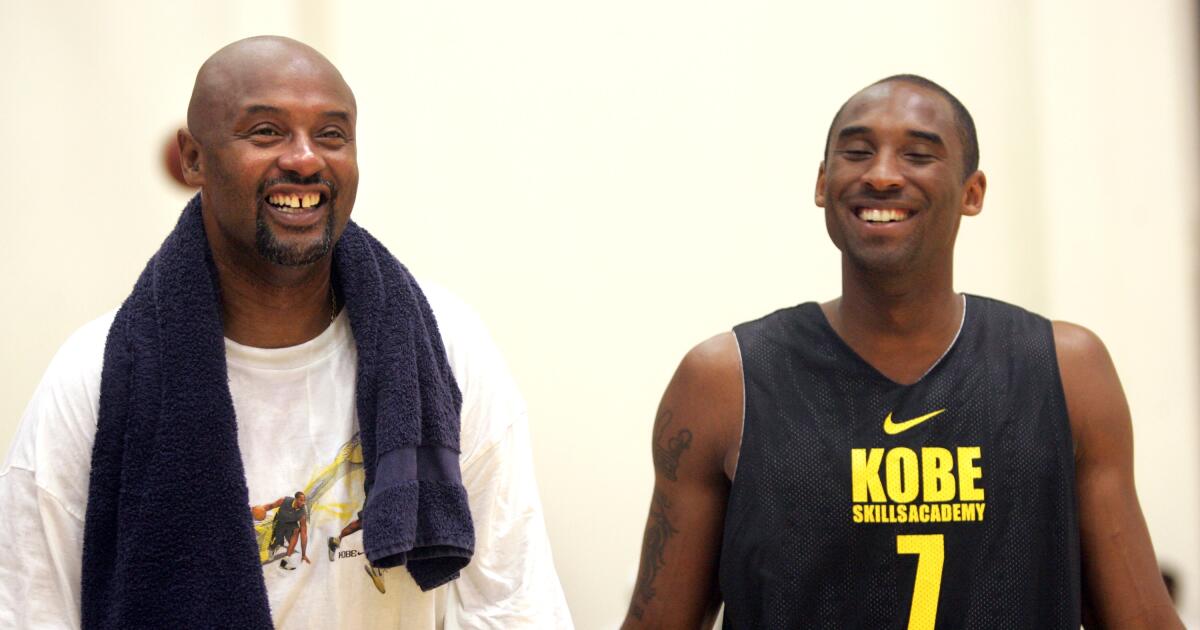
Joe Bryant, a former NBA player and WNBA coach with a colorful nickname, has died at 69, four and a half years after his son, Lakers legend Kobe Bryant, granddaughter Gianna Bryant and seven other people died in a helicopter crash.
Fran Dunphy, the coach at Joe Bryant’s alma mater La Salle, told the Philadelphia Inquirer on Tuesday that Bryant recently suffered a debilitating stroke.
A teammate at John Bartram High School in Philadelphia nicknamed Bryant “Jellybean” because he had a vast array of moves despite being 6 feet 9. “Must be jelly because jam don’t shake like that,” Bryant recalled hearing, quoting the World War II-era hit song by Glenn Miller.
The nickname stuck and Bryant became a star. He was the High School Public League Player of the Year in 1972, then remained in Philadelphia to attend La Salle, averaging 20.3 points and 11.1 rebounds per game during his two seasons.
Paul Westhead, the La Salle coach at the time, seconded all of Jellybean’s motions.
“He had a lot of moves,” Westhead said. “He’d cut you up any which way.”
Bryant was the 14th overall pick in the 1975 NBA draft, going to the Golden State Warriors, who sold his rights to his hometown Philadelphia 76ers shortly before the 1975-76 season began. Perhaps Bryant’s most memorable moment as a player came in his first game with the Clippers when he dunked over Lakers 7-foot-2 center Kareem Abdul-Jabbar.
Also in 1975, the 20-year-old Bryant married Pam Cox, sister of former NBA player Chubby Cox, and they had two daughters, Sharia and Shaya, in addition to their son, Kobe.
Bryant was a key contributor off the bench for four years in Philadelphia, playing behind future Hall of Famers and fellow forwards George McGinnis and Julius Erving. The 76ers made the playoffs in each of Bryant’s seasons, losing in the NBA Finals to the Portland Trail Blazers in 1977.
The 76ers traded Bryant to the San Diego Clippers ahead of the 1979-80 season for a future first-round draft pick and his playing time nearly doubled. He averaged 11 points and 5.5 rebounds in three seasons with the Clippers before averaging 10 points with the Houston Rockets in his last NBA season.
“Joe ‘Jellybean’ Bryant was a local basketball icon, whose legacy on the court transcended his journey across Bartram High School, La Salle University, and his first four NBA seasons with the 76ers from 1975-79,” the Sixers said in a statement. “Our condolences go out to the Bryant family.”
Bryant then embarked on a nomadic career overseas as a player and a coach. He played through 1992 in Italy and France, not returning to Philadelphia until Kobe was about to begin high school. Bryant served as head coach of the girls’ team at Akiba Hebrew Academy in 1992-93 before moving to La Salle as an assistant for the duration of Kobe’s career at Lower Merion High.
“We are saddened to announce the passing of La Salle basketball great Joe Bryant,” the school said in a news release. “Joe played for the Explorers from 1973-75 and was a member of our coaching staff from 1993-96. He was a beloved member of the Explorer family and will be dearly missed.”
Shortly after finishing high school, Kobe was drafted by the Charlotte Hornets and immediately traded to the Lakers in 1996.
Joe and Pam Bryant moved to Los Angeles with their 17-year-old son and had to co-sign his first Lakers contract, a $3.5-million deal over three years, because Kobe was too young to sign for himself.
The Lakers rookie used some of his newfound wealth to buy cars for Joe, Pam, Sharia and Shaya, all of whom lived with him in Pacific Palisades for three years until Joe and Pam purchased a house less than a mile away.
“We weren’t just going to let him come out here by himself,” Joe told Times columnist Bill Plaschke early in 2003.
“My family was always there for me,” Kobe said around that time. “I love them for that.”
Their relationship remained strong until Kobe courted and eventually married Orange County teenager Vanessa Laine in 2001.
“It’s right there in the Bible,” Kobe said. “When you get married, your mother and father and sisters are no longer the priority.”
His parents did not come to Kobe and Vanessa’s wedding or visit their new home. When Lower Merion High retired Bryant’s jersey in 2002, Joe and Pam sat in one section of the stands, Vanessa in another.
Why the tension? Kobe said his father — who had been younger than Kobe when he married Pam at age 20 — felt uneasy about his devotion to Vanessa and did not like that she was Latina. Joe said: “Once he decided to get married, it’s his life now.”
Bryant jumped back into coaching in 2003, spending one year each with the Las Vegas Rattlers and the Boston Frenzy of the American Basketball Assn. He moved to the WNBA and became head coach of the Sparks for two seasons, leading L.A. to a 25–9 record and a conference finals berth in 2006. A year later, he was replaced by former Lakers star Michael Cooper.
“I’m devastated to hear about the loss of my friend Joe “Jellybean” Bryant, the father of Kobe Bryant,” Magic Johnson wrote on X. “Joe was not only a talented basketball player; he was also a great coach.
“Joe was an exceptional human being with a radiant smile that had the power to brighten any room, and a great husband and father. Cookie and I are praying for his wife Pam, daughters Sharia and Shaya, and the rest of the Bryant family, friends, and all those who loved Joe.”
From 2007 to 2015, Bryant coached a handful of teams in Japan, Italy and Southeast Asia. As recently as 2013, Bryant was working out regularly at the full-length basketball court on the second floor of the L.A. apartment building where he and Pam lived.
His workout? He’d make 120 shots, 60 on each end — 20 from the left side, 20 from the right, 20 down the middle — proving to himself that “Jellybean” still had the moves at age 60.



NEWYou can now listen to Fox News articles!
As Philip Rivers has shown he could still tear up the NFL at age 44, American Olympic legend Lindsey Vonn has also proven that age is just a number.
Vonn, 41, qualified for the 2026 Milan Cortina Games, Team USA announced on Tuesday. It will be the fifth Winter Olympics that she competes in.
United States’ Lindsey Vonn reacts at the finish area of an alpine ski, women’s World Cup downhill, in Val D’Isere, France, Saturday, Dec. 20, 2025. (AP Photo/Pier Marco Tacca)
Vonn had an impressive run at the World Cup in France over the weekend. She was third in super-G, hitting a high speed of 71 mph. It was her second consecutive podium finish after she was third in downhill. It was the 142nd podium finish in her World Cup career.
“I am honored to be able to represent my country one more time, in my 5th and final Olympics!” she wrote in a post on Instagram. “When I made the decision to return to ski racing, I always had one eye on Cortina because it’s a place that is very, very special to me. Although I can’t guarantee any outcomes, I can guarantee that I will give my absolute best every time l kick out of the starting gate. No matter how these games end up, I feel like I’ve already won.
US OLYMPIANS MADISON CHOCK, EVAN BATES SEND MESSAGE TO OPPONENT WHO TOOK THEIR GOLD BEFORE DISQUALIFICATION
United States’ Lindsey Vonn celebrates on the podium after taking third place in an alpine ski, women’s World Cup downhill, in Val D’Isere, France, Saturday, Dec. 20, 2025. (AP Photo/Pier Marco Tacca)
“I am grateful for how the season has gone so far, but I am just getting started. See you in Cortina!”
Vonn has already put together an enviable career in skiing.
She won a gold medal in the 2010 Vancouver Games and two bronze medals in Pyeongchang in 2018. She’s also taken home two gold, three silver and two bronze medals in the World Championships.
The Minnesota native also has 83 World Cup wins and several International Ski and Snowboard Federation (FIS) Crystal Globes.
Notably, she’s back competing for gold after being away from the sport for five years.
Austria’s Cornelia Huetter, left, winner of an alpine ski, women’s World Cup downhill, celebrates on the podium with second-placed Germany’s Kira Weidle Winkelmann, left, and third-placed United States’ Lindsey Vonn, in Val D’Isere, France, Saturday, Dec. 20, 2025. (AP Photo/Pier Marco Tacca)
CLICK HERE TO DOWNLOAD THE FOX NEWS APP
The Winter Olympics will begin on Feb. 6 and run through Feb. 22.
The Associated Press contributed to this report.
Follow Fox News Digital’s sports coverage on X and subscribe to the Fox News Sports Huddle newsletter.

Next summer’s World Cup will be the largest, most complex and most lucrative sporting event in history, with 48 teams playing 104 games in three countries. The tournament is expected to draw a global TV audience of nearly 5 billion and FIFA, the event’s organizer, is hoping for revenues of between $10 billion-$14 billion — which is why lower-bowl tickets for Iran-New Zealand at SoFi Stadium cost nearly $700.
All that seemed unlikely after the first tournament in 1930, when the idea of a soccer World Cup was nearly killed in the cradle, the victim from lack of planning, lack of money and lack of interest. That the competition survived, much less thrived, is nothing short of a miracle, says English writer and podcaster Jonathan Wilson, author of the deeply researched “The Power and Glory: The History of the World Cup.”
“1930, it’s incredibly amateurish in many ways,” Wilson said. “It’s got that sort of almost like a school sports day feel to it.”
Only 13 countries took part in the first tournament; it was supposed to be 16 but the Egyptian team missed its boat to Uruguay while Japan and Siam (now Thailand) couldn’t afford the travel costs and pulled out. England, meanwhile, not only refused to play, but the British press ignored the event, as did much of Europe.
That seemed like a wise decision at the time since the first two matches of the inaugural tournament were affected by snow, with one of the opening games drawing just 4,444 fans. The smallest crowd in World Cup history, estimated at about 300, showed up for another first-round game between Romania and Peru and the TV audience … well, there was none since TV had yet to be invented.
The officiating was beyond suspect — Romania’s manager, Constantin Radulescu, also worked two games as a linesman — and the U.S. trainer, Jack Coll, had to be stretchered off the field during his team’s semifinal — yes, the U.S. made the semifinals! — with Argentina when he lost consciousness after inhaling the fumes from a bottle of chloroform that shattered in his pocket.
In another game, the penalty spots were mistakenly marked 16 yards from goal instead of the regulation 12 — and nobody noticed.
“Some of the details don’t make sense,” Wilson said. “The whole thing is so sort of low grade compared to today.”
When Argentine captain Nolo Ferreira left the tournament and returned home to take his law exams his replacement, Guillermo Stábile, scored a tournament-high eight goals in four games — then never played for the national team again (although he did coach it, leading the La Albiceleste to six South American titles and the 1958 World Cup).
Given the farcical nature of the 1930 World Cup, the tournament probably should have ended right there. Instead, 1930 has become the foundation on which next year’s competition was built.
The origins of the tournament, however, actually make sense. Before 1930, FIFA recognized the winner of the Olympic competition as the world champion. But that event was for amateurs, a point on which the International Olympic Committee would not budge.
With professional soccer growing in popularity, FIFA decided to stage its own breakaway event and play it in Uruguay, the country that had won the last two Olympic titles.
Argentina’s goalkeeper can’t stop a shot by Uruguay during the 1930 World Cup final against Argentina in Montevideo, Uruguay.
(Associated Press)
That quickly proved to be a big mistake. The growing effects of the Great Depression left many countries unable to afford the long, slow steamship trip to South America. The first tournament was open to any country that wanted to play, yet two months before the first game no European teams had agreed to come.
“It was taken very seriously by Uruguay and Argentina,” Wilson said, but not by many others.
That changed shortly after Romania’s King Carol II, who ascended to the throne in a coup that deposed his son, personally selected his country’s World Cup roster and sent it on its way. France quickly agreed to go too, entering a makeshift team under pressure from FIFA president Jules Rimet, a Frenchman. Belgium also buckled under FIFA pressure and all three teams boarded the same ship for the trip to Uruguay, working out together on the 15-day voyage aboard the SS Conte Verde, an Italian ocean liner.
“Even the four European nations who go it’s not entirely clear how seriously they took it,” Wilson said. “The French and Romanians, they kept diaries. They seem to have regarded this as a laugh. We’ll try to win but it doesn’t really matter.”
Things didn’t really get loony until the tournament began. The Bolivian team, for example, played in berets, as did an Argentine midfielder, while the 15 referees who worked the games, some of whom had traveled and socialized with the players on the long boat ride from Europe, dressed formally in knickers, long-sleeve shirts, blazers and ties.
The well-dressed officials spent much of the tournament working with police to break up fights; play was so violent at least two players sustained broken legs and the U.S.-Argentina semifinal descended into a full-out brawl, with one American having four teeth knocked out and another hospitalized with injuries to his stomach.
The tournament finally finished with the hosts beating Argentina 4-2, after which the Argentines broke off diplomatic relations with their neighbor and an angry mob in Buenos Aires stoned the Uruguayan embassy.

Uraguay’s team before the 1930 World Cup final against Argentina.
(Keystone / Getty Images)

Argentina’s soccer team before preparing for the 1930 World Cup final.
(Associated Press)
“It ended,” Wilson said of the tournament, “with everybody sort of fighting each other.”
Few disagreed with the Argentine magazine El Gráfico, which seemed to predict there was little future for the fledgling event. “The World Cup is over,” it wrote. “The development of this competition brought not only an unpleasant atmosphere, but also an ungrateful one.”
Yet nearly a century later, the World Cup is still here. And that, too, was foretold in 1930 in the story of Romanian midfielder Alfred Eisenbeisser (who was also known as Fredi Fieraru because, why not?).
On the journey home from the first World Cup, Eisenbeisser contracted pneumonia and a priest was called to administer the last rites. The ship eventually docked in Genoa and he was taken to a sanatorium while the rest of the team continued on to Romania.
Assuming her son had perished in Italy, Eisenbeisser’s mother arranged a wake — only to have her son stroll into the ceremony very much alive, causing the woman to faint. Eisenbeisser would play 12 more years of professional soccer and compete in figure skating in the 1936 Winter Olympics, where he finished 13th in the pairs competition.
Turns out the reports of Eisenbeisser’s demise, like those of the World Cup, were greatly exaggerated.
⚽ You have read the latest installment of On Soccer with Kevin Baxter. The weekly column takes you behind the scenes and shines a spotlight on unique stories. Listen to Baxter on this week’s episode of the “Corner of the Galaxy” podcast.

NEWYou can now listen to Fox News articles!
Philip Rivers’ return to the NFL has many former quarterbacks over the age of 40 wondering if they could turn back the clock and perform at a similarly high level.
If anything, they should at least take note of what Rivers did in the first half for the Indianapolis Colts against the San Francisco 49ers.
Indianapolis Colts quarterback Philip Rivers (17) passes as San Francisco 49ers defensive lineman Keion White (56) applies pressure during the first half of an NFL football game, Monday, Dec. 22, 2025, in Indianapolis. (AP Photo/Carolyn Kaster)
The Pro Football Hall of Fame Class of 2026 semifinalist put on a vintage performance in the first half against the 49ers, delighting NFL fans who tuned into the game on Monday night.
He started the night coming out to cheers from Colts fans at Lucas Oil Stadium – his family also in attendance. The Colts went nine plays, 72 yards and Rivers found wide receiver Alec Pierce for a 20-yard touchdown. Indianapolis jumped out to a 7-0 lead.
NFL SUSPENDS STEELERS’ DK METCALF FOR 2 GAMES AFTER ALTERCATION WITH LIONS FAN
Indianapolis Colts quarterback Philip Rivers (17) passes against the San Francisco 49ers during the first half of an NFL football game, Monday, Dec. 22, 2025, in Indianapolis. (AP Photo/AJ Mast)
San Francisco scored on back-to-back drives thanks to Brock Purdy hooking up with Demarcus Robinson, the special teams forcing a turnover, and then Purdy throwing a touchdown pass to Christian McCaffrey. When Rivers got the ball back, he drove down the field again.
The Colts scored on a 16-yard touchdown pass from Rivers to Pierce to end a 12-play, 66-yard drive. The game was tied with a lot of time to go in the first half.
Indianapolis trailed 24-17 at the half. But the attention was on Rivers.
He was 14-of-21 with 175 passing yards and two touchdown passes. The last time he threw multiple touchdown passes in the regular season was on Dec. 20, 2020, against the Houston Texans.
Rivers came back to the Colts last week at the age of 44. He had a solid performance against the Seattle Seahawks for someone who hadn’t thrown a ball in nearly five years.
Bundle FOX One and FOX Nation to stream the entire FOX Nation library, plus live FOX News, Sports, and Entertainment at our lowest price of the year. The offer ends on Jan. 4, 2026. (Fox One; Fox Nation)
CLICK HERE TO DOWNLOAD THE FOX NEWS APP
Now, the Colts’ playoff hopes rest on his shoulders.
Follow Fox News Digital’s sports coverage on X and subscribe to the Fox News Sports Huddle newsletter.

Devils Shake Up Forward Lines on Island; Markstrom Starts | PREVIEW | New Jersey Devils

Tuesday morning forecast

Near The Coast Of North Carolina Is A Serene Suburb With Fun Shops And Wilmington Proximity – Islands

Wintering Well Series Back For Another Season At McKenzie Co. Heritage Park & North Dakota Oil Museum

Ohio AG on human trafficking: It’s not rich and poor, it’s literally all around us

Florida High School Football Rankings: Top 25 teams – Oct. 21

Cleary's 21 help Le Moyne down Central Connecticut State 69-64 in OT

How old is Bo Nix? What to know about Oregon quarterback ahead of 2024 NFL Draft

99th annual Pony Swim held in Virginia

Video: ‘It Didn’t Have to Happen This Way:’ U.Va. Faculty Call for Review of Police Response to Protests
404 | Fox News

Trump says Greenland ‘essential’ for security: Could he take it by force?

BBC Verify: Satellite image shows tanker seized by US near Venezuela is now off Texas

20% of NYC mayor-elect Mamdani transition appointees have anti-Zionist ties: ADL

Exclusive: Former MEP Kaili doubles down on ‘Belgiangate’
-

 Iowa1 week ago
Addy Brown motivated to step up in Audi Crooks’ absence vs. UNI
-

 Maine1 week ago
Elementary-aged student killed in school bus crash in southern Maine
-

 Maryland1 week ago
Frigid temperatures to start the week in Maryland
-

 New Mexico7 days ago
Family clarifies why they believe missing New Mexico man is dead
-

 South Dakota1 week ago
Nature: Snow in South Dakota
-

 Detroit, MI1 week ago
‘Love being a pedo’: Metro Detroit doctor, attorney, therapist accused in web of child porn chats
-

 Health1 week ago
‘Aggressive’ new flu variant sweeps globe as doctors warn of severe symptoms
-

 Maine7 days ago
Family in Maine host food pantry for deer | Hand Off