Sports
How the House v. NCAA settlement could reshape college sports: What you need to know


Big 12 presidents and chancellors voted to approve proposals of what is expected to be a multi-billion dollar settlement in the House v. NCAA class-action lawsuit Tuesday, a source briefed on the decision confirmed to The Athletic. Their approval is another step toward a resolution in the landmark case likely to reshape the college sports business model.
The Big 12 is the first of the suit’s defendants to vote on the settlement terms, with the remaining power conferences and NCAA Board of Governors also expected to do so this week. It’s expected the settlement will cost them nearly $3 billion in damages and allow power-conference athletes to finally share in annual revenues.
House v. NCAA seeks back pay for Division I college athletes who were barred from earning name, image and likeness (NIL) compensation prior to the NCAA changing its policy in summer 2021, while also pursuing a cut of future broadcast revenues for athletes at power-conference schools.
As college sports face a reckoning on multiple fronts, and with the prospect of the NCAA owing as much as $20 billion in damages were it to lose the House case at trial, settlement efforts intensified in recent weeks.
In addition to more than $2.7 billion in NIL back-pay damages, a settlement would include a system in which roughly $20 million a year can be distributed directly from a power-conference school to its athletes, multiple people briefed on the negotiations confirmed to The Athletic.
All indications are that the last vestiges of amateurism in college sports are coming to an end.
“I expect the athletes who are generating the most money would get the greatest economic return,” said Jeffrey Kessler, one of the lead lawyers representing the plaintiffs. “That’s the economic competitive market we live in.”
A House settlement would be the next legal domino in what has been a busy stretch of forced change for the NCAA, including the U.S. Supreme Court unanimously upholding the NCAA v. Alston decision in 2021 and agreeing that the NCAA’s cap on education-related expenses was an antitrust violation. State legislatures helped usher in the NIL era weeks later. Lawsuits filed by multiple state attorneys general have since forced the NCAA to halt enforcement of NIL regulations and allow multi-time transfers immediate eligibility.
Over the past three years, these lawsuits and policy changes have created (and exposed) cracks in the foundation of the collegiate model.
GO DEEPER
Why is the NCAA proposing a new subdivision? Explaining the related legal battles
“The most important part about the settlement — and let’s face it, there’s still a lot of work to be done there — is it creates some clarity and some visibility on a whole bunch of issues that have sort of been roiling everybody for a while,” NCAA president Charlie Baker said last week. “The other thing it does is create predictability and stability for schools. It creates a tremendous opportunity for student-athletes.”
So what does this mean for fans of college sports? Most immediately, it simply means that the power-conference programs you follow and root for, which bring in millions of dollars in revenue annually from television contracts and ticket sales, can start paying athletes with that money — a significant budgetary adjustment, but not so functionally different from how school-affiliated NIL collectives have started paying players.

GO DEEPER
College football portal confidential: How tampering, NIL deals and portal chaos happen
Yet in the broader scope, this settlement will further widen the gap between high-major revenue sports — particularly power-conference football — and the rest of college athletics. It’s another step toward a future in which the biggest programs stratify or fully separate from the rest of the NCAA into some version of super conferences or a super league. To that end, there’s also been some organized, internal pushback within the NCAA from smaller Division I conferences that believe they will be forced to shoulder a disproportionate amount of the damages in the proposed settlement.
Plenty of hurdles remain beyond the House case as well, including whether athletes will ultimately unionize and/or be deemed employees, or if the NCAA can secure antitrust exemptions from Congress. Regardless, big changes are on the horizon, and in a way the NCAA has long fought.
Here’s more on what’s at stake in House v. NCAA, and what could come next.
Potential settlement details
The NCAA is backed into a corner.
House v. NCAA was filed in June 2020 with Grant House, a former Arizona State swimmer, and Sedona Prince, a former Oregon and current TCU women’s basketball player, as the two named plaintiffs. In November, U.S. District Court Judge Claudia Wilken, who has a track record of ruling against the NCAA in similar cases (O’Bannon, Alston), granted class-action certification for the damages portion of the House case, expanding it to any Division I athlete dating back to 2016 (in accordance with a four-year statute of limitations).
This exponentially elevated the potential cost — and impact — of the case, which is currently scheduled to go to trial in January 2025.
U.S. antitrust laws grant plaintiffs three times the damages they are awarded — known as “treble damages” — meaning if the NCAA lost at trial, it would automatically be on the hook for triple the damage amount ordered by the judge. According to documents circulated among power conference presidents and administrators and obtained by Yahoo Sports, that final class-action figure could be as high as $20 billion, and enough to force the NCAA to file for bankruptcy.
A loss at trial would also strike down any existing constraints on NIL.
“So essentially, if we win, there would be a complete free market in NIL, including from broadcast payments,” said Kessler.
The combination of triple damages, which would likely have to be paid out immediately, and the NIL floodgates fully opening would be a death rattle for the NCAA, and why a settlement is seen as the surest path to the organization’s survival, at least in the short term.
Through a spokesperson, the NCAA declined to comment.
Certain details of the settlement, though not finalized, have been reported by multiple outlets and confirmed to The Athletic. The nearly $3 billion in back-pay damages would be paid out over 10 years, and power-conference programs could opt into the annual $20 million revenue-sharing allocation likely starting with the 2025-26 season.
This would coincide with a change in roster limits that would eliminate existing caps on scholarships, such as a baseball team’s 11.7 scholarships that get divvied up among 30-plus players. If the baseball roster limit was set at 25, for example, schools would have 25-player teams and could fully fund up to 25 scholarships. This impacts football as well, where teams currently have 85 allotted scholarships but can carry up to 115 total players on the roster. There’s fear among coaches that the new roster limit could eliminate walk-ons.
“Our game is not the pro game,” said Wake Forest coach Dave Clawson, a member of the American Football Coaches Association board. “We get players that need to be taught and coached when they come out of high school. …(In the NFL), they have a practice squad, they have access to players and other teams. Once we start practice, our roster is set for the year, and they have to be students.”
ACC commissioner Jim Phillips said those roster determinations would be “local decisions” for each university, with better-resourced schools likely to do more than others within the Power 4 leagues. Roster limits are expected to be part of Thursday’s vote by the conferences, and multiple administrators told The Athletic that they expect specific scholarship figures to be decided collectively by the Power 4 conferences in the coming months.
What the NCAA could avoid with a settlement
The compromises of a possible House settlement are obvious, but so are the benefits. The NCAA doesn’t risk the immediately payable treble damages at trial and can negotiate terms on a revenue-sharing model while maintaining a similar operating structure.
College athletes receive scholarships and other benefits, but the anticipated rate of revenue sharing wouldn’t be nearly as high as their counterparts in the pros. The roughly $20 million annual amount represents 22 percent of the average Power 4 school’s annual revenue. Revenue sharing in the major American professional sports is usually around 50 percent for the players.
A settlement would also address another major NCAA issue by simultaneously resolving other high-profile antitrust cases, including Hubbard v. NCAA and Carter v. NCAA; plaintiffs in both cases are also represented by Steve Berman and Kessler.
Hubbard is similar to House in the sense that it is seeking retroactive damages for education-related Alston payments; Carter argues that rules prohibiting college athletes from receiving “pay for play” violate antitrust law. A House settlement would resolve each of them.
One other antitrust case factors in: Fontenot v. NCAA, a separate, class-action suit filed in Colorado that is seeking similar claims and damages as Carter. A motion to transfer the case to the same Northern District of California court as the other antitrust suits has been requested, ostensibly to have it resolved by a settlement in the House case. A hearing on the transfer is also set for Thursday.
Resolving all four antitrust cases — House, Hubbard, Carter and Fontenot — is a crucial aspect of the settlement for the NCAA, according to people briefed on the negotiations.
“In the current world we live in, planning is very hard to do,” Baker said. “If we can land this thing … I think it creates a lot of stability and clarity for schools. And it makes it possible for all of us to start thinking about what the next act will look like as it rolls out instead of feeling like you’re waiting for the next shoe to drop.”
How it would work
Assuming the NCAA and power conferences sign off on terms this week, there would still be a number of steps to complete a settlement, including official filing, an approval from Judge Wilken and a 90-day period for review and any objections.
If approved, the power-conference revenue sharing will be optional, and there are no specifications on how the money will be distributed, as long as it stays within the capped allotment.
It’s expected that most if not all power-conference programs will opt in to some degree of revenue sharing in order to remain competitive. But even for a number of the schools at that level, it could be a gradual financial process that requires cuts elsewhere.
“As it currently stands, I don’t know many schools that will be able to pay even remotely close to ($20 million) without eliminating some portion of what they currently spend,” said Iowa State athletic director Jamie Pollard.
For back-pay damages, the NCAA would use its reserves to cover $1.1 billion, and the remaining approximately $1.6 billion would come from withheld revenue distributions, chiefly via the NCAA men’s basketball tournament credits. Of that $1.6 billion, nearly 60 percent is expected to come from leagues outside the Power 4 conferences (including the Group of 5), according to people familiar with the settlement proposal.
The 22 smaller, non-FBS conferences (colloquially referred to as the CCA22) were not initially briefed on the settlement talks until earlier this month, multiple administrators said, once the financial structure of payouts had already been formulated.
One Division I commissioner estimated that non-FBS conferences would be on the hook for $2.5 million per year to help cover the NCAA’s costs of the settlement. Two sources in different CCA22 leagues said that equates to roughly 25 percent of the annual revenue those schools receive from the NCAA. That level of reduction could lead to cutting sports and athlete resources, despite a lawsuit that was clearly aimed at power-conference schools with the most lucrative media deals.
“The burden that’s being pushed to us is not following any sort of logic as it relates to the court order,” one non-Power 4 source said.
However, the damages payment model that is being voted on is a slightly tweaked version of the original breakdown put forth by the NCAA, a college administrator briefed on the proposal told The Athletic. That’s despite the non-FBS leagues submitting a formal request to the NCAA’s Board of Governors and Division I Board of Directors on Monday, according to sources briefed on the proposal, asking to either delay a final decision on the financial breakdown or adjust it to an equivalent rate of revenue reductions for each conference. The latter would have made the power conferences responsible for roughly 60 percent of the damages.
The Board of Directors and Board of Governors (the NCAA’s highest governing body) are also scheduled to vote on settlement details this week, including authorizing the NCAA to use its financial reserves.
Another area to be addressed is how the terms of a settlement apply to the new classes of athletes each year. Berman mentioned a potential solution.
“Every year, when an NCAA athlete reports in to start the year, they could be given a copy of the class notice and the settlement, and given an opportunity to object within a few months receiving that notice,” said Berman.
Jim Cavale, the founder of the players organization Athletes.org, questions the forward-looking part of the settlement, saying it lacked athlete input. His organization includes about 1,500 power-conference athletes and recently signed up the entire UAB football team.
“How involved are the current athletes?” he said. “On top of that, how involved if at all are future athletes on these terms? The answer is not at all. The results of a (collective bargaining agreement), the terms of the athlete experience and even these caps are not really the responsibility of these plaintiffs’ lawyers in a class-action lawsuit.”
Some industry sources believe there could be less incentive or motivation for players to unionize once they’re getting a piece of the pie. Cavale disagrees.
“Should it be approved, if we got 500 of our 3,000 athletes to object, the way it’s written, you’re going to have 500 different hearings,” he said.
Other unknowns
Plenty more questions remain.
• How will Title IX apply to revenue-sharing distributions? Will proportional payments need to be made to male and female athletes in order to remain compliant — meaning an athletic department can’t spend all or most of its revenue-sharing dollars on football or other men’s sports — or would schools argue that proportional scholarship opportunities satisfy Title IX? This is not something that can be stipulated by the settlement and could be challenged in court. Multiple administrators at Power 4 schools told The Athletic they believe the total dollar figure needs to be equal between male and female athletes, but that their understanding is that each school can determine how to allot the money between its athletes and sports.
• How would this impact potential unionizing and collective bargaining ventures?. Unionizing efforts by the Dartmouth men’s basketball team and national advocacy organizations such as Cavale’s Athletes.Org and the College Football Players Association have yet to gain widespread support, a challenge within something as wide-ranging and transient as college sports. But the topic could receive renewed attention in the wake of a settlement, along with the ongoing discussion of whether college athletes should be deemed employees, which is at the heart of both the Johnson v. NCAA suit and a National Labor Relations Board complaint against USC, the Pac-12 and the NCAA.
In any event, settling House and resolving the other prominent antitrust lawsuits will not fully shield the NCAA from future legal battles, which is why Baker and the organization will continue to pursue Congressional antitrust exemptions.
“(A settlement) creates a framework that makes it possible to then have a different kind of conversation with Congress,” said Baker. “So, in many ways, I’m hopeful.”
• What about NIL collectives? A settlement wouldn’t fully address the role of these third-party organizations and the culture of pay for play, though Yahoo Sports reported that the informational documents it obtained mentioned “economic incentives” for athletic departments to bring collectives in-house.
• How will the financial adjustments trickle down? Will schools decide to cut athlete benefits, administrative positions or entire sports? Will this finally stem the tide of ballooning, seven-figure annual coaching salaries, bloated staffs and multi-million-dollar buyouts? Wholesale changes to the structure of collegiate athletics and the NCAA’s governance remain likely years away, but that doesn’t mean reverberations won’t be felt sooner in other areas.
“It could be the sports you sponsor,” Pollard said. “It could be what you do for the sports you sponsor. It could be the number of staff you have in football. It could be the number of players you have on a football team. Everything’s going to be on the table.”
—The Athletic’s Chris Vannini and Scott Dochterman contributed reporting.
(Photo Illustration: Pavlo Gonchar / SOPA Images / LightRocket via Getty Images)



NEWYou can now listen to Fox News articles!
The best Indianapolis 500 finish could be subjective, depending on which driver a fan was rooting for to win.
It certainly is in the eye of the beholder.
So take this list for what it’s worth. One view of the 10 best finishes in Indianapolis 500 history. Of course, it skews to more recent decades when the runs have come a little faster and the finishes have had a tendency to be a little closer.
We’ll add one each day to this list of fantastic finishes ahead of the 110th running of the Indy 500 on May 24 (12:30 p.m. ET on FOX).
10. Ericsson outduels O’Ward (2022)
After a red flag, Marcus Ericsson held off Pato O’Ward in a two-lap shootout. The shootout didn’t last two laps, though, as there was a crash on the final lap behind them. Ericsson had a comfortable lead when the red flag came out for a crash with four laps to go, a situation where in past Indianapolis 500 races, they likely would have ended the race under caution with Ericsson as the winner.
9. Foyt survives chaos (1967)
How does a driver who wins by two laps end up on this list? It’s because the win nearly didn’t happen on the last lap. A big crash with cars and debris littering the frontstretch just ahead of Foyt as he came to the checkered flag forced him to navigate through the wreckage for the win.
8. Sato can’t catch Franchitti (2012)
This was one of those finishes where the leader holds on for the win, but boy did the leader have to hold on. Takuma Sato tried to pass Dario Franchitti early on the final lap but to no avail and Franchitti sped off for the victory. This was one of those Indy 500s that made you hold your breath all the way to the checkered flag.
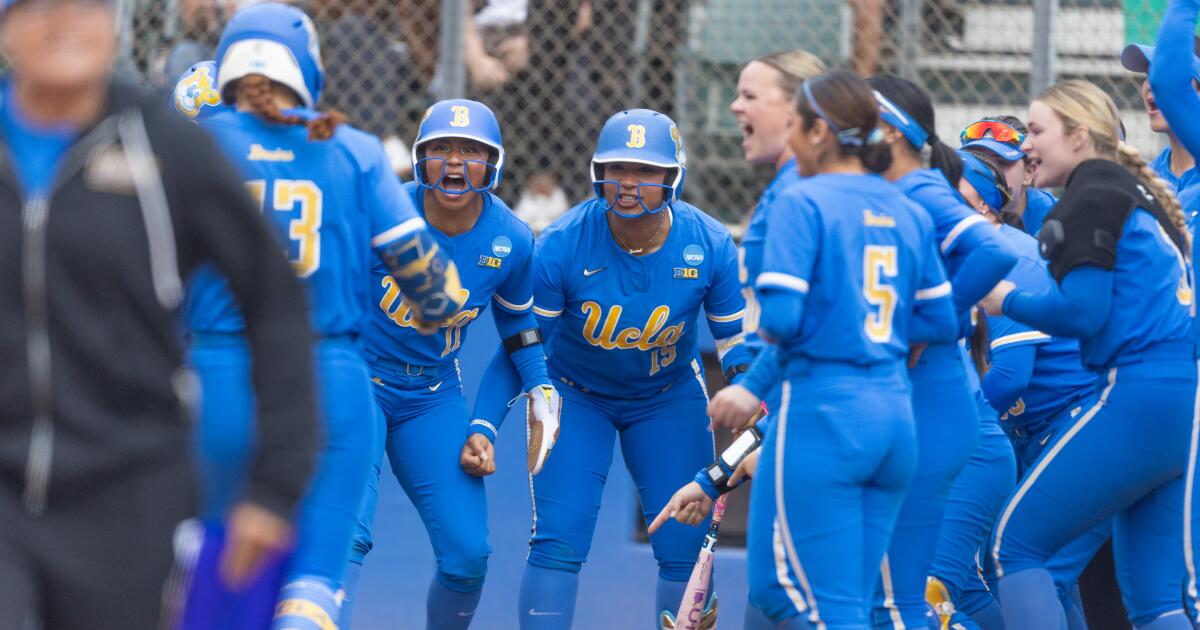
No. 8 UCLA stuck with right-hander Taylor Tinsley throughout the Los Angeles Regional and that faith in the senior paid off.
During the Bruins’ NCAA tournament opener at Easton Stadium, Tinsley gave up 10 runs before her teammates rallied for a walk-off win. She returned less than 24 hours to pitch against South Carolina, giving up two earned runs in a victory. Tinsley was back in the circle Sunday afternoon, yielding one run in UCLA’s 15-1 victory over the Gamecocks to advance to the super regionals.
“I am proud of Taylor’s resiliency, the ability to do whatever she can to help this team,” UCLA coach Kelly Inouye-Perez said. “She got stronger through the weekend. I am proud of that.”
Tinsley and her teammates will host Central Florida in a super regional that begins Friday.
“I feel good,” Tinsley said after pitching three key games in three days. “I could have gone more innings if needed.”
South Carolina right-hander Jori Heard gave up only one hit through two innings, keeping UCLA’s potent bats relatively quiet. The Gamecocks had runners on first and second with two outs in the second, but Tinsley escaped the inning with a pop-up to left field.
The Bruins got on the board first with a two-run home run from left fielder Rylee Slimp in the third inning. The Bruins followed it up by loading the bases with no outs in the fifth for right fielder Megan Grant.
Grant cooked up a grand slam to make it 6-0. She has 40 home runs, extending her hold on the NCAA single-season home run record. Oklahoma freshman Kendall Wells trails Grant with 37 homers.
“Its just incredible because I am blessed to be able to say the number 40,” Grant said.
South Carolina broke through on an RBI single from left fielder Quincee Lilio to cut UCLA’s lead to 6-1 in the fifth inning after being held to just one hit since the first inning. The Gamecocks couldn’t cash in the rest of the way.
The Bruins resumed scoring in the sixth inning, with the bases loaded and Grant at bat again. Fans at Easton Stadium anticipated another grand slam, holding up their cellphones hoping to catch some magic. Grant served up a two-run RBI single to expand the lead 8-1.
Jordan Woolery added to the scoring with a two-run RBI double down the left-field line, and Kaniya Bragg hit a home run to left-center field. Soo-jin Berry put a bow on the win with one more home run.
Sports
Pro wrestling star learns what ‘land of opportunity’ means in US as he details journey from Italy to America

NEWYou can now listen to Fox News articles!
Cristiano Argento has been tearing up opponents in the ring for the National Wrestling Alliance (NWA) as he worked his way up the ladder to get a few shots at some gold.
But the path to get to one of the most prestigious pro wrestling companies in the U.S. was long and a path that not many wrestlers have taken.
Argento was born and raised in Osimo, Italy – a town of about 35,000 people located on the east side of the country closer to the Adriatic Sea. He told Fox News Digital he started training in a ring at a boxing gym before he got started on the independent scene in Italy. He wrestled in Germany, Sweden, France and Denmark before he came to the realization that, to become a professional wrestler, he needed to make his way to the United States.
ZERO BS. JUST DAKICH. TAKE THE DON’T @ ME PODCAST ON THE ROAD. DOWNLOAD NOW!
Cristiano Argento performs in the National Wrestling Alliance (Instagram)
He first worked his way to Canada to get trained by pro wrestling legend Lance Storm. He moved to Canada, leaving most of his friends and family behind and without a firm grasp on the English language.
“At the time, my English was horrible. I didn’t speak any English at all,” he said. “But I was with my friend, Stefano, he came with me and he translated everything for me. I probably missed 50% of the knowledge that Lance Storm was giving to us because I was unable to understand. I was only given a recap and everything I was able to see. I’m sure if I was doing it now with a proper knowledge of English, it would have been a different scenario.
“Eventually, I moved back to Italy after the training and I said, OK, now, I want to go to the U.S. So, I studied English more properly, and eventually I got my first work visa that was in Texas. I was in Houston for a short period of time. I trained with Booker T at Reality of Wrestling. I got on his show, which was my debut in the U.S. That was awesome. I eventually got a new work visa in Pittsburgh, Pennsylvania, where I currently live since 2017. Since then, my wrestling career, thankfully, kept growing, growing, growing and growing until now wrestling for the NWA. One of the bigger promotions in the U.S.”
Argento said that his family thought he was “nuts” for chasing his pro wrestling dream.
He said they were more concerned about his well-being given that he was half-way around the world without anyone he knew by his side in case something went sideways.
“My family, friends, everybody was like why do you want to move to the opposite side of the world not knowing the language, not knowing anybody, by yourself, to try to become a professional wrestler? And I was like, well, we have one life, I love, and that’s what I’m gonna do,” he told Fox News Digital. “Eventually, my family was really supportive. But when I first said, ‘Hey, mom and dad, I want to do that.’ They looked at me like, ‘Are you nuts? Are you drunk or something? What are you talking about?’ And I said, no that’s what I want to do. And they knew I loved this sport because in Italy I was traveling around Europe, spending time in Canada training, so they started to understand slowly that’s what I want to do with my life. They were proud of me.
Cristiano Argento works out in the gym. (Instagram)
“They’re still proud of me. I think more like the fact that you’re gonna try that, that it’s hard than more like you’re gonna leave us. The fact like, oh, my son is gonna go on the opposite side of the world for a six-hour time difference and we’re gonna see him maybe, when, like, I don’t know. Not often. I think it was more that. And for me too, it was really hard. It was heartbreaking not being able to see my family every day or every month. Like once a year if I’m lucky. I think that was the biggest part for them because of concern or that I was here by myself and if I have any issue or any problem, I didn’t have nobody. So they were scared. Like, you get sick, if you have a problem, anything, and they’re not being able to be here next to me. But they were really supportive since day one.”
Argento is living out his dream in the U.S. He suggested that the moniker of the U.S. being the “land of opportunity” wasn’t far from what is preached in movies and literature – it was the real thing.
“I was inspired by people who came to the U.S. and made it big,” Argento told Fox News Digital. “The U.S. was always like the land of opportunity. That’s how they sell it to us and this is what it is. I feel like, in myself, that was true because anything I tried to do so far I was able to reach a lot more than if I wasn’t here. I’m not yet where I’d like to be but I see like there’s so many opportunities in this country. Not just in wrestling but like in any business to reach the goal. I’m really happy of the choices I did here.
National Wrestling Alliance star Cristiano Argento poses in Times Square in New York. (Instagram)
CLICK HERE TO DOWNLOAD THE FOX NEWS APP
“But my big inspirations were big-time actors who moved to the country, who didn’t know English, with no money, no support system. I had one dream, I have to go right there to make it happen and I’m gonna go and do it and I’m gonna make it happen. So those people were always the biggest inspiration even if it wasn’t in wrestling, just how they handled their passion, how they pursued their dream without being scared of anything, how far you are, how alone by yourself … You don’t know the language, you’re like, let’s go, let’s do it.”
Outside of the NWA, Argento has performed for the International Wrestling Cartel, Enjoy Wrestling and Exodus Pro Wrestling this year.
-

 New York1 hour ago
How a Web Developer Lives on $45,000 in Far Rockaway
-

 Los Angeles, Ca1 hour ago
Santa Monica kidnapping suspect in custody after early-morning pursuit, officer-involved shooting
-

 Detroit, MI2 hours ago
5 players who could help Detroit Lions in NFL free agency
-

 San Francisco, CA2 hours ago
San Francisco forward David Fuchs commits to Clemson out of NCAA transfer portal
-

 Dallas, TX2 hours ago
Whataburger revives iconic A-frame design at new Texas restaurants
-

 Miami, FL2 hours ago
Ai’King Hall’s Recruiting Flip to Miami Signals Concerning Oregon Trend
-

 Boston, MA2 hours ago
Sexual assault trial of Alvin Campbell, Massachusetts attorney general’s brother, begins today
-

 Denver, CO2 hours ago
Why the Broncos don’t let players wear these 6 jersey numbers

