Sports
How do you fix an NHL arena where the fans don’t cheer? ‘Play in the sandbox’


It was a small moment in the Toronto Maple Leafs season, a late-January footnote that most of the NHL hardly noticed.
But when the team captain remarked how he was disappointed in the home crowd for showing so little enthusiasm for an early-game fight, it set off plenty of commentary in the center of the hockey universe about the Leafs fan base.
Or, to be more specific, the lack of one in the seats.
“I would’ve liked a little more energy from the crowd after that (fight),” Auston Matthews said following a 5-1 loss to the Columbus Blue Jackets, during which the Leafs’ Ryan Reaves dropped the gloves with Mathieu Olivier in the first period. “I thought it was a little quiet tonight, especially after two guys like that go at it.”
“He’s just admitting what everybody knows,” TSN commentator Bryan Hayes later added. “That building on a Wednesday night in January is never loud.”
Criticism of the crowds at Scotiabank Arena is not new in Toronto, where ticket prices have long outpaced the average fan’s means.
The tepid game atmosphere was raised by many of the hundreds of Leafs faithful who responded to our ownership survey last month. It was heavily featured again when we interviewed season-ticket holders about eye-opening price increases for next year’s packages.
Part of the issue in Toronto has to do with the nature of sports attendance in general over the past 20 years. More and more tickets are bought by companies as corporate perks, to the point that sitting in the lower bowl often doubles as attending a business meeting in major markets such as Toronto, New York and Vancouver.
Swanky suites and expensive lounges near the best viewing areas help woo clientele, who then help inflate revenue beyond what anyone could have imagined in earlier eras.
And yet, even with this growing trend across all sports, many organizations have started sinking millions of dollars into improving the atmosphere in their respective arenas. What’s become known as the “event presentation industry” has grown dramatically in that span. The impact has become particularly noticeable over the last decade or so in hockey, as newer markets have pushed the envelope of what’s possible at an NHL game.
According to some in the event presentation industry, the Nashville Predators may have started it all when they erected a band stage above the Zamboni entrance at Bridgestone Arena, embracing their Music City reputation with live performances integrated into the gameday experience. Plenty of other teams have followed suit, between the Tampa Bay Lightning’s outdoor areas and Tesla coil; the Seattle Kraken’s flying fish; and how the Vegas Golden Knights have … well, there’s a lot going on at T-Mobile Arena.
The result? When you travel to non-traditional markets these days, it’s jarring how much better the arena environment can be compared to some of the most venerated hockey cities on Earth.
It’s a contrast that made me wonder about the science behind working the crowd — and whether, perhaps, the NHL’s old guard can learn something from the new.
When Las Vegas landed an NHL expansion franchise in 2016, the soon-to-be Golden Knights heavily invested in the in-game experience. But they didn’t simply airlift in “hockey people” for the roles.
President Kerry Bubolz, who came by way of the NBA’s Cleveland Cavaliers, instead hired two staffers from the WWE to build out their presentation team: Jonny Greco, who became the Golden Knights’ vice president and chief experience officer, and Andrew Abrams, who specialized in video production at the arena level.
Greco and Abrams had worked in the NHL before — Greco with the Columbus Blue Jackets and Abrams with the St. Louis Blues — but their assignment for the Golden Knights was significantly different. In Vegas, they were tasked with combining what they had learned in both hockey and wrestling; applying the lessons to a unique market; and establishing a new brand that would stand out in an old league.
“Everybody thought we’d just have, like, strippers everywhere,” Greco added. “You know, ‘Vegas — that’s what they’re gonna do!’ And it was like, well, hold on, there needs to be more thought to it than that. … Let’s honor the game and honor the traditions, but let’s also play in the sandbox a little bit. Let’s innovate.”
In the beginning, Abrams and Greco didn’t know if they had a winning product to work with, given the sorry state of most expansion rosters. Instead, the Golden Knights went on to reach the Stanley Cup Final in their first season of existence.
“The show was our No. 1 priority,” said Abrams, now the Golden Knights’ vice president and executive producer. “We had to make it good because if the team wasn’t good, we still needed people to come and have a good time, pay for the ticket and generate the revenue. Luckily for us, the team has been good.”
The Golden Knights have deployed a medieval mascot to rouse the crowd since the franchise’s inception. (Ethan Miller / Getty Images)
The Golden Knights’ initial version of innovation included deploying an actor dressed as a medieval knight to give rousing pregame speeches on the ice while carrying out a plot of a looming battle against an opponent. The team has since added more layers to its game experience, including a group of drummers who can fire up the crowd even while play is going; a “Knight Club” experience with DJs and special celebratory bottle service at the second intermission; and, as of last season, a 34-foot-wide, smoke-emitting dragon at one end of the rink.
Abrams explained that the Golden Knights have taken a lot of inspiration from theme parks, especially when it comes to the scale of some of their designs (see: dragon). And that they try to switch things up, so even season-ticket holders don’t know what they’re going to see any given night.
Even on a Wednesday in January, NHL games in Vegas are never boring.
The approach has won the Golden Knights a boatload of recognition, including the best overall production award at the 2023 IDEA conference, an Emmy Award for their Stanley Cup banner-raising ceremony that same year, and honors as the NHL’s top team for game presentation three times in the past four seasons.
Yes, some of the success is because it’s all happening in Las Vegas. But other teams around the league have taken notice, too. And not just in the Sun Belt. The Edmonton Oilers, for example, installed an area for a band — the Oilers Drum and Brass Crew — that fires up the Rogers Place crowd during games, a new twist for a Canadian market.
The push to innovate the fan experience has been so pronounced that Greco has branched out to start his own company, Shine Entertainment. He now travels the globe helping sports franchises push their crowd work to the next level, bringing some of that Golden Knights touch and encouraging teams to channel that “potential energy” into something fun and authentic for everyone in the building to experience. In one presentation that he regularly delivers, on the “ingredients of a goal moment,” Greco details the appropriate music, animation, lighting, scoreboard visuals and timing for every time a goal is scored.
More and more franchises, Greco said, are rewarding game presentation staff with executive titles and “a seat at the table,” having recognized how important the role is in building momentum with ticket holders.
“People are really realizing the power of the engagement — what I call scoreboard-proof programming,” said Greco, who before launching Shine, also worked as a senior vice president for both the Madison Square Garden Company, which owns the New York Knicks and Rangers, and the Seattle Kraken. “To be able to connect differently, to be able to have the conversations with hockey ops, but also the brand people, and then try to create something that plays and hits all the feels right, that creates home-ice advantage.”
But Greco acknowledged that the challenges for established, traditional franchises can be more pronounced than for those starting anew in, say, Vegas or Seattle.
“It’s way, way harder,” he said. “Some teams do have leaders that are very micromanaging of your show and can’t tell you why they don’t like something. But it’s like, ‘Oh, I don’t like that, don’t do that anymore,’ without maybe a rhyme or reason.”
As interesting — and successful — as the in-arena efforts of newer teams such as the Golden Knights and Kraken have been, some of it will likely never happen in more established NHL markets.
In Toronto, the Leafs have invested in advanced video projection technology, and there’s an impressive display on the ice at Scotiabank Arena before games. But they are not about to put the equivalent of a giant dragon in the corner of their rink.
One idea Greco believes could work to boost the energy level in traditional markets: soccer-like supporters’ sections. It’s already added a new wrinkle to Los Angeles Clippers games this season with “The Wall,” and it’s been tested in NHL arenas to a limited extent over the years in Nashville and Vancouver.
For the Canucks, the group is known as The Larscheiders, and starting in 2016, they worked with the team to purchase large sections of nosebleed seats to seven or eight games a season.
This Larscheiders’ section in the lower bowl is so cool. Never really seen this kind of electric, soccer-like atmosphere at a #Canucks game before pic.twitter.com/xDbLj93Xur
— Harman Dayal (@harmandayal2) April 20, 2022
The Larscheiders have a 10-point code of conduct for fans who buy into the section — “No. 2: Stand the entire game and react to what happens on the ice” — and they’ve received media attention for coming up with popular chants such as “Bruce, there it is!” (in honor of former coach Bruce Boudreau) and rowdily cheering on Elias Pettersson’s first NHL goal.
The motivation behind starting the group was to inject some life into Vancouver’s Rogers Arena, which had become quiet in recent years due to so many seats being sold to corporate interests, group co-creator Carlo Bodrogi said.
“Cheering for your home team while surrounded by other fans who are with you — not on their phones or closing deals — in the same mindset, that’s something really powerful and different from other entertainment options,” Bodrogi said. “It’s a feeling of solidarity and group joy.”
The challenge with building a supporters section, he explained, involves the need for buy-in from the team, as purchasing a block of tickets where hundreds of fans can stand together isn’t possible through Ticketmaster. This season, after making the playoffs last spring and with ticket prices on the rise, the Canucks didn’t set up a section for The Larscheiders, a move that drew criticism in the market.
With the playoffs approaching and the Leafs on a first-round collision course with their long-time rival, the Ottawa Senators, it’s likely the energy will pick up organically in Toronto beginning next weekend. More tickets will find their way to die-hard fans, and the stakes of the postseason will bring more passion to a building that’s needed it at times this season.
Whether the future brings something more, however, remains an open question. At the very least, it’s one worth investing some additional time, money and thought into over the years to come.
(Top photo: Mark Blinch / NHLI via Getty Images)



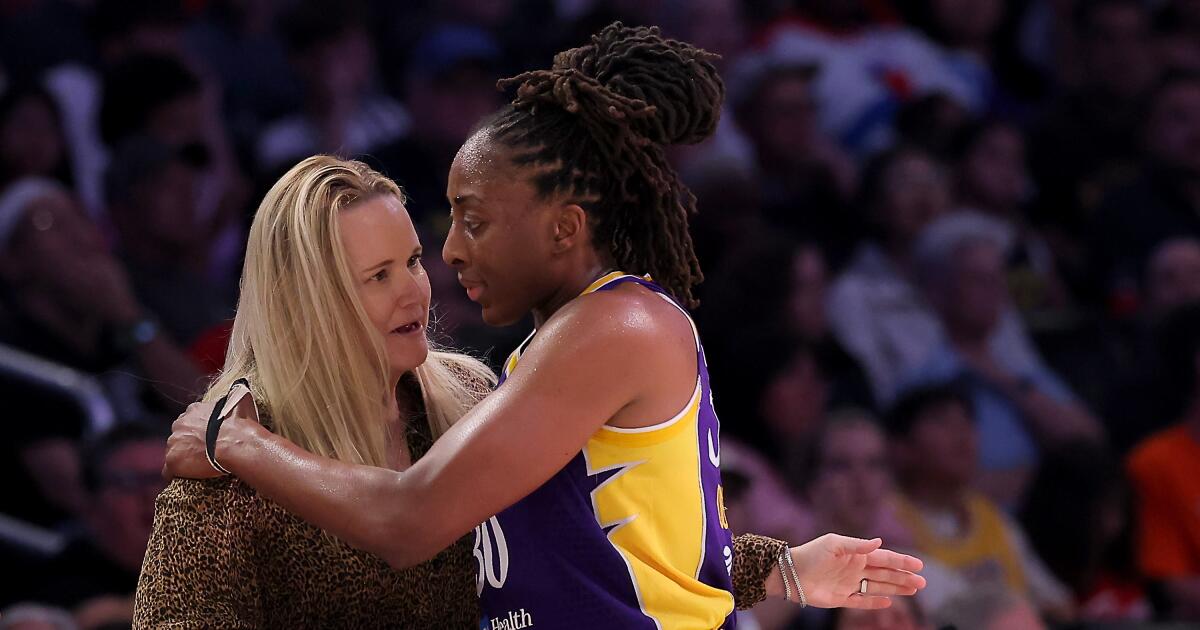
A day after general manager Raegan Pebley was fired, the Sparks were in Atlanta and seemingly still focused on trying to reach the playoffs this year.
The suggestion that Pebley’s removal was a sign that the team is performing poorly didn’t sit well with coach Lynne Roberts.
“I don’t think we underachieved last year and this year is still going,” Roberts said in Atlanta on Monday before the team’s loss to the Dream. “For where we want to get, that’s not where we want to be, but we tripled our win total in my first year — that’s not underachieving. We haven’t hit our stride, we’ve been injured all year. Hopefully we get [Kelsey Plum] and Cam [Brink] back. Our system is designed around KP. I’m not close to thinking we are underachieving.”
Pebley and the rest of the Sparks’ organization signaled a clear intention to compete this season, signing veterans Nneka Ogwumike and Erica Wheeler in the offseason, signing Dearica Hamby to a three-year deal and trading for Ariel Atkins.
The Sparks’ Rae Burrell protects the ball under pressure the Chicago Sky’s Natasha Cloud at Crypto.com Arena on July 10.
(Luiza Moraes / Getty Images)
They are still in the playoff race midway through the season, but have the second-worst defensive rating in the WNBA and sit a game below the postseason cutoff line.
They have competed without Plum, their top scorer, for 12 games and former No. 2 overall pick Brink during the past nine contests.
But even with their struggles, culminating in an 82-64 loss to Seattle on July 6, the Sparks responded well with consecutive home wins against Indiana and Chicago. After those games, Roberts seemed to think the team was moving in the right direction, but team owners made a major change.
The Sparks have a decision to make about how hard they want to push the rest of this season as the team flirts with missing the playoffs for a sixth consecutive season. With the trade deadline on Aug. 2, they could make some moves to improve this season or sell off their veteran assets and attempt to rebuild again.
The Sparks haven’t made the playoffs since 2020 and have made some controversial moves while trying to snap out of the slump.
In addition to the questionable trade of 2024 fourth overall pick Rickea Jackson to Chicago for veteran Atkins this offseason, Pebley traded the picks that would become Storm post duo Awa Fam and Dominique Malonga for Plum and Kia Nurse. In her sole season with the Sparks, Nurse averaged 7.6 points per game.
Pebley also traded the No. 8 pick in 2024 (that later was used to draft Alissa Pili) to Chicago for Julie Allemand and Li Yueru, then lost Allemand in the expansion draft. Yueru was sent to Seattle in the Plum trade and is now playing with Dallas. The Sparks’ 2025 first-round draft pick Sarah Ashlee Barker was left unprotected and went to Portland in the expansion draft.
The Sparks waived their top pick in this year’s draft, Ta’Niya Latson, after barely playing, and she has gone on to join Las Vegas. Sania Feagin, a 2025 first-round draft pick, was waived and signed with Portland.
Most of those moves, though, came after the Sparks lost the top spot in the 2025 draft lottery to Dallas, which selected Paige Bueckers with the No. 1 pick. Before the lottery result, it seemed like the Sparks — who went 8-32 in 2024 before that draft — were lining up for a youth movement led by Brink and Bueckers. A lineup of those three, a healthy Feagin, Barker and Allemand would be an entirely different kind of team.
Once that failed, they focused on adding veterans who could win now and have only managed modest improvement.
The Sparks have their next two first-round draft picks and four players still on rookie contracts after this season (Brink, Chance Gray, Kate Martin and Pili). Brink is their lone lottery pick left from their disappointing past six seasons. (Pili was a top-10 pick, but she has struggled to stay on a WNBA roster and just signed a player developmental contract with the Sparks this month.)
Pebley told The Times in an interview on Friday that she was open to making moves to compete at the deadline this year.

Players on the Sparks’ bench celebrate during a win over the Chicago Sky at Crypto.com Arena on July 10.
(Luiza Moraes / Getty Images)
“We are in a space where we are here to win,” she said. “This is a city that wants to win. We have an ownership that wants to win. You see what they’re doing with the Lakers. You see what they’ve done already with the Dodgers. … We have to always continue to invest in the roster. We have a responsibility to always listen and be aware of what’s out there.”
A league source not authorized to discuss trade conversations publicly told The Times that Pebley had been aggressive ahead of the deadline, and now teams are unsure what approach the Sparks will take moving forward.
“I found out when everybody else did,” Roberts said of Pebley’s firing. “It was a surprise. She’s a good friend of mine. I think the tone is set that we need to keep building and get the Sparks back to where they have been. That’s been the tone. Raegan did some great things for our org in that regard and improved a lot of things. That work can’t go undenied. It’s full-steam ahead and I’m focused on what I can do.”
It would be difficult to move some of their heftier contracts, especially since WNBA teams cannot take on more salary than their remaining cap space allows in a trade. Hamby, 32, is signed for two more years for more than $1 million per season. Atkins is also signed for two years at $1 million-plus and is having a career-worst offensive season, shooting 36.4% with 8.7 points per game.
Wheeler, 35, has another year left on her deal, but a $625,000 cap hit for a player who would be a backup point guard on most teams is a tough sell.
Plum and Ogwumike are on expiring deals, and the Sparks’ most valuable roster asset, Rae Burrell, is a restricted free agent, but one of the few young players left on the Sparks’ roster.
The Sparks have a limited $86,000 in cap space, too, so if they decide they want to buy at the deadline, they have to find a way to clear space.
They enter the trade deadline period in a difficult spot as a team in purgatory that just fired its general manager.
Yet what they decide to do in the next month might be the most clearest sign of their ambition and hope for the future.

NEWYou can now listen to Fox News articles!
ATLANTA — The FBI and Atlanta Police Department are getting ready for a massive security operation ahead of the World Cup semifinals between England and Argentina at Atlanta Stadium.
Both agencies have used drones to search for potential threats on the ground and in the sky. The FBI is enforcing the Federal Aviation Administration’s Temporary Flight Restrictions around the venue.
The FBI has confiscated more than 600 drones nationwide since the World Cup began. Special Agent in Charge of the FBI Atlanta Field Office Marlo Graham said 86 of those drones were seized in Atlanta.
Graham said the FBI uses a “mechanism” that allows agents to see unauthorized drones in restricted airspace. Agents then work to mitigate the threat posed by unknown drones.
“We’ve been able to safely land drones that have been unauthorized in the flight restricted area,” Graham said.
The FBI has confiscated more than 600 drones at World Cup events since the tournament started. (FBI Atlanta)
While the FBI treats every drone as a potential threat, Graham said the threat level can increase depending on the size of the drone and how close it gets to the stadium.
“Obviously, the closer to the venue, the larger the crowd. We are fortunate here in Atlanta that we have a closed dome stadium,” Graham said. “We don’t want the game to be impacted because a hobbyist couldn’t control their drone, and it lands right when one of our star players was getting ready to score a goal.”
EXCLUSIVE: FBI ADDS ALLEGED COVID FRAUDSTER TO MOST WANTED LIST
The Atlanta Police Department’s Drone Unit has helped the FBI track down people suspected of flying in restricted zones.
Sgt. Kindu Franklin said most of the people caught flying drones around World Cup venues are hobbyists with no intent to harm the crowd of soccer fans below.
“In some cases, they just recently bought a drone just for FIFA to get some of the cool footage that they want to put up on their social media,” Franklin said. “There are different ways that you can weaponize these drones. So, we’re operating in a proactive manner.”
The Atlanta Police Department’s drone mission at the World Cup focuses on surveillance. (FOX)
The Atlanta Police Department’s drone mission is focused on surveillance. Officers are looking for potential threats, traffic issues and people the FBI suspects are flying drones illegally.
“So, what we want to do is give our command staff a view that they can’t get from the ground,” Sgt. James Cunningham with APD’s Drone Unit said.
ARMED MAN ARRESTED AT US CAPITOL BARRICADE AS POLICE PROBE WHY HE DROVE ONTO RESTRICTED GROUNDS
Cunningham’s unit can launch drones remotely from handheld controllers. Other drones are launched from docking stations strategically placed across the city, and officers control them from the back of an SUV using a computer and a PlayStation controller.
The Atlanta Police Department launches some drones from docks strategically placed across the city. They are controlled by a computer and a PlayStation controller. (Fox News)
The drone docks are used year-round to help the police get an aerial view of emergency situations before officers arrive. The computer shows the drone pilot where all the police body cameras and vehicles are in the area, allowing them to communicate better with officers on the ground.
For the World Cup, the drone docks let the department have more eyes in the sky and respond to emergencies faster.
“It’s going to cut down time. We’re going to get there quick. And then you’re going to get an aerial perspective of what you can’t see on the ground,” Cunningham said.
The Atlanta Police Department launches some drones from docks to get more eyes in the sky and respond to emergencies faster. (Fox News)
Cunningham said the drone unit has completed more than 1,400 flights and logged more than 550 flight hours since the beginning of June.
“Some people haven’t even done that in years or haven’t even reached those numbers in the life of their drone unit,” Cunningham said.
“We train for the environment. We live here, so we know what to expect,” Anais Paredes, an APD drone pilot, said.
CLICK HERE TO DOWNLOAD THE FOX NEWS APP
The FBI is asking that hobbyist drone pilots know the Temporary Flight Restrictions in their area before taking off.
There is a one-mile restriction around World Cup stadiums on non-match days, and a three-mile restriction on game day.

LAS VEGAS — From the time Austin Reaves joined the Lakers in 2021 as an undrafted prospect, his basketball life centered around playing with a savant in LeBron James.
That no longer will be the case.
Reaves re-signed with the Lakers on a four-year, $180-million deal, but James decided to move on as he prepares to play an unprecedented 24th season.
Reaves was stunned when he heard about James’ decision while playing golf in Lake Tahoe. Nearly two weeks later, Reaves says he still is trying to process the development.
“I kind of was thinking about it last night when I got here,” Reaves said Monday in his first news conference since re-signing. “Starting the season without him being on the team is going to be different for me. He’s kind of all I’ve ever known. Just him being around, joking around, acting like he’s 15. But that’s his decision and like I said in Tahoe, anytime I’ve talked about it, I got nothing but love and respect for him and yeah, let’s play some golf soon.”
The contract Reaves signed was the richest in NBA history for an undrafted player. At 28 and entering his sixth season, Reaves wanted to stay in L.A.
“I wanted to be a Laker the whole time. We had that period from when the season ended until the first [of July] to get something done and we figured it out before then,” he said. “My heart was in L.A. the whole time.”
Reaves will become one of the de facto leaders of the Lakers along with Luka Doncic. The two once again will be one of the most dynamic backcourts in the NBA.
“Obviously my relationship with the guys that were on the team last year,” Reaves said of why he wanted to stay. “And then Luka. I mean, he’s one of my best friends on this planet. Talk to him almost every single day. He sends me videos of his golf swing and asks me what he can do to get better and I tell him I’m not a coach.”
The Lakers have overhauled the roster: All the players who started alongside Reaves in the playoffs last spring are gone. With the signing of former Brooklyn Nets forward Ziaire Williams on Monday, the Lakers have eight new players, all of them arriving either via trades, free agency or the draft.
“They’re good,” Reaves said of the moves. “Obviously, I’ve been with the guys that are leaving for a couple years and with Bron for five years and I hate to see guys like that go. But the pieces that are coming in, I’m very excited about and I’m happy to get started today and see where it goes.”
Walker Kessler dunks during a game between the Utah Jazz and Cleveland Cavaliers on March 23.
(Rob Gray / Associated Press)
One of those new players is Walker Kessler, a 7-foot-2 center the Lakers felt fit best around Doncic and Reaves because he’s a lob threat, rim-protector and good defender and is developing his three-point shooting.
The Lakers got him from the Utah Jazz in a trade and then signed him to a four-year, $130-million contract. The Lakers sent out two unprotected first-round picks (2031, 2033) and two first-round pick swaps (2028, 2030).
Kessler, who played only five games last season after having surgery to repair a torn labrum in his left shoulder, is aware the Lakers paid a big price to get him.
“It definitely makes you feel a certain way when you know an organization believes in you,” Kessler said Monday in his introduction. “And I think what they’ve invested, they’re showing that belief in a monetary value, not just with money, but like you said, assets. And for me, I’m somebody that if I know that they have that belief in me, I’m gonna run through a brick wall for them. That’s just how I’ve been wired my whole life and it definitely makes it a lot easier to go out there and compete for a team.”
Power forward Sandro Mamukelashvili could become a fan favorite, in part because of the tattoo he has on his lower left leg — a No. 24 in honor of Kobe Bryant.
Mamukelashvili, who signed a four-year, $52-million deal, averaged 11.2 points last season with the Toronto Raptors and shot 52.3% from the field, including 38.9% from three-point range.
“I got a Mamba Mentality tattoo. I just love his mindset,” Mamukelashvili said. “Growing up, I used to always say, “Mah-moo Mentality!’ So, I know it’s a little far from each other. But we are getting closer.”
When guard Collin Sexton, another new Laker, was drafted by the Cleveland Cavaliers in 2018, James left and signed with the Lakers. When Sexton signed a two-year, $19-million deal with the Lakers this month, James left again.
Sexton could only laugh about missing out on playing with James.
“He’s just leaving every time I arrive,” Sexton said, laughing. “That’s what it is. No, but one of the other coaches made the same joke yesterday. It’s cool, I know. I’ve always wanted to team up with him for sure, but it’s definitely cool knowing him and just having normal conversations and stuff, so that’s cool.”
Sexton averaged 15.4 points and shot 48.5% last season with Chicago and Charlotte. He’s ready for whatever role coach JJ Redick and the Lakers want for him.
“They believe in me,” he said. “And I just feel like at the end of the day, whenever a coach believes in you and like he said, he’s going to be hard on me and yelling and screaming at me. So, I like that. I think that’s what gets the best from me.”
-
 Business1 minute ago
A ‘next generation studio’ for YouTube creators
-
 Entertainment7 minutes ago
Finn Wolfhard is taking ‘control of the narrative’
-
 Lifestyle13 minutes ago
What are your most cherished memories of the 2026 World Cup in L.A.?
-
 Politics19 minutes ago
Commentary: Two Lorenzos from Mexico. One fulfilled his American dream. ICE killed the other
-
Sports31 minutes ago
What will the Sparks do next? The franchise is at a crossroads after firing its GM
-
World43 minutes ago
Euronews explains: can Hungary's PM Magyar really remove president Sulyok from office?
-

 News1 hour ago
Mexico files criminal complaints in US over migrant deaths in custody
-

 Videos3 hours ago
New explosions near Iranian port cities, says state media | BBC News

