Sports
How did curling become a Winter Olympics sensation? Inside the sports’ unique history

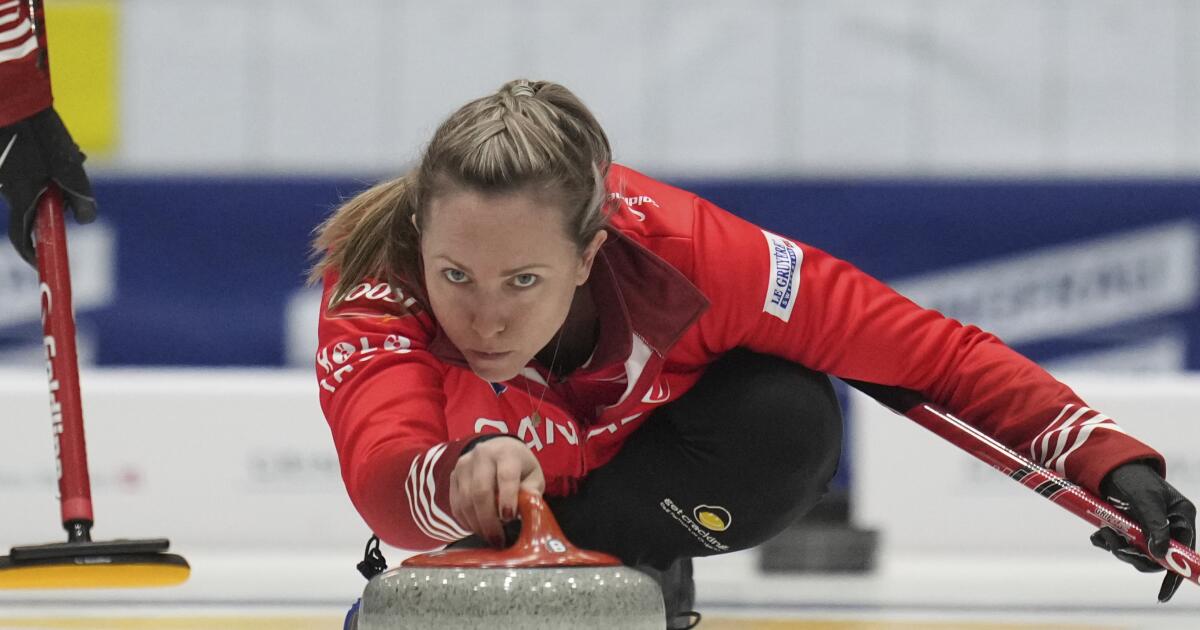
EDMONTON, Canada — Jason Hills grew up in a rural hamlet in southern Alberta so small there were no traffic lights. Which wasn’t a problem because there wasn’t any traffic either.
But there was a curling rink.
“There was nothing else really to do,” Hills said. “So if you weren’t curling you’d go hang out at the curling rink. It’s a community thing. It’s like everyone gets together.”
In much of the world curling is a curiosity, a sport which, like luge or the biathlon, surfaces every four years at the Winter Olympics — as it will do in February in Cortina D’Ampezzo, Italy — then quickly fades from view.
Canada’s Tracy Fleury (R) releases the stone during a gold medal match against Switzerland at the World Women’s Curling Championship in Uijeongbu on March 23.
(JUNG YEON-JE/AFP via Getty Images)
In Canada, however, it’s as much a part of the culture as poutine and maple syrup.
More than 2.3 million people — or one of every 18 Canadians — participate in the sport annually. That’s about 100 times the level of participation in the U.S. And more than 11 million Canadians watched the sport on TV in 2024, according to estimates from Curling Canada, the national governing body for the sport.
“It’s just embedded in the fabric of Canada,” said Elaine Dagg-Jackson, an Olympic bronze medalist and now one of Canada’s top curling coaches. “Canadians have a real identity with what curling is and what it stands for. It’s a gracious sport where people are being polite. They shake hands before and after the game.
“The curling rink was just a really good place to be in Canada. And still is. It just really suits the culture.”
The objectives of the sport are simple: Teams of two to four players slide 44-pound granite stones, also known as rocks, down a narrow 150-foot-long sheet of ice toward a target area called the house, aiming to get their stone closest to the center of the house. One or two players from the throwing team use carbon-fiber brooms to sweep the ice in front of the moving stone, influencing its path and speed.
A round of play ends when each team has thrown eight stones; in Olympic curling, a match consists of 10 ends, eight in mixed curling, with games typically lasting two to three hours.
The simplicity of the sport is both its charm and its curse. Because there is no running, jumping or lifting of heavy objects, everyone from young children to octogenarians can, and do, compete in amateur curling in Canada.
“It’s relatively inexpensive and it’s relatively accessible,” said Heather Mair, an associate professor at the University of Waterloo. “It’s not a hard sport to play and have fun at. It’s hugely entertaining. And you can really play your whole life.
“I don’t know too many sports you could go out with your grandfather and participate. It can be really family-oriented as a sport.”
But while it looks easy, to excel at the highest levels, where millimeters separate winners from losers in competitions that can stretch for as long as seven hours over multiple days, the sport requires surprising strength, stamina, precision and agility.

Canada’s Brett Gallant curls the stone during the 2022 Winter Olympics in Beijing on Feb. 17, 2022.
(LILLIAN SUWANRUMPHA/AFP via Getty Images)
“It definitely takes a toll on your body,” Rachel Homan, a three-time Canadian Olympian and three-time world champion, said during a break in training on a bright Edmonton morning. “That part of the game is maybe overlooked; the physical toll it takes. It’s definitely demanding.”
The curling events at February’s Winter Olympics will be held at the Cortina Olympic Stadium in Cortina D’Ampezzo, one of four event clusters in and around Milan. Canada, which has medaled in curling in every Olympics in the modern era, winning a record six golds, will send a dozen athletes — including Homan, the reigning world champion — to Italy to compete in the men’s, women’s and mixed doubles.
The U.S., which has won two Olympic curling medals, both in the men’s competition, will also have a dozen curlers in Italy competing in all three events. But if the sport is a national pastime in Canada, one that competes with hockey for fans and media attention, it remains something of an oddity in the U.S., where it draws huge TV audiences every four years during the Olympics, then fades from view until the next Winter Games.
“It’s so frustrating to see curling become the next best thing to sliced bread for a month and then it comes off the radar for four years,” said Korey Dropkin, a five-time U.S. champion and a 2023 world champion in mixed doubles. “I want to see something that’s on national television in the U.S. every week. I want to be able to expose our amazing sport to the U.S. audience day in, day out.
“I hope that in the near future we’ll be able to create more opportunities for exposure for curling.”
Curling was born in Scotland in the early 16th century but grew up centuries later on the Canadian prairies, where the severe weather, rural landscape and boredom provided fertile ground.
“In many parts of the country there’s long, long winters,” Dagg-Jackson said. “The farmers would be busy all summer, but in the winter they were looking for something to do. So the old adage in Canada is you could go to any town in rural Canada and find a grain elevator and a curling rink.”

Members of the Highland Curling Club, formed in 1898, play on flooded sheets of ice on Jan. 11 in Inverness, Scotland.
(Jeff J Mitchell / Getty Images)
The sport, which predates hockey by several decades, was brought to Montreal by Scottish emigrants during the colonial period, more than a half-century before Canada became a country. It then moved west as settlers pushed into what would become the central provinces, where the game was played on ponds and lakes before coming indoors.
In many ways the sport and the harsh conditions in which it thrived embodied the traditional values and traits — resilience, community, politeness, resourcefulness — that have come to define Canada’s unique “northern character.”
Mair, the Waterloo professor, has studied the role curling played in creating social and inter-generational connections and found the sport may have been more important from a mental perspective than from a physical one.
“I don’t know if you can appreciate what a Canadian winter is like, but anything that gets us out of our homes and talking to one another is really, really important,” she said. “We know how necessary it is that we spend time socializing with one another, especially in the dark winter days.”
As a result, it quickly became hugely popular, but for reasons that went beyond sport. Most curling rinks, Mair said, provide social spaces where players can visit with the people they’re competing against.
“So you’re sitting there for half an hour with people that you might never run into in any other part of your life and you start to build social relationships,” she said. “In really small rural communities, those are pretty essential. That’s kind of how it started.”

Aksarban Curling Club president Steve Taylor demonstrates how to push off the hack to deliver a stone in front of an all-ages group learning about the sport in Omaha, Neb., in 2018.
(Nati Harnik / Associated Press)
It’s also why the flat lands of Saskatchewan, Manitoba and Alberta became the earliest hotbeds of curling, which aligned well with the farming season. But the sport didn’t stay there. Curling clubs soon sprung up on Army bases and in fishing communities, in big cities and small towns, where it was taught in schools and played in retirement homes. (Curling has taken a different path in the U.S., where it has become popular in nontraditional winter-sports areas such as North Carolina, Florida, Texas and the San Francisco Bay area.)
“There were entire generations, for the most part, who really had a sense of the game,” Mair said. “The[re] were plumbers and carpenters and teachers, they had regular day jobs and yet they were these really talented athletes who would take the sport to these elite levels.
“So you could come from a teeny, tiny club and you might know someone who’s playing in the national championship.”
That romanticism inspired a radio play and novella by W.O. Mitchell, a writer and broadcaster who chronicled life on the Canadian prairies in the mid 20th century. In “The Black Bonspiel of Willie MacCrimmon,” which was also adapted for television, a cobbler from a small town in rural Alberta strikes a deal with the devil to trade his soul for curling success.

American John Shuster watches Matt Hamilton, center, and Colin Hufman, left, sweep his throw during a match against Canada at the Beijing Winter Olympics in 2022.
(Brynn Anderson / Associated Press)
But as curling moved from the prairies to the cities, the object lessons the sport taught changed as well. If Mitchell’s tale is a decades-old take on the timeless tug of war between good and evil, “The New Canadian Curling Club,” a 2018 comedy by playwright Mark Crawford in which four immigrants show up for a learn-to-curl class, is a modern exploration of multiculturalism and acceptance.
What the immigrants share, however, is a belief that understanding Canada starts with understanding curling.
“It’s weird and wonderful. And like all good things, it takes a little time to appreciate,” Mair, who teaches in the department of recreation and leisure studies at Waterloo, said of the sport. “At first glance you’re not totally sure what’s going on. And then as the layers start to kind of unfold, you realize just how interesting and complicated and engaging it can be.
“It’s fun. It really is. It’s quirky and fun. And I think we need more of that.”
But, she added, much of that has changed since curling entered the Olympics.
“We’re at a bit of a crossroads,” she said. “Elite sport is doing just fine in a lot of ways. [But] we need to have a different conversation about community sport. It’s not about a pathway to Olympic gold. It’s about rebuilding our communities and providing safe and accessible sports for everything. And curling is just so special in that way.”
Curling debuted in the Winter Games in 1924 with just three countries taking part; Great Britain, which fielded a team of Scottish curlers, won the gold medal. But the sport didn’t return to the official Olympic program for another 74 years and when it did, the exposure fueled interest in winter sports powerhouses such as China, Japan and South Korea, but also in Afghanistan, Andorra, Bolivia, the Virgin Islands, Kuwait and Mexico, which are all among the 67 members of the World Curling Assn.
“There’s a little bit of perception from America that curling is small potatoes. And it probably is compared to the big four sports,” said Marc Kennedy, a world and Olympic champion from Canada who will be competing in his fourth Olympics in Italy. “But it’s a big deal. Arguably one of the fastest-growing sports internationally. It’s massive in Asia. Some of our most popular athletes are from Japan.”
That added competitiveness — 30 countries attempted to qualify for this year’s Olympic tournament — has not only raised the stakes and professionalized the sport, it also threatens to crush curling’s gracious and polite traditions in a stampede for the top of the medal podium. In last spring’s world championship in Canada, for example, Chinese athletes were accused of touching a stone with a broom, kicking a stone and illegal sweeping — all forbidden acts.
In most other sports, that would have been considered gamesmanship. In curling, the accusations alone were an affront to the sport’s tradition and dignity.

Team Shuster’s Chris Plys throws the rock during the U.S. Olympic curling team trials in Omaha, Neb., on Nov. 20, 2021.
(Rebecca S. Gratz / Associated Press)
“In curling you always divulge that you broke a rule … and apologize,” said Dagg-Jackson, the former Olympian turned coach.
“It’s supposed to be a gentleman’s game. You’re supposed to call your own fouls,” added Chris Plys, a three-time U.S. Olympian. “Now we’re starting to see people doing questionable things.
“It’s sad because the best part of the game is just how honest everything is. And there’s people out there 1766935687 that are willing to do whatever it takes to win.”
Those athletes certainly aren’t cheating for the money since curlers, even at the highest level, have often had to work regular jobs to pay the bills. That could change this spring with the launch of the Rock League, the sport’s first professional competition, which will begin play shortly after the Milan-Cortina Olympics.
“The Rock League is going to be a huge new chapter to the sport,” said Dropkin, the Olympian who will captain the U.S. Rock League team. “That is going to present a whole lot of opportunities to curlers. Curlers now, curlers [in] the pipeline. They can actually make a living.”
The five-week circuit will feature six teams of five men and five women — one from the Asian-Pacific, two from Canada, two from Europe and one representing the U.S. — playing a variety of formats during stops in the U.S. and Canada. Competitors will not just earn money based on performance, but will receive salaries as well.
Historically the sport has relied heavily on prize money, which doesn’t go far. Kennedy’s winning five-man team at the 2025 Brier, the annual Canadian men’s championships, split $108,000 of the tournament’s $300,000 purse last March, which didn’t leave much after paying for travel and housing at the 10-day event.
The Dodgers will pay Shohei Ohtani more than that every time he comes to the plate over the next 10 seasons.
“I don’t think any of us get into curling with the idea of making millions of dollars,” said Kennedy, 43, a father of two who sold his frozen-food franchise 14 years ago to support his curling career. “You’ve got a lot of curlers out there that still play for the love of the game and for the opportunity to represent Canada at the Olympics or World Championships.
“If money was your motivation, then you’re probably in the wrong sport.”

Rachel Homan throws a rock during Canadian Olympic curling trials in Halifax, Nova Scotia, Canada, on Nov. 25.
(Darren Calabrese / Associated Press)
For Homan, 36, a mother of three young children who has traditionally relied on sponsorships, stipends from the national federation and winnings from underfunded tours such as the Grand Slam of Curling to make ends meet, the Rock League has the potential to change not only her life, but her legacy as well.
“In this league, being a part of it, might not mean anything for me financially right now. But it’s more about what you’re leaving behind and what you’re helping create,” said Homan, who will captain one of the league’s two Canadian teams.
Financing a professional league isn’t the only challenge curling will face coming out of the Milan-Cortina Games, though. Because while the Olympics may help the sport gather viewers, it has done little to reverse a steady decline in participation at the grassroots level, which is robbing the sport of its future athletes.
“It’s just hard to get young kids introduced to it and have access to it,” Kennedy said. “Back in the ‘50s, ‘60s, ‘70s and ‘80s it was the community center. Everybody kind of learned curling, especially out west. That’s what was driving a huge part of our sport for a long time.”
Not any more. Canada, like the U.S., has seen millions of people flee rural areas for big cities over the last several decades and as a result the local curling rink is no longer the civic hub it was when Jason Hills was growing up on the frigid plains of central Alberta. And what investment there is in the sport is now being directed to events such as the Olympics, the Grand Slam of Curling or the fledgling Rock League, not to building more community rinks.
“Curling had to pivot a bit,” said Dagg-Jackson, who takes her five grandchildren curling. “It used to be all about membership, about the thousands and thousands of curlers across the country. Now those few competitive curlers that shine in the spotlight are known to all Canadians because they’re on television all the time and they draw attention to the sport.
“Fifty years ago you just waited at the rink and people showed up because it was the place to be. Big events, Olympics, pro leagues, that’s the future of curling. But the culture and the lore, the history of curling, it’ll always be there.”



NEWYou can now listen to Fox News articles!
Israel’s national gymnastics team has suspended all training and team activities amid the recent Iranian counter-attack on the country following the U.S.-assisted strikes on Iran.
The Israel Gymnastics Federation (IGF) provided a statement to Fox News Digital announcing the violence has caused “unavoidable disruptions.”
“The current security situation in our region has resulted in unavoidable disruptions to our regular training schedule and has created significant uncertainty regarding the national teams’ professional plans, particularly as we are at the outset of the international season,” the statement read.
“At this time, all training activities have been temporarily suspended, pending approval from the relevant authorities to safely resume operations. Naturally, the suspension of training and the closure of airspace are causing considerable stress and concern. However, the safety and well-being of our gymnasts and professional staff remain our highest priority. We sincerely hope for safer and calmer days ahead, when we can focus solely on sport.”
A source within the team told Fox News Digital on Saturday that the gymnasts have been moving between bomb shelters since Iran’s counterstrikes began.
Israel’s gymnastics team is considered one of nation’s strongest Olympic programs alongside its Judo and sailing teams. The team is only a week removed from a successful trip at the Artistic Gymnastics World Cup in Germany, where the country’s star Artem Dolgopyat won the gold medal in floor gymnastics.
Now, the team will have to seek safety until the attacks are over.
The U.S. Embassy in Jerusalem has directed all U.S. government employees and their family members to continue to shelter in place either in or near their residences as Iran continues to fire missiles at Israel.
Additionally, the embassy announced that due to the security situation, it would be closed on March 2, and did not give an estimate on when it would be reopening. The closure includes consular sections in Jerusalem and Tel Aviv.
The embassy also said it is “not in a position at this time to evacuate or directly assist Americans in departing Israel.” It noted that Ben Gurion Airport remains closed and there there are neither commercial nor charter flights operating from the airport.
On Friday, ahead of the launch of Operation Epic Fury, the embassy gave all non-essential workers permission to leave Israel, with reports that U.S. Ambassador to Israel Mike Huckabee urged those looking to leave to do so as soon as possible.
Iranian airstrikes killed at least eight Israelis on Sunday as Tehran’s latest missile barrage landed just miles from Jerusalem.
The strikes landed in the Israeli city of Beit Shemesh. Initial reports said four people were killed when missiles landed in a residential area on Sunday, but that death toll rose to eight, according to Israel’s national emergency service.
CLICK HERE TO DOWNLOAD THE FOX NEWS APP
Iran’s military has carried out counterattacks against Israel and U.S. bases in the Middle East after a joint U.S.-Israeli strike killed Supreme Leader Ayatollah Ali Khamenei on Saturday.
The strikes also killed several other top Iranian leaders, including the head of the Iranian Revolutionary Guard Corps.
Follow Fox News Digital’s sports coverage on X, and subscribe to the Fox News Sports Huddle newsletter.

Local chapters of National Football Foundation and College Hall of Fame have begun honoring the top senior football student-athletes, with the Coastal Canyon area banquet set for Sunday in Agoura.
Players are selected based on their grade-point averages and leadership skills, among other attributes, honoring the best of the best.
Such players as James Moffat from Crespi, Mateo Bilaver from Chaminade, Jacob Paisano of Hart, Diego and James Montes from Granada Hills Kennedy will represent their schools on Sunday.
The Los Angeles chapter will hold its gathering in Manhattan Beach on Friday.
Simi Valley coach Jim Benkert has taken over running the Coastal Canyon group with dozens of individual student-athletes set to be honored.
This is a daily look at the positive happenings in high school sports. To submit any news, please email eric.sondheimer@latimes.com.
Sports
US Olympic hockey hero Jack Hughes opens up about support for women’s team amid backlash over Trump’s joke

NEWYou can now listen to Fox News articles!
Team USA Olympic hockey hero Jack Hughes spoke about his support for his country’s women’s hockey team after his team was the subject of backlash for laughing at a joke by President Donald Trump about the women’s team.
During an interview on ESPN’s “The Pat McAfee Show” Friday, Hughes opened up about his respect for the women’s team after McAfee appeared to reference the controversy by joking that Hughes and his teammates “hate” the women players.
“We are hanging out with them so much, the women’s team. We were supporting them. Like, we were at their games, they were at our games,” Hughes said.
Jack Hughes of the United States celebrates after a gold medal win during against Canadaat Milano Santagiulia Ice Hockey Arena during the Milano Cortina 2026 Winter Olympic games Feb. 22, 2026, in Milan, Italy. (Elsa/Getty Images)
Hughes then appeared to address the recent criticism of his team for its response to Trump’s joke.
“Like all these people talking, how many of them watched their gold medal game? Me and Quinn Hughes were at the game. We were at the game until like overtime ended on the glass, and we were jumping up and down so excited for these girls, so excited they won,” Hughes said.
“And how many of these people watched the gold medal game, watched their semifinals game? Like 10 of the 10 of our players went to their game in the round-robin. Like, we supported them so much, and we’re so proud of them. We’re so happy that they won, and they brought a gold medal back and that, you know, I said it, the men’s and women’s team both brought gold medals back. So, just unbelievable for USA hockey.”
Hughes, who scored the game-winning overtime goal against Canada to win gold, reflected on his interaction with the player on the U.S. women’s team who did the same, Megan Keller.
“Me and her had a great moment in the cafeteria after her gold medal game. We played Slovakia the next night, and it was like a late game. And we were in the pasta line — me and Megan. They were just getting ready to go out again, and I just gave her a massive hug, and I said, ‘I’m so happy for you. I’m so proud of you,’” Hughes said.
“A couple nights later, saw her again in the [cafeteria], and we took a great picture and, uh, she just gave me a big hug and was so pumped for me as well.”
Hughes told reporters after the game the first thing he thought about when the puck went in was Keller, who scored the golden goal for the United States women’s team against Canada three days earlier.
US WOMEN’S HOCKEY GOLD MEDALIST SAYS IT’S ‘SAD’ MEN’S TEAM HAD TO APOLOGIZE FOR OLYMPICS CONTROVERSY
The controversy surrounding the men’s team stemmed from a locker room phone call between the players and Trump right after their gold medal win over Canada.
Trump told the men’s team after inviting them to Tuesday’s State of the Union address that he’d “have” to invite the women’s team, otherwise “I probably would be impeached.” The team laughed in response, prompting immense backlash.
Several mainstream media outlets penned op-eds condemning the men’s team for laughing at the joke and then visiting the White House to celebrate and Trump’s State of the Union address.
The United States’ Jack Hughes (86), who scored the winning overtime goal, celebrates after defeating Canada in the men’s ice hockey gold medal game at the 2026 Winter Olympics in Milan, Italy Feb. 22, 2026. (AP Photo/Carolyn Kaster)
U.S. women’s hockey captain Hilary Knight said on Wednesday’s edition of ESPN’s “SportsCenter” that Trump’s “distasteful joke” has “overshadow[ed]” the women’s success.
“I thought it was sort of a distasteful joke, and, unfortunately, that is overshadowing a lot of the success, the success of just women at the Olympics carrying for Team USA and having amazing gold medal feats,” Knight said.
CLICK HERE TO DOWNLOAD THE FOX NEWS APP
“We’re just focusing on celebrating the women in our room, the extraordinary efforts, and continue to celebrate three gold medals in program history as well as the double gold for both men’s and women’s at the same time. And really not detract from that with a distasteful joke.”
Hughes’ mother, Ellen, a former Team USA player and current player development staff member, said the players only cared about “bring[ing] so much unity to a group and to a country.”
Follow Fox News Digital’s sports coverage on X, and subscribe to the Fox News Sports Huddle newsletter.
Related Article


Dems’ potential 2028 hopefuls come out against US strikes on Iran

Scientists make startling discovery when examining prostate cancer tissue

Israeli national gymnastics team suspends all activities after Iranian counter-attack

Tired of websites blocking your VPN? A dedicated IP fixes that
Commentary: The Pentagon is demanding to use Claude AI as it pleases. Claude told me that’s ‘dangerous’

Florida High School Football Rankings: Top 25 teams – Oct. 21

Cleary's 21 help Le Moyne down Central Connecticut State 69-64 in OT

How old is Bo Nix? What to know about Oregon quarterback ahead of 2024 NFL Draft

99th annual Pony Swim held in Virginia

Indiana Members Credit Union announced as new anchor tenant at Bottleworks District
Dems’ potential 2028 hopefuls come out against US strikes on Iran

At least nine killed after Iranian strike on Israel’s Beit Shemesh

Mass shooting at Austin, Texas bar leaves at least 3 dead, 14 wounded, authorities say

Mamdani’s response to Trump’s Iran strike sparks conservative backlash: ‘Rooting for the ayatollah’

Activists hail ‘historic’ EU’s decision on accessible abortion
-

 World3 days ago
Exclusive: DeepSeek withholds latest AI model from US chipmakers including Nvidia, sources say
-

 Massachusetts4 days ago
Mother and daughter injured in Taunton house explosion
-

 Montana1 week ago
2026 MHSA Montana Wrestling State Championship Brackets And Results – FloWrestling
-

 Denver, CO4 days ago
10 acres charred, 5 injured in Thornton grass fire, evacuation orders lifted
-

 Louisiana6 days ago
Wildfire near Gum Swamp Road in Livingston Parish now under control; more than 200 acres burned
-

 Technology1 week ago
YouTube TV billing scam emails are hitting inboxes
-

 Technology1 week ago
Stellantis is in a crisis of its own making
-

 Politics1 week ago
OpenAI didn’t contact police despite employees flagging mass shooter’s concerning chatbot interactions: REPORT