Sports
Explained: The Champions League draw, the Swiss Model and how selection is going digital


The Champions League proper returns next month and this season it will have a brand new format.
The ‘Swiss Model’ makes its debut and, as a result, the Champions League draw tomorrow (Thursday) is going to look rather different to the eight-groups-of-four setup we’ve all become used to in recent years.
So let The Athletic take you through everything you need to know about the draw and the new look for UEFA’s flagship club competition.
First, a quick recap. What is the Swiss Model and why are there so many teams now?
The new format has a ‘league phase’ rather than a ‘group phase’. It ditches eight groups of four and crams all the competing clubs together in one massive table. The format is based on the Swiss system used in chess, and does not require every team to play all of the others.
The number of teams participating increases by four, to 36, with each participant now playing eight matches in the first phase, instead of six in previous iterations. But instead of just three different opponents twice, home and away, teams will face a different team in every game.
In total, there will be 189 matches in the competition proper, capped by the final in Munich on May 31, up from the previous 125.
UEFA hopes the new format will lead to more competitive fixtures from the off, with bigger games earlier in the tournament because teams from pot one (aka, the big names) will play each other earlier rather than largely being kept apart until the knockout phase in February and March, as happened with the previous format. It will also give teams in pot four more of an opportunity to pick up points, because they will be playing two other sides from that pot among their eight matches.
Once the league phase has been completed, which will now take until late January, the top eight sides in the table will qualify directly for a 16-team knockout round, with the other eight places decided by a newly introduced set of two-leg play-offs contested by the teams who finish between ninth and 24th in the league.
The round of 16 and beyond will now be seeded, so the teams who finish first and second in the league phase cannot face each other until the final.
This season’s lineup will be completed tonight, with four clubs winning their places via the last of seven pre-tournament play-offs.
So how does this change the draw format?
Unlike previous years, where teams were drawn into eight groups from four pots, there will be four pots of nine this year, and they will all be seeded by coefficient. A club’s UEFA coefficient is a score based on the results of teams competing in the five previous seasons of the Champions League, Europa League and Conference League.
There’s one exception to that: the only club who won’t be seeded by coefficient are the Champions League title holders, in this case Real Madrid. They will be the first side drawn.
(Robert Michael/picture alliance via Getty Images)
Also, whereas last time every team was manually drawn, and there would be another manual draw to decide which group they would be put in, the draw will now be almost entirely automated.
All 36 teams will be manually drawn by someone on stage. But when a team come out of the ‘hat’, a button will be pressed and, hey presto, their eight opponents will appear. It will also say whether the team has been drawn to play at home or away (they’ll have four of each).
Each team will face two opponents from each pot, including two from the same one they are in.
This will be repeated until all 36 teams have been drawn. Every team will be drawn once but, as the process moves along, fewer sides will need to be assigned fixtures.
So can teams from the same nation face each other in the first phase now?
No. Or not this season, at least. It is no longer entirely impossible, in theory anyway. But the aim is to ensure that does not happen.
The new automated software will have to follow two UEFA rules. The first is that no club will face another from the same nation — unless there is the possibility of what is called a ‘deadlock’ situation; in other words, if it is impossible to avoid putting those teams together without stopping the draw. This is more likely to happen if one nation had a lot of clubs in the same pot, for example. But there is no risk of that for 2024-25.
The other rule is that it will only be possible to face a maximum of two teams from another association. So you won’t see Manchester City taking on all four Spanish qualifiers.

Manchester City’s group in last season’s draw (Valerio Pennicino – UEFA/UEFA via Getty Images)
Why has UEFA gone digital?
The main reason is to save time.
UEFA says that, if the entire draw was to be completed manually, around 1,000 balls would be spread across at least 36 bowls on stage and the whole process would take more than three hours.
Even digitally, drawing pot one is still expected to take 17 minutes.
“Based on rehearsals we have done, we are expecting some 35 minutes of a draw, which is exactly what he had before,” says Tobias Hedtstuck, UEFA’s head of club competitions and calendar, speaking at the body’s briefing on the new system for the media earlier this month.
That time does not factor in the draw’s presentation and sideshow events.
No changes there yet. Sorry about that.
Who is responsible for the software?
Now for the key question. Who has been crafting this mysterious technology?
UEFA has been working on this draw process for nearly a year. The software will be provided by AE Live, which was appointed as UEFA’s partner for all UEFA draws in September 2023 and tasked with developing and testing the software.
And what, you might ask, is AE Live? Well, it’s a company that works in live sport and provides graphic and technology solutions for the industry and has offices in eight countries.
“When it comes to our experience, we have our in-house teams which have a wealth of experience delivering live services across a range of sports, such as cricket, rugby, badminton and even kabaddi,” says Dave Gill, AE Live’s chief technology officer. “But we do have a particular strength in football, across both international and domestic competitions.”
AE Live has provided draw services for more than 20 years, including for the FA Cup, to FIFA, as well as for the International Olympic Committee and CAF, African football’s governing body. “We are very well qualified to provide this draw solution and to support UEFA in this exciting new development,” Gill says.
Global financial services company Ernst and Young has also been appointed to give an “extra layer of assurance and transparency”, according to Giorgio Marchetti, UEFA’s director of football and deputy general secretary. Ernst and Young have audited and monitored the development of the software, and its personnel will also observe and report on the draw operations itself.

Former England midfielder Joe Cole assists with the Champions League’s final manual draw last season (Claudio Lavenia – UEFA/UEFA via Getty Images)
And what happens if this software crashes?
There are fail-safes in place should issues arise, and also to ensure the draw remains feasible and there is no ‘deadlock’ scenario. That means the software has to ensure it’s still possible to find opponents for everyone else after a team is drawn. It assesses this itself when drawing opponents for a given club.
There are also two independent external checking systems.
“The role of these checking systems is to simply confirm what has already been established: that the rules of the draw have been followed and the draw remains feasible,” said Gordon Vince, chief software architect. “This checking takes no more than a second. As a result of that, we have extra confidence that the rules are being followed and that the draw remains feasible.
“Only then are the teams ready to be revealed.”
What about cyber-attacks?
AE Live says it is taking the risk of a cyber-attack seriously and has put several protections in place to keep the draw secure.
“The draw itself will be conducted in an entirely closed environment,” Gill says. “There will be no external access from external interference for a period of time before the draw and during the draw, so there’s no DDoS (distributed denial-of-service) attack (which can overwhelm the system and cause it to fail).
“Access to our code, and our code repository, are controlled through multi-factor identification. It’s a very limited amount of people who have access to our code. We’ve just conducted some penetration testing from an external third-party provider to make sure that we are, as a business, as secure as we can be. We’ve done additional risk assessments around the increased risk around cyber-attacks.”
Surely this fancy computer will be biased against (insert your club here)?
UEFA is also trying to ensure everyone feels comfortable with a process that is not visible, which could easily lead to conspiracy chatter.
“That’s why we appointed an external company (Ernst and Young),” says Marchetti, “to confirm not only that the software has been properly set up, and is purely random while respecting the couple of rules that we have, but also to observe the implementation and application of the software, as well as the procedures on the day of the draw.”
Ernst and Young staff will produce a report after the draw. In a statement, the company said: “In our opinion, in all material aspects, the software source code of AE Live selects and allocates football teams randomly and correctly, in accordance with the league-phase digital draw procedure defined by UEFA.”

Real Madrid’s Dani Carvajal brings out the Champions League trophy before the UEFA Super Cup win over Atalanta (Mikoaj Barbanell/SOPA Images/LightRocket via Getty Images)
What are the worst- and best-case scenarios for each club?
The final lineup for the draw won’t be confirmed until after those final four play-off second legs tonight, so only then will we know the final pot positions and risks for each of the 36 teams.
But we do have an idea about how likely it is that a club faces the hardest possible opponents (ie, the top two sides from each pot) and vice versa.
UEFA has estimated that the probability of either happening is 0.00006 per cent. UEFA says that in the previous iteration of the group stage, that probability was 0.2 per cent.
Doing it this way should make the league phase more competitive.
When will we find out the actual fixtures?
This is a key detail for those looking to book flights and hotels as early as possible.
The dates for the fixtures are not going to be released on the same day as the draw.
That information will be announced at some point on Saturday, August 31, in order to ensure the logistical and security dilemmas of the Europa League and Conference League, UEFA’s second- and third-tier club competitions can be taken into account, too.
“The opponents are selected pot after pot, but the order in which they are displayed does not mean the order of the (match) calendar,” says Marchetti. “The calendar will be decided based on different software; based on hundreds, if not thousands of constraints that we have, such as clubs who play in the same cities, or even the same stadium.”
Each team will play one game at home and one away against sides in each pot. UEFA is aiming to have a “fair and balanced split” between Tuesday and Wednesday matches as well, but this is not guaranteed.
UEFA also wants to spread out the competition’s “top matches”, for spectacle and sporting reasons.
“The key target is that in matchday one and two, or seven and eight, you (a club) should not play two pot-one teams in a row,” says Hedtstuck. “They should spread a little bit. We will try this for all 36 teams. The new system should have a more balanced calendar. Security constraints will have to be prioritised.”
How can we follow it?
The draw will be streamed live for free on UEFA’s website as well as broadcast on their broadcasting partner networks. Those will include TNT Sports in the UK and Paramount in the United States.
When and where is the draw?
The most important detail is saved until last.
The draw is to be held at the Grimaldi Forum, an exhibition centre in Monaco, on the south coast of France, and will be conducted at 5pm BST/12pm ET tomorrow (Thursday, August 29).
The Europa League and Conference League draws, both following the same 36-team format, happen there the following day at 12pm BST/7am ET and 1.30pm BST/8.30am ET respectively.
(Top photo: Rob Newell – CameraSport via Getty Images)



NEWYou can now listen to Fox News articles!
Russell Wilson has announced his retirement from the NFL after 14 seasons, a career highlighted by a Super Bowl victory with the Seattle Seahawks.
Wilson, a 10-time Pro Bowler and the 2020 Walter Payton NFL Man of the Year, announced his retirement in a video posted to social media.
A third-round pick by the Seahawks in the 2012 NFL Draft, Wilson became one of the league’s most recognizable quarterbacks, tallying 46,966 passing yards and 353 total touchdowns during a career that also included stints with the Denver Broncos, Pittsburgh Steelers and New York Giants.
Russell Wilson of the New York Giants walks off the field following the game against the Dallas Cowboys at MetLife Stadium on Jan. 4, 2026 in East Rutherford, New Jersey. (Ishika Samant/Getty Images)
This announcement from Wilson comes after he reportedly finalized a deal to become a CBS Sports NFL analyst. When news broke of his sports media deal, it was unclear if he wished to call it quits for his playing career, or simply take a season off to think about it. But Wilson posted a lengthy video on his social media, where he reflected on his time with the game and confirmed that he would be joining CBS Sports.
“I remember the moment I fell in love with football. Waking up before sunrise with my dad and brother. Deep post routes and ‘moon balls.’ Yeah, that’s where it all began. But somewhere along the way, my love for football turned into more than just passion. It was an obsession,” Wilson narrated as clips from his childhood to college, to the NFL Scouting Combine, to his career highlights.
Wilson found quick success in the NFL after a college career that began at NC State, but flourished at Wisconsin. He went 11-5 in his first NFL season, as the Seahawks quickly became a feared squad in the NFC.
EX-NFL STAR IMPLORES RUSSELL WILSON TO HANG IT UP ‘DO YOUR TV THING’
Accompanied by the “Legion of Boom” defense in Seattle, Wilson and the Seahawks walked into MetLife Stadium for Super Bowl XLVIII and put on a rout of the Denver Broncos, 43-8, to win the Vince Lombardi Trophy. It was just the second season for Wilson, who cemented himself as the future at quarterback for Seattle under head coach Pete Carroll, who he shouted out in his video.
“To Coach Carroll, thanks for taking a chance on the young, 5’11″ black kid from Richmond, Virginia who was told he was too small to ever make it in the NFL. We knew what winning was like,” Wilson said.
Wilson wasn’t able to win the trophy again, ultimately falling to the New England Patriots in Super Bowl XLIV in heartbreaking fashion. Instead of running with Marshawn Lynch on the goal line, the Seahawks infamously chose to pass, and Wilson was picked off by Malcolm Butler to seal victory for yet another Tom Brady ring.
Seattle Seahawks quarterback Russell Wilson passes during warm-ups before an NFL football game against the St. Louis Rams, Sunday, Dec. 30, 2012, in Seattle. (AP Photo/Elaine Thompson)
In 10 seasons with Seattle, Wilson had 37,059 passing yards with 292 touchdowns and a 104-53-1 overall record. Wilson told Seattle fans, “You raised me,” in his video.
It wasn’t as sweet for Wilson once he was traded to the Broncos before the start of the 2022 season, as he started to face some serious adversity and public rifts with head coach Sean Payton. Wilson went 4-11 in his inaugural season with Denver, and after going 7-8 in 2023, the team moved on despite his massive contract looming.
As a result, Wilson took a veteran minimum deal to join Mike Tomlin and the Steelers during the 2024 campaign. He went 6-5 in his starts, earning his 10th and final Pro Bowl bid. The Steelers made the playoffs, but didn’t make it out of the Wild Card Round.
Finally, the Giants signed Wilson before the start of the 2025 season, though they drafted Jaxson Dart out of Ole Miss to be his successor. That quickly changed after just three starts for Wilson, as Dart took over in Week 4 against the Los Angeles Chargers. Wilson never regained the starting role, though he was as classy as ever, talking about his mentorship of Dart.
Throughout the years, Wilson enjoyed working with every coach, teammate and the fans of each franchise across his football journey.
New York Giants quarterback Russell Wilson waves to fans after the game against the Dallas Cowboys at MetLife Stadium in East Rutherford, N.J., on Jan. 4, 2026. (Vincent Carchietta/Imagn Images)
“To every teammate I’ve had the privilege of sharing the locker room with, thank you for the sacrifices, the brotherhood, the memories. None of this is possible without you,” he said.
“To every fan who supported, through the highs and the lows, your belief, your energy and your passion meant more than you’ll ever know.”
Follow Fox News Digital’s sports coverage on X and subscribe to the Fox News Sports Huddle newsletter.
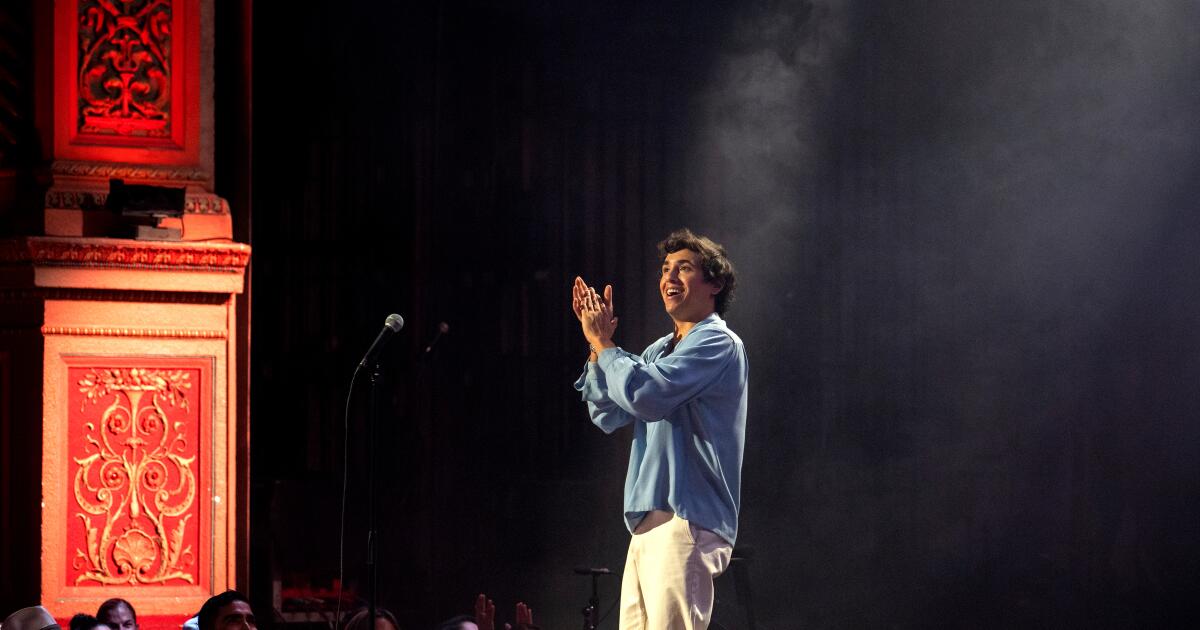
Comedian and “Saturday Night Live” standout Marcello Hernández will host this year’s ESPY Awards, ESPN announced Wednesday.
The event, honoring excellence in sports performance, will be broadcast live on ABC and the ESPN app from the David H. Koch Theater at Lincoln Center on July 15, making it the first ESPYs in New York City since 1999. For the last 25 years, the awards ceremony was held in Los Angeles.
“I started doing comedy 10 years ago, in Cleveland, Ohio, and I would take the train 12 hours to New York to sell comedy tickets on the street in Greenwich Village in exchange for stage time,” Hernández said in a statement. “It is an honor, and frankly feels crazy to be hosting the ESPYs this year in New York. I’m sure the energy is going to be great.”
Hernández recently headlined the biggest Spanish-language comedy show ever at the Hollywood Bowl as part of the Netflix Is a Joke Festival in May, and wrapped up his fourth season of “SNL” soon after. His first stand-up special, “American Boy,” premiered on Netflix in January.
He’s also a sports enthusiast, having grown up playing soccer and competing at the collegiate level during his time at John Carroll University in Ohio.
“Marcello is one of the most electric, young comedians today. His genuine enthusiasm for sports and his ties to New York City make him a natural fit to host this year’s ESPYs,” Craig Lazarus, ESPN vice president and executive producer of the ESPYs, said in a statement.
Hernández succeeds last year’s emcee, comedian Shane Gillis, as well as past hosts that include Jimmy Kimmel, John Cena, LeBron James and Peyton Manning.
In January, Puck reported that the change in venue is an effort to capitalize on the popularity of Fanatics Fest, the massive sports festival taking place in New York’s Javits Center from July 16-19, which also coincides with the World Cup final on July 19 at MetLife Stadium in New Jersey.
“This return to the heart of Manhattan brings the celebration of sports back to its roots for an unforgettable night at an iconic cultural landmark,” an ESPN spokesperson said in a statement.
Sports
AJ Brown trade outcome: Dianna Russini paid a heavy price while Mike Vrabel emerged unscathed

NEWYou can now listen to Fox News articles!
Mike Vrabel and A.J. Brown were winning on Tuesday because the long-rumored trade that reunited them was finally complete. Brown was free of his recent unhappiness with the Philadelphia Eagles, while Vrabel spoke easily and smartly about how his Super Bowl team was getting better.
It was one lovely victory lap for everybody.
Except for Dianna Russini.
New England Patriots head coach Mike Vrabel celebrates after the AFC championship game against the Denver Broncos at Empower Field At Mile High in Denver, Colo., on Jan. 25, 2026. (Cooper Neill/Getty Images)
MIKE VRABEL BREAKS HIS SILENCE ON DIANNA RUSSINI CONTROVERSY
Yes, this is about her as much as Vrabel and Brown. Those three names will be linked for a long time in NFL circles based on what happened going back as far as September of 2025, and then definitely through this offseason that was about, well, the relationship between the coach and the reporter.
If you aren’t up to speed on that relationship, you’ve got homework. And you will probably catch up easily because the reference material is everywhere — the photos of Russini and Vrabel together, the denials of anything untoward between two married people, the collapse of the professional friendship narrative, and everything after.
So, to the uninitiated, you’re excused. Go now and read the soap opera’s opening chapters. Because this might be the saga’s end, barring a major surprise.
And let me cut to that end:
Philadelphia Eagles wide receiver A.J. Brown walks on the field during an NFL training camp in Philadelphia on July 29, 2025. (Matt Rourke/AP Photo)
Brown wins. He’s wholly unscathed, in fact, and happy as a clam with a new team he grew up adoring.
Vrabel wins, too. Yes, he took some lumps, suffered some humiliating moments in front of reporters and had some family conversations he termed “very difficult,” but he’s ultimately none the worse for wear.
And then there’s Russini. She lost. Big time.
FORMER NFL REPORTER MICHELE TAFOYA WEIGHS IN ON WHY RUSSINI’S CREDIBILITY IS GONE
It was saddening to watch Vrabel’s presser because it was Russini who first reported teams were calling the Eagles about Brown back in September of 2025. She first reported the Eagles weren’t interested in trading Brown.
Russini called it when she told everyone the Patriots were interested (so were the Los Angeles Rams, by the way). And she was right again when she said earlier this year that Brown wouldn’t be traded around the start of the league year in March but watch out for June.
She was dead-on accurate with practically all of it.
Dianna Russini, left, and Mike Vrabel, right, are shown in a split composite image featuring Russini with an ESPN microphone and Vrabel on the Titans sideline wearing a headset. (Imagn Images)
But everyone has surmised all that information came out of her relationship with Vrabel. All that insider work came from other alleged inside work.
Russini’s information was great but how she seemingly attained it eventually led to her resigning from The Athletic. And sullying her professional reputation.
Losses.
MIKE VRABEL STEPS AWAY INDEFINITELY TO SEEK COUNSELING
Vrabel? He seemed just fine on Tuesday.
About the hardest thing he had to do was answer a question about Brown’s obvious displeasure last year in Philly.
“I don’t know what happened,” Vrabel said. “I’m not trying to figure out what happened in Philadelphia. I’m trying to focus on what’s going to happen here and trying to get him acclimated to what we do and how we do it.”
Vrabel, during this press conference, congratulated a reporter for winning a marathon. He thanked Executive Vice President for Player Personnel Eliot Wolf for making the trade happen. And he took a bunch of football questions.
Dianna Russini attends the 2026 Fanatics Super Bowl Party at Pier 48 in San Francisco, California, on Feb. 7, 2026. (Cindy Ord/Getty Images)
CLICK HERE TO DOWNLOAD THE FOX NEWS APP
There was not one question about whether he indeed for months leaked to Russini details of where the Patriots and Eagles talks were. Not one question about how his family “counseling” sessions are going or if his marriage is certain to survive.
There was nothing uncomfortable because it seems the local media lost interest or its curiosity on a day the story that Russini beat them on for months was laid bare before them.
And, the thing is, if Vrabel didn’t have to sweat this occasion, he’s probably in the clear. He’s not likely to get tough questions about the whole affair (pardon the pun) again unless more facts come out that raise the issue from the grave.
So, yeah, Mike Vrabel has survived. He’s won.
FOLLOW ARMANDO SALGUERO ON X: @ARMANDOSALGUERO
-

 Boston, MA2 minutes ago
Clover plans to reopen some locations after sudden closure, thanks to an anonymous investor
-
 Denver, CO6 minutes ago
New report finds Denver metro home buyers and sellers experiencing ‘unattainability fatigue’
-

 Seattle, WA14 minutes ago
Seattle mayor grilled over public safety, affordability, CCTV
-

 San Diego, CA16 minutes ago
Automated license plate readers and public surveillance cameras are coming to Imperial Beach
-

 Milwaukee, WI22 minutes ago
Friends, family gather to remember gunshot victim Pepe Sikisi-Belle Jr.
-

 Atlanta, GA29 minutes ago
As FIFA World Cup nears, some MARTA riders raise safety concerns after recent attacks on transit system
-

 Minneapolis, MN32 minutes ago
Minneapolis leaders split over ShotSpotter contract
-

 Indianapolis, IN37 minutes ago
Work completed on $3 million restoration of fountains at Garfield Park

