Sports
‘Double Vision’: How an NHL goalie inspired Foreigner’s arena-rock megahit


The lyrics to both verses were finished, and the first line of the chorus — Fill my eyes — was in place. Lou Gramm and Mick Jones, the driving forces behind Foreigner, one of the best-selling rock bands in history, had worked through the melody enough to know they had another hit on their hands.
It was the fall of 1977, and the band was in a New York City studio working through songs for the follow-up album to the self-titled “Foreigner,” which launched them to fame a year earlier. The new record didn’t have a title, and the song they were most excited about had everything, as Gramm put it, “except a hook and a name.”
“It was quite frustrating,” Gramm told The Athletic. “I could not find the words or a phrase that would culminate what I was singing about in the verses. I wasn’t even wrestling with words, really. I was just drawing a blank.”
Artists and athletes have always mingled, and the 1970s and ’80s were particularly wild times in New York City, where Studio 54 became the celebrity haven. Gramm and Jones became friends with several actors and pro athletes, Gramm said, but they got along best with members of the New York Rangers, including goaltender John Davidson.
There’s no way Gramm could have expected his passion for hockey, and his friendship with Davidson, to pay such dividends as he waited for inspiration to strike so he could complete his favorite track. Then, one evening at the Atlantic Recording Studios in New York City, approximately 1 1/2 miles north of Madison Square Garden, it struck in the form of vulcanized rubber.
“I was inside my vocal booth, this little two-by-three cubby hole,” said Gramm, now 74. “They put you in a soundproof booth so that the music of the band doesn’t leak into your vocal tracks. I had a little eight-inch TV taped to the upper left-hand corner of this little booth, and I would turn it on ever-so-quietly so I could watch the Rangers between my takes.
“John Davidson came out of the net to play a puck and one of the other (opposing) guys conked him. He went down hard. There was a fight, and a couple of the (Rangers) stood around (Davidson) to protect him while he was down. I remember the trainers came out to help him to the bench so he could get checked out.”
In today’s NHL, Davidson would almost certainly have been removed from the game. Back then, it was largely the player’s decision. “I got dinged and stayed in,” Davidson said. “That’s what we did in those days.”
On the Rangers’ TV broadcast, it was announced — likely by then play-by-play voice Jim Gordon or commentator Bill Chadwick — that Davidson had complained of “double vision” on the bench before he re-entered the game.
Gramm, hearing that, immediately reached for his pen and paper.
“I’ve told John this a number of times,” Gramm said. “When he got hit, as frightening as it was, as terrible as it was, it triggered something in my imagination that set off the chorus.
“I knew we had something with that song already. I just knew it, but this was the final piece. I’m in the vocal booth, where I’m supposed to be singing, but instead I’m writing these lyrics as fast as I can. The words started flowing like water. It came out of me quick, faster than I could write, which is how it’d go sometimes.
“I finished, stepped out of the booth, and said, ‘Guys, guys, guys. I’ve got this. I’ve got the chorus.’ And when we finally put it all together, it was unbelievable.”
Fill my eyes with that double vision,
No disguise for that double vision,
Ooh, when it gets through to me,
It’s always new to me,
My double vision gets the best of me
The album was released in June 1978, peaked at No. 3 on the Billboard charts, and sold over 7 million copies, making it the band’s best-selling record. The song “Double Vision” was released three months later, in September, and peaked at No. 2 on the charts, then the highest-charting single for Foreigner.
Pretty wild, considering it almost didn’t get finished in time to make the album.
“It’s a great combination of words,” Jones, now 80, wrote in an email exchange with The Athletic. “It came together pretty quickly. It was such a great song and such a great title that it spurred us on to record the song and name the album after it.
“There are times where the lyrics come first, then the music. Sometimes it’s the music, then the words.”
But this time was different. Call it divine intervention by the hockey gods.
J.D. … a storied career
Davidson has had an almost unrivaled 50-year career in pro hockey as a player (St. Louis Blues and Rangers), a Hall of Fame broadcaster both with the Rangers, “Hockey Night In Canada” and other national outlets, and as an executive who has served as club president for three franchises: the Blues, Rangers and Columbus Blue Jackets.
Last summer, when the Blue Jackets hired president and GM Don Waddell, Davidson stepped down to become senior advisor, and he’s filled in this season when Blue Jackets TV analyst Jody Shelley is on the road broadcasting games for Amazon Prime Video. Davidson’s next game is Monday, when the Jackets play the Islanders in New York.
It’s no surprise, given his broadcasting chops, that Davidson is a master storyteller. It helps, of course, when you have some incredible stories to tell.
Davidson and the Rangers were still weeks away from training camp when “Double Vision” was released. The song was impossible to miss in the U.S., but also in Canada, where it reached No. 3 on the charts. Davidson, a Canadian, remembered hearing and liking the song when he heard it almost hourly on the radio.
But he had no idea he had a role in it until he arrived back in New York before the season.
“All I knew is that it was a great rock and roll song,” Davidson said. “I had somebody with the Rangers come up to me and say, ‘You have to see this.’ It was a review of the song or the record — somebody had written about it — and it mentioned the whole deal about me getting hit and hurt and how Lou took that and used it.
“Pretty incredible. After that, Lou and I talked about it quite a bit. He was around a lot, and we became pretty friendly. He’d play in some charity games, sing the national anthem before Rangers games. We goofed around a little bit. Really good guy.”
The season after “Double Vision” came out, Davidson helped carry the Rangers to the Stanley Cup Final, where they lost to the Montreal Canadiens in five games. They became the toast of the town that spring, and Davidson could be called the toastmaster. He loved music, and musicians loved him.
To his knowledge, Davidson joked, “Double Vision” is the only song that he inspired. But the stories are staggering.
“We went out after games all the time to see musicians playing,” Davidson said. “I went with Diana (his wife) to a place called the Lone Star Cafe to see a group called The Byrds. They were great, and the venue was so small it was like they were playing in your living room.
“After they played a bunch of songs, they called out for somebody to join them, and the guy sitting next to us gets up and goes down to join the band. It was Jerry Garcia.”
Davidson became especially close with Glenn Frey of the Eagles, with whom he shared an agent (Irving Azoff). They’d frequently end up back at Azoff’s house, but one night something special happened.
“Irving has a cassette in his hands — that’s how long ago this was, right, a cassette! — and he wants to play us this song he’d recorded earlier in the day that he thinks is going to be huge,” Davidson said. “He puts it in, presses play, and it was Jimmy Buffett’s ‘Cheeseburger in Paradise.’ Nobody had heard it yet. How wild is that?”
Davidson once got a 6 a.m. wake-up call during a Rangers road trip in Vancouver. It was from Frey, who was partying with Buffett and others in Aspen, Colo., and lost track of time.
Davidson was so close with Frey that in the summer of 1978, when the Eagles were touring to promote “Hotel California,” they allowed Davidson and his crew to sit on the stage one summer night in Calgary, just out of view of the crowd in old McMahon Stadium, which sat roughly 30,000.
“We were 20 feet from the band,” Davidson said. “I’d played in front of crowds before, but that many people so into that band … the wave of energy that comes up to the stage feels like a wind.”
And there was another memorable night that was quite a bit calmer.
“I got a call from (New York author) Larry ‘Ratso’ Sloman. It was around Christmas,” Davidson said. “He said ‘Come into the city with Diana, we’re going to go over to Joni Mitchell’s condo and we’re going to have dinner at her place.’ So we did.
“She, truly, was one of the nicest ladies we’d ever met. Just wonderful. Just like you’d expect, right? We spent half the night making homemade decorations for her Christmas tree.”
Davidson’s fame extended way beyond the rink. He did Miller Lite ads in Canada just after his career ended. He was the voice of EA Sports’ NHL ’97. He was the announcer in the 1999 movie “Mystery, Alaska,” and even appeared a few years earlier in an episode of the sitcom, “The Nanny.”
Where does “Double Vision” rank? Hard to say, Davidson said. But the song, nearly 50 years after it was released, is still played on classic rock radio stations. It’s been streamed nearly 40 million times on Spotify, which says Foreigner averages 17.9 million monthly listeners. The “Double Vision” video has been watched more than 5 million times on YouTube.
“My relatives — the cousins, nieces and nephews especially — they think it’s pretty cool,” Davidson said. “They probably don’t believe me at first. I tell them I’m famous because I got hit in the head with the puck.”
Faded memories
It’s been almost 50 years since “Double Vision” was written and recorded. Davidson was part of the story, sure, but he wasn’t present when Gramm got his burst of creativity and finished the song. Gramm remembers the moment he heard the words “double vision,” but the rest of the details are foggy.
Gramm has said repeatedly that the Rangers were playing the Philadelphia Flyers, which makes sense, because that was the heyday of the Broad Street Bullies. Those Flyers, who loved to fight and intimidate, would run an opposing goalie just out of sheer boredom. He’s also been certain that Davidson left the game for the second-string goalie.
But Davidson played only three of the Rangers’ six games against the Flyers during the 1977-78 season: a 3-3 tie on Dec. 7 and a 2-2 tie on March 15, both in the Garden, and a 3-0 loss at The Spectrum on April 6. But Davidson started and finished all three of those games for the Rangers, meaning he couldn’t have left the game with an injury.
The April 6 game in Philadelphia is the type of game that would make sense. At 15:38 of the second period, all hell broke loose between the Flyers and Rangers, resulting in 88 penalty minutes. Davidson and his Flyers counterpart, Bernie Parent, were each penalized for “goalie leaving the crease” and Davidson got an extra two minutes for roughing.
But Davidson never left that game, either. Plus, “Double Vision” — the album and the song — had already been recorded at a studio in Los Angeles, ready for release just two months later.
Jones has heard Gramm’s account, but he remembers it differently. “I recall that Lou and I were at a Rangers playoff game,” he said. That would jibe with the New York Rangers’ account.
The Rangers played the Buffalo Sabres in a qualifying series, but Davidson played only in Game 2 of that series — the Sabres won in three games — and he never left the ice.
Others have suggested it occurred in a game vs. Montreal. Davidson tells the story that he was struck in the mask by a puck (which matches the Rangers’ account) but Gramm insists it was an elbow or a collision when Davidson came out to play the puck.
The NHL, at the request of The Athletic, found 22 games in which Davidson started a game but didn’t finish. In only one of those, according to Stuart McComish, the league’s senior manager of statistics and research, did Davidson return to finish the game. That occurred on April 3, 1976 — two years earlier — against the New York Islanders.
At this point, the mystery only adds to the story.
“There were two or three games in my career where I got clunked in the head, when you get rattled a bit,” Davidson said. “It was probably one of those, right?
“To be honest, though, I’m not sure it really matters. It’s a hell of a song and a hell of a story.”
Foreigner, which sold 80 million records worldwide, was inducted into the Rock & Roll Hall of Fame in Cleveland last October. Gramm and Kelly Clarkson made a duet out of the band’s biggest hit, “I Want to Know What Love Is,” but Jones was not able to attend because of declining health.
Davidson said he watched the induction ceremony. When a medley of Foreigner’s hits were played, he smiled at one song in particular. That’s how it goes every time he hears “Double Vision” on the radio, in a hockey rink, a shopping mall, etc.
Gramm and Davidson spend their winters in Florida. Gramm is in Sarasota, Davidson is in Naples, approximately 115 miles apart. They’re hoping to meet up for lunch someday.
“It’d be awesome to see my old friend again, wouldn’t it? Tell him I’ll buy lunch,” Gramm said with a chuckle. “That’s the least I can do.”
(Illustration: Demetrius Robinson / The Athletic; Photos: Manny Millan / Sports Illustrated via Getty Images, Rick Diamond / Getty Images)



CHICAGO — Dodgers superstar Shohei Ohtani was out of the lineup Friday against the White Sox after exiting the game before with discomfort in the back of his left knee.
Manager Dave Roberts said Ohtani had imaging done on the knee and showed “the normal wear and tear.”
“He feels fine-ish,” said Roberts, who hopes Ohtani will be back in the lineup this weekend. Ohtani remains in line to make his next pitching start on Wednesday against the Tampa Bay Rays at Dodger Stadium.
Especially at this point in the season, the Dodgers have incentive to play it safe with Ohtani’s recovery. Pushing him to return early and exacerbating the injury would be a larger blow to a team seeking its third straight World Series championship.
With Ohtani out, left fielder Alex Call was in the leadoff spot, and Santiago Espinal served as the designated hitter.

NEWYou can now listen to Fox News articles!
With the largest World Cup field in the history of the tournament, 32 of the 48 teams will be fighting for a spot in the knockout stage.
66.6% of nations will advance out of the group stage this summer, which is a massive upgrade from 50% in past World Cups. Because of this, sportsbooks have adjusted with less favorable odds.
Prior to the start of the tournament, Spain, Argentina, Brazil, England, and Germany entered with the strongest odds to advance from the group stage, supported by recent major-tournament success and talent-rich rosters.
All five nations are heavily favored at -10000 to advance to the knockout round.
The Spaniards are the defending European Champions while the Argentinians are looking to win back-to-back titles. Germany has not made it out of the group stage in the last two World Cups, but has always been a perennial contender— having won four titles in its history. And then of course there’s Brazil, which has more titles than any country with five.
Now, after the conclusion of the first day of the World Cup, Mexico has joined the group at the top. El Tri has surged to -10000 to advance to the knockout stage after initially being just -1400. Mexico’s huge leap up the oddsboard is a direct result of its dominating 2-0 win over South Africa.
With that in mind, let’s dive into the odds for each team to advance to the knockout stage of the 2026 FIFA World Cup as of June 12.
This page may contain affiliate links to legal sports betting partners. If you sign up or place a wager, FOX Sports may be compensated. Read more about Sports Betting on FOX Sports.
Odds to Advance to Knockout Stage
Spain: -10000 (bet $10 to win $10.10 total)
Argentina: -10000 (bet $10 to win $10.10 total)
Brazil: -10000 (bet $10 to win $10.10 total)
England: -10000 (bet $10 to win $10.10 total)
Mexico: -10000 (bet $10 to win $10.10 total)
Germany: -10000 (bet $10 to win $10.10 total)
Portugal: -5000 (bet $10 to win $10.20 total)
France: -5000 (bet $10 to win $10.20 total)
Belgium:-3500 (bet $10 to win $10.29 total)
South Korea: -2500 (bet $10 to win $10.40 total)
Switzerland: -1800 (bet $10 to win $10.56 total)
Netherlands: -1400 (bet $10 to win $10.71 total)
Morocco: -1000 (bet $10 to win $11 total)
Colombia: -1000 (bet $10 to win $11 total)
Uruguay: -1000 (bet $10 to win $11 total)
Canada: -1000 (bet $10 to win $11 total)
Ecuador: -900 (bet $10 to win $11.11 total)
Norway: -900 (bet $10 to win $11.11 total)
United States: -750 (bet $10 to win $11.33 total)
The U.S. men’s national team is currently -750 to advance from Group D (Photo by Omar Vega/USSF/Getty Images).
Croatia: -500 (bet $10 to win $12 total)
Austria: -500 (bet $10 to win $12 total)
Türkiye: -500 (bet $10 to win $12 total)
Ivory Coast: -500 (bet $10 to win $12 total)
Japan: -500 (bet $10 to win $12 total)
Egypt: -340 (bet $10 to win $12.94 total)
Algeria: -310 (bet $10 to win $13.23 total)
Scotland: -310 (bet $10 to win $13.23 total)
Senegal: -230 (bet $10 to win $14.35 total)
Sweden: -230 (bet $10 to win $1435 total)
Bosnia and Herzegovina: -220 (bet $10 to win $14.55 total)
Paraguay: -205 (bet $10 to win $14.88 total)
Iran: -200 (bet $10 to win $15 total)
Czechia: -165 (bet $10 to win $16.06 total)
Ghana: -140 (bet $10 to win $17.14 total)
Australia: -110 (bet $10 to win $19.09 total)
DR Congo: +100 (bet $10 to win $20 total)
Raúl Jiménez helped propel Mexico to a 2-0 win over South Africa in the opening match of the 2026 FIFA World Cup (Photo by Yair Gonzalez/Jam Media/Getty Images).
Saudi Arabia: +105 (bet $10 to win $20.50 total)
Tunisia: +140 (bet $10 to win $24 total)
New Zealand: +150 (bet $10 to win $25 total)
Uzbekistan: +180 (bet $10 to win $28 total)
Cape Verde: +200 (bet $10 to win $30 total)
Panama: +200 (bet $10 to win $30 total)
Qatar: +275 (bet $10 to win $37.50 total)
South Africa: +320 (bet $10 to win $42 total)
Jordan +350 (bet $10 to win $45 total)
Iraq: +450 (bet $10 to win $55 total)
Haiti: +800 (bet $10 to win $90 total)
Curaçao: +1000 (bet $10 to win $110 total)
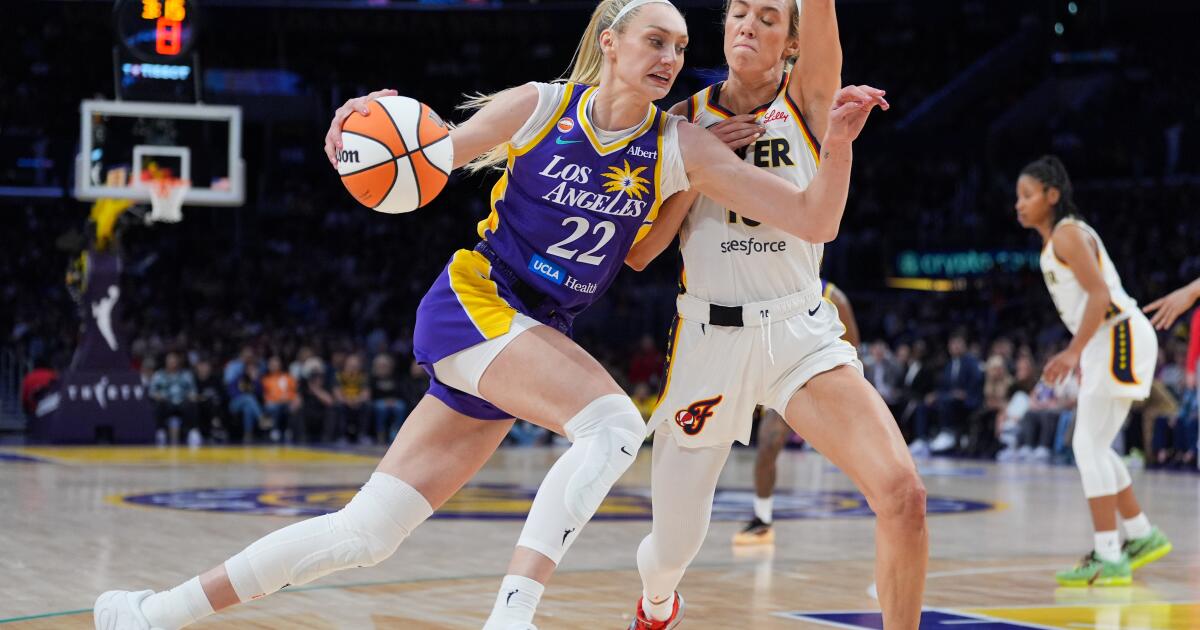
Cameron Brink said she’d appreciate some grace. She really would.
Sparks fans should give her some, because where else is she going to get it?
Certainly not from WNBA refs. Not from opponents with more to play for than ever. Certainly not from the game itself; basketball moves fast, and a bummer can become a bust in a blink.
But Brink, 24, is not on the brink of bust territory, no. Block that thought. Technically, it’s Year 3, but after a torn ACL derailed her as a rookie two summers ago, it’s practically like Year 2 for the former Stanford star. And by design, the WNBA is testing her confidence, her decision-making and her patience as she tries to reestablish herself as one of the WNBA’s best young players.
So, grace.
The recognizable 6-foot-4 forward — she’s the long-blond-haired hooper in the New Balance ads — was the No. 2 overall pick in 2024.
Now she’s her team’s No. 3 option in the post. She’s coming off the bench behind Nneka Ogwumike and Dearica Hamby for the Sparks, who are a modest 6-6 after wins this week over the expansion Portland Fire and the struggling Seattle Storm.
Against the Fire, Brink scored two points and picked up four fouls in nine minutes. Then she went to Seattle and had 15 points in 18 minutes but was pulled with more than five minutes left in the fourth quarter after getting her third, fourth and fifth fouls in 86 seconds. (WNBA players get six fouls before being disqualified.)
For the season, Brink has been called for 49 fouls in 208 minutes. A foul about every four minutes!
They’re silly fouls and they’re phantom calls. Egregious and ticky-tack. Costly and common. A real fouled-up buffet. She sets screens that get scrutinized as if by the most vigilant TSA agent. And sometimes, yes, she’s doing the accidental tripping. Other times, the officials are.
Her reputation precedes her, so everyone gets a superstar’s whistle when being defended by Brink. Opponents bake it into their game plans.
That can’t continue.
All that fouling is hindering Brink’s development because it’s robbing her of important in-game reps — which she needs, foremost, to figure out how to stop fouling.
Sparks forward Cameron Brink, left, blocks the shot of the Tempo’s Laura Juskaite during a game last month.
(Jeff Lewis / Associated Press)
“At the pro level,” said Tara VanDerveer, Brink’s coach at Stanford, “every young player always has a lot of work to do. And I saw her make a three. I see her block shots. She rebounds, she can handle the ball, she’s unselfish, she’s a terrific talent. But there’s always things players need to work on.”
We know what Brink’s thing is.
“She has to be disciplined,” VanDerveer said. “And if you want something so badly, if you want to be an All-Star someday or make the Olympic team, you’ve got to be dependable … and I think anyone can change, if it’s behavior they recognize is not in their best interests or not in their team’s best interests. It’s hard, but it’s something I think people can do.
“That’s what Cam is working on.”
And, VanDerveer added, “I’m really so excited that Nneka is there, because she will give her such great guidance and mentorship.”
And grace. Brink is getting that from Ogwumike — also a former Stanford star, the Sparks legend returned to L.A. this season after two seasons in Seattle — and her other teammates.
“I just do my best to lead by example,” Ogwumike, 35, said. “But then also let [Brink] know that she’s very capable, that she’s more than capable, which is exactly why she’s here with us and it’s exactly why we need her on this team.”

Sparks forward Cameron Brink, wearing a facemask, controls the ball while defended by Sun forward Raegan Beers.
(Joe Buglewicz / Getty Images)
But how long will Brink get grace from the Sparks in the what-have-you-done-for-me-lately business of basketball?
The foul trouble tells us why a win-now team wouldn’t trust her, why the Sparks would give meaningful minutes to two veteran post players ahead of her. Why they wouldn’t prioritize Brink’s development alongside winning as they strive to snap a previously unthinkable five-year playoff drought.
And what about fans? How patient will you all be with a player who was drafted immediately after Caitlin Clark and five spots in front of Angel Reese?
These days, that might depend on what the parlay calls for.
Or, preferably, whether you remember Brink’s first 15 WNBA games. All starts, all signs pointing to stardom. She showed up in 2024 throwing lavish block parties. Her 2.3 blocks per game were message-sending spikes, like what Lisa Leslie used to enthrall Sparks crowds with.
From the jump, she had guys coming to games at Crypto.com Arena wearing her No. 22 jersey and little girls arriving in groups with No. 22 painted on their cheeks and “I love Cam Brink” signs in hand.
And then the torn ACL cost her 25 games of her rookie season and another 25 last season, plus her spot on the United States’ Olympic 3×3 women’s basketball team in Paris in 2024.
She had to start over. Lost a lot of ground. But you see that masked woman stuck on the Sparks’ bench for all but 17 minutes per game?
You can’t miss her. She’s looking uncomfortable in protective facial gear that either hinders her breathing or her peripheral vision, her only options to protect the torn septum she suffered in a victory over the Las Vegas Aces last month.
She’s the one with the 6-8 wingspan who’s averaging 9.2 points, 4.3 rebounds and 1.5 blocks while shooting 52.1% from the field in her limited minutes.
She’s still Cameron Brink. Between fouls, she’s fluid and fast and covers more of the court than almost anyone in the WNBA, able to leap from defending guards to centers in a single bound.
“It’s just looking at every day as a new opportunity to learn and grow and not getting too bogged down when things don’t go exactly as you planned,” Brink told me. “Because more times than not, things are not going to go how you want them to. And that’s life. So I just want to be able to put my best effort out there every single night.
She knows what the Sparks need from her: “To perform, just come on the floor and compete.”
To prove she can stay on the floor to compete.
-
Sports4 minutes ago
Shohei Ohtani held out of starting lineup a day after leaving game with knee inflammation
-

 World14 minutes ago
Pope leaves Spain on plane offered by king after technical glitch
-

 Los Angeles, Ca2 hours ago
MLB to screen Hollywood classic at drive-ins nationwide
-

 Detroit, MI2 hours ago
Detroit at Le Mans: Cadillac favorite, Ford poised for 2027
-

 San Francisco, CA2 hours ago
Hudson Pacific lands SF’s biggest office lease in nearly a decade
-

 Dallas, TX3 hours ago
NFL Brazil tickets are available: Shop Cowboys vs. Ravens NFL Brazil tickets now
-

 Miami, FL3 hours ago
North Miami man accused of stabbing victim 7 times
-

 Boston, MA3 hours ago
Everything you need to know about Sail Boston 2026

