Sports
Column: Reparations for Chavez Ravine families? Not so fast, say some descendants

Larry Herrera-Cabrera’s email to me in May was as polite as it was challenging.
He reached out shortly after The Times editorial board wrote about proposed state legislation that would attempt to right the wrong of Chavez Ravine.
Sponsored by Assemblymember Wendy Carrillo, the bill would require the city of Los Angeles to erect a monument to the families, most of them Latino, who were pushed out in the 1950s to make way for Dodger Stadium. The city would also have to create a task force to study reparations for the “large, long-lasting disparities” faced by those families and their descendants.
Bemoaning what happened in Chavez Ravine is part of the modern L.A. gospel. I’ve read essays by former residents decrying what happened, read books and seen plays and documentaries that captured their plight and enjoyed Ry Cooder’s 2005 concept album, “Chávez Ravine,” which gathered Chicano music legends — Little Willie G, Lalo Guerrero, Ersi Arviz and Don Totsi, among others — to sing about the sordid saga from beginning to end.
That’s why I found Herrera-Cabrera’s email so fascinating.
“My wife and I are both descendants of three families that lived in Chavez Ravine up to 1950,” he began. “Despite the legislative findings in [Carrillo’s bill], and fables on the Internet and elsewhere, our families were neither left destitute, nor were they bitter about moving.”
He went on to offer an alternative narrative I had never considered — one where Chavez Ravine families took the money the city gave them, bought homes elsewhere and went on with their lives. Where descendants feel insulted at the insinuation in Carrillo’s bill that they need help. Herrera-Cabrera’s note added nuance to a tale long considered an open-and-shut, black-and-white case of municipal racism.
Priscilla Leiva, professor of Chicana/o and Latina/o studies at Loyola Marymount University, has spoken with Herrera-Cabrera as part of “Chavez Ravine: An Unfinished Story,” a multidisciplinary project she’s leading with former resident Carol Jacques that includes hundreds of photos and dozens of oral histories. She wasn’t surprised that I was, well, surprised.
“Latino narratives are always flattened, but especially with [the Chavez Ravine] population, because the displacement was so egregious,” Leiva said.
The public long ago stopped paying attention to “what happened before and what happened after,” she noted, which means “a lot of people don’t want to recognize or acknowledge any nuance.”
I visited Herrera-Cabrera and his wife, Katherine, at their spacious San Juan Capistrano home earlier this month. It’s nestled on a hill resembling the neighborhoods where their parents grew up, except this is upper-middle-class suburbia instead of the “poor man’s Shangri-La,” as a photographer famously described Chavez Ravine and as Cooder titled a song.
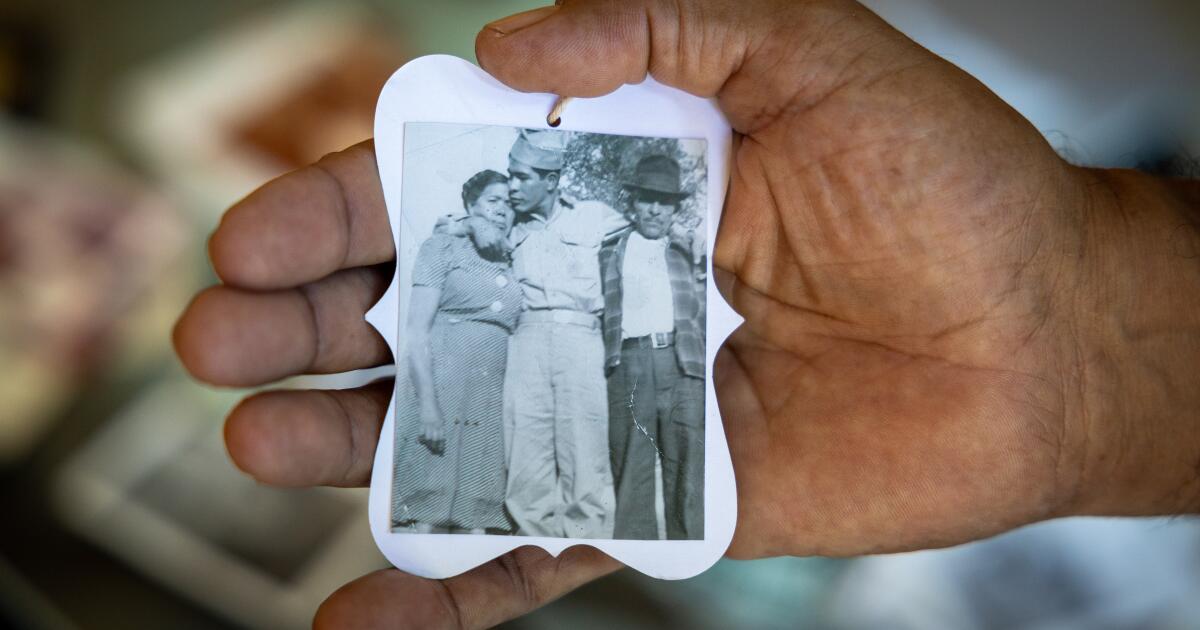
Larry Herrera-Cabrera, shown holding a photo of his Uncle Henry, killed in combat during World War II.
(Allen J. Schaben / Los Angeles Times)
In Herrera-Cabrera’s study, a Biden-Harris sticker was wedged above a photo of his late mother Sally, alongside photos of his biological father and maternal uncles in their World War II uniforms. He described his decades in city and county government as a “progressive bureaucrat,” proudly remembering how he stood up to racist politicos in Santa Barbara County in the 1980s and officiated same-sex marriages as Long Beach city clerk after the Supreme Court legalized them in 2013, two years before he retired.
“Having that connection to [helping] the community was really important to me,” he said as we stood over a kitchen table to look at family photos shot around Chavez Ravine in the 1940s. Three of his maternal uncles in Army uniforms around their mother at a park. His mother and her sisters, wearing sunglasses and bobby soxer skirts and sweaters. A group of unidentified young pachucos.
“Our family’s history gave us strength,” the 71-year-old continued. He’s tall, with bright eyes that make his glasses shine even more. “I know they suffered hardship. Things don’t always work out, but you gotta keep pushing.”
His grandparents used the money from the city of L.A. to buy a home in nearby Lincoln Heights, where Herrera-Cabrera was born in 1952. Nine years later, his mother and stepfather moved to Rosemead but frequently visited his Uncle Joe in Solano Canyon at the base of Dodger Stadium, where some Chavez Ravine families had relocated. City officials had promised them a spot in a public housing project to be built over their bulldozed homes. The stadium went up instead.
“In the early days, you could sit on a hill and watch the games for free,” Herrera-Cabrera said. He and his family sometimes went to games, but he preferred playing with cousins outside Uncle Joe’s house while their elders listened to the game on the radio and reminisced about Chavez Ravine. “They spoke fondly of those days. No one complained about having to move.”
He can’t remember when he learned of the prevailing narrative casting the Chavez Ravine families as pitiable, but he “didn’t care for it.” Nor did Katherine, who eventually joined us in the kitchen.
“Who wants to admit that they’re downtrodden?” she said before referencing the Arechiga family, one of the last holdouts in Chavez Ravine before L.A. County sheriff’s deputies forcibly evicted them. They had lived at their condemned home without paying property taxes for years, according to newspaper accounts at the time.
“Now they come back saying they want reparations?” she said.
“[Chavez Ravine] is more than just the photos of people being dragged out,” Larry Herrera-Cabrera added, referring to the infamous 1959 photo of four L.A. County sheriff’s deputies dragging a member of the Arechiga clan from her home. “It’s their accomplishments.”
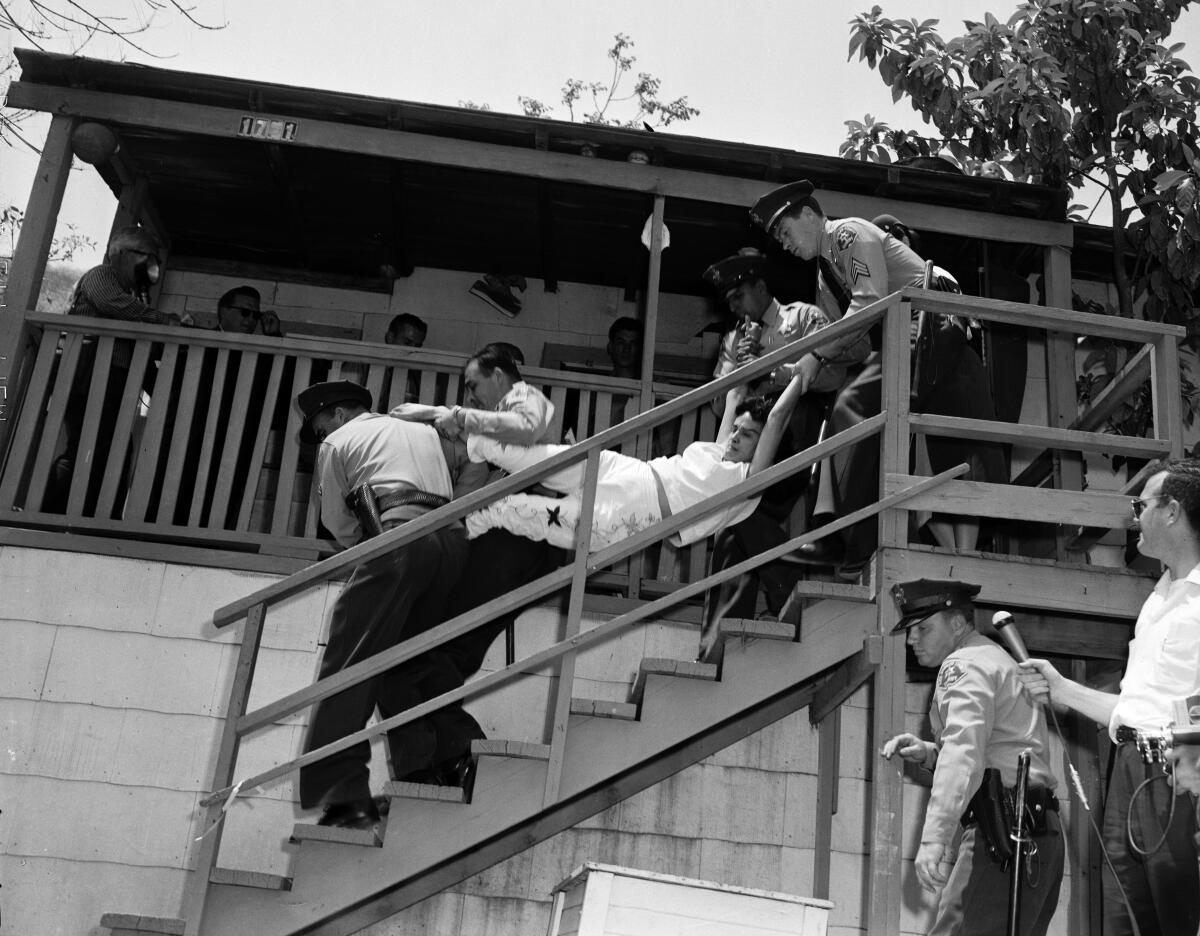
Aurora Vargas is carried by Los Angeles County sheriff’s deputies in 1959 after her family refused to leave their house in Chavez Ravine.
(Hugh Arnott / Los Angeles Times Archive/UCLA)
His perspective about what Chavez Ravine should mean changed in 2019, after a trip to the Ardennes American Cemetery in Belgium to fulfill a promise to his mother. There lies the grave of his maternal uncle, Henry Rivas, an Army private who died in the Battle of Hürtgen Forest at 19. Between them, Larry and Katherine have at least a dozen relatives who served in World War II.
“To think they thought that fascism was worse than what they faced at home was telling,” she said.
“And then they returned and became successful,” Larry added. “I had one uncle who worked in aerospace, and my Uncle Joe worked in the post office. Another uncle opened a restaurant. My dad Domingo did construction. My Uncle Ted — Teodoro — he started a men’s fashion line.”
Last year for the first time, the couple attended an annual reunion of Chavez Ravine families who call themselves Los Desterrados (The Uprooted). There, Larry displayed poster boards of his uncles’ World War II service.
“If I could talk to Wendy [Carrillo], I’d tell her those stories,” he proclaimed. “To me, they were successes. That’s part of the story. As difficult as it was, they still prospered.”
He sent a letter to the state Senate opposing Carrillo’s bill, which is being considered by a Senate appropriations committee, describing it as “hypothetical” and bad policy.
“If people were truly ripped off, that’s one thing. But why would I, as a descendant, be entitled to anything?” he said.
“The bill says people were left destitute,” Katherine said. “Who?”
Vincent Montalvo is a co-founder of Buried Under the Blue, a nonprofit that has long pushed for an apology from the Dodgers and reparations from L.A. County and city while urging people not to use the term “Chavez Ravine” for the neighborhoods of Bishop, La Loma and Palo Verde that were bulldozed to make way for Dodger Stadium.
But they had nothing to do with Carrillo’s bill, which he said he “85% agrees with.” His group also wants three community centers to be built and named after Bishop, La Loma and Palo Verde. The land should be given back to the Gabrieleño Band of Mission Indians, Kizh Nation, and all the parties involved in the displacement should issue a public apology, according to Buried Under the Blue.
Montalvo, who grew up in Echo Park and whose grandparents owned a home in Palo Verde, said former residents have accused him “of wanting a handout.”
“These things hurt,” he said. “But the older generation couldn’t even talk about what happened for forever. But I’ve told them, ‘With respect, you guys do what you’re going to do, and we’re going to do what we’re going to do. And some of you are going to jump back on the wagon, and that’s OK.’ ”
Carrillo, whose district includes Dodger Stadium, told me, “I’ve learned that when advancing policy ideas, some will say it goes too far, while others may say it doesn’t go far enough. But ultimately, we move the needle toward justice, and we try to do as much good for as many people as possible.”
On the criticism that her bill casts Chavez Ravine families as perpetual victims, the Assembly member was more straightforward: “There are no victims, but there are survivors.”
Larry agrees with her and Montalvo on one thing: a monument. But he wants it to focus on the good of his elders, as much as the bad that happened to them.
“My family wasn’t dragged out of Chavez Ravine. Most families weren’t. Like my Uncle Joe would say, let it go like water off a duck’s back.”
He teared up.
“If there were reparations, well, bring them back,” he said, referring to his uncles. “Bring back their stories. I didn’t suffer. It should be about what they did. That is Chavez Ravine’s legacy.”



Sports
US Olympic hockey hero Jack Hughes opens up about support for women’s team amid backlash over Trump’s joke

NEWYou can now listen to Fox News articles!
Team USA Olympic hockey hero Jack Hughes spoke about his support for his country’s women’s hockey team after his team was the subject of backlash for laughing at a joke by President Donald Trump about the women’s team.
During an interview on ESPN’s “The Pat McAfee Show” Friday, Hughes opened up about his respect for the women’s team after McAfee appeared to reference the controversy by joking that Hughes and his teammates “hate” the women players.
“We are hanging out with them so much, the women’s team. We were supporting them. Like, we were at their games, they were at our games,” Hughes said.
Jack Hughes of the United States celebrates after a gold medal win during against Canadaat Milano Santagiulia Ice Hockey Arena during the Milano Cortina 2026 Winter Olympic games Feb. 22, 2026, in Milan, Italy. (Elsa/Getty Images)
Hughes then appeared to address the recent criticism of his team for its response to Trump’s joke.
“Like all these people talking, how many of them watched their gold medal game? Me and Quinn Hughes were at the game. We were at the game until like overtime ended on the glass, and we were jumping up and down so excited for these girls, so excited they won,” Hughes said.
“And how many of these people watched the gold medal game, watched their semifinals game? Like 10 of the 10 of our players went to their game in the round-robin. Like, we supported them so much, and we’re so proud of them. We’re so happy that they won, and they brought a gold medal back and that, you know, I said it, the men’s and women’s team both brought gold medals back. So, just unbelievable for USA hockey.”
Hughes, who scored the game-winning overtime goal against Canada to win gold, reflected on his interaction with the player on the U.S. women’s team who did the same, Megan Keller.
“Me and her had a great moment in the cafeteria after her gold medal game. We played Slovakia the next night, and it was like a late game. And we were in the pasta line — me and Megan. They were just getting ready to go out again, and I just gave her a massive hug, and I said, ‘I’m so happy for you. I’m so proud of you,’” Hughes said.
“A couple nights later, saw her again in the [cafeteria], and we took a great picture and, uh, she just gave me a big hug and was so pumped for me as well.”
Hughes told reporters after the game the first thing he thought about when the puck went in was Keller, who scored the golden goal for the United States women’s team against Canada three days earlier.
US WOMEN’S HOCKEY GOLD MEDALIST SAYS IT’S ‘SAD’ MEN’S TEAM HAD TO APOLOGIZE FOR OLYMPICS CONTROVERSY
The controversy surrounding the men’s team stemmed from a locker room phone call between the players and Trump right after their gold medal win over Canada.
Trump told the men’s team after inviting them to Tuesday’s State of the Union address that he’d “have” to invite the women’s team, otherwise “I probably would be impeached.” The team laughed in response, prompting immense backlash.
Several mainstream media outlets penned op-eds condemning the men’s team for laughing at the joke and then visiting the White House to celebrate and Trump’s State of the Union address.
The United States’ Jack Hughes (86), who scored the winning overtime goal, celebrates after defeating Canada in the men’s ice hockey gold medal game at the 2026 Winter Olympics in Milan, Italy Feb. 22, 2026. (AP Photo/Carolyn Kaster)
U.S. women’s hockey captain Hilary Knight said on Wednesday’s edition of ESPN’s “SportsCenter” that Trump’s “distasteful joke” has “overshadow[ed]” the women’s success.
“I thought it was sort of a distasteful joke, and, unfortunately, that is overshadowing a lot of the success, the success of just women at the Olympics carrying for Team USA and having amazing gold medal feats,” Knight said.
CLICK HERE TO DOWNLOAD THE FOX NEWS APP
“We’re just focusing on celebrating the women in our room, the extraordinary efforts, and continue to celebrate three gold medals in program history as well as the double gold for both men’s and women’s at the same time. And really not detract from that with a distasteful joke.”
Hughes’ mother, Ellen, a former Team USA player and current player development staff member, said the players only cared about “bring[ing] so much unity to a group and to a country.”
Follow Fox News Digital’s sports coverage on X, and subscribe to the Fox News Sports Huddle newsletter.
Related Article


Another winnable game was slipping away, another frustrating performance by USC unraveling in painfully familiar fashion, when Jaden Brownell lifted up from the corner for a wide-open three-pointer, offering a split-second of hope in an otherwise hopeless second half.
But the shot clanked away. A collective sigh from the cardinal-and-gold faithful rippled through Galen Center, only to be swallowed up seconds later when Nebraska’s Pryce Sandfort, who finished with 32 points, knocked down a three-pointer of his own. That’s when USC’s own arena exploded with a deafening Big Red roar, loud enough to make you forget you were in Los Angeles — or that these lifeless Trojans had once looked like a real NCAA tournament team.
There were still more than nine minutes remaining after that in Saturday’s brutal 82-67 loss, though that roar from the Nebraska faithful might as well have been the exclamation point. Whether it becomes the punctuation mark on a frustrating second season for USC under coach Eric Musselman was still to be determined.
The Trojans have lost five consecutive games as of Saturday and sit in a tie for 11th in the Big Ten. They still have two regular-season games remaining to bolster their middling tournament resume, both of which they can ill afford to lose.
A midweek matchup at Washington looms especially large. A loss to the Huskies, who are 14-15, would make climbing back from the bubble brink especially harrowing. A rivalry rematch awaits after that against UCLA.
Nebraska forward Pryce Sandfort (21) drives past USC forward Terrance Williams II (5) during the first half Saturday.
(William Liang / Associated Press)
“I still think we could have a successful season,” forward Terrance Williams II said Saturday . “I had that positive mindset coming into the season. I still have that positive mindset. The season’s not over. … We can change the trajectory of the season very quickly.”
Nothing, though, about Saturday’s second half suggested USC was poised for positive change.
The Trojans positioned themselves in the first half to make a very different statement Saturday. They took advantage of foul trouble from Nebraska point guard Sam Hoiberg and led by five points at halftime. Chad Baker-Mazara had already poured in 14 points, and they barely needed freshman Alijah Arenas, who was left out of the starting lineup and played only nine minutes.
“They had belief,” Musselman said.
Yet after shooting 52% from the field in the first half, the Trojans were suddenly unable to find the target in the second. For the first five minutes of the half, a dunk from Jacob Cofie was USC’s only basket. During another five-minute stretch in the second half, USC couldn’t even manage a dunk.
Its issues only got worse when Baker-Mazara fell hard trying to block a lay-in. He didn’t play the rest of the game, as Musselman said Baker-Mazara told the staff he was unable to go.
“They played great in the second half,” Musselman said, “and we did not play very good.”
The Trojans didn’t fare much better on the glass, either, as Nebraska more than doubled USC’s total rebounds (22 to 10) after halftime.
The defense followed suit, with Nebraska piling up points in the paint at will. Sixteen of the Huskers’ first 20 points in the second half came on either dunks or lay-ins as USC’s defense lacked any semblance of urgency.
“I feel like they came out with more energy to be honest,” Williams said. “The first couple possessions, you could see it. They wanted it more than we did.”
How that’s still the case, after several similarly frustrating second halves this season, is still unclear.
“Second halves, they’re hard,” Brownell said. “We have to accept that and get ready quicker in the locker room, get our mental right and then come in and be ready.”
But with the Trojans on the very brink of the tournament bubble, time is quickly running out on that possibility.
Sports
MLB pitcher Merrill Kelly says California tax rate swayed decision to reject Padres’ free agency offer

NEWYou can now listen to Fox News articles!
Merrill Kelly will once again be wearing an Arizona Diamondbacks uniform when the 2026 regular season gets underway.
Kelly, who entered the free agent market after pitching in 10 games with the Texas Rangers in 2025, agreed to a deal to return to the Diamondbacks.
Kelly spent the first seven years of his professional career with the Diamondbacks but revealed that he received an offer from the San Diego Padres this offseason. Kelly said his decision to turn down the Padres during free agency centered on California’s higher income tax rate compared to Arizona’s.
Merrill Kelly (23) of the Texas Rangers pitches during a game against the Miami Marlins at Globe Life Field on Sept. 21, 2025 in Arlington, Texas. (Gunnar Word/Texas Rangers/Getty Images)
Kelly agreed to a two-year contract worth an estimated $40 million with the Diamondbacks, according to ESPN. Although the Padres offered a comparable deal at three years instead of two, California’s 13% tax rate on income above $1 million proved a key difference.
“I don’t think it’s any secret on how much money you get taken out of your pocket when you go to California,” the right-hander told “Foul Territory.”
Kelly also has deep ties to Arizona, where he attended high school and played college baseball at Arizona State. He said finding a way back to Arizona “was always the priority.”
Merrill Kelly (29) of the Arizona Diamondbacks looks on before Game Six of the Championship Series against the Philadelphia Phillies at Citizens Bank Park on Oct. 23, 2023 in Philadelphia, Pennsylvania. (Rich Schultz/Getty Images)
While Kelly said he is fond of San Diego, he was unwilling to sacrifice a significant portion of his salary to taxes. “I love San Diego,” Kelly said. “It’s just, like I said, they take too much money out of my pocket, man. The taxes over there are a different level.
“We had my numbers guy run the numbers, and it just made more sense to come home.”
Merrill Kelly (23) of the Texas Rangers looks on during a game against the Philadelphia Phillies at Globe Life Field on Aug. 8, 2025 in Arlington, Texas. (Bailey Orr/Texas Rangers/Getty Images)
Arizona’s state income tax rate is roughly 2.5%. Kelly also joked that he prefers the desert landscape to San Diego’s coastal setting.
“It worked out best for us because that was honestly our second choice,” Kelly said. “It was between here and San Diego going into the offseason. San Diego was really the only place that, if we did go somewhere, that was probably high on our list if we weren’t in Arizona. It’s like, ‘All right, let’s just hop over and take a short, six-hour drive to San Diego.’
“But, yeah, the desert is home. I guess we’re not ocean people.”
In a statement to The California Post, the Padres said the team does “not comment on contract negotiations.”
Acquired by the Rangers in July 2025, Kelly went 12-9 while splitting the season between Texas and Arizona.
Follow Fox News Digital’s sports coverage on X, and subscribe to the Fox News Sports Huddle newsletter.
Related Article

Boy dies after being struck by vehicle in Hawaii Kai | Honolulu Star-Advertiser

Who is running for Illinois governor in 2026? What to know as primary Early Voting sites open

Indiana Pacers Must Manage Two-Way Contract Player Availability Down Stretch

Iowa Boys High School State Basketball Tournament Sets Two Classes

Why Matthew Driscoll continues to say Kansas State is ‘close’

Florida High School Football Rankings: Top 25 teams – Oct. 21

Cleary's 21 help Le Moyne down Central Connecticut State 69-64 in OT

How old is Bo Nix? What to know about Oregon quarterback ahead of 2024 NFL Draft

99th annual Pony Swim held in Virginia

Indiana Members Credit Union announced as new anchor tenant at Bottleworks District

Mamdani’s response to Trump’s Iran strike sparks conservative backlash: ‘Rooting for the ayatollah’

Activists hail ‘historic’ EU’s decision on accessible abortion

A long-buried recording and the Supreme Court of old (CT+) : Consider This from NPR

2 Survivors Describe the Terror and Tragedy of the Tahoe Avalanche

Iran fires missiles at US bases across Middle East after American strikes on nuclear, IRGC sites
-

 World3 days ago
Exclusive: DeepSeek withholds latest AI model from US chipmakers including Nvidia, sources say
-

 Massachusetts4 days ago
Mother and daughter injured in Taunton house explosion
-

 Montana1 week ago
2026 MHSA Montana Wrestling State Championship Brackets And Results – FloWrestling
-

 Louisiana6 days ago
Wildfire near Gum Swamp Road in Livingston Parish now under control; more than 200 acres burned
-

 Denver, CO3 days ago
10 acres charred, 5 injured in Thornton grass fire, evacuation orders lifted
-

 Technology1 week ago
YouTube TV billing scam emails are hitting inboxes
-

 Technology1 week ago
Stellantis is in a crisis of its own making
-

 Politics1 week ago
OpenAI didn’t contact police despite employees flagging mass shooter’s concerning chatbot interactions: REPORT