Southwest
US regulators grant Native American tribes authority to block unwanted hydopower projects

- Federal regulators have granted Native American tribes more power to block hydropower projects on their land.
- The Federal Energy Regulatory Commission previously allowed developers to proceed even if tribes objected, but now tribes have the ability to veto proposals quickly.
- This policy change acknowledges and respects tribal sovereignty, according to a spokesperson for the Navajo Nation’s president’s office.
Federal regulators have granted Native American tribes more power to block hydropower projects on their land after a flurry of applications were filed to expand renewable energy in the water-scarce U.S. Southwest.
Previously, the Federal Energy Regulatory Commission granted developers approval to move ahead with planning even if tribes objected. That practice came to an end last week. Now, a new commission policy allows tribes to quickly veto proposals, forcing businesses to cooperate if they want the federal government to grant them exclusive rights to their hydropower projects.
“This is the acknowledgement and respect of tribal sovereignty, which is critical,” said George Hardeen, spokesperson for the Navajo Nation’s president’s office.
MAJOR US POWER SOURCE FACING EXTINCTION THANKS TO RED TAPE, SPARKING CALLS FOR REFORM
The Federal Energy Regulatory Commission recently rejected seven proposals for projects on the Navajo Nation, which stretches 27,000 square miles across Arizona, New Mexico and Utah. When it issued those rejections, the commission also announced the policy change, handing tribes the same power as federal agencies to block projects.
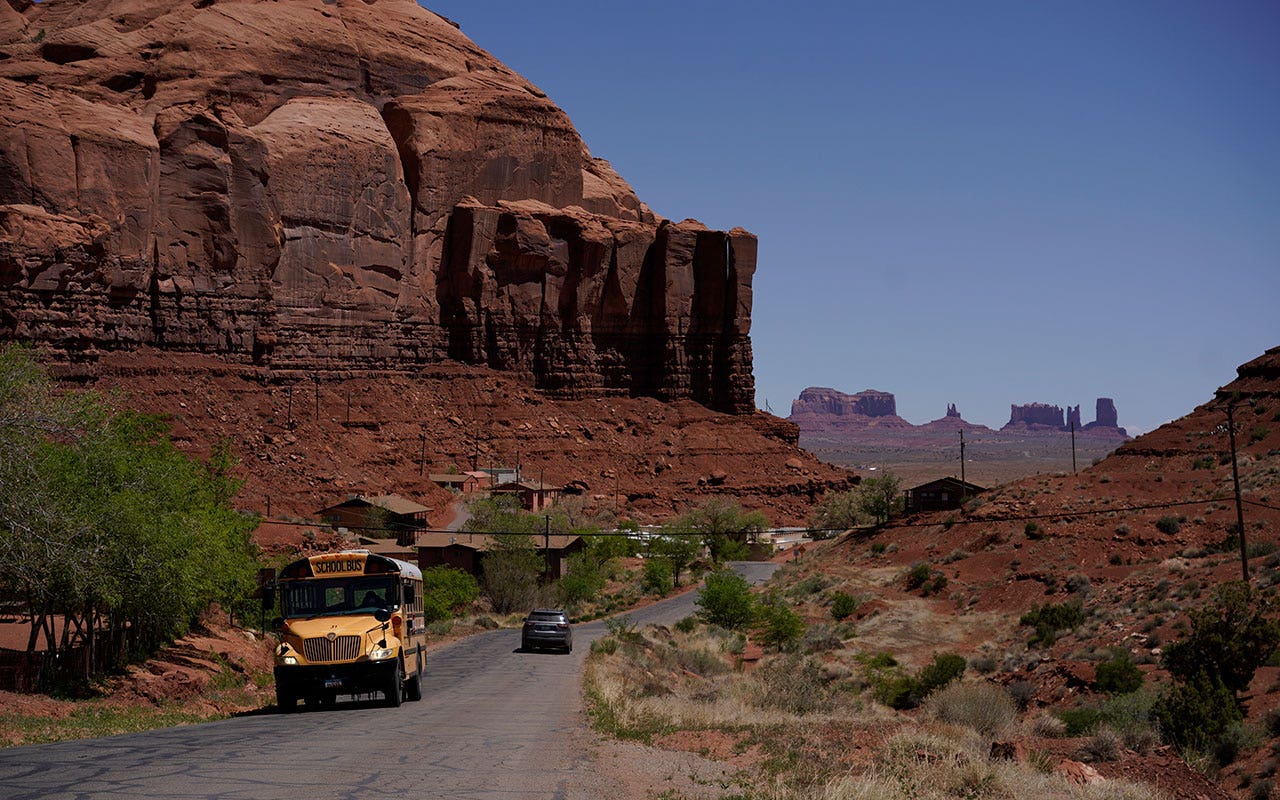
A school bus is seen in Oljato-Monument Valley, Utah, on the Navajo reservation on April 27, 2020. Federal regulators have granted Native American tribes more power to block hydropower projects on their land after a flurry of applications were filed to expand renewable energy in the water-scarce U.S. Southwest. (AP Photo/Carolyn Kaster, File)
“It applies anywhere that a hydropower project might be proposed on tribal lands throughout the United States,” said Aaron Paul, an attorney with Grand Canyon Trust, a conservation group.
The Hopi Tribe, which is completely surrounded by Navajo, urged the commission to cement the policy announcement in a formal rule, worrying a different administration would be less favorable to tribes and change the policy.
$1B CANADIAN HYDROPOWER TRANSMISSION PROJECT TO BE RENEGOTIATED DUE TO COST INCREASES
The hydropower projects are essentially big batteries that generate energy when demand is high and there aren’t a lot of other renewable sources like solar and wind available. Hydropower can be turned on when it is needed and works by releasing water from an upper reservoir to a lower one.
At a later point when the electric grid has excess power, water is pumped in a loop back up to the higher reservoir, recharging the battery.
Developers have expressed new interest in building these pumped hydropower projects as coal-fired plants shut down in the Southwest. The canyons, towering mesas and dramatic river valleys in the area are ideal terrain because the projects require moving water between different elevations.
Environmental groups and some members of the Navajo Nation argue the projects require enormous amounts of water — particularly in a part of the country that already doesn’t have enough. Roughly one-third of the 175,000 people on the Navajo Nation don’t have running water at home.
People are sensitive to how scarce water is, and “they would more likely say ‘no’ to these kinds of projects,” Hardeen said.
Some of the proposals that were rejected came from Nature and People First. For example, the company told federal regulators it wanted to build the Black Mesa East project on the Navajo reservation in Arizona that would have two upper reservoirs with a combined capacity of 100,000 acre-feet and a single, lower reservoir with the same total storage capacity. An acre-foot of water serves two or three homes annually.
The project was proposed near a home site lease that Jheremy Young’s family has held for generations. He’s happy the commission blocked it. The area around the mesa is rugged, quiet and vast, and water has to be hauled in.
“That’s where my dad came from, that’s where his father came from,” Young said. “The sentimental value of the land — the story, the history — were the biggest concern.”
The Navajo Nation told federal regulators the company hadn’t consulted with the correct tribal authorities or addressed key concerns about water use and harm to golden eagle and other species’ habitats. Hardeen said now, developers will first need to go through the Navajo Nation Division of Natural Resources.
Denis Payre, president and CEO of Nature and People First, said the commission’s decision was “undeniably disheartening.” The company secured support from local Navajo communities and talked with Navajo government officials for a project he said would create jobs.
“Developing pumped storage projects is inherently challenging; this additional obstacle threatens to halt our collective efforts,” Payre said.
The company submitted a proposal for a much larger project than it intends to construct, giving it flexibility to build a smaller project on the piece of land it finds is best after study and tribal consultation.
That approach and using that amount of water engenders opposition, according to the Center for Biological Diversity, an environmental group.
“If you are going to propose a small project, actually propose a small project,” said Taylor McKinnon, the center’s Southwest director.
The Federal Energy Regulatory Commission also rejected proposals from Rye Development, which said it values tribal consultation and will continue to study opportunities on tribal land.
Malcolm Woolf, president and CEO of the industry group National Hydropower Association, said he supported tribes’ right to stop unwanted projects. But he said the new policy could halt planning too soon.
The commission denied preliminary permits for the seven projects, which only recognize a business is first in line to develop a project and allows further studies. Developers have to consult with tribes before they can be granted a license and start building.
MAINE HYDROPOWER PROJECT TO RESUME DESPITE $500M PRICE HIKE
Companies don’t want to navigate a complicated permitting process and spend years working with a tribe only for another business to swoop in and win rights to the project at the last minute, Woolf said.
One company quickly caught up in the new policy is Pumped Hydro Storage, which wants a preliminary permit for a project near the Little Colorado River on Navajo Nation land in Arizona. In light of its new policy, the commission asked for more input from those it potentially impacts before they decide what to do.
The company’s manager, Steve Irwin, said pumped storage is important but hard to build on the Navajo Nation’s land.
“There’s no clear pathway to doing business on the reservation,” Irwin said. “It’s almost like you have to have 100% unanimous consensus. It’s not majority, it’s got to be 100%, and it’s like, you are never going to get 100%.”
Read the full article from Here


A black bear was caught on camera roaming the yards of multiple Glendale homes Friday.
Video provided by a viewer shows the bear climbing onto a wall on the 3300 block of Paraiso Way, down the street from Valley View Elementary School, at around 4:15 p.m. The bear then sidesteps a gate and leaps down into the home’s backyard.
-

A black bear hops a wall and jumps into a Glendale backyard on July 17, 2026. (Viewer-submitted video)

Glendale Police Department officers were seen following the bear as it made its way through the neighborhood. A resident had a brief encounter with the bear while they were walking their dog, the viewer who provided the video told KTLA. The resident, dog and bear were all unharmed, they said.
Residents in the foothills of the San Gabriel Mountains have said that bear sightings are more frequent since the Eaton Fire, which burned more than 14,000 acres in the Altadena area.
Watch footage of the bear in the video at the top of this story.

The driver of a Tesla Cybertruck was arrested for driving under the influence early Saturday morning following a pursuit that ended in a crash. According to a California Highway Patrol spokesperson, their officers were assisting the Los Angeles Police Department when the pursuit terminated along the westbound span of the 118 Freeway near De Soto […]

“Moana” has been called a box office flop, an unnecessary money grab by Walt Disney Studios, but what it hasn’t been called yet is a triumphant win for cultural representation on the big screen.
The live-action adaptation of the beloved 2016 animated movie “Moana” effectively bombed at the box office, making much less money than industry insiders anticipated.
While it failed to live up to the expectations of the box office and critics alike, the film did exceed the expectations of moviegoers of Pacific Island descent, and they’ve taken to social media to express just how much the movie means to them.
Moana is more than the main character’s name. It means ocean across several Pacific Islander languages.
One user explained how this kind of representation is more than entertainment.
“When I watched ‘Moana,’ I couldn’t hold back my tears. I heard the language of my parents, the language of my people. I saw our traditional Samoan clothing, our weaving, our siva, our culture, our values. I saw my people. I saw me.”
Another user said seeing Pacific Islanders on the silver screen influenced her own artistry.
“Representation matters. As a sometimes-Female-Polynesian-filmmaker (depending on the day and my imposter syndrome), seeing our stories on a screen this big makes me dream a little bigger too.”
Even the film’s star, Dwayne “The Rock” Johnson, spoke to the film’s representation in a recent Instagram post.
“I feel that our movie ‘Moana’ will always serve a bigger purpose than just a film – it’s representation. Our Polynesian culture showcased to the world, and embraced by the world – with love, humility, warrior spirit and MANA.”
That representation was taken as a serious responsibility by the actors and creative team behind the scenes of Disney’s latest live-action remake.
“We got chosen for a reason,” Rena Owen, who plays Gramma Tala in the film, explains.
“Every single one of us, whether that’s an actor, whether that’s a creative, whether that’s a crew person. We’re raised that way, we’re raised in villages and we’re raised… on our earth, with our sky father and our moana, that’s what we all have in common. So, we just had to be ourselves.”
Disney once again leaned on members of its Oceanic Cultural Trust, a group formed over a decade ago to ensure cultural accuracy for the first “Moana” movie.
The trust’s lead consultant, Dr. Grant Muāgututiʻa, spoke about the work that went into bringing Moana to life on screen.
“We have a big responsibility to our folks who are gonna be watching the film. We’re elated that the film crew and the filmmakers were really receptive to all of the input that we had and we’re really happy with the way it turned out.”
Dr. Muāgututiʻa is a linguist by trade, serving as Assistant Professor of Linguistics at California State University San Marcos. He told KTLA he was thrilled that people of Samoan descent can hear their language spoken in a major Disney film.
“The mountaintop scene where you can hear both Jon Tui, who plays Chief Tui, and Catherine Laga’aia, who plays Moana speaking Samoan. And then the Siva Tau scene, where Seiuli Dwayne Johnson also speaks Samoan. I think those are special moments that are new, especially for our people to see. They’re able to experience real islanders that are proud of their culture.”
“Moana” Choreographer and Cultural Trust member Tiana Nonosina Liufau agreed.
“Seeing an all-Pasifika cast, and hearing them, there’s a lot of Mana in that, hearing these words come out of their mouth, something audiences can trace back to their genealogy, that’s priceless. All worth it.”
-

 San Francisco, CA4 minutes ago
SFPD faces fresh round of questions on Pride weekend arrests
-

 Dallas, TX10 minutes ago
Cowboys news: Christian Parker labeled a ‘big question’
-

 Miami, FL16 minutes ago
Billionaires like Ken Griffin are moving to Miami—but middle-class earners can’t copy them and reap the same benefits, real estate experts say | Fortune
-

 Boston, MA22 minutes ago
Looking back at the World Cup: Fans drank Boston dry, got permanent tattoos, sold out famous BBQ joints, and drove up small business revenue | Fortune
-

 Denver, CO28 minutes ago
How much are Denver Broncos worth after Seahawks’ reported $9.6 billion sale?
-

 Seattle, WA34 minutes ago
Seattle Weather: A sunny Sunday, temperatures heating up
-

 San Diego, CA40 minutes ago
Thomas Michael Hardy, Sr. – San Diego Union-Tribune
-

 Milwaukee, WI46 minutes ago
Milwaukee’s Bradford Beach busy during break from wildfire smoke

