Southwest
Texas lawmaker challenges 'lottery socialism,' urges state AG to rule on the universal income program

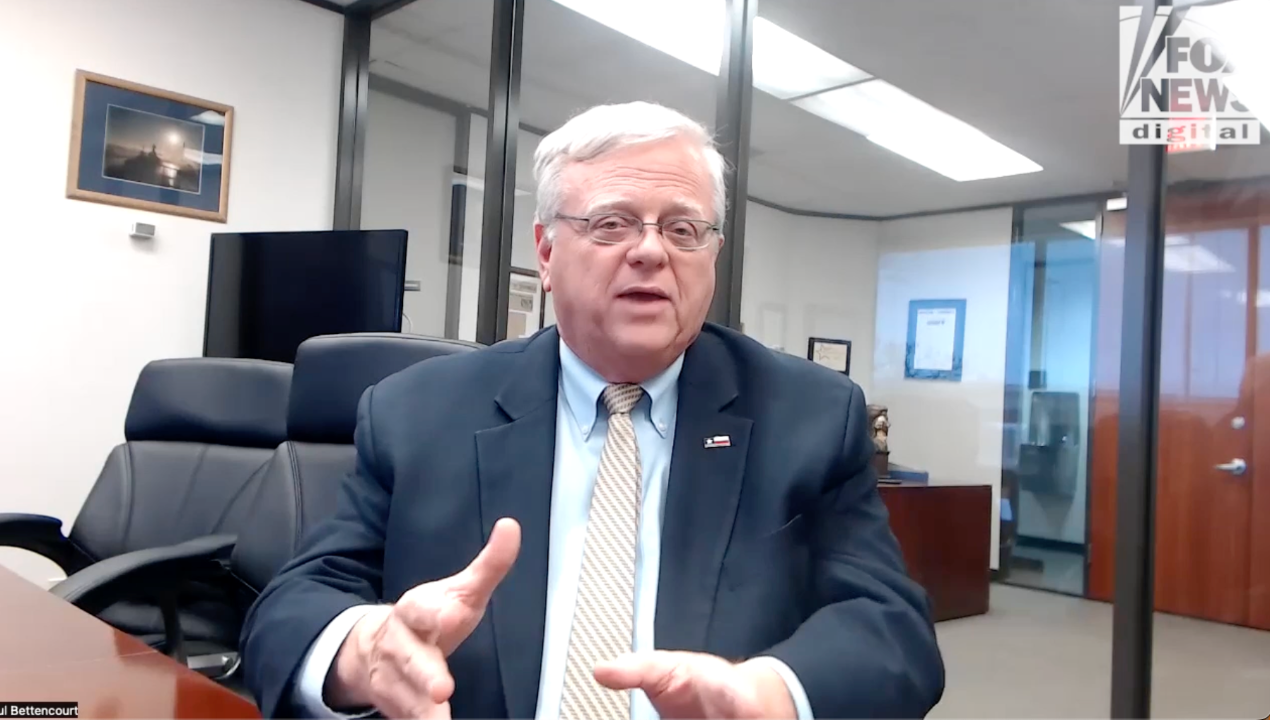
A Texas state lawmaker believes that a universal basic income program pushed at the county level violates the state constitution.
“We just can’t hand out money like popcorn on street corners to people that walk by,” Republican State Sen. Paul Bettencourt told Fox News Digital.
“If you advertise what’s clearly a no-strings universal basic income, and you do a lottery by zip codes, I’m very concerned that that is just fundamentally violating the gift clause of the [Texas] Constitution, which says the state can’t give money with no strings attached.”
The program Bettencourt is referring to is a guaranteed income program called Uplift Harris. The program passed by a vote of 4-1 in Harris County Commissioners Court last year.
DEMOCRATIC PRESIDENTIAL CANDIDATE ANDREW YANG SAYS UNIVERSAL BASIC INCOME ISN’T A SOCIALIST POLICY
A Texas state lawmaker believes that a universal income program pushed on the county level is unconstitutional. (Fox News Digital)
Bettencourt’s comments came after he penned a letter to Texas Attorney General Ken Paxton the same day as the program was enacted in Harris County, requesting the attorney general to issue an opinion on whether counties have the authority to enact such a program.
“Would such a policy violate the gift prohibition clause in the Texas Constitution?” Bettencourt asked in the letter.
Article 3, section 47 of the Texas Constitution prohibits lotteries and gift enterprises in the state with a few listed exceptions.
Uplift Harris is a guaranteed income pilot that would allow participating households to receive $500 per month for 18 months. The program began on January 12, 2024, and is available to 1,924 applicants.
The program received over 59,000 applications, a local FOX affiliate reported.
Applicants to the Uplift Harris program will be “randomly selected through a lottery process,” their website states.
Bettencourt said Harris County is “taking 1,900 families and effectively giving them 20 plus million dollars.”
Considering that over 59,000 people applied for just over 1,900 available spots, Bettencourt asked, how does the government decide who wins and who loses?
“I don’t like the concept of what I would call lottery socialism here because it’s based on specific zip codes, and it’s no strings attached,” Bettencourt told Fox News Digital. “And that’s why I’m concerned about the gift clause of the [Texas] Constitution.”
REP. ILHAN OMAR INTRODUCING ‘UBI PILOT PROGRAM TO GET MONEY IN PEOPLE’S POCKETS’
Uplift Harris stated on their website that similar programs across the country have shown that they are financially and socially beneficial to participants.
Recently, a guaranteed income program in Austin, Texas helped address the problem of housing insecurity in the city, according to a new survey.
After the Austin City Council launched the measure in 2022, the state capital became the first major city in Texas to use tax dollars to fund a “guaranteed income” program. (Brandon Bell/Getty Images)
The program, which was launched as a pilot, issued $1,000 monthly checks to 85 households who were at risk of losing their homes. After the Austin City Council launched the measure in 2022, the state capital became the first major city in Texas to use tax dollars to fund “guaranteed income” programs. The city of Austin explained on its website that the guaranteed income programs “act as a springboard for participants to find a way out of poverty to greater economic mobility and housing stability.”
Bettencourt explained that comparing Austin’s guaranteed income program with the one enacted in Harris County is like “comparing apples to oranges.”
“The point I’m making about counties involved with universal basic income is that it hasn’t happened before,” Bettencourt said. “We don’t have anyone else in the state besides Harris doing that. And counties are different than home-rule cities. The state gives [counties] the authority as an extension of the state to do certain tasks.”
BOSTON REPARATIONS TASK FORCE MEMBER SAYS EXAMINATION OF SLAVERY COULD YIELD ‘REAL DOLLAR’ COMPENSATION
Bettencourt raised concern that the largest county in the state is looking at a guaranteed income program with no strings attached, and how more counties could consider starting a similar program. He also worried about the financial cost if the program was expanded to all 60,000 applicants.
“That’s a $600 million expenditure and that would have to be done by county property tax money. So these are important issues to decide before we just get involved in a discussion of what people think is a solution to a problem, but without ignoring whether the solution is legal in the first place,” he said. “Unfortunately, the county judge down here was talking about expanding the program, to cover people that crossed the border illegally. Now, there’s just not enough money in anybody’s governmental budget for all of this.”
Uplift Harris excluded undocumented immigrants because the program is federally funded using COVID-19 funds. Harris County Judge Lina Hidalgo reportedly wants an “alternative cash assistance program” to cover those who are ineligible for Uplift Harris.
Harris County, Texas, county seat is Houston. According to census figures, the population of Harris County was over 4.7 million, making it the most populous county in Texas and the third most populous county in the U.S. ((Photo by Brandon Bell/Getty Images))
“I know that these days the politically hot topic is to malign immigrants,” Hidalgo said. “But these immigrants, if they’re living in poverty, they’re living in poverty… And supporting them helps all of us and has good downstream effects on all of us, so I just don’t think we ought to leave them out.”
Bettencourt told Fox News Digital that, at this point, Paxton is gathering an opinion on the matter. If the attorney general agrees with Bettencourt’s position, then the county will either have to close the program or argue for its merits in court.
Harris County Attorney Christian Menefee sent Fox News Digital a statement about the matter.
“Both federal and Texas laws authorize Harris County to use ARPA dollars to help residents through our guaranteed income pilot program,” Menefee said.
He added, “Studies of direct payment programs—like the stimulus checks issued by former President Donald Trump—show that most people use the money on housing and other basic needs. I have presented our legal position to the Texas attorney general, and I hope that he gives us a fair shake.”
Menefee on Wednesday responded to Bettencourt’s letter, arguing that Uplift Harris does not violate the gift clause in the Texas Constitution because existing state statutes enable counties to issue cash assistance that serves a “public purpose designed to benefit the entire county.”
Read the full article from Here


A man wanted for a deadly road rage shooting in Los Angeles was arrested and extradited from Mexico after fleeing the U.S. in 2024.
The suspect was identified as Christian Rojas, 21, of Bellflower, according to the California Highway Patrol.
Authorities had been searching for him since the deadly incident on October 10, 2024.
Rojas and a second suspect, Joshua Rojas Sr., 47, of Downey, were driving on the northbound 5 Freeway in Boyle Heights around 4 p.m. when they became involved in an altercation with another driver that escalated into a shooting.
-

Video obtained exclusively by KTLA shows the terrifying moment a road rage suspect opened fire the driver of another car on the 5 Freeway in Los Angeles, fatally wounding him and seriously injuring a passenger, on Oct. 10, 2024. (Credit: @hugoboss01) -
Video obtained exclusively by KTLA shows the terrifying moment a road rage suspect opened fire the driver of another car on the 5 Freeway in Los Angeles, fatally wounding him and seriously injuring a passenger, on Oct. 10, 2024. (Credit: @hugoboss01) -
Video obtained exclusively by KTLA shows the terrifying moment a road rage suspect opened fire the driver of another car on the 5 Freeway in Los Angeles, fatally wounding him and seriously injuring a passenger, on Oct. 10, 2024. The alleged gunman is circled. (Credit: @hugoboss01) -
Video obtained exclusively by KTLA shows the terrifying moment a road rage suspect opened fire the driver of another car on the 5 Freeway in Los Angeles, fatally wounding him and seriously injuring a passenger, on Oct. 10, 2024. (Credit: @hugoboss01) -
Video obtained exclusively by KTLA shows the terrifying moment a road rage suspect opened fire the driver of another car on the 5 Freeway in Los Angeles, fatally wounding him and seriously injuring a passenger, on Oct. 10, 2024. (Credit: @hugoboss01) -
Christian Rojas, 21, of Bellflower, was arrested and extradited to the U.S. from Mexico on June 2, 2026, in connection with a deadly road rage shooting in Los Angeles. (California Highway Patrol)


Video of the tense confrontation showed the suspects, who were driving a Dodge Durango SUV, opening fire on two men in a Cadillac sedan.
The shooting forced the victim to pull over abruptly. That’s when a suspect ran up to the Cadillac, opened the passenger-side door and fired several shots at close range.
In a panic, the Cadillac driver tried to escape by making a sudden U-turn and driving against oncoming traffic. He eventually crashed head-on into several vehicles.
The suspects ditched their SUV and fled toward a freeway exit on foot. The Cadillac driver was left with serious injuries and his passenger was killed. Their identities were not released.
The incident caused a miles-long backup that left thousands of motorists stranded on the freeway for hours and authorities worked to clear the scene.
Following an extensive investigation, detectives identified the two men as the suspects involved.
Joshua Rojas Sr. was arrested in San Bernardino on October 22, 2024, on a murder charge. He remains in custody awaiting trial.
Meanwhile, Christian Rojas had fled the U.S. and was hiding in Mexico, detectives said. A $4.3 million bail warrant was issued for his arrest.
“Through a coordinated international effort, investigators determined that Rojas was living in Palomo de Arriba, Mexico,” CHP officials said. “The U.S. Marshals Service worked with Mexican state police to locate and arrest him on the outstanding warrant.”
On June 2, 2026, Christian was arrested and extradited to the U.S. to face a murder charge.
“This arrest demonstrates that time and distance will not shield violent offenders from justice,” said CHP Southern Division Chief Chris Margaris. “For nearly two years, our detectives remained relentless in their pursuit of those responsible for this senseless act of violence. Through exceptional collaboration with the United States Marshals Service and our law enforcement partners in Mexico, we located and apprehended this suspect and brought him back to face the charges. We remain committed to protecting the public, supporting victims and their families, and holding violent criminals accountable wherever they may try to hide.”

The northbound 405 Freeway will remain closed for several hours near Los Angeles International Airport after a police pursuit ended with officers opening fire Friday morning. Unconfirmed reports indicated the incident began with a robbery at a 7-Eleven store, which ended with Los Angeles Police Department officers pursuing the suspect in a Kia. The chase […]

The victim in a bizarre and deadly stabbing in Tarzana has been identified as 81-year-old character actor James Handy, best known for a recent role in Tom Cruise’s “Top Gun: Maverick.” The stabbing happened around 9:30 a.m. Wednesday in the 19200 block of Erwin Street in the West Valley area. Officers responded after receiving a […]
-

 Technology14 seconds ago
More than a decade later, the team behind N++ is back with a multiplayer sequel
-

 World5 minutes ago
US, Shield of the Americas condemn ‘ongoing efforts’ to overthrow Bolivia’s elected president amid unrest
-

 Politics12 minutes ago
Trump expands TrumpRx prescription drug discount program to more than 800 medications
-

 Health15 minutes ago
Breakthrough pancreatic cancer drug shows survival gains that surprise experts
-

 Sports20 minutes ago
Broncos star Jonathan Cooper arrested on domestic violence charges
-

 Technology27 minutes ago
Will a four-armed robot replace astronauts in space?
-
 Business30 minutes ago
SoFi Stadium workers vote to authorize strike with World Cup days away
-
 Entertainment35 minutes ago
California and other states may sue to block Paramount-Warner Bros. deal

