Southwest
Texas death row inmate mouths final 2-word message to victims' families before execution

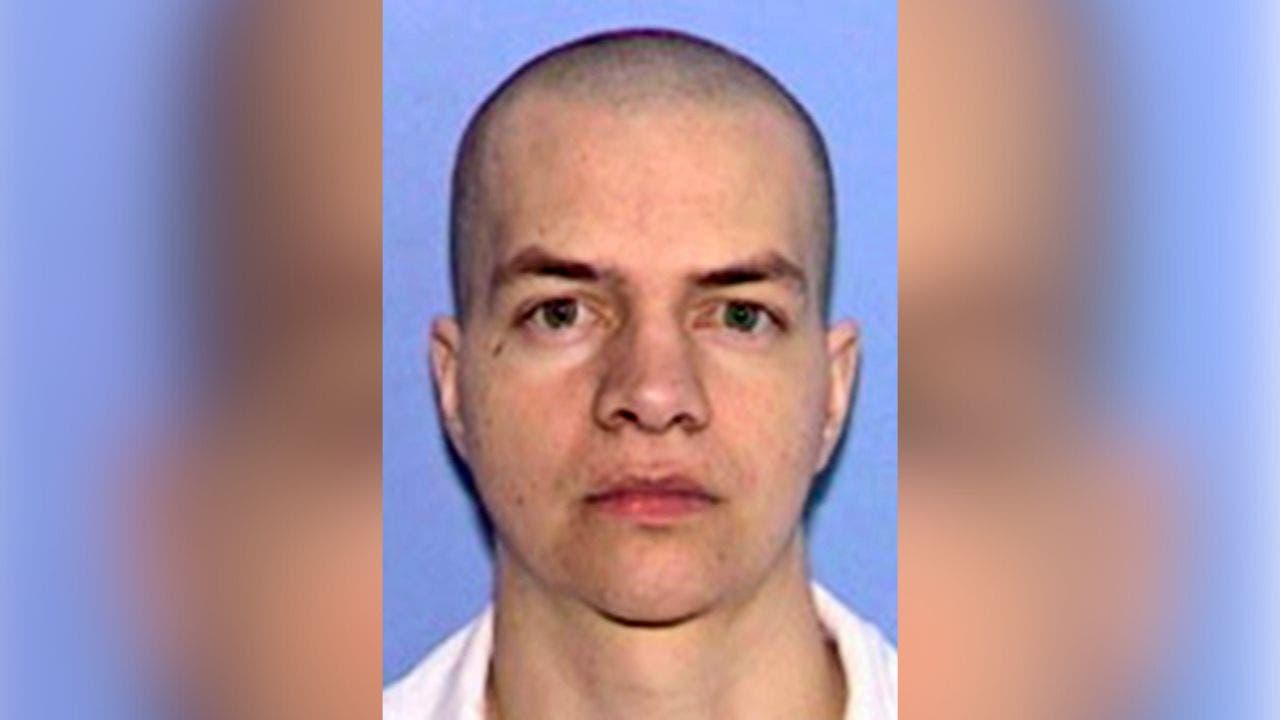
A remorseful death row inmate pleaded for forgiveness and mouthed one final message before being put to death in Texas on Thursday, 20 years after he killed his strip club manager and another man.
Richard Lee Tabler, 46, also admitted to killing two teenage dancers at the club and said he had found God during his two decades in prison.
“I had no right to take your loved ones from you, and I ask and pray, hope and pray, that one day you find it in your hearts to forgive me for those actions,” Tabler said strapped to the death chamber gurney, looking at relatives of his victims who watched through a window a few feet away. “No amount of my apologies will ever return them to you.”
Richard Lee Tabler seen in a photograph.
FLORIDA NEWLYWEDS GET JUSTICE AFTER FAMILY FISHING TRIP ENDED IN MURDER
He told the victims’ family members that there wasn’t a day that went by in which he didn’t regret his actions and thanked prison officials for their compassion and show that he could “change and become a better man and rehabilitate.”
After apologizing several more times, Tabler said that it was the beginning of a new life for him in heaven.
He told the warden at the state penitentiary in Huntsville, “I am finished,” and as the drugs began pouring into his body he mouthed once again, “I’m sorry.”
Tabler then began breathing quickly. After about a dozen breaths, all movement stopped.
Tabler shot and killed Mohammed-Amine Rahmouni, 28, and Haitham Zayed, 25, in a remote area near Killeen in Central Texas on Thanksgiving 2004 after luring them there on the false pretense of buying stolen stereo equipment.
Rahmouni was the co-owner of a club called TeaZers and the two had fallen out.
Investigators said Rahmouni allegedly said he could have Tabler’s family “wiped out” for $10.
The Huntsville Unit prison in Huntsville, Texas, (Francois Picard/AFP via Getty Images)
Two days later, Tabler shot and killed an 18-year-old dancer at the club, Tiffany Loraine Dotson, who he said he had been seeing, along with another dancer, 16-year-old Amanda Benefield.
Tabler was convicted of killing the two men and sentenced to death, so prosecutors didn’t need to pursue the conviction for the young women’s murders, Paul McWilliams, who prosecuted Tabler nearly two decades ago, told USA Today.
“The murder of the men was as cold-blooded as it could be,” McWilliams said. “The killing of the girls was just senseless. There was absolutely no reason for that.”
BRYAN KOHBERGER CASE: IDAHO MAKES KEY MOVE ON FIRING SQUAD EXECUTIONS
Dotson’s father, George, was among the witnesses. He declined to comment on Tabler’s apologies, saying he needed time to process what he had just seen but was glad to have seen it.
“I couldn’t wait,” he said. “It took me 20 years to get here.”
“Today is for Tiffany,” said her godfather, Tom Newton. “And this is justice.”
In 2008, Tabler prompted a massive lockdown at the 150,000-inmate prison when he smuggled a cellphone into the facility and began making death-threat phone calls to then-state Sen. John Whitmire, who is now the mayor of Houston. (Yi-Chin Lee/Houston Chronicle via Getty Images)
CLICK HERE FOR THE FOX NEWS APP
During the sentencing phase of his trial, prosecutors introduced Tabler’s written and videotaped statements saying he killed Dotson and Benefield because he was worried they would tell people he had killed the men.
Tabler had asked several times for courts to stop his appeals and let him be executed. His lawyers questioned whether he was mentally competent.
In 2008, he prompted a massive lockdown throughout the state’s 150,000-inmate prison system when he smuggled a cellphone into the state penitentiary in Huntsville and began making death-threat phone calls to then-state Sen. John Whitmire, who is now the mayor of Houston.
The Associated Press contributed to this report.
Read the full article from Here


A woman was struck and killed by a driver while crossing the street on Pacific Coast Highway in Long Beach.
On June 3, the female pedestrian was using the crosswalk at Pacific Coast Highway and Pacific Avenue around 4:50 a.m.
She had walked against a red light and was hit by a 19-year-old driver in a Chevy sedan, Long Beach police said.
Despite lifesaving efforts, the woman was pronounced dead at the scene. The driver remained at the scene and is cooperating with the investigation.
“At this time, impaired driving, distracted driving and excessive speed are not believed to be a factor in this collision,” police said.
The woman’s name is being withheld pending identification by the Los Angeles County Medical Examiner.
Anyone who witnessed the crash or has information on the incident is asked to call Detective Joseph Johnson at 562-570-7355.
Anonymous tips can be provided to L.A. Regional Crime Stoppers at 1-800-222-8477 or online at lacrimestoppers.org.

A man wanted for a deadly road rage shooting in Los Angeles was arrested and extradited from Mexico after fleeing the U.S. in 2024.
The suspect was identified as Christian Rojas, 21, of Bellflower, according to the California Highway Patrol.
Authorities had been searching for him since the deadly incident on October 10, 2024.
Rojas and a second suspect, Joshua Rojas Sr., 47, of Downey, were driving on the northbound 5 Freeway in Boyle Heights around 4 p.m. when they became involved in an altercation with another driver that escalated into a shooting.
-

Video obtained exclusively by KTLA shows the terrifying moment a road rage suspect opened fire the driver of another car on the 5 Freeway in Los Angeles, fatally wounding him and seriously injuring a passenger, on Oct. 10, 2024. (Credit: @hugoboss01) -
Video obtained exclusively by KTLA shows the terrifying moment a road rage suspect opened fire the driver of another car on the 5 Freeway in Los Angeles, fatally wounding him and seriously injuring a passenger, on Oct. 10, 2024. (Credit: @hugoboss01) -
Video obtained exclusively by KTLA shows the terrifying moment a road rage suspect opened fire the driver of another car on the 5 Freeway in Los Angeles, fatally wounding him and seriously injuring a passenger, on Oct. 10, 2024. The alleged gunman is circled. (Credit: @hugoboss01) -
Video obtained exclusively by KTLA shows the terrifying moment a road rage suspect opened fire the driver of another car on the 5 Freeway in Los Angeles, fatally wounding him and seriously injuring a passenger, on Oct. 10, 2024. (Credit: @hugoboss01) -
Video obtained exclusively by KTLA shows the terrifying moment a road rage suspect opened fire the driver of another car on the 5 Freeway in Los Angeles, fatally wounding him and seriously injuring a passenger, on Oct. 10, 2024. (Credit: @hugoboss01) -
Christian Rojas, 21, of Bellflower, was arrested and extradited to the U.S. from Mexico on June 2, 2026, in connection with a deadly road rage shooting in Los Angeles. (California Highway Patrol)


Video of the tense confrontation showed the suspects, who were driving a Dodge Durango SUV, opening fire on two men in a Cadillac sedan.
The shooting forced the victim to pull over abruptly. That’s when a suspect ran up to the Cadillac, opened the passenger-side door and fired several shots at close range.
In a panic, the Cadillac driver tried to escape by making a sudden U-turn and driving against oncoming traffic. He eventually crashed head-on into several vehicles.
The suspects ditched their SUV and fled toward a freeway exit on foot. The Cadillac driver was left with serious injuries and his passenger was killed. Their identities were not released.
The incident caused a miles-long backup that left thousands of motorists stranded on the freeway for hours and authorities worked to clear the scene.
Following an extensive investigation, detectives identified the two men as the suspects involved.
Joshua Rojas Sr. was arrested in San Bernardino on October 22, 2024, on a murder charge. He remains in custody awaiting trial.
Meanwhile, Christian Rojas had fled the U.S. and was hiding in Mexico, detectives said. A $4.3 million bail warrant was issued for his arrest.
“Through a coordinated international effort, investigators determined that Rojas was living in Palomo de Arriba, Mexico,” CHP officials said. “The U.S. Marshals Service worked with Mexican state police to locate and arrest him on the outstanding warrant.”
On June 2, 2026, Christian was arrested and extradited to the U.S. to face a murder charge.
“This arrest demonstrates that time and distance will not shield violent offenders from justice,” said CHP Southern Division Chief Chris Margaris. “For nearly two years, our detectives remained relentless in their pursuit of those responsible for this senseless act of violence. Through exceptional collaboration with the United States Marshals Service and our law enforcement partners in Mexico, we located and apprehended this suspect and brought him back to face the charges. We remain committed to protecting the public, supporting victims and their families, and holding violent criminals accountable wherever they may try to hide.”

The northbound 405 Freeway will remain closed for several hours near Los Angeles International Airport after a police pursuit ended with officers opening fire Friday morning. Unconfirmed reports indicated the incident began with a robbery at a 7-Eleven store, which ended with Los Angeles Police Department officers pursuing the suspect in a Kia. The chase […]
-

 New York49 minutes ago
How Tony Danza Spends a Day Playing a Villain and Frank Sinatra
-

 Los Angeles, Ca56 minutes ago
Woman killed by driver while crossing PCH in Long Beach
-

 Detroit, MI1 hour ago
Tigers takeaways: Detroit rolls to a little ALDS revenge vs Seattle
-

 San Francisco, CA1 hour ago
Chapman (8 RBIs) among trio of Giants with 2 HRs in 18-run Wrigley romp
-

 Dallas, TX1 hour ago
Isolated Flooding Threat to North Texas Late Saturday
-

 Miami, FL2 hours ago
Tampa Bay Rays beat the Miami Marlins in game 1 of the series, with a score of 6-0
-

 Boston, MA2 hours ago
Red Sox win series opener, ending rough stretch against Yankees – The Boston Globe
-

 Denver, CO2 hours ago
Denver weather: Near-record heat Saturday

