Southwest
Oklahoma's oldest Native American college faces uncertain future due to financial woes

- Founded in 1880, Bacone College evolved into an Indigenous-led institution, fostering an intertribal community and offering degrees.
- Currently, the college is grappling with financial woes after struggles with mismanagement, leadership instability and lawsuits.
- In response to financial difficulties, Bacone has suspended classes, facing the risk of permanent closure.
The hallways of Bacone College are cold and dark. In the main hall, there are no lectures to be heard, only the steady hum of the space heater keeping the administrative offices warm.
Students aren’t attending classes here this semester, but work still needs to be done. In the college’s historic buildings, there are leaks to plug, mold to purge and priceless works of Native American art to save from ruin. Not to mention devising a plan to keep the college from shuttering for good. It’s a daunting task for the nine remaining employees.
But on this rainy December morning, the college’s president is running a DoorDash order. “If we have the money, we can pay,” Interim President Nicky Michael said regarding salaries. Even she has to find a way to make ends meet.
US ARMY DENIES REQUEST TO RETURN REMAINS OF NATIVE AMERICAN BOYS WHO DIED AT PENNSYLVANIA BOARDING SCHOOL
Founded in 1880 as a Baptist missionary college focused on assimilation, Bacone College transformed into an Indigenous-led institution that provided an intertribal community, as well as a degree. With the permission of the Muscogee Nation Tribal Council, Bacone’s founders used a treaty right to establish the college at the confluence of three rivers, where tribal nations had been meeting for generations.
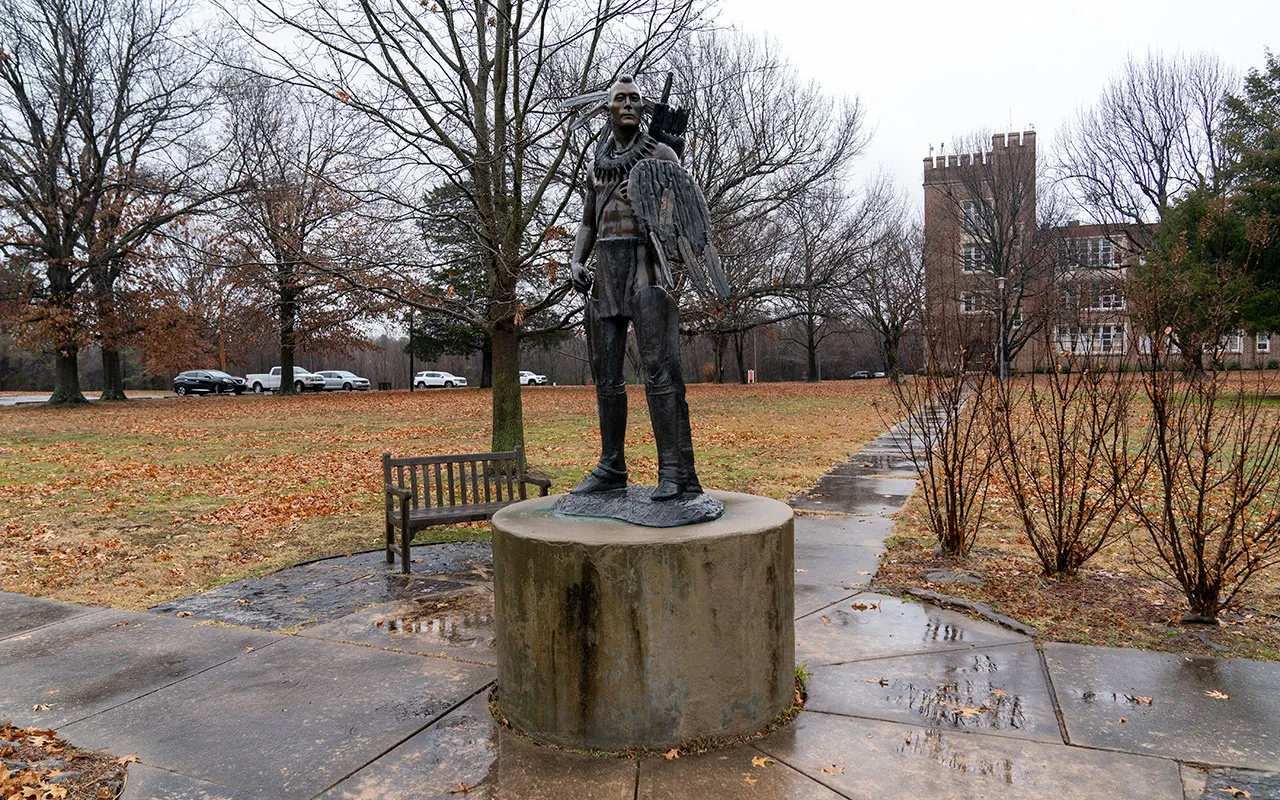
A statue of a Chickasaw warrior sits on display at Bacone College on Jan. 8, 2024, in Muskogee, Oklahoma. The Native American school is nearing the brink of closure as years of poor financial decisions, inconsistent leadership and disrepair threaten what was once a haven for Indigenous academics. (AP Photo/Nick Oxford)
Throughout the 20th century, the center of this was Bacone’s Native American art program, which produced some of the most important Indigenous artists of their time, including Woody Crumbo, Fred Beaver, Joan Hill and Ruthe Blalock Jones.
They and their contemporaries pushed the boundaries of what was considered “Native American art.” During a period of intense hostility against tribal sovereignty by the U.S., Bacone became defined by the exchange of ideas its Native faculty and students created and represented a new opportunity for Indigenous education and academic thought.
“Bacone was the only place in the world where that could happen for Native people,” said Robin Mayes, a Cherokee and Muscogee man who attended Bacone in the ’70s and taught silversmithing there in the ’90s. “It’s a tragedy to think that it’s going to be discontinued.”
For decades, the college has been plagued by poor financial choices and inconsistent leadership, triggering flashpoints between administration, students and staff over the mission and cultural direction of the college.
Some have accused recent administrations of embezzlement, fraud and intimidation, resulting in multiple lawsuits. Students expressed frustration with a lack of resources and cultural competency among some school leaders. The college also has had trouble maintaining its accreditation.
Last year, a lawsuit crippled Bacone’s finances. Ultimately, Michael made the decision to suspend classes for the spring semester. She hopes the deferment is temporary, but if the college can’t muster up millions of dollars, Oklahoma’s oldest continually operating college likely will close its doors.
“It has endured for over 140 years through terrible decisions,” said Gerald Cournoyer, an instructor who was hired in 2019 to restart the college’s art program.
“Providing oversight for Bacone has been a struggle because of the leadership or lack thereof,” said Cournoyer, who also is a renowned Lakota artist. Some presidents focused time and money on athletic programs, others on Bacone’s Baptist missionary roots. “When you put absolutely no money, nothing, not $20, not $10, into your fundraising efforts, this is what you get.”
During the time Patti Jo King was the director of the Center for American Indians at Bacone from 2012 to 2018, leadership wanted to build a state-of-the-art museum to replace the 80-year-old building housing many priceless pieces of Native art.
“We didn’t even have the money to keep it open seven days a week,” said King, now a retired Cherokee professor, writer and academic.
Even when she first arrived on campus, King said Bacone’s financial debts already had caught up to it. The student dorms didn’t have hot water, staff were severely underpaid and graduation rates among the college’s remaining students were low.
Still, she and other faculty endeavored to make it a place where Native students could find community, but Bacone’s old problems never went away. Like Cournoyer, after years of working toward rebuilding, she left in frustration.
Today, the old museum is empty. Its artifacts were moved to another location so they wouldn’t be exposed to extreme temperatures.
The remaining staff act as caretakers of the historic stone buildings that predate Oklahoma, themselves important pieces of the past. In the museum, Ataloa Lodge, the fireplace is made of stones sent to the college from Indigenous communities across the country: one from the birthplace of Sequoyah, one from the grave of Sitting Bull, another from the field where Custer died. Five hundred in all, each stone a memory.
Michael, the interim president, and others have been cleaning up buildings in hopes they might soon host graduation banquets and student gatherings. Other staff chase off looters. Rare paintings still hang across campus, including pieces by members of the Kiowa Six, who became internationally famous a century ago, and Johnnie Diacon, a Muscogee painter and alumnus whose work can be seen in the background of several episodes of the television show Reservation Dogs.
A few years ago, experts from a museum in Tulsa warned that many of the paintings are contaminated with mold, which will spread to other nearby works of art. Leslie Hannah, a Cherokee educator who sits on the college’s board of trustees, said he’s concerned, but the cost of restoring them falls far down the list, behind broken gas lines, flooded basements and a mountain of debt.
Bacone’s current financial crisis stems partially from a lawsuit brought by Midgley-Huber Energy Concepts, a Utah-based heating and air company that sued the college over more than $1 million in unpaid construction and service fees. Twice last year, the Muskogee County Sheriff’s Office put Bacone’s property up for sale to settle the debt. Both times the auction was called off, most recently in December.
MHEC owner Chris Oberle told KOSU last month that he intended to purchase the historic property. Attorneys for MHEC have not returned repeated requests for comment from the Associated Press.
Alumni have called the validity of any sale of the property into question, pointing to the treaty right that established the campus and its listing on the National Register of Historic Places. Attorneys for the college declined to comment, citing the ongoing litigation.
PRO-NATIVE AMERICAN ACTIVISTS FIGHTING TO SAVE INDIGENOUS TRADITIONS IN NATIONWIDE WAR AGAINST WOKENESS
Michael said she doesn’t know what stalled the auction, but she is grateful for more time to try to save Bacone.
Across the country, there are only a few dozen tribal colleges, according to the American Indian College Fund, a nonprofit that supports Native American access to higher education. Tribal colleges must be sponsored by a federally recognized tribe and have a majority Native student enrollment. But unlike most of those colleges, Bacone was built on its identity as an intertribal school, a quality that former staff and alumni say made it special.
Now a private institution, Bacone no longer receives state or federal assistance. Its finances have long relied heavily on student tuition, and now it has no students. Michael said judging from the finances, it’s a miracle the college managed to keep its doors open this long.
“Now I’m looking back on this thinking this was set up for failure,” she said.
Read the full article from Here


A broken water main sent water gushing from an apartment building and turned nearby streets into rivers in West Hollywood early Thursday morning. The break was reported around 3 a.m. near Holloway Drive and Sunset Boulevard. “It’s a rupture of one of the significant mains that goes through here. West Hollywood, as it turns out, […]

After more than four decades, the remains of a woman who was found buried in the mountains of Riverside County were identified as a multi-millionaire who went missing in 1981.
The body of Thelma Gaston was discovered by a person gathering firewood in a mountainous area near Sugar Loaf Mountain and the Pinyon Crest community on Nov. 28, 1981.
After experiencing a series of heartbreaking life events, including the death of her husband and her 32-year-old son in the same year in 1957, Gaston continued forging ahead, focusing on her business of buying repossessed properties and selling them.
By 1980, she had amassed a fortune estimated to be over $20 million, SFGATE reported.
On June 28, 1981, a note was left on the front door of her home near Century City, saying she was out searching for her cat. However, she never returned home and her loved ones did not hear from her.
By then, Gaston was 80 years old. As Los Angeles Police Department detectives investigated her disappearance, they discovered a younger man, Lawrence Remsen, then 39, had recently entered her life and was the woman’s romantic companion, SFGATE reported.
At one point, the woman’s friends said Gaston had wondered about Remsen’s motives in being with her.
Police eventually found letters and documents reportedly signed by Gaston that gave Remsen power of attorney. Another letter allegedly written by the woman claimed she had run away “to have some fun in life.” However, her friends said the move was completely out of character.
Detectives later confirmed the letters were certified with a stolen notary stamp and her signatures were believed to be forged.
Remsen had tried selling some of Gaston’s properties and attempted to withdraw more than $100,000 from her bank accounts. Remsen eventually fled the Southern California area.
A few months later, he was arrested by border agents when he tried to enter the U.S. from Mexico. He was charged with Gaston’s murder even though the woman’s body had not been found.
During a trial hearing, Remsen later claimed he found the woman dead of natural causes in her home and, attempting to take her fortune, had disposed of her body in the ocean.
The judge disagreed and later ruled that Remsen had killed the woman “intentionally and with malice.” He was convicted of murder and sentenced to life in prison.
Gaston’s body was later discovered buried in a shallow grave in the mountains. However, due to the poor condition of the remains, investigators were unable to narrow down an identity.
A breakthrough occurred in 2022 when the Riverside County Sheriff’s Coroner’s Bureau received new funding to reexamine long-standing unidentified cases.
“Combined with significant advances in forensic science, this funding opened new avenues for identification,” the sheriff’s office said.
In May 2026, utilizing investigative genetic genealogy and dental records, the remains were positively identified as Gaston’s.
“The Riverside Sheriff’s Coroner’s Bureau extends its sincere appreciation to everyone whose dedication, expertise, and perseverance made this identification possible,” officials said in a statement. “Together, these efforts have ensured that Ms. Gaston has her name—and her story—returned to her.”
Remsen, who is now 83 years old, continues serving his life sentence at the California Institution for Men in Chino.

Southern California remains under an extreme heat warning as residents brace for the hottest day of the week on Wednesday.
“It will be roasty toasty in the valleys, lower mountain elevations and far interior, with highs ranging from 100 to 110 degrees,” the National Weather Service said. The warmest conditions are expected in the western San Fernando Valley.
An extreme heat warning remains in effect for much of Southern California until 8 p.m. Thursday. Forecasters say there is a high risk of heat-related illness for anyone outdoors for extended periods. Heat advisories are also in place for areas along the coast.
“Highs for today: 98 in Ojai, 100 in Ontario. Temecula, good morning to you, 100 degrees expected there. 112 in Palm Springs. Unbelievably hot,” KTLA’s Kirk Hawkins said Wednesday morning.
Residents are urged to adjust their afternoon plans to limit strenuous outdoor activities during the heat of the day, stay hydrated and check in on elderly neighbors and loved ones.
The Weather Service said record highs are slightly warmer than those forecast for Wednesday. As a result, despite the extremely hot conditions, few, if any, temperature records are expected to be broken.
A few degrees of cooling are expected Thursday, but a more significant cooldown will arrive Friday as onshore winds increase.
Afternoon highs are expected to cool even more over the weekend, with below-average temperatures possible in some areas.
-
 Science4 minutes ago
California employer health premiums will cost as much as a new car in 2027
-
 Sports10 minutes ago
How Spain ‘recaptured the spirit of 2010’ in its run to the World Cup final
-

 World22 minutes ago
Fake Hezbollah video threatening attack on France possibly Russia-tied
-

 News52 minutes ago
Trump’s ‘American Flag Blue’ in the Lincoln Memorial pool is already gray — and the Olympic canoer ‘vandal’ is fighting his arrest | Fortune
-

 Los Angeles, Ca2 hours ago
Water main break floods West Hollywood streets, traps cars
-

 Detroit, MI3 hours ago
Detroit’s air quality early Thursday ranked as hazardous, worst in the world
-

 San Francisco, CA3 hours ago
‘It was a scene from the Titanic’: Fishermen recall rescuing passengers from sinking boat in SF Bay
-

 Dallas, TX3 hours ago
Big picture takeaways from the Dallas Mavericks first week at Summer League

