Southwest
Ex-AZ education department workers used 'ghost students' to launder voucher money

Three former Arizona Department of Education employees were indicted on conspiracy and money laundering charges in what prosecutors say was a scheme to defraud more than $600,000 from an education voucher program that has drawn criticism for its skyrocketing costs and lax regulation by the state.
Prosecutors said Thursday that the three employees approved applications for 17 students -– five of which were fictitious — that admitted them into the voucher program using forged birth certificates and special education evaluations.
Delores Lashay Sweet, Dorrian Lamarr Jones and Jennifer Lopez, who were fired last year from the Department of Education, are accused of using the money for their own benefit, such as luxury purchases. Two of Sweet’s adult children, Jadakah Celeste Johnson and Raymond Lamont Johnson Jr., also were charged with conspiracy and money laundering.
THESE STATES PLAN AN AGGRESSIVE UNIVERSAL SCHOOL CHOICE PUSH IN 2024: ‘TEACHERS UNIONS OVERPLAYED THEIR HAND’
“They created ghost students with forged birth certificates – children that didn’t exist –- and gave them fake disability diagnoses that would make them eligible for larger funding amounts,” said Arizona Attorney General Kris Mayes, whose office is examining other suspected abuses of the voucher program.
No attorneys for the former Department of Education employees and Sweet’s two adult children could be found in court records.
Phone messages left late Thursday afternoon for Sweet and Jones, as well as a number listed for both Jadakah and Raymond Johnson, weren’t immediately returned. Efforts to get Lopez’s phone number were unsuccessful.
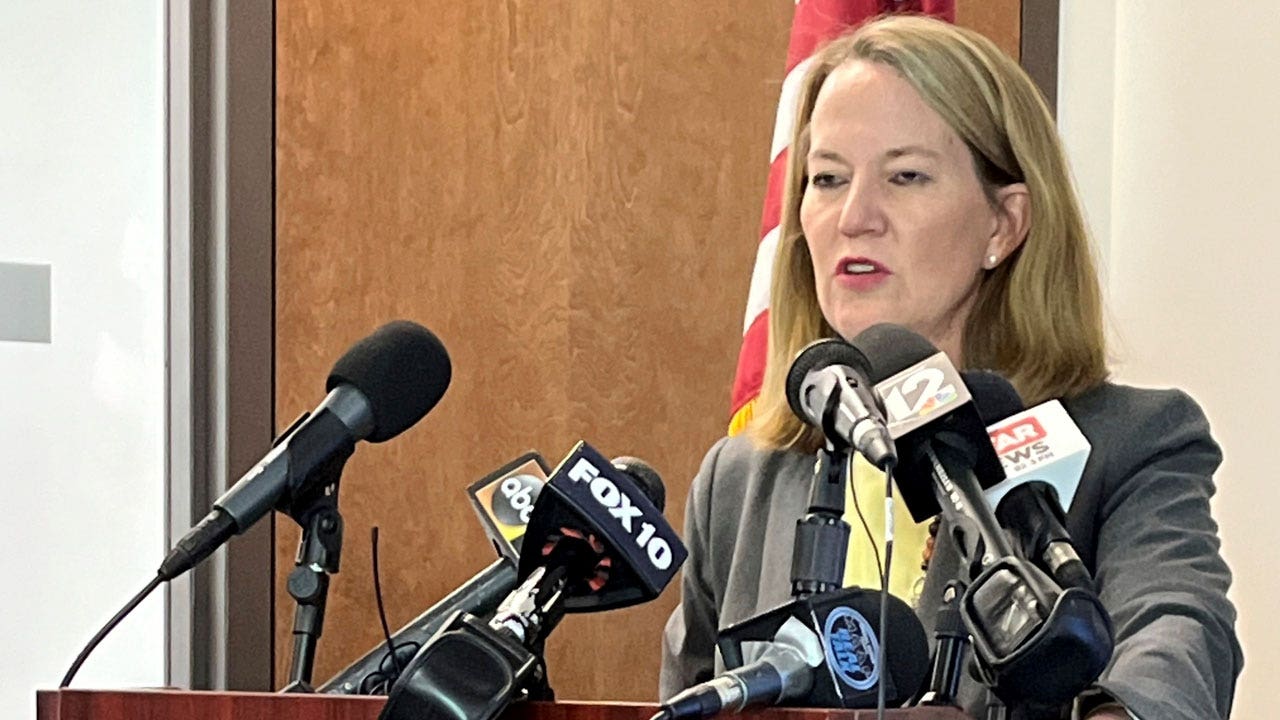
Arizona Attorney General Kris Mayes is seen speaking about the indictment of three former Arizona Department of Education employees on charges they defrauded the state’s education voucher program out of more than $600,000, on Feb. 29, 2024 in Phoenix. (AP Photo/Jacques Billeaud)
The Democratic attorney general said the case shows the voucher program is an easy target for fraud and that the Republican-majority Legislature should take steps to lessen the opportunity for fraud within the voucher program.
Sen. John Kavanagh, a Republican who supports the vouchers, said he doesn’t see the problem as fraud within the Empowerment Scholarships Account program, but rather fraud in the agency that runs it.
“I don’t think that it’s anymore damning of the ESA than when a bank teller steals money from the banking system,” Kavanagh said. “It (the problem) is about the people, not the program.”
Mayes said investigators were tipped off to the alleged fraud not by the education department, which runs the voucher program, but rather a credit union that noticed unusually large cash withdrawals.
In a statement, Superintendent of Public Instruction Tom Horne disputed that his office didn’t tell the Attorney General’s Office about the fraud, saying his office had alerted Mayes’ office to concerns about two of the three employees. He also said he has placed more controls on the program and reported other instances of suspected abuse of the voucher program to Mayes’ office.
“Our discovery of the activities of the two former staffers is consistent with my determination to root out potential fraud and abuse,” Horne said.
The voucher program lets parents use public money for private-school tuition and other education costs. It started in 2011 as a small program for disabled children. But it was expanded repeatedly over the next decade until it became available to all students in 2022.
Originally estimated to cost $64 million for the current fiscal year, budget analysts now say it could top $900 million.
The changes in Arizona’s voucher program led to a sharp increase in the number of participants. Before the expansion, nearly 12,000 students — including disabled children, those living on Native American reservations and children in low-performing schools — took part in the program. Now that all students can apply for the vouchers, more than 75,000 students participate.
Critics say the expansion is a drain on the state’s coffers, while backers say the expansion lets parents choose the best school for their children.
About 75% of the students who got vouchers immediately after the program was expanded had no prior record of attending an Arizona public school, according to Department of Education data reported in 2022. That suggests the state subsidies went largely to students whose families already were paying private school tuition.
Read the full article from Here


The star-studded feel-good giveback event of the summer has returned. KTLA 5 is teaming up once again with Project Angel Food for the annual “Lead with Love: Going the Distance” telethon to raise critical funds for medically tailored meals delivered to people living with serious illnesses throughout Los Angeles County. The seventh annual telethon airs […]

A woman was hospitalized with serious injuries after she was violently attacked by a robber in downtown Long Beach. On June 18, Jennifer Silva, 34, was attending a World Cup watch party at a Hooters restaurant at 90 Aquarium Way. After the game ended, she left the restaurant just before 11 p.m. As she walked […]

Jurors deliberating the fate of the man accused of starting the Palisades Fire, one of the most destructive wildfires in California’s history, failed to reach a verdict Thursday afternoon, telling the judge they were deadlocked.
A spokesperson from the United States Attorney’s Office told KTLA that jurors will continue to deliberate until they reach a verdict or give up.
Jonathan Rinderknecht, 30, a former Uber driver and one-time Pacific Palisades resident, is accused of starting the Lachman Fire on New Year’s Eve. The fire continued to smolder underground for about a week, even after Los Angeles firefighters believed it had been extinguished.
Flames reignited on Jan. 7, erupting into the deadly Palisades Fire that killed 12 people and destroyed thousands of homes in the upscale community, authorities said.
-

A courtroom sketch of Jonathan Rinderknecht, 29, during his initial court appearance on Oct. 23, 2025. (Bill Robles) -
The U.S. Dept. of Justice booking photo of Jonathan Rinderknecht over the Palisades Fire devastation in Malibu, California in January 2025 (AP).


Prosecutors argued that Rinderknecht deliberately set the fire, claiming he had grown increasingly resentful of wealthy residents and viewed Pacific Palisades as a symbol of that frustration.
“Their case, though circumstantial, is strong,” KTLA legal analyst Alison Triessl said. “The defense is relying on, can they (prosecutors) show beyond a reasonable doubt that Mr. Rinderknecht actually started this fire and it wasn’t the result of fireworks or some intervening cause.”
The defense argued there is no direct physical evidence tying Rinderknecht to the fire and said the prosecution’s case relies entirely on circumstantial evidence. Rinderknecht did not testify during the trial.
Defense attorney Steve Haney spoke outside the courthouse Wednesday about why he believes it will be difficult for prosecutors to prove how the fire started.
“The lack of scene preservation. The fact that they got there after a lot of the evidence was missing. Not a lot of direct evidence. This is a circumstantial case, which is always difficult as a prosecutor to prove,” Haney said.
Rinderknecht, who was arrested and indicted last October, faces up to 45 years in prison if found guilty of three arson counts, including destruction of property by means of fire, arson affecting property used in interstate commerce and timber set afire.
Tony Kurzweil contributed to this report
-

 Los Angeles, Ca44 minutes ago
Watch Project Angel Food's 'Lead with Love' telethon on KTLA
-

 Detroit, MI1 hour ago
Metro Detroit weather forecast, June 26, 2026 — 4 p.m. Update
-

 San Francisco, CA1 hour ago
Newlyweds celebrate Pride-themed weddings inside SF City Hall as parade preparations underway
-

 Dallas, TX1 hour ago
All Dallas restaurants firing up specials for July 4th and America’s 250th
-

 Miami, FL1 hour ago
Helping Venezuela: State Department deploys Miami-Dade search-and-rescue team
-

 Boston, MA1 hour ago
Photos: Norway takes on France in high-powered World Cup matchup in Foxborough – The Boston Globe
-

 Denver, CO2 hours ago
Denver Transplant Games sets Guinness World Record for mos living donors, recipients in one place at one time
-

 Seattle, WA2 hours ago
How to watch Egypt vs. Iran World Cup match in Seattle

