West Virginia
Voting: The Kids Are Not All Right – West Virginia Public Broadcasting


This story aired in the June 4, 2024 episode of West Virginia Morning.
Voter turnout in West Virginia, and across the country, is low. It’s even worse among young voters who say they are disconnected and not interested.
Just before the May 14 primary election, two journalism students from Northwestern University’s Medill School of Journalism based in Washington, D.C. — Meaghan Downey and Anastasia Mason — came to the Mountain State to report on the state’s low voter turnout and the effect it has on young voters.
They spoke with students at West Virginia University (WVU) and BridgeValley Community and Technical College. This is part of a larger project the journalism students are working on about how young peoples’ disillusionment with political institutions is a threat to democracy.
We are in our early 20s and have both studied politics. We’re following the upcoming election pretty closely. But we realized a lot of our friends aren’t and we wanted to find out if we were unusual.
We discovered that, according to voting data, yes, we are. Young people turn out to vote a lot less than older people. And it’s worse in some states than others.
West Virginia is one of those states. In 2020, only four states had worse young voter turnout. For our research, we traveled to WVU. There, we asked the students whether they’ll participate in the upcoming election.
“Probably not. I just don’t really know a whole lot about it, you know?” said Emily Reed.
“I definitely feel like there’s not as many people who are like, focused on voting because they think that one vote can’t make a difference,” said Sam Carver.
Alanna Berry agreed with Reed and Carver. “Honestly, I don’t know who the candidates are. Are we talking about Biden?”
Most of the young people we met weren’t sure they were going to vote. We learned that 18 to 29-year-olds feel disconnected from politics across America. A poll released recently from Harvard’s Kennedy School showed the lowest levels of confidence in public institutions since the survey began 24 years ago.
According to Amherst College Professor Austin Sarat, it’s a stark contrast to previous generations.
“About 75 percent of people born in the 1930s say it is essential to live in a society governed democratically,” he said. “People born in the 1980s and later, that number is 25 percent.”
Younger generations are not voting, they’re frustrated, and they’re disillusioned with democracy. The question for the researchers was: “How did we get here?”
And more importantly: “Why don’t young West Virginians vote?”
It’s a problem that even long-term political organizers like the West Virginia Citizen Action Group have been struggling with. The organization has worked for nearly 50 years to encourage citizen participation in government.
Julie Archer, the group’s project manager, said the culture in West Virginia plays a role in why people don’t vote.
“Part of it might be like, kind of Appalachian fatalism,” she said. “We have had some examples of politicians that were pretty corrupt, and so anytime you have something like that, I think it just reflects negatively on even the people who are in there who are good and who are responsive to their constituents and want to do the right thing.”
For 80 years, West Virginia was a blue state. In 2000, the state flipped red and has voted increasingly conservative since. But Archer and her fellow activists say West Virginians feel that — whether it’s Democrats or Republicans in charge — the state’s big problems, especially poverty, don’t go away.
At a Sunday night potluck in Morgantown, local organizations gathered in the upstairs gym of a local church across the street from WVU. They’re talking about social, political and environmental justice.
Photo Credit: Anastasia Mason/West Virginia Public Broadcasting
Jessica Nelson is one of the few young people there. She tells us why voting is towards the bottom of many West Virginians’ to-do lists.
“Just taking time off to get to the poll is a huge challenge,” Nelson said. “You know, getting a ride, getting time off, having someone to watch your kids or cover your shift, things like that. And even if you could find all that stuff, it’s a headache to do it. Are you really going to do that every two years for something that feels like it has no effect?”
Nelson is the opinions editor for the local paper. She met up with her mom, Cynthia, and the two of them had lots of opinions. They agree that nonvoting only makes matters worse. And it’s at the local level where the most damage is done.
“Our neighboring county, Preston, the buildings are literally falling down around the students,” Cynthia Nelson said. ”And they can’t pass the levy to save their lives, because it’s a very impoverished county and people say, ‘I can’t afford those additional taxes to build a school.’”
Young West Virginians have grown up in a culture of nonvoting. And some saw the effects of it in their schools.
Young people who are interested in voting often feel shut out of politics or think they don’t know enough to cast their ballots. A 2022 poll from the Center for Information & Research on Civic Learning and Engagement at Tufts found that only 40 percent of young people feel well-qualified to participate in politics.
In South Charleston at BridgeValley Community and Technical College, we met 21-year-old Alexzander Messer. We asked him if he felt young people were encouraged to vote. He is from Madison in Boone County.
“Maybe encouraged, but talked about only specifically usually in one way,” Messer said. “There’s one way to vote usually around here, especially where I’m from. Republican, typically.”
He noted that some areas and states vote traditionally Democrat.
“So I’m not really sure if people know what they vote for,” he said.
That one-sidedness of the political conversation has dissuaded Messer from voting, he said.
“I probably won’t vote because I don’t get into it,” he said. “I don’t have a side. If I did, I’m relatively independent. I see things both ways. But there’s just drama with it. So there’s not really anything for me to vote for.”
On the other hand, he said he felt voting is important.
“I would say it is important to vote but then I did say I don’t vote myself. So it is important, but again, I haven’t done it,” he said.
Amherst professor Sarat said there’s a big problem, not just in West Virginia, but across the country.
“Many of the students that I teach are caught between hope and resignation,” he said. “And that resignation is young people have reason to be resigned and disillusioned. How do you move a group of people, a community, a society, a university from one place to the next? And what’s missing, between resignation and hope, is a commitment to democracy.”
Data shows that nearly a third of youth believe democracy is no longer viable in the U.S., according to a 2023 YouGov study.
The stark contrast between this generation and previous generations’ commitment to democracy is alarming for people like Sarat.
“Why are people my age more attached to democracy?” he said. “In part, because we grew up at a time when democracy was really threatened by fascism and communism. Young people have grown up at a time when they could take democracy for granted with all of its flaws.”
Sarat thinks things can get better. There were record turnouts of young voters last election.
“A conversation about democracy, which was dormant before Donald Trump came down the elevator, is now very much part of the American conversation,” he said. “Maybe that will, overtime, reconnect people to why democracy is important, why participation is important, why it’s important to get out there and get your hands dirty to make political change.”
Connect with these student journalists:



West Virginia
Belle residents learn about, discuss proposed Clean-Seas plastic repurposing plant – WV MetroNews

BELLE, W.Va. — A plastic repurposing plant was the topic of a multi-hour town hall meeting in eastern Kanawha County hosted by the West Virginia Department of Environmental Protection.
Over 50 residents in the town of Belle attended a public comment hearing Tuesday evening to learn more about a proposed plastic-conversion facility planned for the area. The plant is planned at the former 84 Lumber property along Dupont Ave.
Clean-Seas West Virginia is the company seeking an air quality permit from the DEP. The Clean-Seas company website said it converts plastic through a process called pyrolysis, breaking down plastic at the covalent bond level, and repurposes it into new plastics, fuels, and industrial chemicals.
Tuesday’s hearing featured DEP and its Division of Air Quality personnel outlining their role in the process, in addition to taking questions from Belle residents. The hearing is mandated in the permit process in a 30-day public comment period. Public comments about the permit will be accepted until July 27 at 5 p.m.
DEP officials emphasized that they can’t control which businesses come to the area, but rather they determine whether Clean-Seas is compliant with DEP and air quality rules and regulations.
Concerns included a myriad of topics. Residents voiced concerns as to how emissions would affect children, how much oversight the Clean-Seas company would have from the DEP, and the overall safety of the proposed plant itself.
Joe Kessler with the Division of Air Quality was one of the officials who took questions during the meeting. One of the concerns he addressed was compliance from the company and how much monitoring would take place from air quality division. He said because their staff can be stretched thin, they can’t constantly monitor every single facility across the state. Instead, he said companies fill out compliance forms — and crews make inspections as necessary.
“Whether we like it or not, we don’t have enough staff to have somebody all the time at every facility across the state,” Kessler said. “That’s obvious. So, we have to build in monitoring for the company to do, and that they have to certify it. There’s a form they certify it with.”
“If we catch them lying, and there are ways to do that, if we feel they’re lying, we can prosecute them criminally, then we can shut the plant down, so there’s a weight behind that,” Kessler continued. “No company is going to want to be issued a violation for lying on their certified record.”
Kessler said it’s not a foolproof system, but rather the reality of having a limited staff.
Morgan King, climate and energy manager with the community organization West Virginia Citizen Action Group, addressed the DEP personnel and said she’s heard a widespread desire to block Clean-Seas from coming to Belle. She said West Virginia Citizen Action is against the plant’s arrival, citing safety concerns.
“The operation poses potential health risks to the people in the upper Kanawha River Valley, especially for those most vulnerable,” King said. “Our students, local schools, and community members who live nearby, and visit the library, the clinic, and the shopping complex.”
Community organizer and Belle resident Eric Caruthers said his entire family would be affected by the Clean-Seas plant. He said his nephew attends Riverside High School, and his sister teaches at Midland Trail Elementary; both schools within a mile from the Clean-Seas property. Caruthers said his parents also live nearby.
Caruthers asked the Division of Air Quality to deny the Clean-Seas’ request for an air permit.
“As a resident, my concern is not based on rhetoric. It is based on proximity and process reality,” Caruthers said. “Heating 50 to 200 tons of plastic daily releases volatile organic compounds, hazardous air pollutants, and fine particle matter.”
Caruthers said giving the permit to Clean-Seas would be taking an “unacceptable risk” of harming the Belle community’s health and well-being. He said air permitting relies upon honest self-monitoring and accurate emissions reporting on the part of plants.
“Clean-Seas has repeatedly mischaracterized this operation to the public as a zero emission, green process, when independent data shows that this plastic oil is primarily destined to be burned as industrial fuel,” Caruthers said. “They have already broken community trust through shifted timelines and misleading narratives. These behaviors have caused us to lose all confidence in Clean-Seas as an organization of integrity.”
The pyrolysis process remains “unproven,” Caruthers said, and the Belle community should not be a “testing ground for industrial experimentation.”
Another concerned resident, Martha “Marty” Gibson, said she has health challenges that could be impacted by Clean-Seas.
“I’m asthmatic,” Gibson said. “(When) I see somebody burning a fire, I don’t step out of my house. That makes me a prisoner in my house. and I shouldn’t have to do that. I’m not going to stand still and have a company come in here who only wants to make money, doesn’t care about the people of this state, and let them make me a prisoner in my house as well.”
Clean-Seas has brought equipment to the property already, which is within their rights before receiving a permit, Kessler said. They just can’t “hook up” anything unless that permit is secured.
Learn more about DEP permitting processes here.


Here’s the latest on cycloporiasis in NYC: cases, symptoms
Both the state and city health department are investigating an increase of cyclosporiasis cases in the region. Here’s the latest.
The Centers for Disease Control and Prevention and states are investigating a surge of cyclosporiasis cases across the country.
Cyclosporiasis, or the disease caused by the parasite Cyclospora cayetanensis, has been confirmed in 1,645 cases as of July 13 and is under investigation in more than 5,100 additional cases, according to data from the Centers for Disease Control and Prevention.
CDC officials said a cluster of cases in four states − Michigan, Ohio, West Virginia and Kentucky − are likely linked.
Data from state health departments suggests the total number of cases could be higher that what’s been publicly reported. In Michigan, officials are tracking more than 2,600 infections as of July 13, according to the state’s Health and Human Services department.
The parasitic infection can cause explosive diarrhea, cramping, nausea and other gastrointestinal symptoms. Officials are probing whether a food or produce item is the source of a surge in cases of cyclosporiasis.
CDC officials said symptoms can appear two days to two weeks after someone is infected with the parasite. The organization also issued a health alert to doctors, other medical providers and public health officials about the outbreak.
This story is developing and will be updated.

Help Wanted
Upshur County Schools is hiring a part-time MedEd nursing instructor — a licensed RN or certified medical assistant — to lead high school students through hands-on training in clinical and hospital settings, in partnership with WVU Medicine St. Joseph’s Hospital. Read more →
This story brought to you paywall-free, courtesy of the My Buckhannon team and our community partners
FRENCH CREEK, W.Va. — The West Virginia Division of Natural Resources announced the West Virginia Wildlife Center will host its 10th annual Rendezvous Celebration Friday, July 31, and Saturday, Aug. 1, from 9 a.m. to 5 p.m. each day.
The event will be held rain or shine and will feature an immersive living-history experience spanning precolonial times through the Civil War era.
“The Rendezvous is one of the Wildlife Center’s most anticipated annual events, and reaching our 10th year makes it even more special,” said Mark Biller, wildlife biologist at the West Virginia Wildlife Center. “This gathering brings West Virginia’s frontier history to life in a way that is both educational and engaging for visitors of all ages.”
Historical reenactors, dressed in authentic period clothing and demonstrating daily life from early American history, will establish a living-history encampment on the grounds of the Wildlife Center. Visitors will have the opportunity to observe traditional skills including blacksmithing, woodworking, beadwork, sewing, cooking and knife making. Additional demonstrations will highlight the role of a frontier scout, showcasing bush survival techniques, weapons history and gunsmith artifacts that reflect the challenges and ingenuity of early settlers.
Regular admission rates apply, and Wildlife Center passes are accepted. Admission is $4 for adults ages 16 and older, $2 for children ages 6 to 15 and free for children five and under. Both cash and credit cards will be accepted at the gate.
The West Virginia Wildlife Center is located 12 miles south of Buckhannon on Route 20 and approximately 29 miles north of Flatwoods. For more information about the event, visit WVdnr.gov or call the Wildlife Center at 304-924-6211.
-
Business3 minutes ago
Grocery Outlet restarts expansion with new California branches
-
 Entertainment9 minutes ago
Review: Christopher Nolan’s ‘The Odyssey’ is a mighty Trojan horse of his thematic obsessions
-
 Lifestyle15 minutes ago
They just completed all of L.A. Times’ 101 Best California Experiences — and we’ve got questions!
-
 Politics21 minutes ago
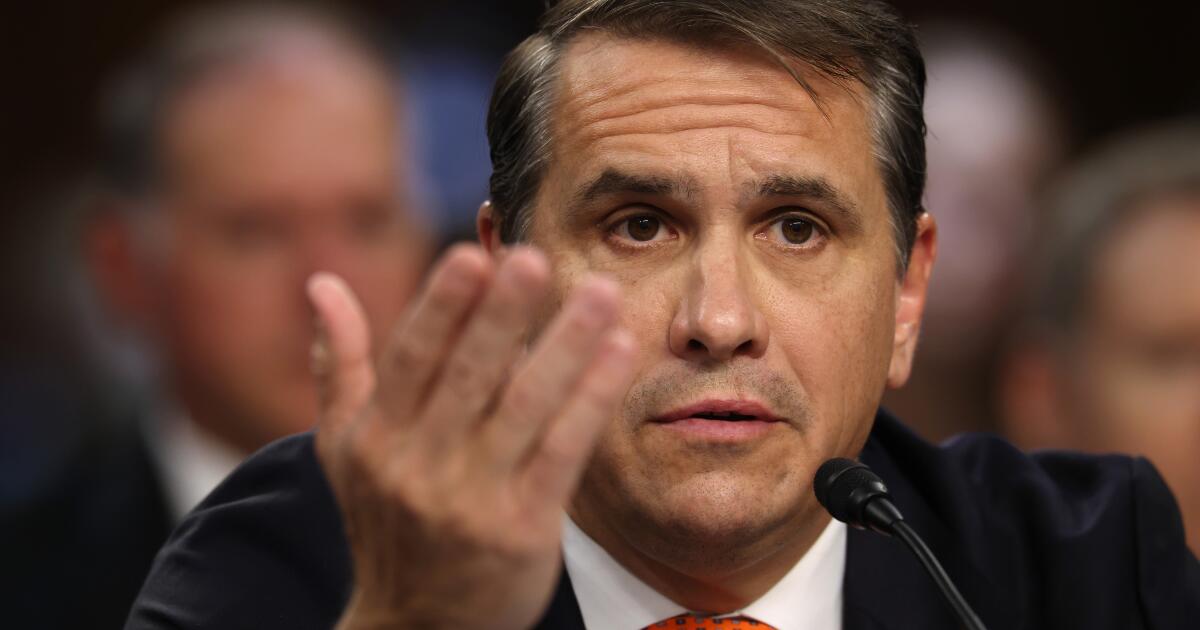
Blanche to face questions about his independence at attorney general confirmation hearing
-
 Sports33 minutes ago
How World Cup senior citizens like Lionel Messi have bio-hacked longer careers
-

 World45 minutes ago
Baltic presidents warn of Russian infrastructure attack plans
-
News1 hour ago
ICE should do traffic stops despite recent shootings, Trump says, seeming to oppose new suspension
-

 Los Angeles, Ca3 hours ago
Southern California hits hottest day of its extreme heat warning


