Washington, D.C
Senate passes separate RFK stadium site bill after removal from federal spending bill


The U.S. Senate has passed a bill granting control of the old RFK Stadium site to the District of Columbia, a last-minute passage that helps clear the way for the Washington Commanders to potentially move back to the city.
The passage early Saturday comes after a provision to transfer control of the land from the federal government to D.C. was removed from Congress’ slimmed-down, short-term spending bill as lawmakers raced to pass it before a government shutdown.
Washington Commanders owner Josh Harris praised the passage, saying in a statement: “We are extremely grateful that our elected officials have come together on a bipartisan basis to give Washington D.C. the opportunity to decide on the future of the RFK stadium site. This bill will create an even playing field so that all potential future locations for the home of the Washington Commanders can be fairly considered and give our franchise the opportunity to provide the best experience for all of our fans.”
The Commanders are considering locations in the District, Maryland and Virginia to build a stadium in the coming years. Their lease at Northwest Stadium in Landover, Maryland, runs through 2027, and Harris called 2030 a “reasonable target” for a new one.
The team played at RFK Stadium two miles east of the Capitol from 1961 to 1996 before moving to Maryland. Harris and several co-owners, including Mitch Rales and Mark Ein, grew up as Washington football fans during that era, which included the glory days of three Super Bowl championships between 1982 and 1991.
The bill will transfer administrative jurisdiction of the RFK site from the Secretary of the Interior to the D.C. government. While the federal government will still own the land, D.C. will be able to redevelop the land for a stadium, commercial and residential development and other public purposes, according to the office of U.S. Rep. James Comer, R-Kentucky, who introduced the bill.
“The Senate’s passage of the D.C. RFK Stadium Campus Revitalization Act is a historic moment for our nation’s capital,” Comer said in a statement Saturday. “If Congress failed to act today, this decaying land in Washington would continue to cost taxpayers a fortune to maintain. Revitalizing this RFK Memorial Stadium site has been a top economic priority for the city, and I am proud to have partnered with D.C. Mayor Muriel Bowser to get this bill across the finish line and to the President’s desk.”
The U.S. House passed the bill in February. With the bill’s passage in the Senate as well, it now heads to President Joe Biden to be signed into law.
“This is a win for DC, for our region, and for America,” Bowser wrote in a social media post Saturday morning. “Everybody loves a good comeback story — and that’s DC’s story.”
News4 is awaiting comment from D.C. Del. Eleanor Holmes Norton.



Among the liquor store, barber shop and dry cleaners at the Watergate Complex’s retail plaza, there is a new pop-up museum dedicated to the scene of the crime that toppled Richard Nixon’s presidency.

Among the liquor store, barber shop and dry cleaners at the Watergate Complex’s retail plaza, there is a new pop-up museum dedicated to the scene of the crime that toppled Richard Nixon’s presidency.
The temporary exhibit features the work of artist Laurie Munn — portraits of members of the Nixon administration and those connected to the Watergate break-in. The exhibit features members of Congress, the media and some who were on Nixon’s enemies list.
Keith Krom, chair of the Board of Directors of the Watergate Museum, told WTOP the exhibit was first featured in the gallery in 2012 for the 40th anniversary of the break-in at the Democratic National Committee.
“When she (Munn) learned about our museum effort, she offered to reassemble them as a way for us to expand awareness of the museum,” Krom said.
Krom, who lives in the Watergate, said his favorite portrait is of one of the special prosecutors, whose firing sparked the “Saturday Night Massacre” in 1973.
“I had the pleasure of being a student of Archibald Cox,” Krom said. “He served as my mentor for my third-year writing project.”
Krom said during this time, at the Boston University School of Law, he spent a great deal of time with him.
“I didn’t realize how much he must have gone through. Here he was, this one man, who was challenging the president of the United States over something pretty serious,” Krom said.
The pop-up opened in October and was recently extended to stay open until April 25. Krom said the hope is to find it a permanent location within the Watergate Complex, where they can “present the history of Watergate, but with two perspectives.”
The first would be on the building’s “architectural significance to D.C.,” he said.
“You may not like the design, you actually may hate it,” Krom said. “But you cannot deny that it changed D.C.’s skyline.”
The secondary focus would, of course, be on the mother of all presidential scandals that changed the course of American history.
“That’s where that suffix ‘-gate’ started and continues to be used for almost every scandal that comes out today,” Krom said.
The inspiration for the museum spawned from an interaction from a tourist outside the Watergate.
“He says, ‘This is the Watergate, right?’ And I was like, ‘Yeah, it’s one of the buildings,’” Krom recalled.
The tourist then asked Krom, “So where’s the museum?”
“I was like, ‘Oh, we don’t have a museum.’ And he literally just looked at me and said, ‘That’s so sad.’ And he got on his bike and rode away,” Krom said.
While the self-proclaimed political history nerd said he “still gets goose bumps” when he drives by the Capitol at night, Krom hopes that when people leave the museum, “they’ll walk away with a new appreciation for how our government works, the guardrails that are in place.”
“Maybe an understanding that those guardrails themselves are kind of frail, and they probably need our collective help in making sure they last — that’s what we hope to accomplish,” Krom said.
Get breaking news and daily headlines delivered to your email inbox by signing up here.
© 2026 WTOP. All Rights Reserved. This website is not intended for users located within the European Economic Area.

According to the National Park Service at the National Mall, famous cherry blossoms around the nation’s capital have hit peak bloom conditions. The National Park Service X account for the National Mall proclaimed this morning, “PEAK BLOOM! PEAK BLOOM! PEAK BLOOM!”
It became apparent yesterday that the bloom would be at peak today. “Despite a sunny afternoon and patches of blue sky, the cherry blossoms remain at Stage 5: Puffy White,” the Park Service wrote on X yesterday. Stage 5, “Puffy White”, is the final stage blossoms go through before being in full bloom. They start at Stage 1 as a “Green Bud”, grow into Stage 2 with “Florets Visible”, and then florets become extended at Stage 3. In Stage 4, there is “Peduncle Elongation” which sets the stage for the puffy blossoms to appear in Stage 5. Puffy White and Peak Bloom are defined as when 70% of the blossoms on the trees reach that stage.

Peak bloom varies annually depending on weather conditions; the most likely time to reach peak bloom is between the last week of March and the first week of April. According to the Park Service, extraordinary warm or cool temperatures have resulted in peak bloom as early as March 15 in 1990 and as late as April 18 in 1958.
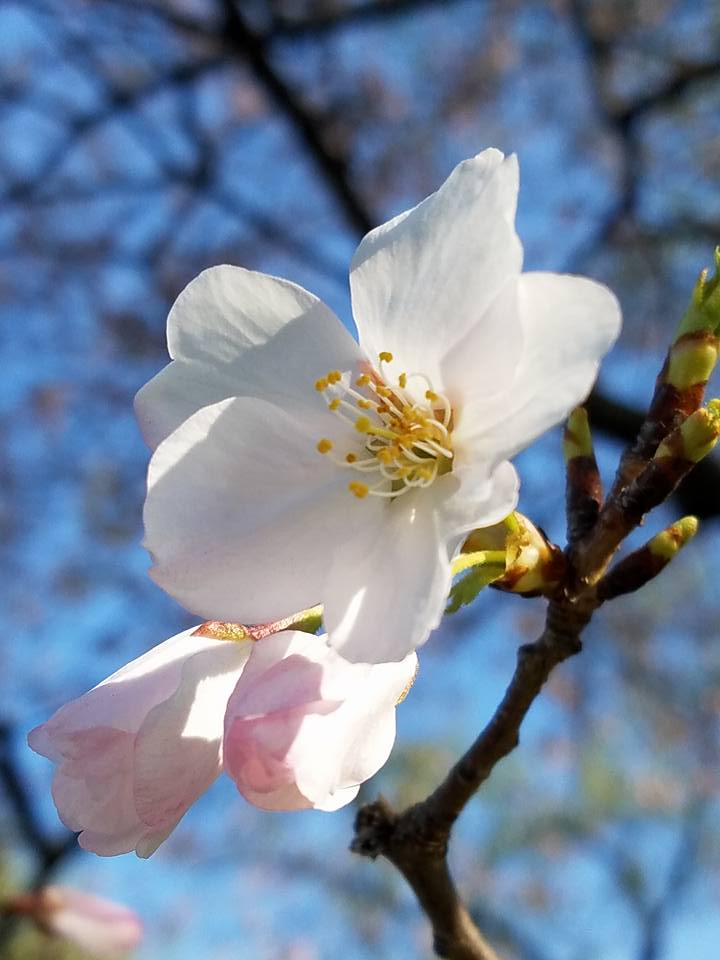
The planting of cherry trees in Washington DC originated in 1912 as a gift of friendship to the People of the United States from the People of Japan. In Japan, the flowering cherry tree, or “Sakura,” is an important flowering plant. The beauty of the cherry blossom is a symbol with rich meaning in Japanese culture.
Dr. David Fairchild, plant explorer and U.S. Department of Agriculture official, imported seventy-five flowering cherry trees and twenty-five single-flowered weeping types from the Yokohama Nursery Company in Japan. After experimenting with growing them on his own property in Maryland, he deemed that the cherry tree would be perfect to plant around the Washington DC area. This triggered an interest by a variety of individuals to plant the tree around Washington. In 1909 the Mayor of Tokyo, Yukio Ozaki, donated 2,000 trees to the United States on behalf of his city. When the trees arrived, they were riddled with disease and insects and to protect other agriculture, they were burned. The Tokyo Mayor made a second donation of trees in 1910, this time amounting to 3,020 trees. This started the forest of cherry trees that now line the Potomac basin around Washington DC. In a gesture of gratitude back to Japan, President Taft sent a gift in 1915 of flowering dogwood trees to the people of Japan. Thousands of trees have been added since, including another gift of 3,800 trees from Japan in 1965.


WASHINGTON (7NEWS) — Authorities are searching for an SUV after an officer with the Metropolitan Police Department (MPD) was struck by a hit-and-run driver in Southwest D.C. on Wednesday night.
The crash happened just before 10 p.m. at Martin Luther King Jr. Avenue and Forrester Street, SW.
Police confirmed the officer, an adult man, was conscious and breathing when he was rushed to a nearby hospital for treatment of his injuries. There is no word on his condition.
The driver involved fled the scene, and investigators are looking for a white Range Rover with a partial South Carolina tag of “403.”
Anyone with information is urged to call 202-727-9099 or text tips at 50411.
This is a developing story that will be updated as more information becomes available.

How to Watch No. 1 Texas Longhorns Hosting No. 15 Texas A&M in Lone Star Showdown

Utah Falls in Emotional, Physical Game Against Capitals | Utah Mammoth

46 anti-Trump No Kings protests planned in Vermont. How to go

Virginia bill targets vape shops that sell to underage buyers – WTOP News

These Wisconsin Rapids restaurants are offering Easter specials

Florida High School Football Rankings: Top 25 teams – Oct. 21

How old is Bo Nix? What to know about Oregon quarterback ahead of 2024 NFL Draft

Cleary's 21 help Le Moyne down Central Connecticut State 69-64 in OT

99th annual Pony Swim held in Virginia

Indiana Members Credit Union announced as new anchor tenant at Bottleworks District

Video: Will ICE Change Under Its New Leader?

DHS shutdown breakthrough comes at cost for Republicans as funding fights nears end

Rubio joins crucial G7 talks as Iran war set to dominate second day

A surprise resignation could open the door for an independent to win a Montana Senate seat

Video: Savannah Guthrie Says She Believes Her Mother Was Taken for Ransom
-

 Detroit, MI1 week ago
Drummer Brian Pastoria, longtime Detroit music advocate, dies at 68
-

 Science1 week ago
How a Melting Glacier in Antarctica Could Affect Tens of Millions Around the Globe
-

 Movie Reviews1 week ago
‘Youth’ Twitter review: Ken Karunaas impresses audiences; Suraj Venjaramoodu adds charm; music wins praise | – The Times of India
-
 Science1 week ago
I had to man up and get a mammogram
-

 Sports6 days ago
IOC addresses execution of 19-year-old Iranian wrestler Saleh Mohammadi
-

 New Mexico4 days ago
Clovis shooting leaves one dead, four injured
-
 Business1 week ago
Disney’s new CEO says his focus is on storytelling and creativity
-

 Texas1 week ago
How to buy Houston vs. Texas A&M 2026 March Madness tickets