Washington, D.C
Inauguration Day Weather Likely To Be Coldest Since 1985 | Weather.com


Inauguration of Ronald Reagan, 1985, which had to be moved into the rotunda of the U.S. Capitol due to extreme cold.
(Architect of the Capitol photo courtesy of the Library of Congress, Prints & Photographs Division)
- The presidential inauguration ceremony will take place on what could be the coldest inauguration day since 1985.
- The forecast high for Washington, D.C., is in the upper teens to low 20s.
- It is likely that Donald Trump will be inaugurated indoors due to the cold.
- The high on Inauguration Day has only been below freezing once since 1985, in 2009.
The 2025 United States Presidential Inauguration is now more likely to be moved indoors due to the coldest weather for an inauguration in 40 years for Washington, D.C., with a high in the upper teens to low 20s.
This will be the first inauguration to be held indoors in 40 years. The record for the coldest January inauguration is currently held by the second inauguration of Ronald Reagan in 1985, when the temperature at noon for the swearing-in ceremony was only 7 degrees, according to the National Weather Service.
The weather for this year’s inauguration is forecast to somewhat mimic that of 1985, which took place on Jan. 21. The high temperature that day was 17 degrees, with sunny skies and afternoon wind chills in the minus 10 to minus 20-degree range. The parade was ultimately canceled, and the swearing-in ceremony had to be held indoors.
The Rotunda is prepared as the inclement weather alternative for each inauguration in the event of inclement weather, according to the Associated Press.
The 2025 Inauguration will be similarly sunny, with wind chills in the lower teens or single digits and winds gusting up to 35 mph in the afternoon. During the ceremony, the temperature will hover in the lower 20s.
Alternate plans are required for the more roughly 250,000 guests ticketed to view the inauguration from around the Capitol grounds and the tens of thousands more expected to be in general admission areas or to line the inaugural parade route from the Capitol to the White House.
Trump said some supporters would be able to watch the ceremony from Washington’s Capital One area on Monday, a day after he plans to hold a rally there. He said he would visit the arena after his swearing-in.
The current forecast high for Inauguration Day is only a couple of degrees above the current record for coldest afternoon high on Jan. 20, though it would break the record for the coldest Inauguration to take place on that date.
Only one other year had a sub-freezing high on inauguration day: Barack Obama’s first inauguration in 2009.
The warmest January Inauguration Day took place in 1981 for Ronald Reagan’s first inauguration, meaning Reagan’s two inaugurations hold the record for the warmest and coldest January Inauguration.
Warmer inaugurations have happened though: Before the 20th Amendment was enacted, Inauguration Day traditionally took place on March 4, which has an average high of 50.2 degrees. Jan. 20 has a cooler average high of 42.9 degrees.
The all-time record high for a U.S. presidential inauguration was set in August 1974 with the Inauguration of Gerald Ford with a high of 83 degrees, though that was a non-traditional inauguration date prompted by the resignation of Richard Nixon.
Here’s a look at some other notable inauguration day weather.
Snowiest Inauguration: William Taft, 1909
On the day of William H. Taft’s 1909 inauguration, nearly 10 inches of snow fell, setting the record for inauguration day. The snow and wind began the day before, with strong winds toppling trees and telephone poles. Trains were stalled and city streets clogged. All activity was brought to a standstill. Sanitation workers shoveled sand and snow through half the night. It took 6,000 men and 500 wagons to clear 58,000 tons of snow and slush from the parade route.

Inauguration of William H. Taft, 1909
(Library of Congress)
Fun fact: Historically speaking, there is approximately a 30% chance of snow on the ground in Washington, D.C., from a previous system for the date Jan. 20.
Worst Inauguration Day Travel: JFK, 1961
On the eve of John F. Kennedy’s inauguration in 1961, 8 inches of snow fell causing the most crippling traffic jam of its time. Hundreds of cars were stranded and abandoned. The president-elect had to cancel dinner plans and, in a struggle to keep other commitments, is reported to have had only 4 hours of sleep. Former President Herbert Hoover was unable to fly into Washington National Airport because of the weather and missed the swearing-in ceremony. By sunrise, the snowfall had ended and the skies cleared but the day remained bitterly cold.
An army of men worked all night to clear Pennsylvania Avenue, and despite the cold, a large crowd turned out for the swearing-in ceremony and inaugural parade. At noon, the temperature was only 22 degrees with the wind blowing from the northwest at 19 mph making it feel like the temperature was just 7 degrees.
Fatal Inaugurations: William Henry Harrison, 1841, and Franklin Pierce, 1853
The weather has caused two inaugurations to have fatal implications, and the most historically significant fatality was that of William Henry Harrison in 1841. Harrison decided to brave the elements and deliver the longest inauguration speech ever, an oration lasting an hour, and 40 minutes.
It was a cloudy, cold and blustery day, and the National Weather Service has estimated the temperature at noon to be approximately 48 degrees.
Harrison, who wore neither hat nor overcoat, also rode a horse to and from the Capitol ceremony. He subsequently caught a cold that developed into pneumonia. Harrison died a month later.

Inauguration of President Franklin Pierce, 1853
(Library of Congress)
The second inauguration with a fatal effect was that of Franklin Pierce in 1853. The morning of the inauguration, there was heavy snow that continued until about half an hour before the ceremony. Skies looked to be brightening by noon, but the snow resumed shortly after Pierce took the oath of office.
The heavy snow dispersed much of the crowd and ruined plans for the parade. Abigail Fillmore, first lady to the outgoing President Millard Fillmore, sat on the cold, wet, exposed platform during Pierce’s swearing-in ceremony. She caught a cold that developed into pneumonia and died at the end of the month.
Rainiest Inauguration: Franklin D. Roosevelt, 1937
The first inauguration to be held on Jan. 20 – Franklin D. Roosevelt’s second inauguration in 1937 – also set the record for the heaviest rain on inauguration day. The day was cold and rainy, with sleet and freezing rain in the morning. Between 11 a.m. and 1 p.m., a period that includes the swearing-in ceremony, nearly three-quarters of an inch of rain fell.

Inauguration of Franklin D. Roosevelt, 1937
(Library of Congress)
Roosevelt insisted on riding back to the White House in an open car with half an inch of water on the floor. Total rainfall for the day was 1.77 inches, which remains the rainfall record for Jan. 20.
First Outdoor Oath: James Monroe, 1817
The first seven inauguration ceremonies from 1789 to 1813 were conducted indoors, making James Monroe’s 1817 inauguration the first that was held outdoors in the weather. Luckily, it was warm and sunny that day, with an estimated temperature at noon of 50 degrees.
Sara Tonks is a content meteorologist with weather.com and has a bachelor’s and a master’s degree from Georgia Tech in Earth and Atmospheric Sciences along with a master’s degree from Unity Environmental University in Marine Science.
The Associated Press contributed to this report.

Washington, D.C
What’s that noise? What you need to know about D.C. flyovers Friday and Saturday – WTOP News

Reagan National Airport will close for America 250 flyover rehearsals Friday and celebrations Saturday featuring the Thunderbirds, Blue Angels and more.
Reagan National Airport will close from 10 a.m. to 1 p.m. Friday for rehearsals ahead of this weekend’s America 250 celebrations, meaning people around D.C., Arlington and Alexandria may hear and see low-flying military aircraft.
According to Freedom 250 event organizers, Friday’s “Wings of Freedom” demonstrations over the National Mall will feature parachute teams, helicopters and military aircraft, including the U.S. Marine Corps’ MV-22 Osprey and F-35B, the Navy’s F-18F and F-35C, the Air Force’s F-22 Raptor, the Thunderbirds and a tri-bomber formation.
On Saturday, the FAA will close the airport from noon to midnight for the full celebration. All arrivals and departures at Reagan National are scheduled to end before noon.
Flyovers and demonstrations are scheduled throughout the afternoon and evening along the National Mall and Washington Monument grounds, including appearances by Air Force One, the Thunderbirds, Blue Angels, military aircraft fleet reviews, parachute demonstrations and B-2 stealth bombers.
Highlights include an Air Force One flyover scheduled for 7:03 p.m., a Thunderbirds demonstration beginning at 6:25 p.m., a tri-bomber formation at 6:02 p.m. and a stealth aircraft flyover at 7:38 p.m.
Friday’s schedule of flyovers and demonstration rehearsals along the National Mall and Washington Monument
- 10 a.m.: Golden Knights, Leap Frogs
- 10:15 a.m.: Army Helo Flyover
- 10:20 a.m.: USMC V-22 Osprey Demo
- 10:35 a.m.: USMC F-35B STOVL Demo
- 10:50 a.m.: USN F-18F Demo
- 11:10 a.m.: USN F-35C Demo Team
- 11:30 a.m.: USAF F-22 Raptor Demo
- 11:50 a.m.: NASA F-5s
- 12 p.m.: HUGE (1) Formation
- 12:05 p.m.: USAF Thunderbirds
- 12:55 p.m.: USAF Tri-Bomber
Saturday’s schedule of flyovers and demonstration along the National Mall and Washington Monument
- 1:14 p.m.: – NASA F-5 Flyover
- 1:24 p.m.: -NASA Fleet Review
- 1:44 p.m.: USCG Helo Flyover
- 1:54 p.m.: USCG Fixed Wing Flyover
- 2:09 p.m.: Golden Knights, Leap Frogs
- 2:29 p.m.: Army Helo Flyover
- 2:44 p.m.: USAF Fleet Review – Wave 1 – Heavies
- 2:54 p.m.: USAF Fleet Review – Wave 2 – AFSOC
- 3:04 p.m.: USAF Fleet Review – Wave 3 – Fighters
- 3:29 p.m.: Executive Rotary Wing Airlift
- 3:39 p.m.: USMC Fleet Review – Wave 1 – Rotary
- 3:49 p.m.: USMC Fleet Review – Wave 2 – Fixed Wing
- 3:59 p.m.: USN Fleet Review – Wave 1 – Rotary
- 4:09 p.m.: USN Fleet Review – Wave 2 – Fixed Wing
- 4:19 p.m.: USN Fleet Review – Wave 3 – Fighters
- 4:21 p.m.: USN F-18F Demonstration
- 4:59 p.m.: USN Blue Angels
- 5:26 p.m.: USMC MV-22 Osprey Demonstration
- 5:44 p.m.: USAF Fleet Review – Fighters
- 6:02 p.m.: USAF Tri-Bomber Formation
- 6:05 p.m.: USN F-35C Demonstration
- 6:25 p.m.: USAF Thunderbirds Demonstration
- 7:03 p.m.: Air Force One Flyover
- 7:07 p.m.: USAF Thunderbirds Delta Break
- 7:17 p.m.: HUGE 1 Flyover Led by the Newly Renovated Air Force One
- 7:38 p.m.: U.S. Stealth Airpower Flyover
- 7:39 p.m.: F-22 Raptor Demo
- 7:53 p.m.: F-22 Raptor in Afterburner
- 7:59 p.m.: B-1 Flyover
- 8:07 p.m.: B-1’s in Afterburner
- 8:11 p.m.: HUGE ONE Fly Over Review
- 8:22 p.m.: Golden Knights Twilight Jump
- 10:36 p.m.: B-1 Afterburner Night Pass
Get breaking news and daily headlines delivered to your email inbox by signing up here.
© 2026 WTOP. All Rights Reserved. This website is not intended for users located within the European Economic Area.

An Air Force major was arrested in uniform on the steps of the Capitol after he called for the impeachment of President Donald Trump.
U.S. Capitol Police arrested Jason Watson, an active-duty service member, on Wednesday afternoon following remarks at a news conference where he said Trump and Vice President JD Vance should be removed from office.
The event was organized by the Removal Coalition, a group that lobbies members of Congress to impeach Trump, and attended by Rep. Al Green, D-Texas, who has repeatedly introduced articles of impeachment against Trump.
“I’m here with him because Rep. Green is the only member of Congress that has demonstrated the courage and conviction to … force a vote on articles of impeachment,” Watson said at the event. “If Congress followed his example, we could remove the entire Trump administration, but Congress remains unconvinced of the urgency and necessity for them to honor their oaths, so we must persuade them with our unrelenting, uncompromising civil resistance.”
Watson said he is not a Democrat and does not share policy positions with Green, who lost his re-election bid this year. Green’s office did not immediately respond to a request for comment on Watson’s arrest.
Capitol Police said in a statement that it “is generally against the law for the public to demonstrate on the House Steps unless they are with a Member of Congress.”
“Yesterday afternoon, a man was escorted to the House Steps by a Member of Congress,” the statement said. “When the Member of Congress left the area, our officers gave the man lawful orders to stop the illegal demonstration or he would be arrested. The man refused our lawful orders.”
Capitol Police identified the man as Watson, adding that he was arrested on charges of “Crowding, Obstructing, and Incommoding” and that it is legal to protest in other spots on the Capitol grounds.
Service members are subject to stricter laws than the average citizen when it comes to protesting. The Uniform Code of Military Justice prohibits officers from “using contemptuous language towards the President, Vice president, the Secretaries of War and of a military department, Congress, and certain other officials,” according to an Air Force memo last year.
An Air Force spokesperson said in a statement Thursday: “Service members must comply with all laws, regulations and policies governing conduct and the wear of the uniform. All Department of the Air Force personnel are expected to uphold the highest standards of discipline and professionalism, both on and off duty.”
All service members, not just members of the Air Force, are prohibited from participating in “political activities” in uniform.
Watson’s criticism of Trump and Vance focused on the administration’s actions in Venezuela and Iran, calling them “an unconstitutional usurpation of Congress’ authority and a violation of the War Powers Clause.”
“These violations resulted in the deaths of 13 service members and injuries of hundreds more,” he said, referring to the number of U.S. military deaths tied to the Iran war. “For this, the president and vice president must be impeached, convicted and removed.”
Watson also called the administration’s immigration policies and tactics unconstitutional.
The Removal Coalition did not immediately respond to a request for comment, and Watson could not be reached.
President Donald Trump responded to criticism of a financial disclosure that listed $1.4 billion in crypto earnings largely driven by meme coins.
Berk Kutay Gökmen
02 July 2026•Update: 02 July 2026
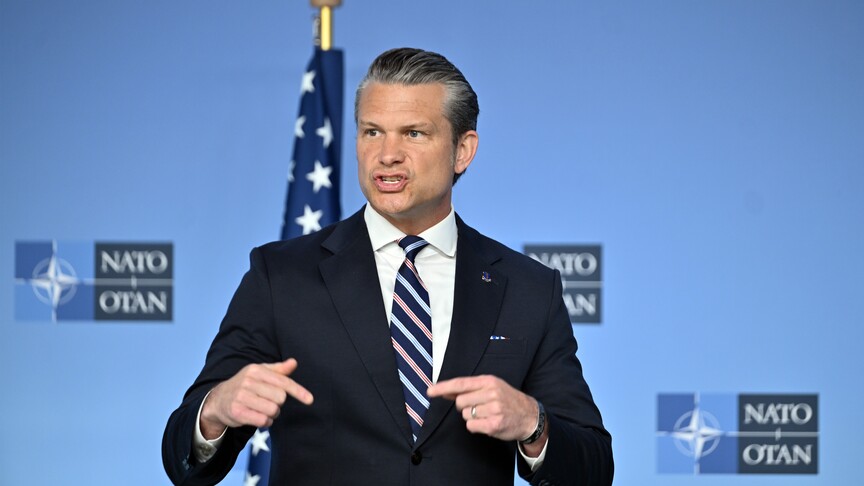
US Defense Secretary Hegseth on Thursday faced protesters while hosting the Trump administration’s DC Safe and Beautiful Task Force ceremony in Washington DC.
During the ceremony at Meridian Hill Park, which saw the gathering of National Guardsmen, dozens of demonstrators gathered near the park to protest Hegseth.
Footage shows the demonstrators chanting a short distance away from where Hegseth and roughly 200 members of the National Guard had gathered in the park
In social media posts, one protester was seen holding a Palestinian flag, while another person was holding a sign that reads “arrest Hegseth.” The protesters want a “Free DC,” according to social media posts.
In his address to the National Guard, Hegseth said that “this background noise is perfect,” referring to the protests.
“It’s the sound of ingrates, of ingratitude—of people who are so blinded by ideology they can’t see law and order and common sense in front of them,” he said.
Meridian Hill Park was repaired by the National Park Service and the Interior Department as part of a larger initiative to restore and enhance federal parks and public spaces throughout the nation’s capital in preparation for America’s 250th anniversary, which falls on this Saturday, July 4.
Though such beautification projects are typically popular with the public, the current initiative has been controversial both for its choice of projects and the use of no-bid contracts to hire firms to do the work, sometimes with disappointing results.
The work aligns with President Donald Trump’s DC Safe and Beautiful Task Force, established by a March 2025 executive order that directs federal agencies to coordinate public safety and beautification efforts across Washington.
-

 Georgia4 minutes ago
Comparing Mark Richt’s NFL Georgia stars since 2006 to Kirby Smart’s
-

 Hawaii11 minutes ago
State parks superintendent accused of having 2 million secret nude recordings of employees
-

 Idaho14 minutes ago
Idaho Falls Chamber of Commerce CEO resigns amid podcast allegations – East Idaho News
-

 Illinois19 minutes ago
Illinois legislation to regulate cannabis market
-

 Indiana26 minutes ago
Prostitution charges filed against two women in Westfield
-

 Iowa29 minutes ago
After convictions for theft and abuse, Iowa nurse faces sanctions from licensing board
-

 Kansas34 minutes ago
Kansas man injured after jet ski incident at Lake of the Ozarks
-

 Kentucky41 minutes ago
Kentucky Picks Up Latvian Record Holder Nikolass Deicmans For Class of 2026

