Washington, D.C
Faulty sensor triggers days-long alarm at former Iranian Embassy in DC


Faulty sensor triggers days-long alarm at former Iranian Embassy in DC
It was an alarm that blared at the former Iranian embassy since last Friday night. That’s when D.C. Fire says the original call came in for an alarm going off at the former embassy. FOX 5’s David Kaplan has the story.
WASHINGTON – It was an alarm that blared at the former Iranian embassy since last Friday night.
That’s when D.C. Fire says the original call came in for an alarm going off at the former embassy.
The U.S. State Department’s Office of Foreign Missions preserves and maintains buildings owned by a foreign mission, but no longer occupied by them.
According to the State Department’s website, the U.S. and Iran have had no formal diplomatic relations since 1980.
Faulty sensor triggers days-long alarm at former Iranian Embassy in DC
D.C. Fire was the agency that responded to the building on Embassy Row on Massachusetts Avenue nearly each time someone called 911 but determined that there was likely no emergency, and couldn’t enter the building until the State Department was able to help them get in.
“As people passed by, they’ve heard an audible alarm at the former embassy, and the fire department has been sent out to investigate,” said Danny McCoy, D.C. Fire’s deputy chief for special operations and homeland security.
McCoy says, in all, six people called 911 in the last few days, typically passersby.
Serena Wiltshire lives nearby and was thankful she couldn’t hear the alarm from her home, but heard it while walking her dog on Massachusetts Avenue.
“When I walked the dog up to Massachusetts Avenue, about a block away from it, I started to hear it,” Wiltshire said.

Faulty sensor triggers days-long alarm at former Iranian Embassy in DC
McCoy says in the case of an active embassy, D.C. Fire is often welcomed in, especially if there’s an emergency, but the process can be slowed a bit when they need to be granted access by another entity.
“Situations like this, when the building is locked up, we can’t get in, we contact the State Department, or the service, and we go through the process of finding out who’s responsible if they can get somebody out to assist us,” McCoy said, while adding fire officials determined there was no emergency when they responded.
Monday, D.C. Fire and the State Department went into the building, determined it was likely a faulty sensor causing the alarm to go off, shut it off, and then left.
D.C. Fire confirmed the alarm went off again overnight.
A State Department spokesperson says the fix is in the works and declined comment on why it took multiple days for the alarm to be shut off.



Berk Kutay Gökmen
02 July 2026•Update: 02 July 2026
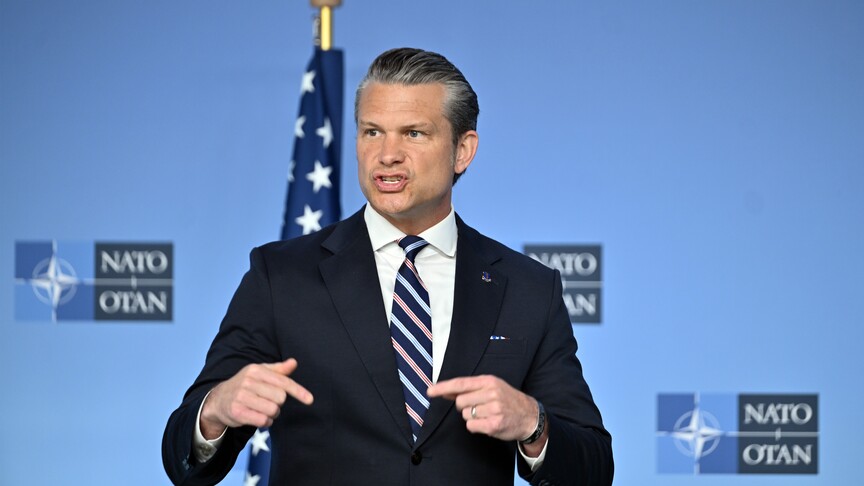
US Defense Secretary Hegseth on Thursday faced protesters while hosting the Trump administration’s DC Safe and Beautiful Task Force ceremony in Washington DC.
During the ceremony at Meridian Hill Park, which saw the gathering of National Guardsmen, dozens of demonstrators gathered near the park to protest Hegseth.
Footage shows the demonstrators chanting a short distance away from where Hegseth and roughly 200 members of the National Guard had gathered in the park
In social media posts, one protester was seen holding a Palestinian flag, while another person was holding a sign that reads “arrest Hegseth.” The protesters want a “Free DC,” according to social media posts.
In his address to the National Guard, Hegseth said that “this background noise is perfect,” referring to the protests.
“It’s the sound of ingrates, of ingratitude—of people who are so blinded by ideology they can’t see law and order and common sense in front of them,” he said.
Meridian Hill Park was repaired by the National Park Service and the Interior Department as part of a larger initiative to restore and enhance federal parks and public spaces throughout the nation’s capital in preparation for America’s 250th anniversary, which falls on this Saturday, July 4.
Though such beautification projects are typically popular with the public, the current initiative has been controversial both for its choice of projects and the use of no-bid contracts to hire firms to do the work, sometimes with disappointing results.
The work aligns with President Donald Trump’s DC Safe and Beautiful Task Force, established by a March 2025 executive order that directs federal agencies to coordinate public safety and beautification efforts across Washington.
Washington, D.C
Metro, DC leaders lay out more details on transit at new Commanders stadium – WTOP News

D.C. officials expressed an urgency Wednesday to begin preparing transit infrastructure for the opening in 2030 of the new Washington Commanders stadium on the old RFK Stadium campus.
D.C. officials expressed an urgency Wednesday to begin preparing transit infrastructure for the opening in 2030 of the new Washington Commanders stadium on the old RFK Stadium campus.
The work will impact far more than the single, cramped Metro station nearby.
During a roundtable discussion with District leaders, Metro General Manager and CEO Randy Clarke laid out the need for improvements to the existing Stadium-Armory Metro stop, and touted a new rapid bus transit line with dedicated lanes.
In tandem, those will be key to getting tens of thousands of people to events at the coming stadium, Clarke said.
“I absolutely believe the first couple of experiences that people have going to a Commanders game, going to some of the first big events, is going to dictate how people feel about taking transit,” D.C. Council member Charles Allen, who chairs the committee that oversees transportation projects, said. “So, we don’t have an option to get it wrong. We have to get it right.”
That’s why Clarke and other District leaders agreed that reaching a memorandum of understanding that lays out the roles, responsibilities and financials of these projects by July 23, the next Metro board meeting, is crucial.
“I think we’re all working towards that, and pretty optimistic,” Clarke said. “Then we’ve got to work really hard on design, we’ve got to work really hard on procurement, we’ve got to work really hard on construction.”
Clarke said the stadium’s ability to attract blockbuster events will depend on the transit agency and its ability to move people in and out of the complex.
“We’re not going to try to get, hosting the Super Bowl, we’re not going to try to host women’s World Cup, we’re not trying to get Taylor Swift and Beyoncé back here. I mean, at the end of the day, Metro is going to be the key to the success. We understand the pressure on us,” he said.
For the Stadium-Armory station, that means renovating the mezzanine and adding elevators to handle the increased demand. Clarke also talked about new street-level infrastructure to help manage the flow inside the station.
“So it’s very Disney-esque, where people feel like they’re constantly moving without actually going too far, if you know what I mean,” Clarke said. “Then we filter them where we need to go. That is a good example of what we need to do at the surface.”
But Metro won’t rely entirely on its trains. The roundtable also discussed what’s been dubbed the Gold Line, which would run buses from Union Station to the stadium.
Construction estimates for bus line are in the $75 million range, District Department of Transportation Director Sharon Kershbaum said
The Gold Line is to run through the heart of the H Street corridor, and transportation leaders said the impact will be everything the streetcar was supposed to be.
“This is now going to be the east-west corridor that we never were able to accomplish on the streetcar,” Kershbaum said.
“This is going to have frictionless service, because it will be center-running. So all of the issues — when a car double-parked and it stopped streetcar service — all of those things, we’ll be immune from. We are going to see the transportation service that was really never ever reached by streetcar achieved with this,” she said.
The vision for the Gold Line goes beyond the handful of weekends when NFL football is played at the stadium, and beyond initial Union Station-stadium route. Transportation officials see the buses eventually traveling between the Benning Road Metro Station and Rosslyn, Virginia.
“We want the Gold Line to solve the cross-town problem we’ve had in this community for a long, long time,” Clarke said.
That means providing access to the convention center and also solving the gridlock that fills up K Street NW every day. Clarke said coming up with dedicated lanes on K Street would actually be the most pivotal part of this new transit line.
“The downtown core of D.C. does not move, especially during p.m. rush hour,” Clarke said. “If you want people in Benning Road that may work, say on K Street, to have better transportation, solving K Street is equally as important, if not more important, because of time savings and reliability.”
Officials did not specify a timeline for the full expansion, but it would not be completed by 2030.
Where it does run, Gold Line buses would travel in the middle lanes, to avoid what caused problems for the Streetcar, which could grind to a halt when cars would double park. Building out the Gold Line would mean more changes to the way cars move along H Street in Northeast.
“You can’t do what you want to do and also keep all the parking,” At-Large Council member Christina Henderson said.
“There’s intersections where we’re going to have to take turns away at certain intersections, maybe parking in certain places,” Clarke said. “In other places parking could be kept, because we’re looking at putting platforms.”
Stadium-related transit construction will run far beyond H Street and the Stadium Armory stop.
“We do want to minimize outages, but there’s going to be significant outages to do this project,” Clarke said.
“It’s all about where we can turn trains around and how to manage that,” he added. “So if we do an outage to Stadium Armory, what that really means is we’re impacting customers from New Carrollton and Largo all the way through the system, and some people that are west of the system that want to go east of Stadium Armory won’t be able to.”
But with the project not even really in the design phase yet, it’s hard to plan out how and when those impacts will happen.
“We’ll be doing obviously overnight work,” Clarke said. “We’ll probably do some, what we call, early outs. Sometimes we’ll start at 10 o’clock at night. We might be able to do some single tracking on certain types of work. Other work is going to be complete shutdowns.”
“And the question is, is that going to be X amount of weekends or is it going to be like a two-, three-, four-week block at a time,” he added. “We’ve got to work through all of that.”
Get breaking news and daily headlines delivered to your email inbox by signing up here.
© 2026 WTOP. All Rights Reserved. This website is not intended for users located within the European Economic Area.

WASHINGTON, D.C. — Ohioans are among the visitors traveling to the nation’s capital this week for the Great American State Fair, part of the country’s 250th birthday celebration.
On Wednesday, visitors trickled into the Ohio state pavilion booth, which includes a map of Ohio’s most iconic places and an exhibit on several children’s initiatives championed by Gov. Mike DeWine, First Lady Fran DeWine and Lt. Gov. Jim Tressel.
“I wanted to come here, we wanted to see the sights here. We figured once in a lifetime,” said Carolyn Golamb of Fremont, who was visiting Washington, D.C. with her husband, Mark.
The fair has been a source of controversy after multiple musicians scheduled to perform at a kickoff concert withdrew, citing political concerns.
The event was organized by Freedom 250, a White House-backed group that has been accused of usurping the government’s official America250 commission, created by Congress 10 years ago for the same purpose. In addition, many elements of the fair have pushed a partisan message, such as President Donald Trump’s campaign-style rally on June 25 and events like “MAHA Mondays.”
Amid the controversy, attendance at the fair has been sparse.
Rep. Dave Taylor, R-Ohio, attributed the light turnout not to politics, but to forecasts of triple-digit heat this week.
“The weather is going to hold numbers down a little bit,” he said. “There’s a lot of walking to go from one place to another here, and people are here visiting with little kids. I think you’re going to see the numbers pick up as we get closer to Saturday for sure.”
Several visitors from Ohio said they did not notice any partisanship at the fair.
“That is the reason why I’m here, is because all of us have made a big positive contribution to what makes America great. And it’s not just one group or one party or anything. It’s all of us together,” said Toledo native Cassandra Newsome.
“It’s the 250th anniversary. No matter who was in power at the time, I still would be here,” said Mark Golamb.
The fair runs June 25 to July 10 on the National Mall.
-

 Connecticut6 minutes ago
Connecticut 250, 251, 252, 253 . . . – New Haven Independent
-

 Delaware8 minutes ago
Wilmington fire displaces 20, damages 6 homes on Clayton Road; cause under investigation
-

 Florida14 minutes ago
USF Health brings emergency pregnancy training to rural Florida without maternal care
-

 Georgia21 minutes ago
Middle Georgia looks to see a scorcher for the Fourth of July
-

 Hawaii24 minutes ago
Car drives into Sunshine Market in Honolulu
-

 Idaho29 minutes ago
Obituary for Eugene Merland Ricks – East Idaho News
-

 Illinois36 minutes ago
Two charged after severed arm with Packers tattoo found in Illinois lake, police say
-

 Indiana39 minutes ago
Warden resigns from Indiana prison housing hundreds of ICE detainees

