


Continue to check WAVY.com for updates.
Virginia
Should legislators tweak Virginia’s 2006 voter roll law for more clarity? • Virginia Mercury


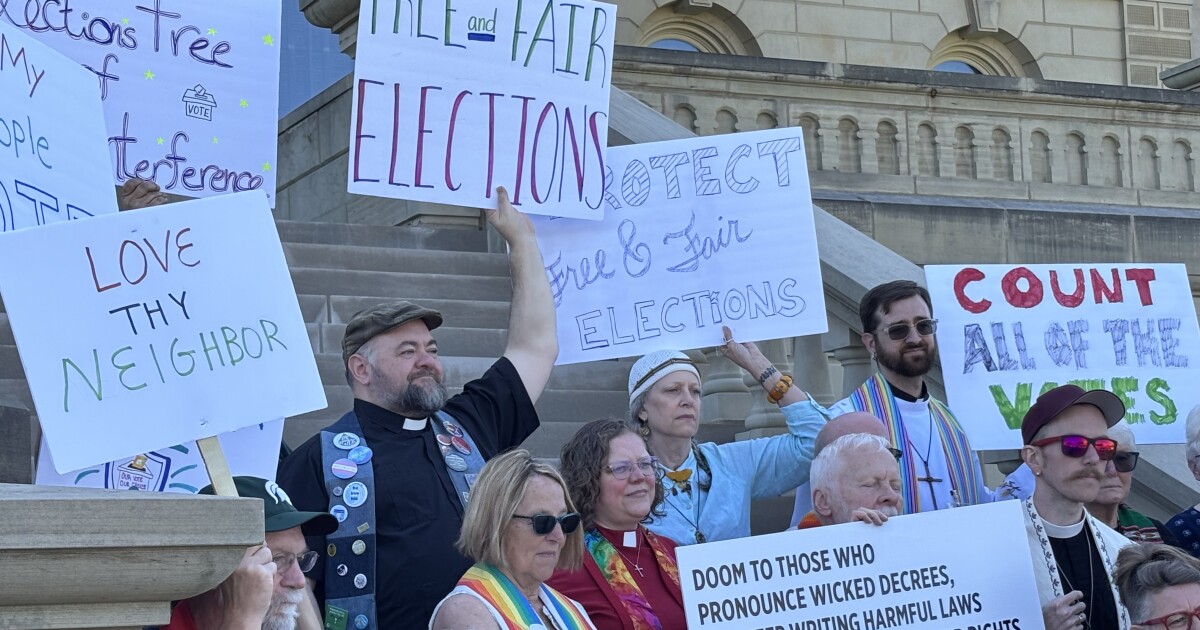
Virginia officials have asked the United States Supreme Court to block a lower court’s ruling that roughly 1,600 people purged from voter rolls by Gov. Glenn Youngkin’s executive order must be reinstated. Two lawsuits allege that Youngkin’s order violated federal law by removing voters from rolls too close to Election Day, a claim the governor refutes by pointing to a 2006 state law as the basis of his action.
Virginia asks Supreme Court to block order to reinstate 1600 people stripped from voter rolls
The situation has raised questions on whether state lawmakers should consider amending that law for additional clarity and to avoid future legal disputes over how Virginia confirms voter registration shortly before elections.
The 2006 law
Youngkin has said repeatedly that his executive order was built on a 2006 state law for voter roll cleanups, which directs the Department of Motor Vehicles to send data to the State Board of Elections of people who failed to indicate U.S. citizenship in paperwork. There’s a process of notification and then purging of voters who fail to prove their citizenship, and in previous years, the process was done on a monthly basis. Youngkin’s order directed DMV and Elections Department officials to perform it daily.
The lawsuits the state and Youngkin face say Youngkin’s order ran afoul of the National Voter Registration Act, which institutes a “quiet period” on such actions 90 days before an election. Several state lawmakers have signaled they agree with that allegation, including House Speaker Don Scott, D-Portsmouth, who previously told The Mercury “The reason that we have this 90-day rule is that we don’t want citizens to be accidentally removed.”
Privileges and Elections Committee chair Sen. Aaron Rouse, D-Virginia Beach, called Youngkin’s order “reckless” and alleged that it’s being used to “fire up the (Republican) base.”
“When you actually look at the issue of the matter, it’s the 90-day quiet period,” Rouse said.
The courts will decide the matter concerning the legal challenges, John Aughenbaugh, a political science professor at Virginia Commonwealth University, said.
But he added that the Youngkin administration “brought this on themselves” by issuing the order so close to the 90-day federal threshold.
However, Aughenbaugh said, “I can understand why the Youngkin admin told Fox News ‘we didn’t think we were doing anything wrong,’” in citing the 2006 law.
That measure was carried by former republican state Sen. Ken Cucinelli and signed by former Democratic Gov. Tim Kaine. At that time, Republican President George Bush’s Department of Justice had issued a memo that it didn’t object to the law.
In the time since, no one has challenged it, until the two suits against Youngkin.
An argument in Attorney General Jason Miyares’ Supreme Court filing notes confusion on when the federal 90-day law should overpower the 2006 state law.
“The current confusion surrounding the NVRA makes the rules anything but clear,” Miyares’ petition reads. “States are unaware of when, or whether, they can remove noncitizens from the voter rolls. They need to know with certainty whether they can remove noncitizens at any point, only outside of the Quiet Period, or never.”
On Tuesday, the Republican National Committee and Republican Party of Virginia also filed a brief in support of the state’s SCOTUS request.
Virginia GOP calls on U.S. Supreme Court to reinstate Youngkin’s voter purge order
Rouse said there hasn’t yet been talk between himself and other members of the Privileges and Elections Committee about tweaking the 2006 law to spell out the 90-day threshold of the NVRA.
“We haven’t had those conversations,” he said.
As to resolving any confusion, Sen. Bill Stanley, R-Franklin County, said that the state legislature broadly is always looking at ways past laws might need to be amended.
“This might be one of those times,” he said. “The question then becomes ‘is there a bipartisan solution?”
It might also come down to the question of how to prevent governors from overstepping or skirting federal law, as well as how to prevent presidential administrations from wading into state law, Aughenbaugh suspects.
The debacle playing out on the national stage might prompt Virginia legislators to ask, “Did the Youngkin administration too broadly interpret the law? Do we want to rein-in gubernatorial administrations in the future?” Aughenbaugh posited. “Meanwhile, how do you revise the law so that future presidential administrations don’t single out a state for lawsuits two weeks before Election Day?”
Rouse said there’s valid reasons for those types of deliberations.
“It’s more of a bigger picture with Governor Youngkin in terms of inciting fear and undermining our elections,” Rouse said of conversations he’s having with his fellow lawmakers. “We understand that this administration has been known to make mistakes.”
Rouse pointed to how the administration pulled out of ERIC, a multi-state data-sharing coalition meant to maintain voter roll accuracy — and how he vetoed legislation prompting Virginia’s return to it this year, along with other voting-related bills. The administration also mistakenly canceled over 3,000 people’s registrations last year, Rouse said.
Can same-day voter registration and provisional ballots fix it?
Regardless of whether eligible voters were caught up in the recent purge or runs into other election-access issues, registrars have said that use of same-day registration and provisional ballots are an option that would allow them to vote on Election Day. Provisional ballots require follow-up after voting to verify a person’s address, citizenship status or other factors.
It’s an argument Republican national and state leadership is making as a reason Youngkin’s order and the subsequent voter purges should stand.
“Even if a person entitled to vote were erroneously removed from the voter rolls and unable to respond to the Commonwealth’s outreach, they may still take advantage of same-day registration and cast a ballot,” the state’s request to the Supreme Court stated. “No legal voters could or would be disenfranchised.”
Aughenbaugh doubts the nation’s highest court will grant Virginia’s request so close to the elections and suspects people who have been purged may not have to resort to provisional ballots this year.
“I don’t think there are enough (Supreme Court) justices that have the appetite to wade into that dispute less than a week before elections,” he said.
GET THE MORNING HEADLINES.


CHARLOTTE, N.C. — In this world of college football, with the transfer portal and recruiting battles, bad blood is present more than ever before between head coaches.
That’s not the case between the Virginia Tech head coach and Clemson head coach Dabo Swinney, however. In fact, Franklin revealed at ACC Kickoff on Thursday that the two are actually close friends, dating back to their time at the Nike trip that various coaches take over the summer.
“Dabo’s my guy,” Franklin said on Thursday. “We go way back. We’ve been on the Nike trip for a long time. His wife and my wife are friends.”
The long-time Penn State head coach is making the move to the ACC after being fired from the Nittany Lions in October. 12 seasons of being with the program had Franklin hold a 44-21 record against top 10 opponents, an impressive record for a new conference foe of Swinney’s.
But when that trip comes around, there’s a camaraderie between Swinney and Franklin and both of their wives. In fact, the two hang out with each other instead of the other coaches at times. It simply comes to an “edgy” time in college athletics that raises tempers.
“I’m going to be honest, I wouldn’t say we’re necessarily like the type of people that love a lot of other coaches and a lot of other programs,” Franklin said. “It’s hard when you just compete year-round.”
On Swinney’s end, there are a few who could immediately come to mind among Clemson fans. Perhaps the most recent would be Ole Miss coach Pete Golding, who played the most significant role in the tampering of former linebacker Luke Ferrelli.
It’s a select list of coaches who make the good side of the Tigers’ head coach, and Franklin is certainly on that list. On the other hand, Hokies’ head coach has Swinney on his own shortlist.
“Obviously, tremendous respect for what he has built at Clemson and what he’s done at Clemson, and what he’s done for the ACC,” he said.
The two will see that close relationship face off at Memorial Stadium this upcoming season. Clemson will host the Hokies on Oct. 24 in what could be a potential title-eliminator for the ACC Championship.
Of course, the last game that we’ve seen the Tigers play in was against Franklin’s former team in Penn State at the Bad Boy Mowers Pinstripe Bowl. That game ended in a 22-10 contest that saw a foundation of Franklin players end Clemson’s season in disappointment.
Swinney will see many of those players once again in October, including starting quarterback Ethan Grunkemeyer, in that contest. The anticipated Hokie starter recorded 260 yards and two passing touchdowns on the Tigers in the Bronx that day.
Although friends become foes, another ACC coach has given Swinney his flowers for what he’s been able to do for the conference. In the upcoming moments, Franklin will look to prepare his team to prove itself on one of the biggest stages in the ACC, while Swinney looks to put his team back at the top of a conference he’s dominated for over 15 years.
Add us as a preferred source on Google
Follow

MARTINSVILLE, Va. (WSET) — Extreme drought conditions in parts of Virginia have prompted an emergency drought warning for a wide swath of the region, including Bedford, Campbell, Charlotte, Franklin, Halifax, Henry, Mecklenburg, Patrick, Pittsylvania and Roanoke counties, along with the cities of Danville, Roanoke, Salem and Martinsville.
The governor has warned that if conditions worsen, she will activate mandatory nonessential water-use restrictions.
In Martinsville, city leaders have issued a voluntary water conservation notice and are urging residents and businesses to cut back where they can. The request comes as local businesses that rely heavily on water say the drought is already affecting day-to-day operations.
SEE ALSO: Botetourt County residents adjust daily routines as voluntary water restriction continues
John Hughes, owner of John’s Car Wash, said the dry conditions have hit his business hard in recent weeks. “For the last 3 weeks, it’s been hitting pretty hard. We done three yesterday and haven’t done anything today with the drought and hot weather. Yeah, I’m really concerned about it,” Hughes said.
Restaurants are also feeling the strain. David Kitzmiller, an owner of Be Wiched, said water is essential for routine tasks such as washing dishes and preparing some menu items.
“We use a lot of water for washing dishes and some of our recipes if they limit us in anyway defiently can’t produce and its a scary aspect,” Kitzmiller said.
Kitzmiller added that cutting back is not always realistic for businesses that must meet sanitation needs. “Not really feasible for a business that depends solely relies on water to wash their dishes, so that can’t definitely be an impact there,” he said.
City leaders emphasized that the conservation request is voluntary for now, but they are encouraging everyone to do their part by taking shorter showers, turning off the faucet when it is not in use, washing only full loads of laundry, and limiting outdoor watering whenever possible.

VIRGINIA BEACH, Va. (WAVY) — Five people were charged after Virginia Beach Police conducted a two-day human trafficking and vice operation on July 3, according to the Virginia Beach Police Department.
The department’s Special Investigations Bureau conducted the operation, which was aimed at identifiying human trafficking victims, reducing the demand for commercial sex and targeting individuals seeking to exploit or recruit children for prostitution.
Detectives used many investigative techniques to proactively identify individuals involved in criminal activity related to prostitution, human trafficking and offenses against children. The operation was conducted in Virginia Beach, involving personnel from all of the bureau’s squads.
As a result of the operation, five people were identified and charged with offenses ranging from solicitation of prostitution to sex trafficking and crimes involving minors. Two vehicles and U.S. currency were seized during the operation. Other people were connected to victim services through Samaritan House.


The operation led to the following people being charged:
- Shane Carter, 28, of Norfolk, was charged with solicitation of prostitution.
- Robert Harris, 64, of Virginia Beach, was charged with solicitation of prostitution and assault and battery.
- Larry Pittman, 53, of Portsmouth, was charged with sex trafficking and use of electronic devices to facilitaate certain offenses involving minors.
- Kenric Frazier, 46, of Portsmouth, was charged with sex trafficking, use of electronic devices to facilitate certain offenses involving minors and solicitation of child pornography.
- Cameron Lewis, 24, of Norfolk, was charged with solicitation of prostitution.
Investigators also developed leads about people who are suspected of trafficking and exploiting others for commercial sex. Those are now active and ongoing investigations. There may be more charges and arrests pending further investigation and consultation with the Virginia Beach Commonwealth’s Attorney’s Office.
If you’re a human trafficking victim or know someone who is, you can report it to the National Human Trafficking Hotline at 1-888-373-7888.
-

 San Diego, CA5 minutes ago
EXCLUSIVE: Ignition Press Welcomes eBay Live & Revenge Of to San Diego Comic-Con Ignition Pavilion
-
 Milwaukee, WI11 minutes ago
Milwaukee comedy club The Laughing Tap hosting stand-up challenge
-

 Atlanta, GA17 minutes ago
Georgia couple spots black bear on their front porch
-

 Minneapolis, MN23 minutes ago
Minneapolis City Council rejects police drone contract with controversial Skydio
-

 Indianapolis, IN29 minutes ago
Businesses await next steps after Braun ends diversity program
-

 Pittsburg, PA35 minutes ago
Pittsburgh-area family finds large void under garage of house built by Ryan Homes
-

 Augusta, GA41 minutes ago
Driver taken into custody after chase, rollover crash in Augusta
-

 Washington, D.C47 minutes ago
IndyCar announces start time for highly anticipated Freedom 250 Grand Prix on the streets of Washington, DC

