Texas
Colin Allred two points behind Ted Cruz in second Texas poll


Democrat Texas Senate hopeful Colin Allred is just two points behind Republican incumbent Ted Cruz, according to a second poll in a matter of days.
A survey from the Clean and Prosperous America PAC, an environmentalist advocacy group that campaigns for Democratic Party candidates, showed Cruz ahead of congressman Allred by 47 percent to 45 percent. The results are similar to a YouGov/University of Houston poll released on August 22, which also showed Allred about two points behind Cruz (46.6 percent to 44.5 percent).
The Clean and Prosperous America survey also suggests the Senate race in Florida between Sen. Rick Scott and former congresswoman Debbie Mucarsel-Powell could be very competitive. The poll shows that Scott is up by 3 points against Mucarsel-Powell (48 percent to 45 percent), which is among the closest margin of any public poll.
Andrew Harnik/Getty Images
A number of Democratic figures have suggested that Texas and Florida—both considered strong red states—could be in play in November in the Senate races, and the presidential election between Kamala Harris and Donald Trump.
If Allred were to flip the Texas senate seat from Cruz in November, he would become the first Democrat senator in the Lone Star state since 1988.
The Clean and Prosperous America poll shows Trump is leading Harris in Texas by 5 points (49 percent to 44 percent) and by 4 points in Florida (51 percent to 47 percent).
Greg Rock, executive director of the Clean and Prosperous America PAC, said in a statement: “The results of these two surveys show that both Florida and Texas are competitive states in the general election. Senators Rick Scott and Ted Cruz are unpopular and narrowly lead their opponents despite their incumbency.
“It’s too early to predict exactly who will vote in November or what the outcome will be,” Rock added. “But this snapshot shows that voters in Texas and Florida have clear choices ahead of them and might surprise the pundits and forecasters.”
Allred’s and Cruz’s offices were contacted for comment via email.
An Allred victory in Texas would be a major boost for the Democratic Party’s bid to hold on to the Senate after November’s elections.
The Democrats currently control the upper chamber by a 51-49 seat margin, including four independent senators who caucus or align with the party. The GOP is widely expected to flip the West Virginia seat held by outgoing Democrat-turned-independent senator Joe Manchin in November.
A previous University of Houston/Texas Southern University (TSU) poll released in July showed Cruz leading Allred by 3points (47 percent to 44).
The results revealed Allred had drastically cut the margin down from the 9-point lead Cruz held over his Democratic rival in the same poll late last year.
Michael Adams, director of the Executive Master of Public Administration graduate program at TSU, suggested that Allred is becoming more popular as his name recognition grows.
“As a congressman from Dallas, he wasn’t well-known in the rest of the state, but as a result of winning the primary and months of campaigning and advertising, his name ID has increased, and support has nudged up by 5 points,” Adams said.
The Clean and Prosperous America poll showing Allred behind Cruz by 2 points was conducted just prior to Allred giving a speech at the Democratic National Convention in Chicago.
Election forecasters Race to the White House are giving Cruz a 66 percent chance of winning November’s Texas Senate race, with Allred estimated to have a 34 percent chance. This is down from the 73 percent chance Race to the White House was giving Cruz in July.
The Clean and Prosperous America poll surveyed 837 registered voters in Florida and 725 in Texas between August 21-22. The results have a margin of error of plus or minus 3.4 percent in Florida and 3.6 percent in Texas.



AUSTIN, Texas (KXII) — KXII 12 received 10 first place awards at the Texas Broadcast News Awards by the Texas Association of Broadcasters over the weekend.
The station won the following awards in the small market division:
•Breaking News
•Investigative Report
•Election Results Coverage
•Sports Special (The Max Blitz)
•Sports Anchor (David Reed)
•Station Photojournalism
•Individual Photojournalism (Drury Vaughan)
•Morning Newscast
•Evening Newscast
•Overall Broadcast Excellence
KXII 12 has been recognized for Overall Broadcast Excellence three times in the past four years. The award is the top station honor in each division.
“This is an incredible honor and a testament to the integrity and hard work of our entire news team,” station vice president & general manager Derek Rogers said. “We’re proud to be recognized for journalism that puts Texoma first, and we’re grateful to our viewers for trusting us to tell the stories that matter most.”
Station news director Matt Griffin said the awards reflect the team’s commitment to the community.
“These awards are a testament to the dedication and professionalism of the team we have at KXII 12,” Griffin said. “They are committed to serving our communities by giving them the quality coverage they deserve every day.”
Copyright 2026 KXII. All rights reserved.
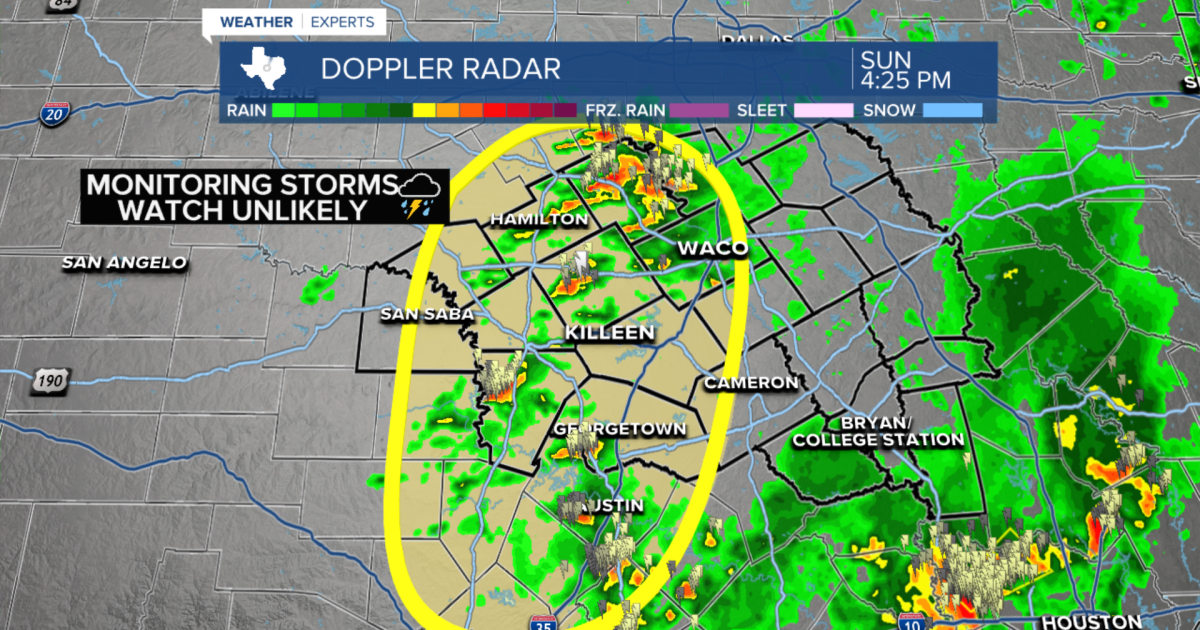
CENTRAL TEXAS — Strong thunderstorms started to fire up west of I-35 after 2pm Sunday afternoon after several rounds of morning rain and thunderstorms. These thunderstorms will continue to pepper regions along and west of I-35 for the remainder of the evening. Individual storms are traveling North-Northeastward at a slow pace. Severe weather isn’t out of the question, but risks will mainly be small hail, wind gusts around 40mph, frequent lightning, and heavy rain. Rain totals could climb to 3″ for some affected.
A Severe Thunderstorm Watch is unlikely to be issued today.
A Flood Watch was issued for Bell, Williamson, Milam, Robertson, Leon, Burleson, Brazos, Madison, and Grimes counties until 4am Monday morning. A complex of thunderstorms closer to I-10 have prompted Flash Flood Warnings for excessive rain, but this has so far stays south of the Brazos Valley.
Any thunderstorms, severe or not, should conclude by 10pm tonight. After which, conditions remain humid with lows in the upper 60s. Monday’s storm chances have diminished greatly, and only an isolated chance for showers and storms remain for those east of I-35. Waco is looking dry. Highs climb to the low to mid 80s.
The next thunderstorm chance appears to be around Wednesday of this week. There is a chance for stronger storms but Waco is at the extreme southern most extent of thunderstorm chances to begin with, so this isn’t a particularly great chance for nasty thunderstorms. The bulk of that action is likely well north extending from Dallas, TX to Milwaukee, WI.
The week finishes very warm. Waco’s high temp will climb to about 86 degrees and College Station up to 88 potentially.
– 25 News Meteorologist Thomas Patrick
Want this forecast delivered to your inbox each morning? Sign up for the daily forecast email newsletter here.

In May, Dallas voters will have an opportunity to decide on a bond election by Dallas ISD valued at more than $6.2 billion, a record amount in the State of Texas.
If voters approve, they will agree to raise their property tax rate by one cent. It’s estimated it will cost homeowners an extra $2.79 each month and an extra $33 annually with a home value of $500,000 after the $140,000 homestead exemption.
The bond would build 26 brand new schools, renovate and modernize all campuses, remove the 700 remaining portable classrooms and upgrade security.
It will also provide various updates, including technology for students, debt service refinancing and repairs for swimming pools.
The bond election is comprised of four propositions, A through D. Early voting for this and other municipal elections runs from Monday, April 20, through Tuesday, April 28.
CBS News Texas political reporter Jack Fink spoke with the Dallas ISD Bond Campaign co-chair and former school board trustee Miguel Solis, who explained more about why the bond is needed.
“Kids getting a high-quality education in high-quality facilities will inevitably lead to a better economic outlook,” Solis told Fink. “Because more kids will then be getting better grades that lead to better jobs and maximizes their earning potential… this is a workforce play as much as anything else.”
Solis said that the tax rate in Dallas ISD has been consistently decreasing since 2019.
“When you look at the ten largest districts in North Texas, it’s actually got the lowest tax rate,” he said. “That only gets the district so far to be able to ensure, once and for all, that every student and every school across Dallas ISD can have physical infrastructure improvements.”
According to Solis, there are 135,000 students in Dallas ISD.
“That number alone is larger than most Texas cities outside of Dallas,” Solis said. “The district is just big.”
The Texas Public Policy Foundation said that if the Dallas ISD bond is approved, it could double the district’s debt.
“Anytime you issue a bond, that’s you’re essentially issuing debt,” Solis said. “And that debt can extend out over the course of, you know, multiple years. The 2015 bonds over the course of, I’d like to think maybe the next 5 or 10 years, we will probably see that debt ultimately paid off.”
Solis said that the district feels “pretty confident” that it can manage any existing and new debt.
This week’s full episode can be found below:

Ahupua‘a restoration in Molokai offers potential flooding remedy | Honolulu Star-Advertiser

California 'sandos' set for first Idaho location

Illinois Cash Rents and Leasing Expectations Through 2027 – farmdoc daily

Physical guard commits to Indiana basketball from transfer portal: Stats, highlights

Why Jimmy Butler wore an Iowa State volleyball shirt before NBA game

Florida High School Football Rankings: Top 25 teams – Oct. 21

How old is Bo Nix? What to know about Oregon quarterback ahead of 2024 NFL Draft

Cleary's 21 help Le Moyne down Central Connecticut State 69-64 in OT

99th annual Pony Swim held in Virginia

Indiana Members Credit Union announced as new anchor tenant at Bottleworks District

Melania Trump’s Epstein remarks turn up the heat on DOJ, Acting AG Todd Blanche to do more
Newsletter: Cautious optimism in Brussels as Orbán ousted in landslide Hungarian opposition win

More than a quarter of private colleges are at risk of closing, a new projection shows

NYC mayor cites $180K racial wealth gap to justify taxes, police cuts

Abuse allegations against lead Democrat shake race for California governor
-

 Atlanta, GA1 week ago
1 teenage girl killed, another injured in shooting at Piedmont Park, police say
-

 Georgia6 days ago
Georgia House Special Runoff Election 2026 Live Results
-

 Arkansas3 days ago
Arkansas TV meteorologist Melinda Mayo retires after nearly four decades on air
-

 Pennsylvania7 days ago
Parents charged after toddler injured by wolf at Pennsylvania zoo
-
 Milwaukee, WI7 days ago
Potawatomi Casino Hotel evacuated after fire breaks out in rooftop HVAC system
-

 Technology1 week ago
Anthropic essentially bans OpenClaw from Claude by making subscribers pay extra
-

 Austin, TX6 days ago
ABC Kite Fest Returns to Austin for Annual Celebration – Austin Today
-

 World1 week ago
Two dozen Democrat-led states sue Trump over mail-in ballot limits