Tennessee
New Automatic Selective Service law fuels military draft fears in Tennessee


NASHVILLE, Tenn. (WZTV) — A new federal law tied to Selective Service registration is stirring up concern online, with some young men wondering whether the U.S. could be moving closer to a military draft.
But a retired Army recruiting official in Tennessee says that is not what this law does.
The change, set to take effect in December, would automatically register eligible men for Selective Service instead of relying on them to sign up themselves.
The Selective Service System (SSS), which maintains the database of men eligible for a draft, states on its website that under the new, “streamlined” registration process, responsibility for registering will shift “from individual men to SSS through integration with federal data sources.”
Almost all male citizens and male immigrants between the ages of 18 and 25 are required by federal law to register with the SSS within 30 days of either marking their18th birthday or entering the U.S.
Men who fail to register can become ineligible for state financial aid, state and federal employment, and—in the case of male immigrants—U.S. citizenship.
A new federal law tied to Selective Service registration is stirring up concern online, with some young men wondering whether the U.S. could be moving closer to a military draft. (Photo: WZTV)
The 2026 NDAA amends the Military Selective Service Act to include language stating that men between the ages of 18 and 26 “shall be automatically registered under this Act by the Director of the Selective Service System.”
Men will be automatically registered within 30 days of their 18th birthday under the new policy, the same period during which eligible men are currently required to self-register.
They will then receive written notice that they have been registered, per the NDAA—and be notified of the process for contesting their registration, if they fall into the select groups who are exempt from the requirements.
The proposed rule will not change who is required to register.
That distinction is getting lost online.
“I’ve heard that there’s like a possibility like 18- to 25-year-olds have to enter into the draft pool by like December or something,” said Zach Rutter, a 22-year-old Vanderbilt senior. “But that’s all I really know.”
Rutter said the idea of “automatic registration” does raise concern.
“It does make me a little more concerned that it’s like a possibility. It could happen,” he said. “But it seems like kind of far in the future if it does.”
Even after learning the law does not create a draft and instead automatically handles a process already required, Rudder said the change still makes some people wonder why it is happening now.
“It just does kind of make me think there’s a possibility that, you know, they’re kind of thinking in the back of their heads, they might need a draft,” he said. “So that’s like my bigger concern, I guess.”
That fear is exactly what Lee Elder says many people are getting wrong.
Elder is a retired civilian employee for Army Recruiting Command, where he worked for 27 years, and a retired Tennessee National Guard officer who served in Desert Storm, Bosnia and Operation Iraqi Freedom.
“No, I don’t see it happening,” Elder said when asked whether the U.S. is headed toward a military draft.
He said bringing back a draft would take far more than automatic registration.
“For one thing, it would take congressional approval to do that,” Elder said. “The American public, they love the all-volunteer Army. You say the draft or the D word and people get upset.”
Elder said people are confusing two very different things.
“Enrolling a person is one thing. Putting them in the military service is something totally different,” he said.
He described the new law as more of an administrative change than a signal that a draft is imminent.
“If you’re a male and you reach your 18th birthday, then you need to sign up for Selective Service. You have to do this anyway,” Elder said. “So like I said, I just see it more as a convenience for the government.”
Elder also said even in a worst-case scenario, a draft would not happen overnight.
“It would take weeks, if not months, just to sort out from the list who is qualified and who is not,” he said.
He noted that only a fraction of the population would even meet military qualifications, and said the armed forces already have other options before anything like a draft would be considered, including active-duty troops, reserves and National Guard members.
“A full-scale mobilization simply isn’t in the picture,” Elder said. “It would take a while to pass Congress. It would take a while to get funded. It would take a while to be implemented. It would take months to get draftees into uniform and train them and prepare them for a combat mission.”
Elder said the type of event that would likely be needed to trigger a draft would be much more severe than current world tensions.
“I think you’d have to have several things happen,” he said. “First of all, there’d have to be a threat to our territory, to our homeland. And with anything else we do in our form of government; you’ve got to have a majority of people who support it. And neither of those conditions seem to be in play right now.”
He said he believes much of the panic is being driven by misunderstanding and alarmist posts online.
“I think there’s a lot of people who like to sound the alarm for threats that really aren’t that substantial,” Elder said. “But again, I just don’t see it as a realistic possibility at this point.”
For young men like Rutter, that explanation may calm some fears, but not all of them.
While he said he is not entirely opposed to automatic registration since Selective Service is already required, he also understands why people his age are uneasy.
The law may not start a draft, but as debate over global conflict continues online, the word “draft” alone is enough to get attention.

The Tennessee Lottery offers several draw games for those aiming to win big.
Here’s a look at June 28, 2026, results for each game:
Winning Cash 3 numbers from June 28 drawing
Evening: 5-3-8, Wild: 7
Check Cash 3 payouts and previous drawings here.
Winning Cash 4 numbers from June 28 drawing
Evening: 5-6-1-2, Wild: 1
Check Cash 4 payouts and previous drawings here.
Winning Daily Tennessee Jackpot numbers from June 28 drawing
05-08-17-19-31
Check Daily Tennessee Jackpot payouts and previous drawings here.
Winning Millionaire for Life numbers from June 28 drawing
04-11-31-54-58, Bonus: 03
Check Millionaire for Life payouts and previous drawings here.
Feeling lucky? Explore the latest lottery news & results
Are you a winner? Here’s how to claim your lottery prize
All Tennessee Lottery retailers will redeem prizes up to $599.
For prizes over $599, winners can submit winning tickets through the mail or in person at Tennessee Lottery offices. By mail, send a winner claim form, winning lottery ticket, a copy of a government-issued ID and proof of social security number to P.O. Box 290636, Nashville, TN 37229. Prize claims less than $600 do not require a claim form. Please include contact information on prizes claimed by mail in the event we need to contact you.
To submit in person, sign the back of your ticket, fill out a winner claim form and deliver the form, along with the ticket and government-issued ID and proof of social security number to any of these locations:
Nashville Headquarters & Claim Center: 26 Century Blvd., Nashville, TN 37214, 615-254-4946 in the (615) and (629) area, 901-466-4946 in the (901) area, 865-512-4946 in the (865) area, 423-939-7529 in the (423) area or 1-877-786-7529 (all other areas in Tennessee). Outside Tennessee, dial 615-254-4946. Hours: 9 a.m. to 4 p.m. Monday through Friday. This office can cash prizes of any amount.
Knoxville District Office: Cedar Springs Shopping Center, 9298 Kingston Pike, Knoxville, TN 37922, (865) 251-1900. Hours: 9 a.m. to 4 p.m. Monday through Friday. This office can cash prizes up to $199,999.
Chattanooga District Office: 2020 Gunbarrel Rd., Suite 106, Chattanooga, TN 37421, (423) 308-3610. Hours: 9 a.m. to 4 p.m. Monday through Friday. This office can cash prizes up to $199,999.
Memphis District Office: Chiles Plaza, 7424 U.S. Highway 64, Suite 104, Memphis, TN 38133, (901) 322-8520. Hours: 9 a.m. to 4 p.m. Monday through Friday. This office can cash prizes up to $199,999.
Check previous winning numbers and payouts at https://tnlottery.com/.
When are the Tennessee Lottery drawings held?
- Powerball: 9:59 p.m. CT Monday, Wednesday, and Saturday.
- Mega Millions: 10:00 p.m. CT Tuesday and Friday.
- Cash 3, 4: Daily at 9:28 a.m. (Morning) and 12:28 p.m. CT (Midday), except for Sunday. Evening game daily, seven days a week, at 6:28 p.m. CT.
- Daily Tennessee Jackpot: 9:00 p.m. CT daily.
- Tennessee Cash: 10:34 p.m. CT Monday, Wednesday, and Friday.
- Powerball Double Play: 10:30 p.m. CT Monday, Wednesday and Saturday.
- Millionaire for Life: 10:15 p.m. CT daily.
This results page was generated automatically using information from TinBu and a template written and reviewed by a Tennessean editor. You can send feedback using this form.

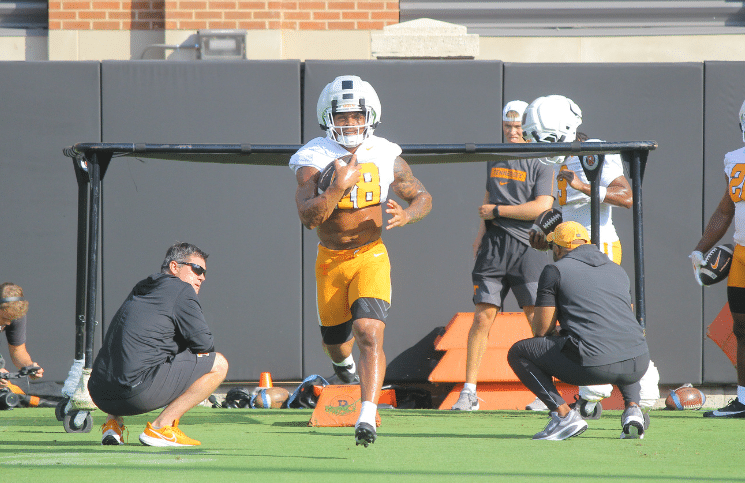
A position group that has stability at the top but questions behind the starter is running back. DeSean Bishop returns as the unquestioned starter after a dominant redshirt-sophomore year, but both the pieces behind him a year ago that split the load have departed.
Now, it’ll be a battle for reps between young returners Daune Morris and Justin Baker and Tulane transfer Javin Gordon. Tennessee has rotated up to three backs a game, as well, making a chance for two to be in a game-by-game position to contribute.
Bishop, the star of the room, has expectations that he could play his way into an NFL draft pick this upcoming year. This past season, he took 182 carries for 1,076 yards and 16 touchdowns. That was good for a really strong average of 5.9 yards per tote.
More From RTI: Tennessee Left Off Eight-Team List of SEC College Football Playoff Contenders
Gordon, the Tulane transfer, joins after his true freshman year with the Green Wave. While it wasn’t at the SEC level, he was very productive, posting 128 carries, 516 yards and five touchdowns.
Morris and Baker return after limited roles. Morris was the fourth back, meaning he got more run than Baker when injuries did occur. He finished his freshman year with 35 carries, 133 yards and a touchdown while also returning punts. Baker took 14 carries for 43 yards.
“It’s huge because you look at the production, you got a guy that understands what he’s walking into in terms of seeing it week in and week out in terms of the caliber of teams that we’re going against,” Tennessee running backs coach DeRail Sims said in the spring about Bishop returning. “His understanding of what it’s like when the game’s on the line and having to go out there and make plays in all three facets of the game, in running the ball, the protection piece, and the passing game. So it’s huge having Bish back.”
The other pieces of the running back room are three-star freshman Will Rajecki and redshirt-senior Hunter Barnes.

MURFREESBORO, Tenn. (WSMV) – Traffic on Interstate 24 will be impacted Sunday as Middle Tennessee Electric crews conduct electrical line work.
MTE said crews will be performing electrical line work across I-24 near Exit 76 in Murfreesboro Sunday, June 28.
“The project will require one full interstate traffic stoppage and multiple rolling roadblocks beginning at sunrise,” MTE said. “The work is expected to take approximately five to six hours to complete.”
MTE said Guardian Traffic Control will assist with traffic management.
The work could be rescheduled in the event of inclement weather.
Copyright 2026 WSMV. All rights reserved.
-

 Technology10 minutes ago
The Flipper Zero creators’ Busy Bar productivity display will go on sale next month
-

 World13 minutes ago
Families watch in horror as skydiving plane crashes in France, killing all 11 aboard
-

 Politics18 minutes ago
DOJ launches grand jury probe into Marxist mogul Neville Roy Singham’s funding of leftist groups
-

 Health25 minutes ago
America’s lifespan has doubled since 1776 — experts reveal what changed
-

 Sports28 minutes ago
Thekla embarrasses Stardom’s Starlight Kid after retaining AEW World Women’s Championship at Forbidden Door
-

 Technology33 minutes ago
AI may spot deadly heart risk in a routine ECG
-
 Business40 minutes ago
SpaceX IPO sparks race for luxury housing in Southern California
-
 Entertainment42 minutes ago
Movies, books, art and music to explore as America turns 250

