South-Carolina
Dunleavy’s gifts major donation


Jan. 27 was a great day to kick off the year and put much needed funds — courtesy of a record-breaking $47,501 check by Dunleavy’s Pub — in the Special Olympics coffers.
In addition to the vast number of regular events Special Olympics South Carolina provides for athletes around the state, 2026 is also a year of the Special Olympics USA games. South Carolina will be sending a delegation of 152 athletes and coaches to Minnesota at a cost of about $1300 per attendee.
All fundraising efforts are vital this year, reports Special Olympics South Carolina Director of Marketing & Development Sandye Williams.
The organization’s next polar plunge will take place in February on the Isle of Palms, followed by a “huge” bocce tournament on May 23.
Viist www.boccebash.com for more information.



USC’s Jazzy Davidson and Kara Dunn on wild OT win over Clemson
Trojans’ Jazzy Davidson and Kara Dunn share their feelings
Sports Pulse
COLUMBIA, S.C. ― The second round of the Women’s NCAA Tournament features a Monday night game between the USC Trojans and the USC Gamecocks, raising the question: Who is the real USC?
Ella Sather and Alyssia Hamilton, reporting for USA TODAY Sports Network, posed the question to the players from top-seeded South Carolina and No. 9 seed Southern California. The answers were somewhat expected but also … enlightening.
One Trojan said, “Honestly, before this, I’ve never heard anybody call South Carolina USC,” while a Gamecock delivered this bit of possible bulletin-board material: “I actually didn’t know they were a school until I got to college.”
These players are likely to know each other pretty well after the second-round game, which we predict USC will win.

NORTH CHARLESTON, S.C. (WCIV) — On the verge of clinching a ticket to the Kelly Cup Playoffs, the South Carolina Stingrays faced off against the Allen Americans Saturday at the North Charleston Coliseum, cheered on by 5,430 fans.
For the second straight night the Rays scored early, with forward Anthony Rinaldi sending home a goal giving the Stingrays a 1-0 lead only 3:14 into the period.
Over ten minutes later the Stingrays doubled their advantage thanks to Kyler Kupka who knocked home a center goal fed by Dean Loukus on the power play.
South Carolina was ahead 2-0 with 4 minutes left in the first, however Allen Americans player Danny Katic scored a quick goal making it 2-1 at the end of the first. Allen seemed to gain momentum after that goal with Harrison Blaisdell tying the game early in the second with a shorthanded goal.
Now with the two-goal lead buffer gone the Rays were searching for a break in Allen’s defenses.
READ MORE | Stingrays sign forward Casey McDonald after four-year college career at LIU
Yet again one of the newest team acquisitions delivered as Rays player Rinaldi tucked home an odd-man chance just over five minutes into the second period pushing South Carolina back in front, 3-2.
The Allen American’s goalie Marco Costantini was peppered with shots from the rays throughout the second, as they worked to regain a larger edge. Costantini blocked 17 shots on goal in the second period and both teams moved to the third maintaining a 3-2 score.
Over seven minutes into the third period Kupka punched home his second goal of the night, building South Carolina’s lead back to 4-2. The Americans responded quickly however, when forward Michael Gildon made a score with 8:19 left in regulation.
Heading into the final minutes of the game with only a one-goal cushion, the Stingrays earned a much needed insurance goal at the hands of Casey McDonald.
Though the Americans pulled their goalie to bring out an extra player with 2:32 left, they ended up scoring only one goal, unable to totally cover the two goal lead that the Stingrays had continually built up.
With this victory, the Stingrays have qualified for the Kelly Cup Playoffs for the 30th time in 33 seasons. South Carolina has points in 15 of its last 16 games, and have 24 wins at home this season, second most in the ECHL.
The Stingrays will return to the North Charleston Coliseum on March 22nd, against the Allen Americans for Pucks and Paws Day presented by Washes and Wags Pet Grooming at 3:05 p.m.
South-Carolina
The fault(s) in our state: The geological forces that cause SC’s earthquakes, explained

COLUMBIA — You might have missed it, but the Midlands was hit by yet another earthquake this week.
The Magnitude 2.1 earthquake struck just about two miles west of Irmo on March 19, according to a preliminary report by the U.S. Geological Survey. It was a “blink and you’ll miss it” temblor, as earthquakes of that size typically just spur minor disruptions — like causing suspended objects to swing — according to the USGS.
Over the past several years, the Midlands has experienced a higher-than-normal (at least from a human perspective) level of seismic activity, The Post and Courier has previously reported.
The March 19 quake is just one of the many earthquakes the Palmetto State experiences every year.
South Carolina is bisected by a number of fault lines that cause those temblors. Those formations are the lingering scars of seismic activities that slammed continents together, raised the Appalachians from the Earth and created the Atlantic Ocean.
And those wounds are far from healed.
“Once you form a fault, it never truly disappears,” said Steven Jaume, a professor of geology and seismology at the College of Charleston.
“ If you break anything, you can glue it back together,” Jaume explained. “But unless you happen to have glue that’s stronger than the original material, it’s gonna break in the same place that broke the first time.”

An earthquake hit near Lake Murray on March 19, 2026, making it the sixth recorded earthquake in the area in less than two months.
The coastal plain has historically been the most earthquake-active part of the state, according to the S.C. Department of Natural Resources. Much of that activity — including the 1886 earthquake, one of the deadliest natural disasters to strike South Carolina — has been clustered around the Summerville area.
The faults that run under the coast and Midlands are “inferred” faults. That means they require special equipment and techniques to detect, Jaume said, as the coastal plain’s sediments cover up most of the visual surface indicators.
“We usually can’t see them directly,” he explained.
“ In 1886, we don’t know exactly what moved because it did not break the Earth’s surface,” he added. “And if it doesn’t break the Earth’s surface, you can’t put your finger directly on it.”
Age is another major difference between coastal faults and their Upstate cousins, Jaume said. Many of the Upstate faults were formed when North America and Africa collided hundreds of millions of years ago, forcing the Appalachians skyward. As the two continents drifted apart, opening the Atlantic Ocean, newer fault lines began to form.
“We think the (younger faults) are being reactivated now underneath the Charleston area,” Jaume said.
The most recent temblor to strike the coastal area was a Magnitude 2 which occurred a few dozen miles offshore of McClellanville on March 13. It was the first offshore quake to hit the state in at least 20 years, according to a DNR database.
As to the Midlands swarm? It’s actually two distinct clusters — one centered in the Elgin area, and the other by Lake Murray. Jaume said both the Elgin and Lake Murray clusters appear to be the reactivation of a fault line. The March 19 quake was part of the Lake Murray cluster.
He added that it is possible for man-made reservoirs to spur earthquake activity, but that doesn’t appear to be the case with Lake Murray, which was constructed in the late 1920s. But that trend, called “Reservoir-induced Seismicity” has been documented at Lake Monticello, which was built for the VC Summer Nuclear Power Station.
“ When they put that one in, they had thousands of micro-earthquakes following the filling of that lake,” Jaume said. “And they periodically have swarms. There was one in fall of ‘21 and fall of ‘23.”
South Carolina’s fault lines fall into three categories. Strike-slip faults occur when plates move horizontally to one another. A thrust fault occurs when the plate above the fault slides up and over another. A standard fault causes the plate above the fault to slide lower than the opposing one.

UPDATE: Plane found in swamp near Cleco lake, RPSO says

Maine Maple Sunday Weekend draws visitors to 100-plus sugarhouses statewide

What’s on Maryland lawmakers’ deadline day to-do list

Sweet 16 crossroads for Nimari Burnett journey to Michigan basketball

Big ballot mistakes: Mass. rent control, tax cut proposals would backfire – The Boston Globe

Florida High School Football Rankings: Top 25 teams – Oct. 21

How old is Bo Nix? What to know about Oregon quarterback ahead of 2024 NFL Draft

Cleary's 21 help Le Moyne down Central Connecticut State 69-64 in OT

99th annual Pony Swim held in Virginia

Indiana Members Credit Union announced as new anchor tenant at Bottleworks District

Video: Plane Collides With Vehicle at LaGuardia Airport

As cattle herds shrink and beef prices rise, investors back AI cow collars

French elections: Paris stays left as far right makes mixed gains

ICE officers set to deploy to airports as delays mount, border czar Homan confirms

Video: ICE Agents Will Be Deployed to U.S. Airports, White House Confirms
-

 Detroit, MI4 days ago
Drummer Brian Pastoria, longtime Detroit music advocate, dies at 68
-

 Oklahoma1 week ago
Family rallies around Oklahoma father after head-on crash
-

 Georgia1 week ago
How ICE plans for a detention warehouse pushed a Georgia town to fight back | CNN Politics
-
 Science1 week ago
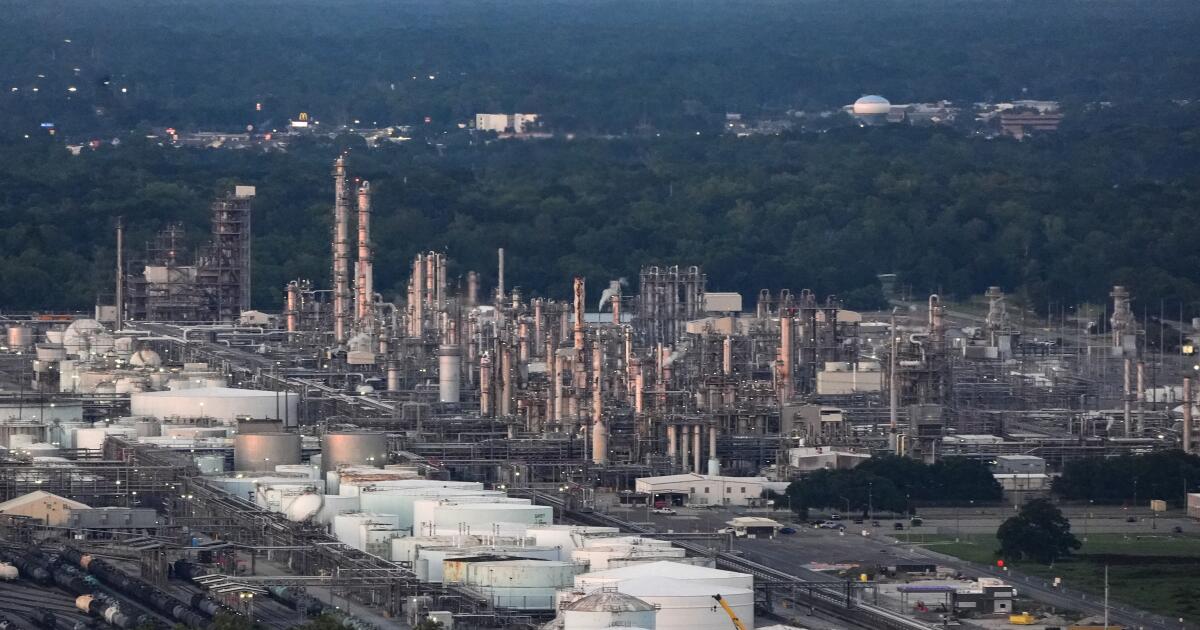
Federal EPA moves to roll back recent limits on ethylene oxide, a carcinogen
-

 Alaska1 week ago
Police looking for man considered ‘armed and dangerous’
-

 Movie Reviews4 days ago
‘Youth’ Twitter review: Ken Karunaas impresses audiences; Suraj Venjaramoodu adds charm; music wins praise | – The Times of India
-

 World1 week ago
Thousands march worldwide in solidarity with Palestine, Iran on al-Quds Day
-

 World1 week ago
Jamal Rayyan, the first face of Al Jazeera, dies at 73