North Carolina
It’s official, North Carolina professors will have to publicly post syllabi


The UNC System has officially adopted a policy to force all state university professors to publicly post their syllabi.
System President Peter Hans approved the policy measure Friday evening, which didn’t require a vote from the UNC Board of Governors. The new regulation was posted on the System’s website without a public announcement and while all campuses are on winter break.
The decision puts North Carolina in league with other Southern states like Florida, Georgia, and Texas; two of which legislatively mandate syllabi to be public records.
The UNC System’s new syllabi policy not only requires the documents to be public records, but universities must also create a “readily searchable online platform” to display them.
All syllabi must include learning outcomes, a grading scale, and all course materials students are required to buy. Professors must also include a statement saying their courses engage in “diverse scholarly perspectives” and that accompanying readings are not endorsements. They are, however, allowed to leave out when a class is scheduled and what building it will be held in.
This policy goes into effect on Jan. 15, but universities aren’t required to publicly post syllabi or offer the online platform until fall 2026.
Hans had already announced his decision to make syllabi public records a week in advance through an op-ed in the News & Observer. He said the move would provide greater transparency for students and the general public, as well as clear up any confusion among the 16-university System.
Before now, a spokesperson told WUNC that the syllabus regulations were a “campus level issue” that fell outside of its open records policy. That campus autonomy assessment began to shift after conservative groups started making syllabi requests – and universities reached opposing decisions on how to fulfill them.
Lynn Hey (left); Liz Schlemmer (right)
Earlier this year, UNC-Chapel Hill sided with faculty, deciding that course materials belong to them and are protected by intellectual property rights. UNC Greensboro, however, made faculty turn in all of their syllabi to fulfill any records requests.
“Having a consistent rule on syllabi transparency, instead of 16 campuses coming up with different rules, helps ensure that everyone is on the same page and similarly committed heading into each new semester,” Hans said in the op-ed.
Still, faculty members from across the UNC System tried to convince Hans to change his mind before his decision was finalized.
About a dozen attempted to deliver a petition to his office days after the op-ed. More than 2,800 faculty, staff, students, and other campus community members signed the document – demanding Hans protect academic freedom.
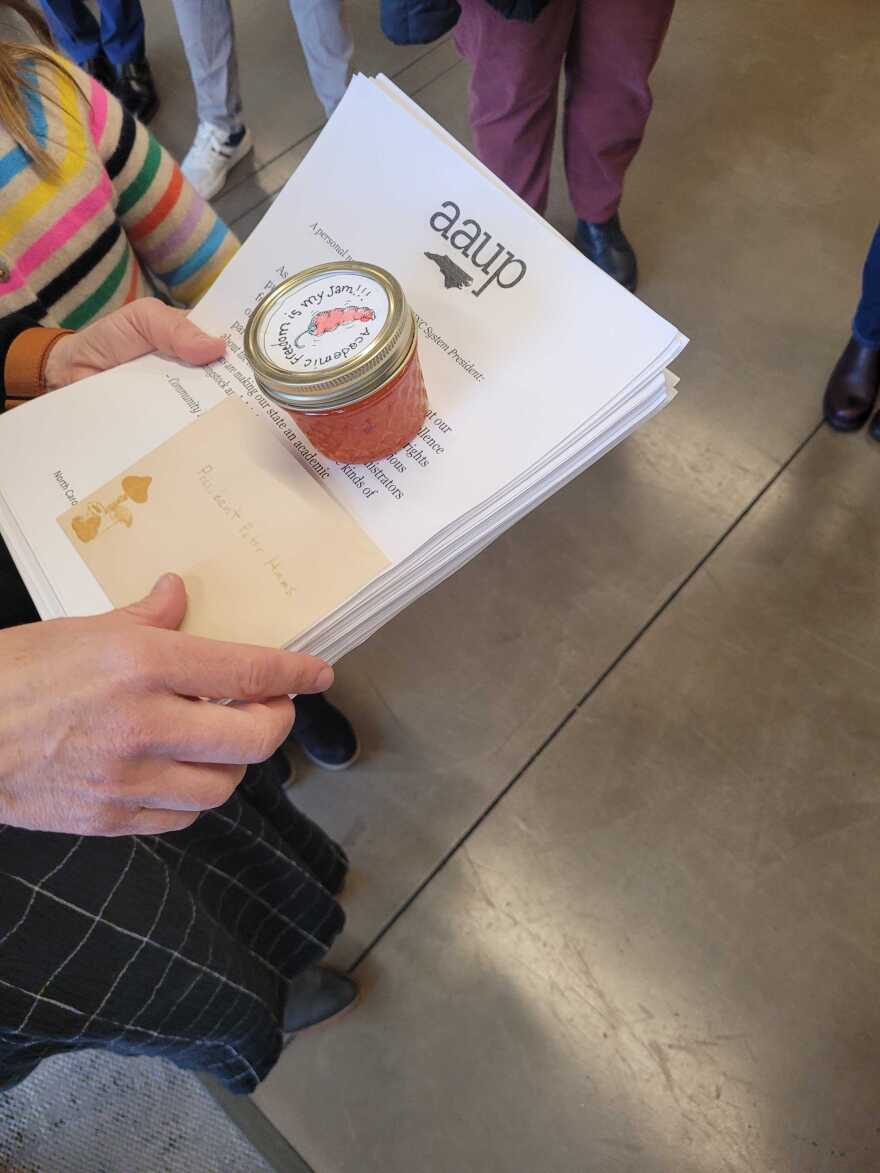
One of those signatories is Michael Palm, the president of UNC-Chapel Hill’s AAUP Chapter. He spoke to WUNC shortly before the petition drop-off.
“Transparency, accountability accessibility – these are important aspects of a public university system, but that’s not what this is about,” Palm said. “This is about capitulating to pressure at the state level and at the federal level to scrutinize faculty and intimidate faculty who are teaching unpopular subjects right now.”
A public records request from The Oversight Project put UNC-Chapel Hill at the epicenter of the syllabi public records debate in North Carolina this summer.
The organization, which is a spin-off of the conservative think tank The Heritage Foundation, requested course materials from 74 UNC-Chapel Hill classes. This included syllabi, lecture slides, and presentation materials that contained words like diversity, equity, and inclusion; LGBTQ+; and systems of oppression.
Mike Howell, The Oversight Project’s president, told WUNC in September that his goal is to ultimately get DEI teachings or what he calls “garbage out of colleges and universities.”
“One of the ends will be the public can scrutinize whether their taxpayer dollars are going toward promulgating hard-left, Marxists, racist teachings at public universities,” Howell said. “I think there’s a lot of people in North Carolina and across the country that would take issue to that.”
Faculty say pressure from outside forces is why they petitioned Hans to protect their rights to choose how and when to disseminate syllabi.
“There are people who do not have good intentions or do not have productive or scholarly or educational desires when looking at syllabi,” said Ajamu Dillahunt-Holloway, a history professor at NC State. “They’re more interested in attacking faculty and more so attacking ideas that maybe they have not fully engaged with themselves.”

In his op-ed, Hans said the UNC System will do everything it can to “safeguard faculty and staff who may be subject to threats or intimidation simply for doing their jobs.”
Hans has yet to share details about what those measures will look like, and turned down a request from WUNC for an interview to explain what safety measures the UNC System may enact.
WUNC partners with Open Campus and NC Local on higher education coverage.


RALEIGH, N.C. (WTVD) — North Carolina lawmakers are nearing agreement on a new state budget that Rep. Zack Hawkins says could bring long-awaited stability to agencies and employees who have been operating under 2023 spending levels.
Hawkins, a Democrat representing Durham, said Monday that legislators are close to finalizing the budget after waiting 1,000 days since the last budget passed
“We’re going to potentially meet the June 30, July 1 deadline, so that there’s stability for all the agencies and all the entities that depend on the state budget,” Hawkins said.
Hawkins said the prospect of a finalized budget offers needed certainty.
“The opportunity for them to have a budget means stability,” he said.
The expected spending plan centers on pay increases for educators and state employees. State workers could receive an average 3% raise and a $1,700 bonus for those earning under $75,000. Hawkins said the goal is to ensure workers have a “strong and respectable pay scale.”
“State employees know that they’re not going to get rich, but we need to make sure that they have a strong and respectable pay scale, bonuses that keep up with inflation, and the benefits, of course, that the state of North Carolina brings, and so we’re hoping that we value them in this budget,” he said.
Teachers could see an average 8% raise. Hawkins, a former educator, said he hopes North Carolina can lead the South in teacher pay.
“And eventually beating the national average. But alongside that, we really want to make sure that there’s an opportunity to keep and retain teachers who’ve been teaching for 10, 15 and 25 years,” he said.
The budget is also expected to include a 13% pay raise for law enforcement, according to a post from Rep. Brenden Jones, who celebrated the finalization of the budget.
The budget could come with a plan to reduce the personal income tax rate and a higher tax rate for sports gambling operators. The rate would increase from 18% to as high as 23%, a change Hawkins supports.
“We can bring in even more revenue, because it’s going to some really good places, it’s going to universities, athletic departments, it’s going to support youth sports, it’s going to support outdoor opportunities and grants,” he said.
One proposal not included in the budget is funding for a Major League Baseball stadium in Raleigh. Hawkins said the Senate-led idea was not the right fit this year.
“Because we have to make sure that we’re taking care of our basic obligations, our people,” he said.
Hawkins said agencies have been operating under the 2023 budget, affecting hiring and pay raises. Many are waiting for Tuesday’s release of the new spending plan.
Download the ABC11 News app
Copyright © 2026 WTVD-TV. All Rights Reserved.
North Carolina
North Carolina is hot, dry, and about have fireworks everywhere. Why isn’t there a burn ban?

Right now, it’s unmissable. North Carolina, and especially the Triangle, is both very hot, and very dry. Fireworks stands are popping up, just in time for the Fourth of July. So why isn’t the state under a burn ban?
It’s a straightforward question, with a complex answer.
Both the state, through the North Carolina Forest Service, and individual counties can declare burn bans. The vast majority of the time, county fire marshals listen to the Forest Service. And right now, the Forest Service says the danger isn’t great enough – yet.
“We’re still dry, fire danger is still high, but we haven’t reached that hazardous category yet,” said Phil Jackson, a Forest Service spokesperson.
Jackson points out that the state has two fire seasons, spring and fall, and conditions right now are very different.
For one, humidity is much higher right now, and humidity “tends to bring relief to fire risk and any ongoing wildfire activity that might be happening at that moment,” said Jackson.
Leaves are also key. In spring, plants are trying to wake up from their long winter sleep. Doing that requires a lot of water, drying out the soil.
“Think of each individual root system as being a straw that is just pulling water out of the ground,” said Jackson.
In the fall, the ground is covered in lots of new dry leaves, increasing the danger again.
“When they’re in full green, like they are now, they tend to be more fire resistant,” said Jackson.
Jackson points out it’s not impossible to have a summer-time burn ban. The Forest Service is constantly monitoring conditions, and it’s possible those conditions could get worse in the coming weeks. For now, though, the fire danger, Jackson says, is “manageable.”
But while the fire risk might be manageable, that doesn’t mean people should be careless.
“We always encourage residents to avoid outdoor burning, unless it’s absolutely necessary,” said Johnston County Fire Marshal Travis Johnson.
Johnson says, especially with the Fourth of July right around the corner, anyone burning or lighting fireworks should always have a source of water nearby to douse any runaway flames. “We never want anything to happen, but want to make sure that you’re safe while using those,” said Johnson.
If a burn ban were to be implemented, it would impact Fourth of July fireworks shows. For now, though, those shows are allowed to go ahead, and remain the best option, Johnson says, for anyone who wants to see fireworks this year.
Johnson, and other fire marshals WRAL spoke with, also stressed official fireworks shows are put on by professionals, are strictly permitted and regulated, and there are always firefighters there, on standby, just in case.
“Just be safe, and enjoy the holidays,” said Johnson.

The video above is a live stream of WBTV and affiliated programming, and may not be directly related to the article below.
GRANITE FALLS, N.C. (WBTV) – A man was killed and a teenager was hurt after a head-on crash in Caldwell County on Sunday.
The deadly crash happened along Highway 321 near Glenn Ridge Drive in Granite Falls, just before 7:45 p.m. on June 28.
North Carolina state troopers said 65-year-old Marvin Wayne Anderson was driving the wrong way on Highway 321 when he crashed head-on into an 18-year-old.
Troopers said Anderson died on the highway, while the teenager was taken to a nearby hospital with minor injuries.
Highway Patrol said its initial investigation did not find speed or impairment to have been factors in the wreck. Troopers did not say why or how Anderson ended up on the wrong side of the road.
The crash reportedly shut Highway 321 down for several hours but it has since reopened.
Also Read: Mail worker killed in broad daylight in rural North Carolina, officials say
Copyright 2026 WBTV. All rights reserved.
-

 San Diego, CA4 minutes ago
Adobe Falls: The elusive waterfall that briefly returns after San Diego rains
-

 Milwaukee, WI7 minutes ago
Steve Czaban returns with new home in Milwaukee sports-talk radio
-

 Atlanta, GA12 minutes ago
Golestan brings a taste of Persian home cooking to Peachtree Corners – Atlanta Magazine
-

 Minneapolis, MN19 minutes ago
Minneapolis City Council abandons tax hike near George Floyd Square, revises development plan
-

 Indianapolis, IN22 minutes ago
Caitlin Clark not practicing Tuesday, to do individual workout
-

 Pittsburg, PA27 minutes ago
Pittsburgh area’s low jobless rate beats state, U.S. rates
-

 Augusta, GA34 minutes ago
Salvation Army of Augusta collects heat relief supplies
-

 Washington, D.C37 minutes ago
Washington Spirit Announces Midseason Roster Update

