Louisiana
US: Deep freeze hits Florida, Louisiana – DW – 01/22/2025


Snow, sleet and Arctic winds have plunged the United States’ Deep South region into an unusual deep freeze, with airports, highways, schools and government offices closed across usually sunny southern states.
Having covered Texas and the northern Gulf Coast with record-breaking snow, the major winter storm moved eastwards on Wednesday, causing governors in Georgia, Louisiana, Mississippi, Alabama and even Florida – famously dubbed the Sunshine State – to declare states of emergency.
At least three people have died due to the extreme weather, including two in Austin, Texas, and another person in Georgia.
After being closed or suspending flights on Tuesday, Jacksonville Airport in Florida, Louis Armstrong Airport in New Orleans and both airports in Houston, Texas, were planning to reopen in the course of Wednesday.
But more than 1,300 flights to, from or within the US were canceled on Wednesday morning and more than 900 were delayed.
The airport in Charleston, South Carolina, was also closed, as was the massive 2.5-mile (4-kilometer) Ravenel Bridge that carries about 100,000 vehicles a day between Charleston and areas up the coast.
Unfamiliar winter wonderlands
Nevertheless, the rare cold weather also led to some unusual scenes across the regions as residents swapped sun loungers for toboggans and build snowmen rather than sandcastles.
Some of the heaviest snowfall was recorded in Mobile, Alabama, where authorities asked people to stay off roads which were covered in over five inches (13cm) of snow.
With experts predicting this winter storm could break the 130-year-old record for snow fall in the area, schools and some workplaces were also closed, giving people some spare time to have snowball fights instead.
In Tallahassee, Florida, which hasn’t seen snow since a light dusting in 2018, Lina Rojas said she had never seen anything like it.
“I don’t even know what to call it!” she said, as she wrapped up her dachshund Petunia in a warm dog-coat and put little mittens on her paws.
In the “Sunshine State,” inflatables are usually deployed in swimming pools or at the beach. But in Pensacola, they proved equally useful in the six-inch (15cm) deep snow at Bayview Park.
“Believe it or not, in the state of Florida we’re mobilizing snowplows,” said Governor Ron DeSantis as snow covered the white-sand beaches of popular summer vacation spots.
In Houston, people took advantage of the snow to go sledding on the banks of the Buffalo Bayou river, while unprecedented blizzard warnings were issued for several coastal counties near the Texas-Louisiana border.
It’s been more than a decade since snow last fell on New Orleans, but Tuesday’s snowfall set a new record.
Ten inches (25cm) of snow fell in some parts of the city, far surpassing the record of 2.7 inches (6.8 centimeters) set on New Year’s Eve, 1963.
“Wow, what a snow day!,” the weather agency said in a social media post. “It’s safe to say this was a historic snowfall for much of the area.”
In downtown New Orleans, the city’s central Bourbon Street became a location for urban skiing, while priests and nuns engaged in a snowball fight outside a suburban church.
Others went sledding down the snow-covered Mississippi River levees on kayaks, cardboard boxes and inflatable reptiles.
“This is a white-out in New Orleans, this is a snow-a-cane,” said local high-school teacher David Delio, as his two daughters glided down a levee on a yoga mat and a boogie board. “We’ve had tons of hurricane days but never a snow day.”
mf/jcg(AP, Reuters)



Up close view of the launch of Artemis II
Hundreds of media members and special guest from all over the world converge on the LC-39 press site to watch the launch of the Artemis II moon mission
A rocket built in Louisiana is powering Artemis II’s trip to the moon.
Nearly 90 percent of the rocket powering the mission was manufactured at NASA’s Michoud Assembly Facility in New Orleans, which is known as “America’s Rocket Factory.”
“For generations, Louisiana has played a central role in America’s aerospace industry, anchored by NASA’s work at Michoud,” Louisiana Economic Development Secretary Susan B. Bourgeois said. “That history has built a skilled workforce, strong supplier networks and advanced manufacturing capabilities across the state. Artemis II reflects that foundation — and signals the opportunity ahead as Louisiana continues to grow its aerospace economy.”
NASA made history on April 1 when it launched a crew of four astronauts on a 10-day expedition around the moon and back, the agency’s first lunar launch since its last Apollo mission in 1972.
Michoud is an 829-acre facility located near downtown New Orleans that has a national economic impact of more than $507 million, according to Hansel Gill, director of NASA Michoud Assembly Facility.
“We are grateful for this opportunity to help strengthen our ties with the community,” Gill said in a statement.
New Orleans Mayor Helena Moreno held a watch party in her office for the April 1 launch, pointing to the blazing rocket during lift off.
“Incredibly proud that NASA’s Michoud Assembly Facility in New Orleans East constructed the rocket that will send Artemis II to the moon,” Moreno said in a statement. “The team at Michoud is once again showing the level of innovation possible right here in New Orleans. Let this be a reminder that big things are possible in New Orleans, and when we’re all in, the sky, or even the moon, is the limit.”
Artemis II crew members are expected to travel “farther from Earth than any previous human mission,” according to NASA.
The expedition will send the crew about 252,000 miles into space, which will break the record set by the Apollo 13 mission in 1970, when it was roughly 248,000 miles from Earth.
Greg Hilburn covers state politics for the USA TODAY Network of Louisiana. Follow him on Twitter @GregHilburn1.

BATON ROUGE, La. (WAFB) – A COVID variant called Cicada has been detected in Louisiana, prompting health officials to monitor its spread.
The variant gets its name from the insect because doctors say it has been lurking underground, surfacing slowly and retreating without triggering a major wave.
“I think it’s just possibly the next surge or wave, but it’s not going to cause any more increased hospitalization or deaths from this variant,” said Dr. Rubin Patel, CEO of Patient Plus Urgent Care.
COVID numbers declining
Patel said COVID numbers have tailed off dramatically over the last two months. The Cicada variant makes up about 10% of all COVID cases in the country.
Researchers are watching Cicada closely. The variant carries 70 to 75 mutations in its spike protein, the part of the virus that helps it enter human cells. That level of mutation raises questions about how well existing vaccines will hold up against it.
“The vaccine hasn’t been created against this variant. The variants previously, that’s what’s in the vaccine. So yes, it’s not going to be as effective, but whether it’s herd immunity, whether it’s vaccine immunity, whether it’s just an individual that’s had multiple versions of COVID, you’ll have some protection in that manner,” Patel said.
Variant affecting children
Health officials are saying the variant seems to be mostly infecting children, but doctors say researchers are still trying to understand why.
The symptoms look familiar: fever, chills, cough, congestion, shortness of breath, nausea, and fatigue — the same signs seen with other variants.
“The biggest thing is it’s not causing any more significant hospitalizations or deaths,” Patel said.
Patel said COVID has a history of spiking around August when school is back in session.
“They’re wondering if this could, with its, like you were saying, with the spike protein and all the mutations within it, could it become that new, that new surge, that new wave that dominates over 50% of the cases?” Patel said.
Doctors say there is no need to panic yet, but they urge people to stay alert, especially when kids head back to school in the fall.
The Louisiana Department of Health recommends staying up to date on all vaccinations, practicing good hand hygiene, and staying home when sick.
Click here to report a typo. Please include the headline.
Click here to subscribe to our WAFB 9 News daily digest and breaking news alerts delivered straight to your email inbox.
Watch the latest WAFB news and weather now.
Copyright 2026 WAFB. All rights reserved.

Less than two months after ICE deployed in large numbers to Louisiana, nine protesters in Texas were convicted of federal charges including “terror” for a noise demonstration in support of immigrants held at the Prairieland Detention Center in Alvarado last July.
Just a state away in Louisiana, the silence is as deafening as it is dangerous. Texas and Louisiana operate as a unit to help the Trump administration execute mass deportation and the criminalization of those who resist it.
It’s past time to speak up: about the central role our two states play in the brutal federal deportation campaign, our state governors’ eagerness to create their own state-run immigration empire, and the Prairieland protest of July 4, 2025, which ended with anti-ICE protesters convicted as terrorists.
As Texas’s partners in crime, Louisiana is actively participating in the federal system that these defendants are fighting. And as the repression that stems from Prairieland spreads, the path leads next to Louisiana.
In December, the widespread organizing in Louisiana in response to Catahoula Crunch brought a glimpse of what local resistance to ICE and DHS could look like. The agencies left Louisiana early, relocating their show of force from New Orleans to Minneapolis. But their attack on immigrants and the people who support them across the Gulf South continues. We cannot afford to lose focus or momentum.
At this moment in Louisiana, that means keeping all eyes on the Prairieland defendants and the ways our fate will be tied to theirs.
Since the beginning of the second Trump administration, the highly visible brutality of ICE and resulting demonstrations like the one in Prairieland have brought increased attention to what is designed to be an invisible matrix for the disappearance, detention, and deportation of people living in the US.
Together, Texas and Louisiana make up the center of ICE activity, working as a logistical and political unit to maintain the world’s largest immigration incarceration regime. Nearly half of the nation’s detainees are held in these two states.
Though Southern states have long housed the majority of ICE detainees, over the last year the agency has increasingly transported people arrested in other regions to Texas and Louisiana, where private facilities profit from filling beds and people can be detained indefinitely without bond due to a decision this February from the conservative Fifth Circuit Court of Appeals in New Orleans.
Texas, where the Prairieland defendants staged their protest, leads the nation in detainees and deaths. Louisiana is second and frequently receives transfers from Texas and other states as home to the Alexandria Staging Facility, the only ICE facility in the U.S. with its own airport that serves as the nation’s busiest hub for deportations.

Gov. Jeff Landry has also formalized partnerships with Gov. Greg Abbott of Texas for joint immigration investigation and enforcement, including an interstate compact to share intelligence and surveillance and the funding and authority, approved by the Louisiana legislature, to dispatch the Louisiana National Guard to Texas to secure its southern border that divides the U.S. and Mexico.
In 2021, in response to the lifting of Trump-era federal immigration, Abbott declared a “state of emergency,” which he has since renewed monthly. This tactic is part of a broader strategy to claim immigration as a state responsibility, alongside or instead of federal authorities. Both Texas and Louisiana have passed laws that would shift these powers from emergency allowances into permanent statutes. Louisiana’s SB 388 is explicitly tied to the Texas law on which it was modeled, with both paused as they await a decision from the Fifth Circuit this spring.
As Louisiana and Texas power our national mass deportation machine, the Prairieland case is a warning and test case for how the two states are expanding their attack on immigrants to include the people who stand up for and support them. In the U.S. Department of Justice’s first successful prosecution of alleged “anti-fa” members on charges related to terrorism, the federal government has also succeeded in marginalizing nine people who oppose the escalation of state violence. These are not extremists.
Noise demonstrations like the one these defendants joined outside of Prairieland Detention Center in Texas are an established tradition in New Orleans. Every year on New Year’s Eve, a crowd of people gather and make noise outside Orleans Parish Prison. During noise demonstrations, the point is for people locked inside to hear voices, music, and noise, to remind them that they are not alone. The Prairieland defendants used a megaphone to chant words of support and solidarity to detainees.
Some inside were fellow protesters. ICE detention has become an increasingly common tactic to silence and punish people born outside the U.S. for using their freedom of speech to criticize the U.S. government. At the time of the noise demonstration, Leqaa Kordia was detained inside Prairieland because of an arrest at Columbia University, where she had been protesting the genocide in Palestine. Months later, she was detained, flown to Prairieland Detention Center, and held for a year in conditions she described as “filthy” and “inhumane.”
Four hours from New Orleans, another Columbia protester, Mahmoud Khalil, was held for over one hundred days at a detention center in Jena, Louisiana, where a federal judge issued a deportation order that remains in legal limbo.

Every witness who participated in the Prairieland noise demonstration testified that they had no expectation of violence. They wore black, carried a “Resist Facism” flag, blew soap bubbles into the air, and carried sparklers and a few small fireworks. Prosecutors took the use of fireworks out of context to charge defendants with the use of “explosives,” then used these counts to substantiate charges of “riot” and “terror.”
In trial and in the court of public opinion, the prosecution has likewise catastrophized a nonfatal shooting into a conviction for “attempted murder,” while both failing to disclose that the Alvarado Police Department officer who was allegedly shot in the shoulder got out of his car with his gun drawn, barring the alleged shooter from claiming self-defense or defense of others.
We have seen across the nation that people largely support the right to protest, especially in the face of ICE’s mounting brutality. But in the Prairieland case, the prosecution’s strategy to put the shooting front and center has distracted and divided a movement just as it was gaining momentum.
The Prairieland demonstration was not an isolated event. It came a month after the mass protests against ICE in Los Angeles and the Trump administration’s first deployment of the National Guard to what would be a series of American cities. As public outrage reaches a turning point, the Prairieland case gives federal officials a timely opportunity to demobilize a growing national movement against ICE by spreading misinformation and fear.
This playbook has already been in use. After Renee Good and Alex Pretti were murdered by federal immigration agents in Minneapolis less than three weeks apart, Department of Homeland Security leaders labeled both of them “domestic terrorists.”
The attempts to discredit Good and Pretti largely failed. But in the Prairieland case, defendants have been convicted of “terror.” For this federal administration, that makes Prairieland a success, and a model to follow to stifle future opposition.
At a time when the state is flexing overt and fatal forms of repression, we are still defending the humanity of the people they kill, lock up, or disappear. The Prairieland defendants met the fate of the people who defend the victims of U.S. state violence the loudest and most insistently, which is to join them, caged and dismissed as criminals (even as nearly 75% of detainees have not been convicted of a crime).
On Monday, lawyers for the nine Prairieland defendants filed motions to overturn their convictions. As they go through their appeals, it’s likely that the case will unfold in the Fifth Circuit in New Orleans, where the defendants will fight for the right to resist a crisis of humanity as rooted in Louisiana as it is in Texas.
The verdict will have a bearing not only on our ability to support immigrants and resist ICE, but to carry out any form of political dissent.
This type of repression can easily happen in Louisiana. A law passed this year made it a state crime to interfere with ICE, language that the bill’s own sponsor acknowledged is expansive enough to charge someone for providing aid to an “unauthorized” immigrant.
This has been a long time coming. Trump first announced his intent to designate “anti-fa” as a terrorist organization on social media six days after the murder of George Floyd, a promise he followed through on this past September in response to another mass movement against law enforcement brutality.
The idea did not come out of nowhere. In 2019, Sen. Ted Cruz and Sen. Bill Cassidy of Louisiana jointly introduced a resolution proposing the designation.

Though “anti-fa” stands for “anti-facism,” Trump and his backers in Texas and Louisiana have mangled its origins and purpose, invoking the abbreviation to discredit demonstrators as marginal and extreme. As Pam Bondi has already assured, Prairieland will not be the last time that Trump and his backers twist the term to propose that people who speak out against fascism are somehow more threatening than fascism itself.
As mass deportation and the criminalization of dissent crosses state lines, so too must our solidarity. Where Texas goes, Louisiana follows. We are all the Prairieland defendants, whether we choose to see it now or once it’s too late.
While Leqaa Kordia was still being held in the Prairieland Detention Center, Mahmoud Khalil wrote to her: “It will end…Not because the system will suddenly discover its conscience. Not because those who put you there will wake up one morning and realize the cruelty of what they have done. It will end because people will force it to end.”
The Prairieland defendants were some of these people. We say to them and to everyone in ICE custody what Khalil said to Kordia in closing: “I will carry you until you are free.”
Related

Ex-Steelers QB Fires Back at Adam Schefter Over Aaron Rodgers Rumor

Kathryn Lively Spears Obituary April 1, 2026 – Thomas Poteet & Son Funeral Directors

Large pothole damages vehicles on I-90 east

Bluebonnets Austin: 25 Best Places To See Blooms In 2026

What is Alabama’s best burger? Foodie picks this local favorite

Florida High School Football Rankings: Top 25 teams – Oct. 21

How old is Bo Nix? What to know about Oregon quarterback ahead of 2024 NFL Draft

Cleary's 21 help Le Moyne down Central Connecticut State 69-64 in OT

99th annual Pony Swim held in Virginia

Indiana Members Credit Union announced as new anchor tenant at Bottleworks District

Video: Trump Struck Iran. Now Farmers Are Paying the Price.

What B-52 bombers bring to Iran fight — and what it means for the war now

Podcast: Hungary elects: what is at stake and who is likely to win?
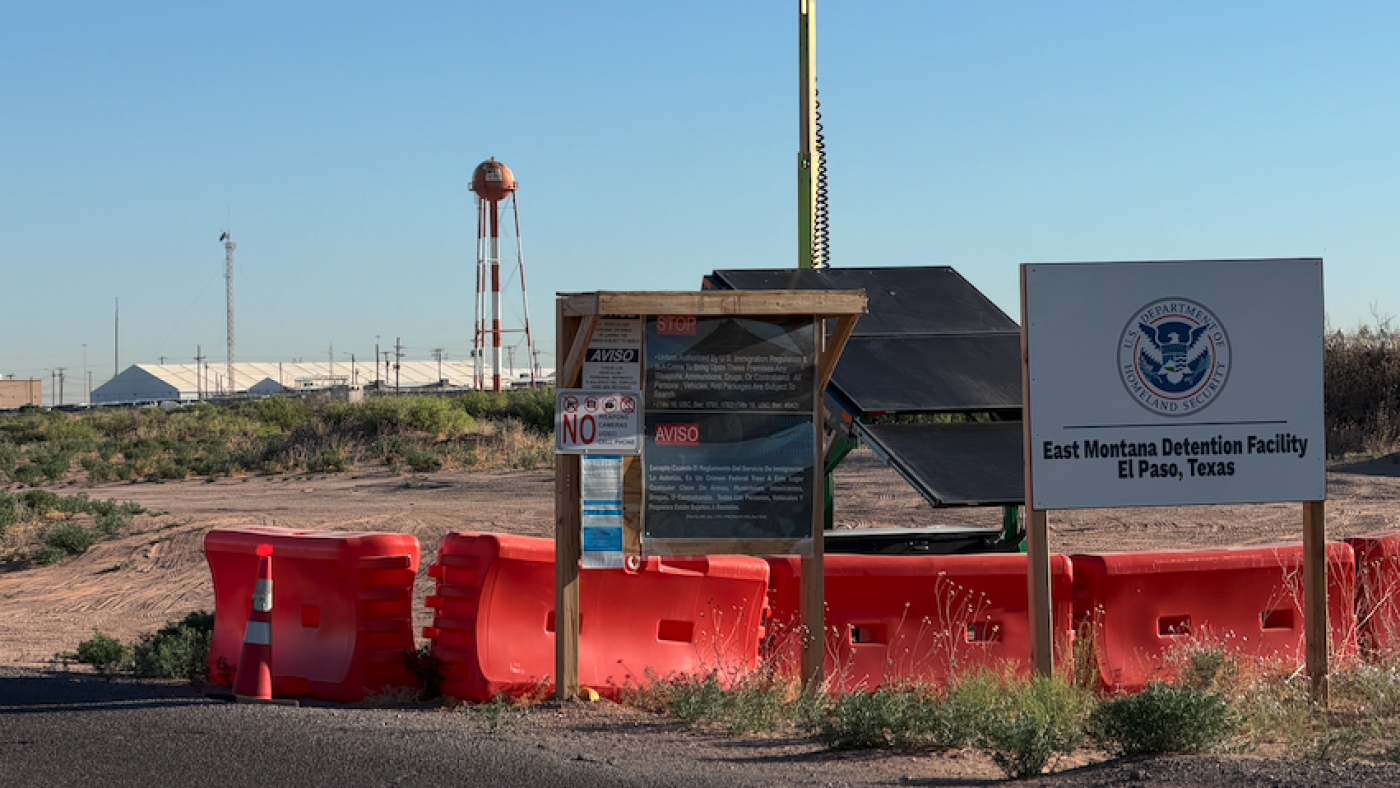
ICE detention deaths are on a record pace. One Texas facility bears the brunt

GOP rails against ‘s— sandwich’ deal as all eyes turn to House to end DHS shutdown
-

 Culture1 week ago
Wil Wheaton Discusses ‘Stand By Me’ and Narrating ‘The Body’ Audiobook
-

 South-Carolina5 days ago
South Carolina vs TCU predictions for Elite Eight game in March Madness
-

 Miami, FL1 week ago
Jannik Sinner’s Girlfriend Laila Hasanovic Stuns in Ab-Revealing Post Amid Miami Open
-

 Culture1 week ago
What Happens When We Die? This Wallace Stevens Poem Has Thoughts.
-

 Minneapolis, MN1 week ago
Boy who shielded classmate during school shooting receives Medal of Honor
-

 Vermont5 days ago
Skier dies after fall at Sugarbush Resort
-

 Education1 week ago
Video: Transgender Athletes Barred From Women’s Olympic Events
-

 Politics5 days ago
Trump’s Ballroom Design Has Barely Been Scrutinized