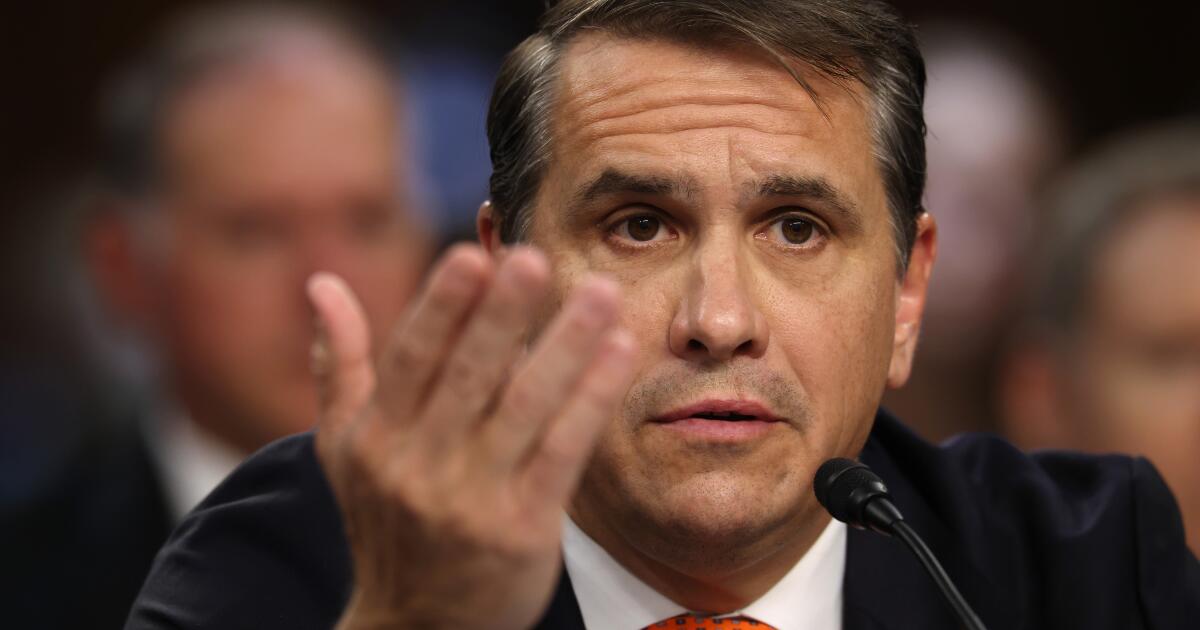
NEW ORLEANS (AP) — Louisiana parish officials who threatened to arrest and imprison an environmental activist as she attempted to speak during a public meeting did not violate her right to freedom of speech, a unanimous civil jury ruled Wednesday.
Joy Banner had sought more than $2 million in damages from two St. John the Baptist parish officials — Parish President Jaclyn Hotard and councilmember Michael Wright — who she said blocked her from raising allegations of corruption tied to industrial development at a public meeting. While Banner’s attorneys said the case had important implications for protecting outspoken citizens from government censorship, lawyers representing the parish said they were model officials trying to curtail disruption and keep the meeting on track.
The case is part of a broader series of disputes playing out in courts and public hearings between grassroots community groups and Louisiana officials over industrial expansion in the 85-mile (136-kilometer) chemical corridor between Baton Rouge and New Orleans, often referred to by environmental activists as “Cancer Alley” because of its high pollution levels.
Trusted news and daily delights, right in your inbox
See for yourself — The Yodel is the go-to source for daily news, entertainment and feel-good stories.
Advertisement
Banner, co-founder of the environmental and racial justice organization The Descendants Project, gained a national reputation fighting against an $800 million grain terminal slated for her predominantly Black community in St. John the Baptist parish. The project was later aborted.
In a November 2023 parish council meeting, Banner sought to oppose an agenda item introduced by Hotard to use taxpayer funds for a lawyer to defend parish officials from ethics complaints. The state ethics board had launched an investigation after Banner filed a complaint pointing out that Hotard’s mother-in-law, Darla Gaudet, owned a marine transport company that owned land near the proposed site for the grain terminal.
As Banner began to discuss these concerns during the public comment period, councilmember Michael Wright repeatedly banged his gavel and both he and Hotard told Banner she was not speaking on topic as she made her remarks.
Wright then quoted from an obsolete law under which anyone who publicly shared testimony given to a state ethics board investigation could be subject to one year of imprisonment. A federal judge deemed the law unconstitutional years ago.
“When I heard the words imprisonment and misdemeanor, I thought, ‘That’s it, I’m going to jail, I’ve messed everything up, my business is going to be ruined, my name is going to be ruined.’ I was terrified and shocked,” Banner later testified.
Advertisement
Ike Spears, the parish officials’ attorney, noted that they had also interrupted and instructed to stay on topic other members of the public who spoke during the public comment period. He described Banner as a “disruptive citizen” striving to become a “social media influencer” and garner media attention from the litigation.
“She wants us to reward this conduct with $2 million plus,” Spears told jurors.
Banner’s attorney William Most countered that her intended comments at the public meeting were “vital” to informing the parish about Hotard’s potential conflicts of interest.
“Joy Banner was treated differently than anyone else: She was the only person threatened with arrest and she was also the only one to raise the issue of Hotard’s family business interests,” Most said. “She was directly on topic.”
Hotard also used vitriolic language to describe Banner, including fantasizing about strangling her, in text messages to her mother-in-law that were introduced as evidence. Most said the messages indicated that Hotard had a personal motivation to shut down Banner’s participation in a public meeting.
Advertisement
The state ethics board ruled last year that Hotard had not violated state ethics laws.
Yet Hotard’s mother-in-law later revealed during a deposition for Banner’s lawsuit that Hotard’s husband is a beneficiary of a trust that owned land overlapping with the planned railroad route leading into the proposed grain terminal.
Spears acknowledged that Hotard would “probably” personally benefit from the grain terminal’s approval. But he said increased tax revenue and good-paying jobs were the parish president’s driving motivation in supporting the project.
Hotard, who was not present for the verdict, did not respond to an emailed request for comment.
The jury sent a “strong message against frivolous lawsuits,” Wright said in an emailed statement to The Associated Press. “This is a significant victory for St. John Parish and a promising sign for businesses and industries considering the River Parishes as their home.”
Advertisement
Juror Cam Owen said he was ready to vote in Banner’s favor following closing arguments. He changed his mind — and came to tears during deliberations — after closely reviewing the facts and video footage of the public meeting, which he described as the “deciding factor” for the jury. Owen said jurors calculated the amount of time Banner was able to speak and concluded she was able to express most of her viewpoint.
“At the end of the day, you know, they did try to stop her, but she did actually say what she had to say,” Owen said.
The jury also ruled that the parish had not violated Louisiana’s open meetings law.
Banner said she had no regrets about bringing the lawsuit and said it uncovered the parish president’s hidden financial interests.
“The purpose of this case was for transparency,” Banner said. “I think it’s important to hold people accountable for the things that we feel are wrong.”
Advertisement
“I hope you can heal,” Eastern District of Louisiana Judge Nannette Jolivette Brown told Banner and the parish officials after the verdict. “This is only one part of the process.”
___
Brook is a corps member for The Associated Press/Report for America Statehouse News Initiative. Report for America is a nonprofit national service program that places journalists in local newsrooms to report on undercovered issues. Follow Brook on X: @jack_brook96.
Saronic Technologies is at the center of a major shift in naval warfare, a move toward autonomous vessels, artificial intelligence and faster defense manufacturing, The New York Times reports.
That shift gained attention after a June rescue mission near the Strait of Hormuz, when a Saronic-built Corsair unmanned vessel helped recover two stranded military aviators after their helicopter was downed. Navy officials said the mission demonstrated how autonomous systems can reduce risk and save lives.
For Louisiana, the larger story is Saronic’s decision to establish a major manufacturing presence in Franklin. The Austin-based defense technology company acquired the former Gulf Craft shipyard and is expanding the facility as it works to move from prototype development into higher-volume production of autonomous vessels.
Advertisement
Saronic is also competing for a role in the Navy’s roughly $2.1 billion effort to build a new fleet of medium-sized unmanned surface vessels. The company was among seven firms selected to continue in the competition, but the process has sparked controversy. Some competitors argue that the Navy gave Saronic preferential treatment, while the Defense Department denies any political favoritism and says the selections were based on technical capability and readiness.
The competition reflects a broader transformation in defense contracting. Traditional military shipbuilders are now competing with newer defense technology companies that combine software, artificial intelligence, autonomous systems and private investment. Saronic’s strategy has been to pair that technology approach with shipbuilding capacity, including its Louisiana facility.
The Franklin shipyard is a key part of that strategy. Saronic plans to expand the site to support production of larger autonomous surface vessels, including its Marauder platform, as the Pentagon increasingly looks for scalable systems that can complement traditional naval assets.
For Louisiana’s maritime industry, the investment highlights the state’s potential role in the next generation of defense manufacturing. The region’s existing shipbuilding workforce and industrial base provide a foundation for companies seeking to build advanced vessels, though expansion will depend on maintaining a pipeline of skilled workers such as welders, fabricators and marine technicians.
Louisiana pastor Tony Spell must stay 50 yards from his neighbor’s home unless he’s checking the mail after a protection order was issued against him – as shocking bodycam appears to show him using a homophobic slur to describe his alleged assault victim, just two days after he was arrested.
Spell, 48, is banned from speaking with the neighbor either online and in person, according to the order issued Friday, which has since been reported by The Advocate.
“Mr Spell may walk over and check his mailbox; other than checking his mailbox, he is to be 50 yards away from the protected person’s property,” a note on the order says.
Pastor Tony Spell allegedly assaulted his neighbor’s son after he threatened to kill and rape his wife. WBRZ
Spell, the pastor of Baton Rouge’s Life Tabernacle Church, will appear in court in September after being charged with second degree battery over last month’s assault that unfolded opposite the church.
Advertisement
He claimed Scott Sherwin’s son had threatened to rape and kill his wife before delivering 35 blows.
But two days after the brawl Scott Sherwin reported Spell for allegedly mowing his lawn at 4 a.m., WBRZ reported.
“He’s doing this to intimidate my victim son,” Sherwin claimed in bodycam video seen by The Post.
“Do you cut your grass at 4 in the morning?” he asked the responding officer.
“You gotta get him to stop man,” the furious dad said.
Advertisement
Sherwin claimed his family was unable to sleep – alleging Spell was carrying out “psychological warfare.”
An enraged Sherwin then swore at his neighbor, allegedly flipping him off, according to the bodycam.
Tony Spell kneeling and holding a goat. Tony Spell / Facebook
“I was asleep when this started at four in the morning,” Sherwin stressed, aggressively pointing at his phone.
The cop then went over to Spell, who was sitting on his lawnmower, before asking for his name.
“Everybody in the world knows my name,” Spell brazenly replied to the cop.
Advertisement
Spell, who faces up to eight years in prison if convicted, then labeled Sherwin’s son a “f—-t” and seemed to take pride in the now-viral beatdown.
“He’s just sore because I beat the crap out of his f—-t boy,” he said.
“And he’s next if he comes over here and harasses these boys,” Spell said, speaking while a group of teens gathered nearby.
He has been embroiled in a rivalry with his neighbor. Tony Spell
Spell then started his lawnmower up and told the boys “get to work,” essentially ordering them to clear off.
Spell strongly defended his actions after being released from jail over the assault.
Advertisement
“Number one, I’m a husband, number two, I’m a father, and number three, I’m a pastor who shepherds his flock,” he said. “I will not allow a man to murder my children when I’m gone,” he told reporters.
He revealed what Sherwin’s son allegedly said, which prompted the beatdown.
“He said, ‘Tony, I’m going to rape your wife, I’m going to rape all your grandchildren, and the next time you go out of town, I’m going to kill them,’” Spell said.
He addressed the altercation to his congregation and compared it to “domestic terrorism.” He also cited a Bible passage from Mark 16:18, WAFB reported.
Advertisement
“In my name, they shall lay hands on the sick. And they shall recover,” he said.
“So today, I fulfilled the scripture. I laid hands on the sick. I don’t know how much recovery they’re going to have, but I laid hands on the sick.”
Spell has been in a longstanding feud with Sherwin; the pastor filed a lawsuit during the pandemic in 2020 over surveillance cameras that were installed.
During the COVID-19 pandemic, Spell was ticketed for holding in-person church services, defying Louisiana’s social distancing restrictions.
Spell claimed the cameras were installed to monitor him.
Advertisement
In April 2020, Spell was accused of attacking a protester outside his church. Police alleged that Spell backed his church bus in the direction of the protester, who was identified as Trey Bennett, according to news station WAFB-TV.
He was arrested for aggravated assault but never formally charged.
A new study from researchers at LSU’s Pennington Biomedical Research Center, FMOL Health | Our Lady of the Lake Regional Medical Center, and the Metamor Institute found that metabolic and bariatric surgery can be delivered safely and effectively for adolescents and young adults living with severe obesity, leading to significant weight loss and improvements in obesity-related health conditions.
Published in Obesity Surgery, the study examined outcomes from 76 patients ages 10 to 25 who underwent bariatric surgery through a Louisiana-based program at the Metamor Institute between January 2020 and March 2025. Researchers evaluated safety outcomes as well as longer-term health improvements associated with surgical obesity treatment.
The study found that patients achieved an average total body weight loss of 29%-32% maintained over one to five years. Among patients with available follow-up data, 94% experienced remission of type 2 diabetes, 67% showed improvement in hypertension and dyslipidemia and 64% experienced improvement in gastroesophageal reflux disease. Surgical complications remained low, with only 5% of patients experiencing complications within 30 days of surgery.
Advertisement
Researchers noted that these outcomes were likely supported by a comprehensive, multidisciplinary care model that included experienced surgeons, nutritional guidance, behavioral support and coordinated medical follow-up. The study population represented a broad cross-section of Louisiana patients, with nearly 75% covered by Medicaid, highlighting the importance of ensuring access to effective obesity treatment options across socioeconomic backgrounds.
The findings support current American Academy of Pediatrics recommendations that adolescents age 13 and older with severe obesity and related health risks be evaluated for metabolic and bariatric surgery as part of comprehensive, evidence-based obesity care.