Louisiana
Louisiana considers ‘homelessness courts’ as housing advocates stress lack of resources


A relocation notice is posted in front of a makeshift shelter at the Earhart Boulevard homeless encampment Jan. 13, 2025. Those living near the corridor were take to a state-operated transitional center in Gentilly. (John Gray/Verite News)
A bill to criminalize public camping and create “homelessness courts” in Louisiana passed its first hurdle Tuesday, despite objections from housing advocates and religious groups.
Senate Bill 196, sponsored by Rep. Robert Owen, R-Slidell, would make “unauthorized public camping” a crime punishable by six months in jail, a $500 fine or both for the first offense. The second offense imposes a sentence of one to two years in jail and a $1,000 fine.
A Senate committee advanced the bill in a 4-3 vote along party lines, with Republicans prevailing. Republican Gov. Jeff Landry supports the legislation.
The proposal would also allow parishes to establish a court program for unhoused people, versions of which already exist in other states. They would give defendants the option to have their conviction set aside if they agreed to be placed on supervised probation and enter into long-term substance or mental health treatment. If the person failed to complete the program, they would face criminal sentencing. The defendant would be responsible for paying program costs, unless a judge waives them.
SUBSCRIBE: GET THE MORNING HEADLINES DELIVERED TO YOUR INBOX
Prosecutors and judges would have the authority to decide whether homeless defendants, facing a misdemeanor or felony charge, could be diverted to the homelessness court program. People charged with a violent crime or sex offense, or with a past homicide or sex crime conviction, would not be eligible to take part. Owen’s bill also excludes persons accused of driving under the influence of alcohol or drugs that resulted in someone’s death.
Disagreement over the bill came down to views on housing solutions. Its supporters argued enough resources exist for homeless people, but they need to be convinced to accept assistance.
“We need to have some kind of stick and carrot, essentially, attached to the bill that gives it a little teeth,” Owen told the Illuminator after the hearing. He added that amendments to his proposal are likely.
Organizations against the bill are those that advocate and support people without housing. They include the Travelers Aid Society and Unity of Greater New Orleans. Representatives with the Louisiana Interchurch Conference and the Louisiana Conference of Catholic Bishops also testified against the proposal.
They argued the bill criminalizes homelessness without offering housing solutions, funding or support services. Sufficient affordable housing and needed treatment programs simply don’t exist in Louisiana, they said.
“Housing costs have doubled in the last 10 years. Sending these people to jail is a travesty,” said David Larsen, 50, who told lawmakers on the committee he was homeless for seven years.
Sens. Joe Bouie and Royce Duplessis, both Democrats from New Orleans, expressed skepticism about the expense of setting up homelessness courts falling on state and local governments and lack of housing support for people as they go through addiction or mental health treatment.
Bouie specifically took issue with the bill’s requirement for a 12-month treatment plan.
“What’re they doing during that time if they don’t have housing?” Bouie asked. “Where do they go? Back on the streets?”
Duplessis noted he lives near encampments in New Orleans, where he often sees homeless people who are not suffering from behavioral health issues and would benefit from simple financial support. According to federal data, 40% to 60% of homeless people in the U.S. have a job, but their wages have not kept up with the cost of housing.
“They literally can’t afford a place to live,” he said.
Meghan Garvey of the Louisiana Association of Criminal Defense Attorneys said Owen’s bill would only exacerbate homelessness in the state.
“This isn’t informed by any of the best practices” the American Bar Association recommends for homelessness courts, Garvey said, stressing the bill is “creating a whole new crime.”
Will Harrell of the Orleans Parish Sheriff’s Office, which operates the city jail, testified against opposed the bill. He warned it would worsen chronic capacity issues there. “There is no more room in the inn,” he said.
According to Orleans Sheriff Susan Hutson, it costs $53,000 to keep someone in jail for a year. Permanent supportive housing costs about $16,000 annually, said Angela Owczarek with the New Orleans housing advocacy organization Jane’s Place.
‘These resources don’t exist’
Christopher Walters, the governor’s deputy general counsel, appeared before the committee to support Owen’s bill and rejected opponents’ framing of it.
“I don’t believe this is criminalizing homelessness,” he said. “It’s criminalizing actions like erecting tents on public property.”
Walters and Owen suggested sufficient housing vouchers and nonprofit services already exist to help people. Owen also rejected the idea that housing is the solution to homelessness.
“I just don’t think building more housing is the way out of this,” the senator told the committee.
Housing advocates provided data in the meeting to contradict Owen’s statement.
Jennifer Carlyle of East Baton Rouge’s Continuum of Care said her homelessness service provider coalition has 2,000 people on its waiting list for housing vouchers, many of whom have waited for months or years for rental assistance.
Louisiana is short 117,000 affordable housing units, according to the National Low Income Housing Coalition.
“We’re asking people to get housed without having housing to put them in,” Carlyle said.
Some bill opponents also stressed that a person’s homelessness does not reflect a lack of desire to be housed. Donna Paramore of Travelers Aid said 98% of the people her nonprofit places in homes stay housed.
Detox and treatment centers often have weeks-long waitlists for beds, according to Owczarek.
“These resources don’t exist in our state,” she said.
Detractors of the bill also said it would likely disproportionately affect people of color, noting that more than 55% of tenants facing eviction in New Orleans are Black women.
“Just weeks ago, a single mom with five kids was sleeping in a van on my corner because no family shelter spaces were available,” Owczarek told the committee. “There’s nothing to stop this bill from leading to her arrest.”
Owen’s bill comes in the wake of a 2023 U.S. Supreme Court ruling that asserted it is not cruel and unusual punishment to arrest people who are sleeping outside when no shelter space is available.
The bill is similar to model legislation supported by the Cicero Institute, a public policy group whose backers include Elon Musk. Cicero has two lobbyists registered in Louisiana.
SUPPORT: YOU MAKE OUR WORK POSSIBLE



Louisiana’s recent tax reforms have improved the state’s competitiveness, but lasting economic growth will stall without a stronger workforce. That is why enacting policies to help businesses meet their workforce needs must start now.
Across industries, employers continue to report difficulty finding workers with the skills required for their jobs. At the same time, many Louisianans struggle to connect with opportunities that offer good-paying jobs and long-term career paths.
This disconnect is the reason Public Affairs Research Council and Leaders for a Better Louisiana are joining forces to call for the state’s renewed and sustained focus on workforce development, particularly in the ongoing legislative session.
This is not simply a labor shortage. It is a persistent mismatch between the needs of businesses and the preparation, awareness and mobility of our workforce.
If Louisiana wants to fully capitalize on its economic reforms, infrastructure investments and emerging industries, we must strengthen the systems that connect education and training to the needs of employers.
The challenge is visible in the data.

Steven Procopio, president of Public Affairs Research Council, has been with the organization for 10 years.
Louisiana’s labor force participation rate hovers around 58% — 43rd worst among states and several points below the national average. That gap represents over 100,000 working-age adults who are neither working nor actively seeking work. Even modest improvements would translate into significant gains for families, businesses and the state’s economy.
At the same time, the state reports roughly 124,000 jobs open statewide, compared with about 88,000 individuals actively seeking employment. This imbalance reflects issues involving workforce solutions for employers, skills relevance and alignment in education and the ability of individuals to navigate from education or training into the available jobs.
These pressures are unfolding at a pivotal moment for Louisiana’s economy.
The state has seen significant jobs announcements and capital investment in recent years across manufacturing, energy, technology and other sectors. While these projects create opportunity, these announcements alone do not guarantee broad-based prosperity.
Without a workforce prepared at the necessary scale with the right skills or employers able to address their talent shortages, Louisiana risks constraining growth and limiting the benefits of that investment.
This is not a failure of workers or employers: It is a systems challenge.
Louisiana’s workforce development, education and economic development efforts often don’t operate in alignment. Students struggle to understand how academic choices connect to careers. Employers struggle to find training partners responsive to rapidly changing skill needs. Workforce programs are difficult to navigate, fragmented across agencies and inconsistent in their coordination.

Barry Erwin
Improving outcomes requires strengthening these connections. Better career counseling can help students make informed decisions about education and training pathways. Clearer workforce signals can help institutions align programs with high-demand fields. Stronger partnerships among business, higher education and workforce agencies can accelerate the transition from classroom to career.
Louisiana already has examples of progress to build upon.
The M.J. Foster Promise Program is funding working-age adults to earn credentials in high-demand fields. Industry partnerships, apprenticeships and technical training programs are expanding in key sectors. Regional collaborations are demonstrating how employers and educators can work together to meet workforce needs. These efforts show that targeted investments and intentional alignment can produce real results.
But isolated successes are not enough. Louisiana must scale what works and remove barriers that limit participation.
That means simplifying how individuals access education and training, strengthening coordination across agencies and institutions, improving transparency around outcomes and ensuring accountability for results. Workforce development should function as an integrated strategy, not a collection of disconnected programs.
The stakes extend beyond economic development. Workforce policy is also economic mobility policy. When Louisianans can access training that leads to stable, well-paying careers, families benefit. Communities benefit. Employers benefit. The state benefits.
Conversely, when individuals remain disconnected from opportunity, the consequences are felt in lower incomes, reduced growth and widening inequality.
Louisiana has meaningful economic opportunity ahead. The question is whether the state can connect its people to that growth at the scale required. Workforce development is the bridge between economic development and shared prosperity for Louisiana families. We believe that workforce reform is one of the urgent issues Louisiana leaders must address during the 2026 legislative session.
Louisiana
ULM Pelican Cup 2026: Student entrepreneurs win $140,000 in Louisiana’s premier startup competition

MONROE, La. (KNOE) – Months of planning came down to 90 seconds. For one Louisiana State University Shreveport team, that pitch was worth $50,000.
RX Connect, a prescription navigation app developed by LSUS graduate students, took first place in the graduate division of the 2026 ULM Pelican Cup competition. The team also won the elevator pitch competition, earning an additional $2,000.
Team leader Kurtis Alton said the journey tested his commitment. He works full-time, attends school and has a family.
“Questioning myself whether it’s worth putting in all the effort,” Alton said. “This isn’t the first competition, but I learned from what I didn’t gain prior so I can implement it here to get better. I didn’t give up.”
RX Connect addresses a problem in the healthcare system: what happens when a prescription can’t be filled. The app helps patients navigate the system to find solutions.
Team member Wendy Alton said there were moments of doubt during development, but she believed in the vision.
“There were moments that I told myself, where are we going?” she said. “But I know that in my heart, he had the passion, he had the drive. And I just believed that this was going to be something.”
Graduate division winners
The Pelican Cup competition is open to students from any major at any Louisiana university. Faculty advisor Mike McDaniel said the winning proposal will change lives beyond the team.
“Where they have taken this idea and then turned it into this winning proposal that will change lives, not only theirs, but all of the patients in our healthcare system that need this help immensely,” McDaniel said.
First Place – $50,000
RX Connect (Louisiana State University Shreveport)Team Leader: Kurtis Alton Team Members: Jyotish Batra, Wendy Alton Advisor: Mike McDaniel Also won Elevator Pitch Winner – $2,000
Second Place – $25,000
Hustlr (University of Louisiana Monroe)Team Leader: Dylan Hayden Team Members: Chase Gunn, Nokia Masengu Advisors: Joyce Zhou
Third Place – $10,000
Bio-Pod (University of Louisiana Lafayette)Team Leader: Natasha Syed Team Members: Matthew Hasling, Mansu Acharya Advisor: Jonathan Shirley
First, second and third place faculty advisors receive $3,000.
Undergraduate division winners
Social Bridge AI, a University of Louisiana Monroe team, won $25,000 in the undergraduate division. The platform uses artificial intelligence to help people with autism practice communication and social skills through roleplay.
Team leader Anjan Mandal said the company will stay rooted in Louisiana.
“I’m glad that we have started this company from Louisiana and we’re going to impact the millions and millions of lives in the whole United States, but we’ll start that from Louisiana,” Mandal said. “We win that money. We’re going to put that money in our company and that company will be only from Louisiana.”
First Place – $25,000
Social Bridge AI (University of Louisiana Monroe)Team Leader: Anjan Mandal Team Members: Roshani Pathak, Pradeep PoudelAdvisors: Prasanthi Sreekumari
Second Place – $15,000
Xplify (University of Louisiana Monroe)Team Leader: Damir Filaretov Team Members: Viktor Motov, Connor Pauley, Katie McCullars Advisor: Veronika Humphries Also won Elevator Pitch Winner – $2,000
Third Place – $10,000
Sensory Sync (University of New Orleans)Team Leader: Pranish GhimireTeam Members: Simant Singh, Krish Neupane Advisor: Shafin Khan
First, second and third place faculty advisors receive $3,000.
Competition organizers said they have seen teams develop from classroom concepts into businesses with millions of dollars in investment.
Copyright 2026 KNOE. All rights reserved.

On a recent morning, the AI boom in Richland Parish, a rural county in northeast Louisiana, could be measured in tacos.
Tim and Lindsey Allen were preparing over 1,600 of them with names like “Divine Swine” (smoked pork), “Righteous Rooster” (braised chicken), and “Golden Calf” (brisket), for construction workers building Meta’s massive 2,250-acre, 4-million-square-foot AI data center, Hyperion. It’s a catering order that would have been unthinkable here just a year ago.
The Allens, parents of five, had long joked about starting a taco joint called Holy Tacos. (Tim is a church administrator and children’s pastor at the First Baptist Church in the small Richland Parish town of Rayville.) When Meta announced in December 2024 that it was investing in a $10 billion facility in Richland Parish, its largest data center to date, they saw a rare opening. Thousands of construction workers, they’d heard, would soon descend on the site—an unheard-of customer base for this otherwise rural, economically depressed community.
At first, the plan was to park a taco truck at the site. But when Allen learned that the vehicle he had invested in wouldn’t be allowed inside the construction zone, he rented a small vacant building in Rayville, pulled the truck inside, and turned it into a makeshift restaurant serving “food worth praising.”
The risk paid off. Workers coming off 12-hour shifts in safety gear began to stop by for quick, to-go meals. And as Meta’s construction ramped up, the Allens landed recurring catering work with Mortenson, one of the project’s three major contractors.
“Just this month, we picked up about 10 caterings,” Allen said. Without Meta, he added, the family likely wouldn’t have taken the leap. “It’s been a huge blessing for us.”
For Allen and many other local business owners, Meta’s arrival has brought new customers, contracts, and long-deferred opportunities in a parish that had been losing population and jobs for decades.
The outcome has been very different for Katie and Logan Stewart. The couple—a nurse and a former farmer in their mid-thirties with two children—invested more than $40,000 of their life savings into Opal’s Orange Food Truck after seeing construction workers post on Facebook asking for food options near the Meta site.
It was a high-stakes bet. Logan had recently stepped away from farming land near the project, and the food truck—serving burgers, chicken, gumbo, and rice and beans—seemed like a way to build a new livelihood without leaving the community.
“I think we were like the second or third truck out there,” Katie said. “When we first started, we were doing 100 to 120 orders a day.”
But the momentum didn’t last. When one of the project’s main contractors, DPR, brought in an out-of-state catering company to feed workers on-site, much of the foot traffic Opal’s had counted on disappeared. Workers no longer needed to leave the grounds for lunch.
“You talk about supporting the local community, but then you outsource the work,” Katie said of DPR’s catering decision. “It felt like a slap in the face.”
The Stewarts couldn’t afford the $1,500 to $2,500 monthly fees charged by two new food truck parks located right across the street from the main Meta entrances, so they parked their truck on a friend’s land a short drive away. Orders fell to fewer than 40 a day. In recent weeks, foot traffic picked up after a local independent journalist wrote about Opal’s, and the Stewarts recently landed a catering job with Meta. They say they’re determined to adapt. “We’re planning on sticking it out and adjusting where we need to,” Katie said.
Stories like those of the Allens and Logans are playing out across the country, as companies such as Meta, Google, and Amazon—alongside fast-growing AI startups like OpenAI and Anthropic—embark upon an unprecedented AI data center spending spree. Collectively, they are projected to invest roughly $630 billion to $700 billion in 2026 alone, a 62% jump from 2025, with total AI-related data-center capital expenditures expected to reach $5.2 trillion by 2030, driven largely by GPUs and energy infrastructure. These mega-scale projects—built to power the AI boom and bolster the U.S. race with China for technological dominance—are helping to grow the U.S. economy, and are being welcomed with open arms by local officials eager for a piece of the economic development these projects promise. A rising tide, they reason, can lift many ships.
And indeed, there’s historical precedent for this optimism: The frenzied construction of massive AI data centers across the country echoes earlier American booms—from the California Gold Rush to the early oil fields of Texas—when fortunes were made by those in the right place at the right time, selling equipment, food, and shelter to the pioneers of new industries. In those eras, local economies thrived on demand for tools, timber, meals, and rooms for laborers chasing the next big thing.
Today, though, in an era of globalization and corporate consolidation, the “pick-and-shovel” ripple spreads very differently. Many of the materials, logistics, and meals for the site are supplied by out-of-state contractors from places like Texas and Arkansas. And the specialized chips and many components that power Hyperion’s AI servers are manufactured primarily overseas as part of the global semiconductor and IT hardware supply chain.
So for many Richland Parish residents, the experience is less one of opportunity than of spectatorship: watching the bustle of progress unfold nearby—and suffering through its accompanying headaches—without being able to participate or share in its rewards.
Camille Farrah Lenain for Fortune
Reached for comment, a spokesperson for Meta said it remains “committed to supporting local resources and prioritizing local partnerships whenever possible,” including working with local food vendors to supply more than 600 meals daily. But, they explained, “Given the scale and size of the craft workforce currently at the site, our general contractors needed to find a catering solution that could meet the scale and logistics required to feed thousands of people.”
When Fortune visited the community, residents expressed a worry that the short-term influx of construction workers will reshape their community, raise rents and tear up the countryside, leaving it spoiled when the construction phase ends and the data centers are left to hum away, consuming water and electricity and employing only a few hundred workers. The dynamic is testing long-held assumptions about who actually benefits when a mega-project arrives in town.
Several residents told Fortune the speed at which the Meta deal was made, and its lack of transparency, left them feeling sidelined. Major decisions about land use, tax incentives, and infrastructure were largely finalized before most community members fully understood the project’s scale—which has also grown into a much larger build-out than originally planned. In October 2025, Meta announced it had entered a joint venture with funds managed by Blue Owl Capital to finance, build, and operate the Hyperion data center campus—an arrangement targeting up to $27 billion in total development costs and suggesting that Hyperion is intended as a long-term, multiphase campus.
Some described the process as emblematic of a long-standing “good ol’ boys” culture in local development—one in which deals are struck by a small circle of political and business leaders, who then benefit from the result.
“The small businesses who are profiting…it’s not a fair game where the best contractor with the best price and the best qualification wins,” said Amber Perez, the local independent journalist who is also a community activist and posts regularly on Facebook about the Meta project. Instead, she said many residents believe the “winners” are those who are politically and economically connected.
But supporters of the project, including local government officials, economic development leaders, and longtime residents, argue that the Meta investment represents a once-in-a-generation opportunity for a region that has struggled with poverty, job loss, and population decline for decades. In their view, the disruption is the visible price of long-overdue capital flowing into a part of the state that has rarely attracted projects of this magnitude. Even if the number of permanent jobs ultimately proves modest compared to the construction surge, they contend that the billions in investment, new infrastructure, workforce training programs, and heightened national attention could help reposition northeast Louisiana for future industry and growth.

Camille Farrah Lenain for Fortune
A mixed blessing
Driving east on Route 80 toward the Meta site in Holly Ridge, an unincorporated rural community about 15 minutes east of Rayville—the landscape is defined by flat expanses of soybean and cotton fields, punctuated by grain silos, grazing cows, and the occasional tractor.
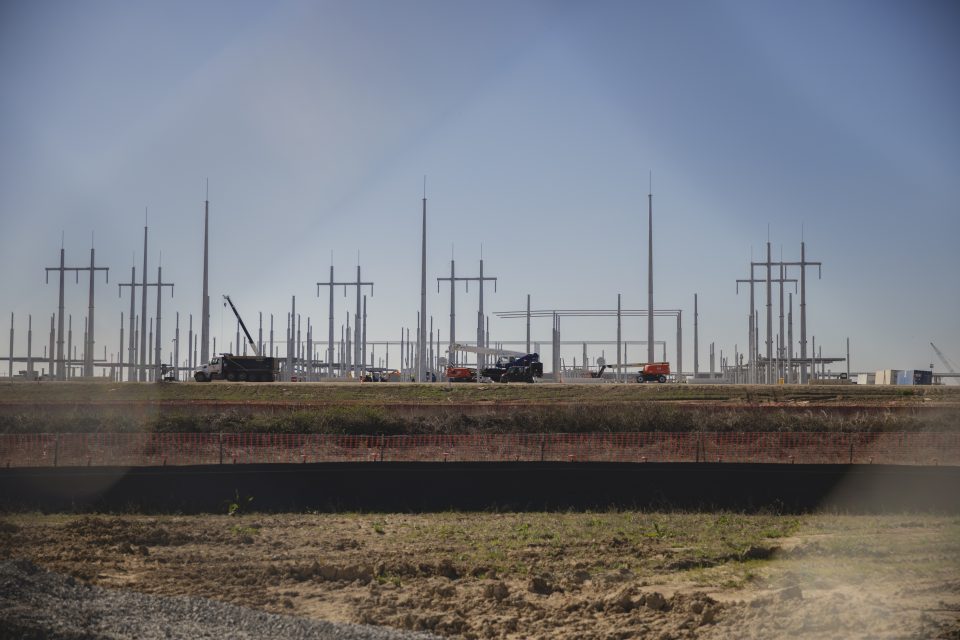
At Holly Ridge, however, the terrain changes abruptly. Generations of sharecroppers farmed the land, called the Franklin Farms megasite, until 2006, when the Franklin family sold it to the state of Louisiana, which then hoped to attract an auto plant. That was not to be, but Meta entered a long-term lease for the site in 2024 and purchased it in 2025. Since the company broke ground in early 2025, the farmland has been scraped and leveled into a construction site so disorientingly vast, it resembles the early stages of a city rising from the dirt. At five miles long and 1 mile wide at some points, steel frames jut from the ground. Heavy machinery operates around the clock. An endless stream of trucks pours in before sunrise, feeding a project where thousands of workers move through the site in hardhats and neon vests. Residents complain about damage to their vehicles because of rocks kicked up by the trucks hurtling to and from the Meta site.
Something enormous and unfamiliar has landed, seemingly all at once.
A newly-built road leading into Meta’s Hyperion site carries a prescient name: Far Far Away Lane. The nod to Star Wars is intentional, and the landscape does seem like a new frontier—representing not just Meta’s stratospheric AI ambitions, but the financial, energy-hungry reality of building the infrastructure that underpins the AI boom.
Camille Farrah Lenain for Fortune

Before Meta came to town, the biggest claim to fame of Richland Parish, a community where a quarter of residents live under the poverty line, was arguably that country music artist Tim McGraw was born and raised there. Now, residents are living through a seismic shift that has brought new jobs and excitement to some, and stress and disappointment to others—as well as heavier traffic on rural roads, rising rents, and mounting pressure on housing, utilities, and daily routines in communities unaccustomed to rapid growth. Beyond those immediate disruptions, whether the short-term gains of massive construction translate into lasting opportunity remains an open question.
Meta says the project has already created hundreds of construction jobs and will support thousands more over the buildout, along with a much smaller number of permanent roles once the data center is operational—the original announcement said 500. The company has also partnered with a local community college to launch a construction and workforce-training program aimed at preparing residents for jobs tied to the site and future industrial development.
And indeed at Meta’s Hyperion site, as thousands of temporary workers have descended on Richland Parish, taking space in hotels, short-term rentals and newly-built RV parks, there are clear examples of individual businesses booming. GrowNELA, the regional economic development authority for northeast Louisiana, pointed Fortune to companies like ServiceMaster Action Cleaning, a Monroe-based facilities maintenance firm that has doubled its workforce since Meta arrived, and Copeland Electric, another Monroe company that says the project has driven a roughly 40% increase in hiring.
The arrival of the Meta project was a catalyst for Chris Holyfield, the owner of Holy Dippers, a company created specifically to serve the construction project. He supplies septic services and eco-friendly restroom facilities for Meta workers—58 units so far, with more to be added as construction ramps up.
Holyfield wanted to take advantage of the once-in-a-lifetime opportunity, after leaders from the construction companies working on the Meta project told Holyfield that “this area’s about to explode,” he said. “No one believed it at first,” he explained. “Now we’re all feeling the difference.”
Holyfield also owns three restaurants in Monroe that do catering work for Meta’s large contracting companies, as well as a seven-story office building in Monroe where Meta leased space before the data center announcement was made.
Rob Cleveland, president and CEO of GrowNELA, who arrived in Louisiana in July 2024 after eight years in a similar role in Michigan, dismissed complaints about the level of local job creation as “silly.” He emphasized that several thousand new jobs have already arrived in the rural Richland Parish community—both working on the Meta site and for businesses servicing the site. Jobs are jobs, he argues—and the pragmatic reality is there aren’t many options for a community like Richland Parish.
“Constant naysayers say they’re short-term jobs, that there will be only 500 long-term jobs, why aren’t you recruiting automotive plants with 3000 long-term jobs,” Cleveland said. “Well, those projects don’t really exist anymore, and we don’t have the labor to support those projects.”
Where will they all live?
The influx of workers has created an immediate, practical problem in Richland Parish: housing. Currently, there are about 3,700 workers connected to the site, with an estimated peak in a couple of months of 5,000 (though locals say they have heard numbers as high as 8,000).
To accommodate the influx of construction workers, a patchwork of RV parks, or “man camps”—both large and small—has sprung up across the area. One of Meta’s three primary construction firms, DPR, hired subcontractor Mammoth Industries to build a sprawling, 130-acre workforce housing complex that includes more than 300 full-service RV sites near the Meta project.
And smaller, family-run RV parks are emerging as well. Kayla Caskey, the owner of South Stuart RV Park, about 25 minutes from the Meta site, grew up on the land where the park now sits. “We’ve had it for a couple of generations—it was passed down from my grandparents,” she said. “I got married and moved away, but my family still lives there—my mom and my brother—and we decided to take advantage of this opportunity.”
South Stuart RV Park has room for just 12 RVs, and Caskey said getting it up and running required navigating zoning rules and installing proper facilities, including showers and bathrooms. “We learned a lot along the way,” she said. “But we hope, in the end, this will be something good for our family.” The park filled quickly after opening, she added, and she continues to receive daily inquiries.
Caskey is realistic about the park’s future once construction winds down. “It may just be land out there again,” she said. “But hopefully, over the next couple of years, it’ll pay off while the workers are still here.”
But for others, the rapid spread of RV parks in the area has felt disruptive and overwhelming. For example, Fortune visited one mile-long dead-end road that until recently was lined with just eight homes. Now, two large RV parks—together expected to add up to 700 hookups—are under construction on the street, many directly next to or across the street from the few single-family homes.
Other area residents say they are being priced out of the area, or even facing attempted eviction, because of the influx of workers. Erika James, a 34-year-old mother of two who grew up in Richland Parish and now lives in a mobile home park in Monroe, a small regional hub about 30 minutes west of the Meta site, says her rent increased several times over the past six months. Earlier this month she received an eviction notice after paying her rent just one day late, saying her family had just five days to vacate.
Camille Farrah Lenain for Fortune
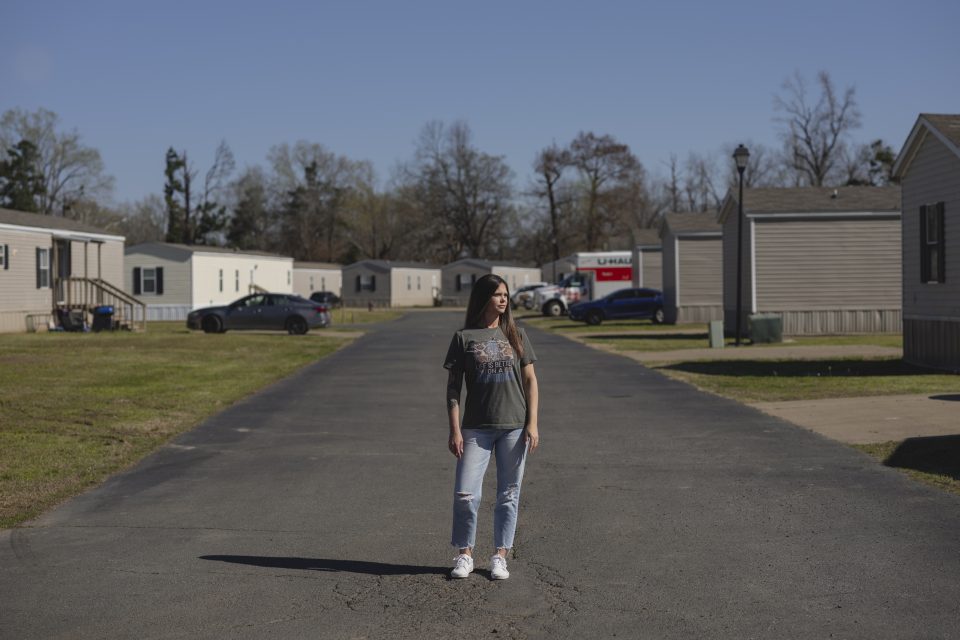
“I panicked and my husband immediately called the property owner and was told it had nothing to do with rent,” she said. “In fact, he said he didn’t even agree with the decision but it came from ‘above him’ because ‘they needed to make room for other tenants.’”
After agreeing to pay an “eviction fee,” James has been able to stay, but her lease ends at the end of April, with no word about renewal.
“Meanwhile, there is literally a sign outside welcoming Meta workers while local families are left wondering where they’re supposed to go,” she said. “We are now having to entertain the idea of leaving the area completely. There is nowhere to go if you can’t pay triple prices.”
“It breaks your heart to even think about having to leave here,” she said. “But it’s getting more expensive every day.”
The Meta project has promised transformation, explained Perez. But she added many residents of Richland Parish have little clarity about what that transformation will actually look like in the end.
“Transform, how?” she said. “That’s what people are on the edge of their seats trying to figure out, because right now you’re in the chaos phase where you don’t know which way to look, and when the dust settles, what’s left?”
Perez had heard that some people are “waiting it out” because they want to see if they can sell their property when it becomes more valuable. “Others just want the heck out because they want their quiet life back, and this is not what they signed up for,” she said. “And then there’s others who are just stuck.”
A rural Louisiana parish’s fervid campaign to bring Big Tech to its back roads
In Louisiana, the effort to court Meta for the Richland Parish site began early. According to reporting by the Times Picayune, Entergy Louisiana economic development executive Ed Jimenez and CEO Philip May hosted roughly half a dozen Meta executives at Entergy’s headquarters in New Orleans in early 2024, after May learned the company was searching for a Southern location to build a data center.
This is not unusual: Across the nation, consortia of state governments, utilities, and economic development groups are actively competing to attract tech companies to build AI data centers. For example, OpenAI said it and its partners reviewed more than 300 proposals from over 30 states before selecting five additional sites for its Stargate data center program, following the launch of its flagship facility in Abilene, Texas.
Over dinner, the Meta folks told Entergy that they would consider Louisiana but that the state would have to move fast to come up with a deal. Entergy executives worked with recently-elected Governor Jeff Landry to forge agreements with legislative leaders, cabinet secretaries and local government officials.
Meta ultimately secured significant tax incentives for the project, including a sales tax exemption on the billions of dollars it will spend on servers and equipment. But Meta emphasized that Richland Parish would also reap tax revenue and economic development.
Camille Farrah Lenain for Fortune
“Richland Parish receives both a portion of sales tax from our construction materials along with a PILOT (payment in lieu of taxes), based on jobs and capital investment,” a Meta spokesperson said.
These PILOT agreements—common in large data center deals—allow companies to pay a negotiated annual fee instead of full property taxes, with the amount tied to how much they invest and how many jobs they create. Public details of the Richland Parish agreement are limited, but a state contract reviewed by WIRED last year confirmed Meta’s payments and tax breaks are structured around hitting specific investment and hiring thresholds. The Meta spokesperson said the company has invested over $300 million to date in roads, water, and other local infrastructure.
While Louisiana also offers broad sales tax exemptions for data center equipment, local governments can still collect revenue from construction-related spending, because the state’s “sales and use tax” system applies taxes based on where materials are ultimately used. The result is a complex mix of long-term tax relief for the company paired with more limited, often temporary, revenue streams for the parish.
Meanwhile, the Hyperion project is already getting even bigger. Even as residents grapple with the disruption of the current buildout, Meta has quietly acquired roughly 1,400 additional acres adjacent to the existing 2,250-acre Hyperion site, according to people affiliated with companies working on or around the project, paving the way for a second phase of expansion. In reporting this story, Fortune observed active work underway on the newly acquired land.
A temporary boom is better than no boom at all
Some local leaders push back on residents’ complaints that the disruption outweighs the opportunity. GrowNELA’s Cleveland said complaints about traffic and housing are “completely valid and understandable,” adding that “it’s happening very quickly and it’s happening exponentially.” But he pointed out that the land used for the Meta site has been marketed as industrial for more than two decades and the state had long hoped for development to come. Those efforts coming to fruition is something to celebrate, not complain about, he argued: “We’ve hit the gold rush.”
Monroe Mayor Friday Ellis, who was elected to a second term in 2024 and sits on GrowNELA’s board, argues that the challenges now surfacing around housing, traffic, and infrastructure are not unique to the Meta project—but reflect the challenges of building on a “hyper” scale in a region that has long lacked investment.
Camille Farrah Lenain for Fortune

Ellis also says he understands why people are skeptical of the promises Meta and local politicians are making about the development bringing economic opportunity. He grew up in Richland Parish, and was raised by a single father who sharecropped on the land. He said skepticism toward the project is rooted in a history of broken promises. “For years, they’ve been ignored,” he said. “They don’t believe this is a real opportunity.”
Still, Ellis is unapologetically bullish. He argues that large projects like Meta’s offer a rare chance to change the community’s trajectory. “This region has a lot of poverty, and poverty exists because there’s no opportunity,” he said. “Opportunity and education lift people out of poverty. Our job right now is to connect as many people as possible to opportunity.”
Ellis has described the region as a budding “Silicon Bayou,” and said increased attention—from investors, contractors, and state leaders—has already begun to unlock new economic activity. “What gives me hope,” he said, “is that more people are paying attention to this part of the world.”
The Silicon Bayou label may not be hyperbole for northern Louisiana. The entire northern part of the state is increasingly being marketed as an AI infrastructure hub. In addition to Meta’s Hyperion expansion, Amazon recently announced plans to invest $12 billion in northwest Louisiana to build data center campuses.
And GrowNELA’s Cleveland said that more tech investment is coming to Richland Parish: “We are actively working on a diverse mix of projects for Richland Parish and the entire region,” he said. “That mix includes data centers, manufacturing, warehouses and suppliers of the Meta and Amazon data centers.”
But Richland Parish resident Dewanna Sanders, who owns a small food business and lives about three miles from the Meta site, said she was saddened by the changes to the landscape when she leaves her home before sunrise.
“It’s lit up like New York City,” she said of the site, describing it as a “halo” she can see from her front steps.
Camille Farrah Lenain for Fortune

While Sanders acknowledges that the data center will likely be good for the area in the long run—and that both her business and her husband’s have benefited—she said she cried when it was announced.
“It’s not the country anymore,” she said. “Everything is going to change here. Nothing’s going to be the same again.”
Sanders said she has received several offers on her 600-acre property and initially thought she might want to leave. “But where are you going to go?” she said. “This is home.”
Even Tim Allen, whose Holy Tacos business has benefited greatly from the Meta project, acknowledges how overwhelming the scale of the construction has been for many in what was once a quiet farming community. “Now it’s lights and noise, day and night,” he says. Still, as a pastor and father, Allen sees the project as a chance for something the region has long lacked. “There was nothing here for our kids,” he said. “They were growing up and moving away.”The Meta site, he believes, offers an opportunity for families to stay—and for the community to adapt. “It’s not going anywhere,” he said. “So we’re trying to meet it with empathy, figure out how to help the people who are struggling, and ask how we can grow and benefit together.”

Penny Lee Brown Obituary March 25, 2026 – Eckersell Funeral Home

Bears stadium deal should not include lawmaker perks or raise property taxes

Retro Indy: Five years ago Covid confined March Madness to Indiana

Two Iowans sentenced to prison for creating child pornography

Will Flory Bidunga Return to Kansas, Enter the NBA Draft, or Transfer?

Florida High School Football Rankings: Top 25 teams – Oct. 21

How old is Bo Nix? What to know about Oregon quarterback ahead of 2024 NFL Draft

Cleary's 21 help Le Moyne down Central Connecticut State 69-64 in OT

99th annual Pony Swim held in Virginia

Indiana Members Credit Union announced as new anchor tenant at Bottleworks District

Video: Will ICE Change Under Its New Leader?

DHS shutdown breakthrough comes at cost for Republicans as funding fights nears end

Rubio joins crucial G7 talks as Iran war set to dominate second day

A surprise resignation could open the door for an independent to win a Montana Senate seat

Video: Savannah Guthrie Says She Believes Her Mother Was Taken for Ransom
-

 Detroit, MI1 week ago
Drummer Brian Pastoria, longtime Detroit music advocate, dies at 68
-

 Science1 week ago
How a Melting Glacier in Antarctica Could Affect Tens of Millions Around the Globe
-

 Movie Reviews1 week ago
‘Youth’ Twitter review: Ken Karunaas impresses audiences; Suraj Venjaramoodu adds charm; music wins praise | – The Times of India
-
 Science1 week ago
I had to man up and get a mammogram
-

 Sports6 days ago
IOC addresses execution of 19-year-old Iranian wrestler Saleh Mohammadi
-

 New Mexico5 days ago
Clovis shooting leaves one dead, four injured
-
 Business1 week ago
Disney’s new CEO says his focus is on storytelling and creativity
-

 Texas1 week ago
How to buy Houston vs. Texas A&M 2026 March Madness tickets