Louisiana
Louisiana bears the burden of upstream runoff. Why doesn’t it push for solutions?

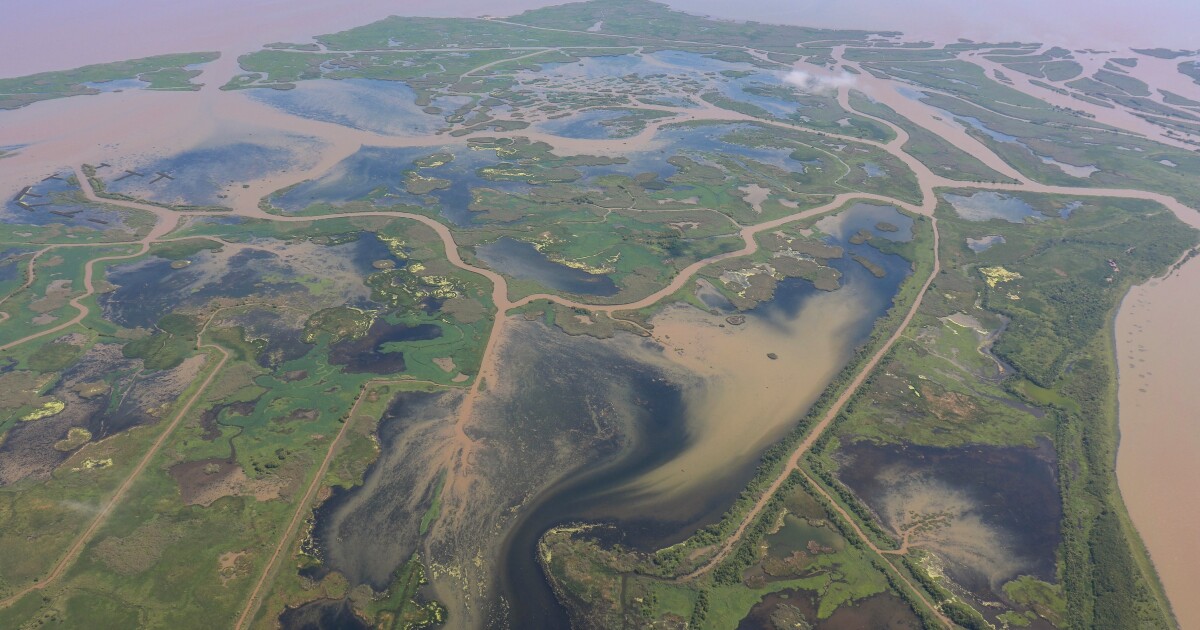
CYPREMORT POINT, La. — Thomas Olander has watched his shrimp catch shrink over the last 15 years. It’s not just the abundance of Louisiana shrimp; Olander said that the average size of the crustacean has also shrunk.
Credit: Darrell Hoemann, Investigate Midwest; ROSCOSMOS/NASA. Graphic: Annie Ropeik, Ag & Water Desk
In the past, shrimpers could expect the crustaceans to grow throughout the spring season, which starts in May in Louisiana waters and generally runs through July. “Since we’ve been dealing with this ‘dead zone,’” said Olander. “We’re not seeing that growth no more.”
The dead zone is a stretch along the shallows of the Gulf of Mexico where algae blooms choke off oxygen in the water.
This month, the National Oceanic and Atmospheric Administration (NOAA) estimated that this summer’s dead zone would reach 5,827 square miles – an area roughly the size of Connecticut. That’s up from approximately 3,058 square miles in 2023.
These massive algae blooms are caused by nutrients that run off of farms up and down the Mississippi River Basin, which stretches from Northern Minnesota to the Gulf of Mexico.
Fertilizer that helps crops grow contains high levels of nitrogen and phosphorus. These nutrients run off the fields during rainstorms at the end of the growing season and end up in waterways leading to the Mississippi River.
In 1996, the dead zone in the Gulf of Mexico came to national attention through local reporting. The Gulf of Mexico Hypoxia Task Force was established in the fall of 1997 – a collaboration of state, federal and tribal agencies – and asked the group to create and implement an action plan.
A preliminary goal is to reduce both nitrogen and phosphorus by 20% by 2025. But despite some progress, the task force has not yet met its goals.
The U.S. Geological Survey showed that in May 2024, while nitrogen loads in the lower Mississippi River were 7% lower than baseline measurements, phosphorus loads increased by 22%.
The 2025 target is simply not a priority for the task force, said Doug Daigle, a research scientist at Louisiana State University and coordinator of the Louisiana Hypoxia Working Group. He added that neither the task force nor Louisiana attempted to raise funds from Congress to implement programs that would reduce nutrient pollution.
“It’s a problem with the task force, not just Louisiana. There has not been an organized attempt to garner more funding for the action plan,” said Daigle.
Where is the Clean Water Act?
The task force’s action plan is hindered by a lack of enforceable limits on nitrogen and phosphorus, according to the Tulane Institute on Water Resources Law and Policy. Instead, it focuses on voluntary state efforts and guidelines.
In a presentation to the Louisiana Governor’s Advisory Commission on Coastal Restoration, Protection and Conservation in early June, Daigle said the state has been a passive and largely silent member of the task force.

David Kovaluk for St. Louis Public Radio
Daigle said the 176-page strategy is not technically a strategy because it doesn’t have any targets or goals. He added that the state has missed years of opportunity to reduce the dead zone.
To address the sheer quantity of nutrient pollution from the upriver basin states, Tulane lawyers suggest that Louisiana could petition the U.S. Environmental Protection Agency for greater enforcement under the Clean Water Act.
One section of the law allows for the government to set specific, maximum amounts of daily pollutants for bodies of water deemed to be impaired. Louisiana could petition the EPA to declare sections of the Mississippi River or the Gulf of Mexico as impaired, which would allow for the creation of an enforceable limit on nutrients entering the river upstream.
Louisiana could also petition the EPA administrator to convene an interstate water management conference to address pollution upriver. While the Gulf Hypoxia Task Force currently acts as a mediary between states, it lacks the enforcement power that the Clean Water Act could provide.
But the state has so far not done any of this. Louisiana Gov. Jeff Landry’s office did not respond when asked if Landry has any plans to petition the EPA or address the growth of the dead zone.
In 2016, the Gulf Restoration Network sued then-EPA administrator Lisa P. Jackson for the agency’s “hands-off approach” to dealing with nitrogen and phosphorus pollution under the Clean Water Act. This lawsuit followed a petition submitted by several environmental non-profits in 2008 that demanded numeric water quality standards be set for the nutrients.
But ultimately, the Eastern District of Louisiana court ruled that the EPA could continue a voluntary approach to nutrient reduction.
In 2019, when the most recent version of Louisiana’s nutrient reduction and management strategy was released, Mark Davis, director of the Tulane Institute on Water Resources Law and Policy, submitted recommendations for improvements to the Louisiana Department of Environmental Quality (LDEQ).
Davis wrote that it has become clear that neither the EPA nor the task force would be implementing numeric targets any time soon. Those specific, enforceable limits would not be forthcoming “until Louisiana makes their development a priority and focuses the issue on upstream states and the federal government,” he wrote.
“They did not make a dent,” Davis said.
‘The solution to pollution is not distribution’
As Louisiana works to review its Nutrient Reduction and Management Strategy, some critics say that the state focuses too heavily on plans to redirect the flow of the Mississippi River.
The Coastal Protection and Restoration Authority (CPRA) highlights the benefits that would come from plans to reconnect the river to land across the coast.
“CPRA is constructing diversions with the main purpose of building and sustaining Louisiana’s coastal wetlands,” said Angelina Freeman, a research scientist at CPRA who was a member of the Louisiana Nutrient Reduction and Management Strategy interagency team.
She explains that by redirecting the river’s flow, nutrients that would have otherwise fueled the dead zone would instead nourish the state’s recovering wetlands.

La’Shance Perry
/
The Lens
A few man-made diversions are already up and running, such as the Caernarvon and Davis Pond Diversions. Davis Pond is restoring wetlands in the upper Barataria Basin on the west side of the Mississippi River near Luling, in St. Charles Parish, Louisiana, while Caernarvon delivers sediments and nutrients to Breton Sound on the river’s east bank in Plaquemines Parish.
The 2023 Louisiana Coastal Master Plan calls for redirecting sediments and nutrients into Barataria Bay on a massive scale through the largest single restoration project in U.S. history. The Mid-Barataria Sediment Diversion would build and nourish up to 27 square miles of coastal wetlands over the next 50 years.
But to Daigle, centering the state’s nutrient reduction and management strategy around sediment diversions such as the yet-to-be-built Mid-Barataria is a mistake.

Cassandra Glaspie
/
Louisiana State University
“Until [the diversions] are built and operating they don’t do anything, good or bad,” he added. “Talking about them doesn’t accomplish anything. Having them in a plan doesn’t accomplish anything.”
“The solution to pollution is not distribution,” said Nancy Rabalais, a professor at Louisiana State University who, for years, led Gulf research cruises to monitor the size of the dead zone.
Rabalais and fellow LSU researcher R. Eugene Turner published a separate June 2024 dead zone forecast that was less dire than the above-average estimate released by NOAA. Their prediction looks at the potential effects of warmer water on oxygen levels.
They emphasize that their reduced forecast is “solely due to ocean warming, not to a decline in nitrate loading from the Mississippi River.”
Cutting down on nutrients within Louisiana
While the vast majority of nutrients that create the dead zone every summer come from agriculture in the states upriver from Louisiana, there is still a significant input of runoff from farmland within the state itself.
In 2022, the LDEQ published a report on long-term nitrogen and phosphorus trends at ambient water quality monitoring stations across the state. They found that nutrient concentrations are decreasing at the majority of testing locations.
Following these trends, Louisiana received a recent influx of funding to further reduce nutrient runoff within the state from the Gulf of Mexico Division of the EPA.
Earlier this year, the Gulf of Mexico Alliance received a grant to help farmers in northeast Louisiana adopt practices to prevent excessive runoff from entering the Bayou Lafourche watershed, and ultimately the Red River and Atchafalaya Basin.
The Atchafalaya River siphons off 30% of the Mississippi River’s flow. The Atchafalaya has a growing delta system, such as at the Wax Lake Outlet, but excess nutrients still escape to the Gulf of Mexico, expanding the dead zone to the west.
In Morehouse Parish, farmers are being taught how to limit their contribution to nutrient runoff that would reach the Gulf through the Mississippi-Atchafalaya Basin. The grant will fund new farming techniques, including the subsidizing of cover crops to reduce runoff, which may also increase soil productivity and cash crop yields.
“We’re doing exactly what we hope and wish everyone north of us would be doing,” said Joey Breaux, assistant commissioner of the Louisiana Department of Agriculture and Forestry. He added that the farmers in Morehouse Parish have been very receptive to the new program.

La’Shance Perry
/
The Lens
The $1.4 million grant will run through 2026 with the specific goal of reducing the Gulf of Mexico’s dead zone.
The funds will go to help farmers plant cover crops in between growing seasons to reduce soil erosion and prevent nutrients from running off into the river. The farmers will also receive instruction in no-till management, which calls for crops to be planted in narrow rows within the untilled seedbeds of previous crops. Keeping the soil intact increases organic matter and productivity while reducing the need for excess fertilizer.
Olander, the shrimper, said that he wishes the Department of Wildlife and Fisheries would support his industry’s losses in the way that they are for farmers. “They are really keeping their farmers going,” he added. “Call me a farmer of the sea; I’ll take that title if they would help us.”
What to expect from the next dead zone tour
On July 21, the R/V Pelican will set sail to take stock of this summer’s dead zone. NOAA will fund a six-day tour of the traditional hypoxic area to the west of the Mississippi River, where the Atchafalaya River also dumps nutrient runoff into the Gulf of Mexico.
This year, the cruise will be extended for four extra days to tour the area east of the Mississippi River. This portion of the cruise will be funded by a grant distributed by the Gulf of Mexico Alliance from the Bipartisan Infrastructure Bill.
And that tour may bring new scientific research to be considered before Louisiana issues its five-year update to the state nutrient reduction strategy.
“This strategy is up for revision,” said Daigle, “I think it needs a total revision, not just tweaking.”
This story is part of the series Farm to Trouble from the Mississippi River Basin Ag & Water Desk, an independent reporting collaborative.


NEW ORLEANS, La (WVUE) – A new education center in the town of Jean Lafitte is giving visitors a chance to learn about south Louisiana’s coast.
Dave McNamara explores how the center combines history, culture, science, and a walk through a cypress swamp in the heart of Louisiana.
For more, visit the Heart of Louisiana archive here.
See a spelling or grammar error in our story? Click Here to report it. Please include the headline.
Subscribe to the Fox 8 YouTube channel.
Copyright 2026 WVUE. All rights reserved.


Luxury resort in Sarasota County ranked among South’s best new hotels
Luxury resort in Sarasota County ranked among South’s best new hotels
When you think of resorts, you probably think of hotels with expansive grounds, upscale amenities and all-inclusive packages.
While these types of resorts can surely be found in major-destination cities and foreign countries, Louisiana has its own resorts that are just as nice.
At Louisiana’s resorts, you can enjoy all the same amenities and stay at locations that are just as luxurious.
Plan your stays with Booking.com
Why these 6 resorts are the best in Louisiana for 2026
Travel US News has ranked the six best resorts in Louisiana based on hotel class rating, property type and guest reviews.
1. L’Auberge Casino Resort in Lake Charles
L’Auberge Casino Resort in Lake Charles is the best resort to stay in Louisiana, with a guest rating of 8.7 out of 10. More than just a nice place to stay, this resort offers premiere casino games, plenty of shopping, golfing opportunities, a spa, relaxing cabanas and upscale restaurants. The hotel also has business and fitness centers, and the rooms are in the modern arts and crafts style.
2. Caesars in New Orleans
Caesars in New Orleans is the second-best resort in Louisiana and has a guest rating of 7.9 out of 10. This resort has a great location within the Central Business District, making it near all the top attractions in the Crescent City. Here, there are plenty of dining and gambling opportunities. The rooms are equipped with standard amenities and are in a Louisiana-inspired style.
3. Margaritaville Resort Casino in Bossier City
Margaritaville Resort Casino in Bossier City is the third-best resort in Louisiana, with a guest rating of 8.7 out of 10. Strategically located across the Red River from Shreveport, this resort offers plenty to do, like testing your luck at the casino, spending a day by the pool, relaxing at the spa, eating delicious food at one of the restaurants or enjoying live entertainment at the performance hall.
4. Bally’s Casino & Hotel in Shreveport
Bally’s Casino & Hotel in Shreveport is among the best resorts in Louisiana and has a guest rating of 7.6 out of 10. Bally’s offers plenty of casino games and dining opportunities, and you can keep the night going with drinks and dancing at one of the lounges. The hotel offers business and fitness centers and the rooms come with standard amenities, like flat-screen TVs and minifridges.
5. Nottoway Plantation Resort in White Castle
Nottoway Plantation Resort in White Castle is one of the best resorts in Louisiana, as it is among the 4.0 star hotel class. This historic antebellum plantation, originally constructed in 1859, includes nine Acadian-style cottages, a salon, an outdoor pool, a fitness center and tennis courts. Visitors can tour the plantation house itself and embark on a guided tour of the on-site museum.
6. Cypress Bend Resort, a Wyndham Hotel in Many
Cypress Bend Resort, a Wyndham Hotel in Many is among the best resorts in Louisiana, with a guest rating of 7.7 out of 10. This hotel features two restaurants, a golf course, fitness center indoor and outdoor pools, as well as a bar and lounge. Belonging to the 3.0 star hotel class, this casual resort is the perfect spot for a quick getaway, as it’s set on 600 acres on Toledo Bend Lake.
Presley Bo Tyler is the Louisiana Deep South Connect Team for USA Today Network. Find her on X @PresleyTyler02 and email at PTyler@Gannett.com
The Louisiana Lottery offers several draw games for those aiming to win big.
Here’s a look at July 6, 2026, results for each game:
Winning Powerball numbers from July 6 drawing
17-44-63-66-67, Powerball: 04, Power Play: 2
Check Powerball payouts and previous drawings here.
Winning Pick 3 numbers from July 6 drawing
8-7-1
Check Pick 3 payouts and previous drawings here.
Winning Pick 4 numbers from July 6 drawing
5-9-3-6
Check Pick 4 payouts and previous drawings here.
Winning Pick 5 numbers from July 6 drawing
0-3-3-5-6
Check Pick 5 payouts and previous drawings here.
Feeling lucky? Explore the latest lottery news & results
Are you a winner? Here’s how to claim your lottery prize
All Louisiana Lottery retailers will redeem prizes up to $600. For prizes over $600, winners can submit winning tickets through the mail or in person at Louisiana Lottery offices. Prizes of over $5,000 must be claimed at Lottery office.
By mail, follow these instructions:
- Sign and complete the information on the back of your winning ticket, ensuring all barcodes are clearly visible (remove all scratch-off material from scratch-off tickets).
- Photocopy the front and back of the ticket (except for Powerball and Mega Millions tickets, as photocopies are not accepted for these games).
- Complete the Louisiana Lottery Prize Claim Form, including your telephone number and mailing address for prize check processing.
- Photocopy your valid driver’s license or current picture identification.
Mail all of the above in a single envelope to:
Louisiana Lottery Headquarters
555 Laurel Street
Baton Rouge, LA 70801
To submit in person, visit Louisiana Lottery headquarters:
555 Laurel Street, Baton Rouge, LA 70801, (225) 297-2000.
Hours: 8 a.m. to 4:30 p.m., Monday through Friday. This office can cash prizes of any amount.
Check previous winning numbers and payouts at Louisiana Lottery.
When are the Louisiana Lottery drawings held?
- Powerball: 9:59 p.m. CT Monday, Wednesday and Saturday.
- Mega Millions: 10 p.m. CT Tuesday and Friday.
- Pick 3, Pick 4 and Pick 5: Daily at 9:59 p.m. CT.
- Easy 5: 9:59 p.m. CT Wednesday and Saturday.
- Lotto: 9:59 p.m. CT Wednesday and Saturday.
This results page was generated automatically using information from TinBu and a template written and reviewed by a Louisiana editor. You can send feedback using this form.
-

 Los Angeles, Ca1 hour ago
Bicyclist killed by hit-and-run driver in Long Beach
-

 Detroit, MI1 hour ago
Child shot while riding bike outside home on Detroit’s west side, police say
-

 San Francisco, CA2 hours ago
Bay Area restaurant has strict policy on acceptable children behavior
-

 Dallas, TX2 hours ago
Detroit Pistons trade Marcus Sasser to Dusty May’s Dallas Mavericks
-

 Miami, FL2 hours ago
The offseason has been a massive success for the Miami Heat
-

 Boston, MA2 hours ago
Can’t afford Boston’s priciest restaurants? Try these instead. – The Boston Globe
-

 Denver, CO2 hours ago
City of Denver says images of piling waste a case of illegal dumping
-

 Seattle, WA2 hours ago
14-year-old dies in electric motorcycle crash at Seattle bike park

