Florida
‘Trust is gone’: fears grow as police on some Florida campuses trained by Ice


Fears of a new wave of deportations and student visa cancellations are rising at a number of Florida’s most diverse universities after administrators signed agreements recasting campus police as federal immigration agents.
Miami’s Florida International University (FIU) is one of at least 11 state colleges to enroll in the top tier of the Immigration and Customs Enforcement (Ice) 287(g) program that trains local police departments for “limited” involvement in immigration operations.
The partnerships give campus officers broad new powers to stop, question and detain students about their immigration status, and share information directly with Ice, which students and faculty members believe could escalate the Trump administration’s assault on those studying in the US from abroad.
Nationally, more than 1,400 international students and recent graduates perceived by the government to be pro-Palestinian have had their F-1 or J-1 visas canceled by the homeland security department, according to a tally by Inside Higher Ed, with the Miami New Times reporting dozens in Florida.
Additionally, a series of prominent arrests, detentions and deportations of students, alumni and scholars have sparked outrage and protests on campuses nationwide. They include Mahmoud Khalil, Rümeysa Öztürk and Mohsen Mahdawi.
At the University of Florida (UF), which confirmed its collaboration with Ice earlier this month, students have organized several demonstrations against the agreement, and in support of Felipe Zapata Velázquez, a Colombian third-year student deported after he was arrested last month by local police for alleged traffic offenses and handed over into Ice custody.
Maxwell Frost, a Democratic Florida congressman, decried what he called Velázquez’s “government-funded kidnapping”. Protesters say his deportation is part of an ongoing Trump administration purge of overseas students, many for minor infractions.
Earlier this year, the government reactivated the taskforce model of the Ice partnership program that was discontinued by Barack Obama in 2012 for racial profiling, and which the American Civil Liberties Union has argued is unconstitutional.
Ron DeSantis, Florida’s rightwing Republican governor, directed state law enforcement agencies in February to sign up, and the Miami Herald reported on Thursday that almost every college with its own campus law enforcement agency is enrolled.
“That the University of Florida has signed on to the highest level of these agreements is atrocious,” Stephen Sykes, the chair of the UF chapter of the Young Democratic Socialists of America, said.
“There’s no rule in Florida that any group sign on at this level, which effectively makes the police force a wing of Ice itself.”
Sykes continued: “Even across activist communities at UF that generally don’t have the best relationships with police, they were seen as kind of the good people. They protected activists during our Palestine encampment, they were just there hanging out. It felt more like they were protecting us than trying to box us in. Now a lot of that trust is definitely gone.
“Students are scared to come out now, because to even speak up is to risk deportation.”
Activists at FIU share Sykes’s concerns that international students in particular will be reluctant to seek help from campus law enforcement, or to report crimes.
“What will they do with any information they receive? Who will they send it to?” said Bayan Abedulazis, the president of FIU’s Students for Justice in Palestine chapter.
“Things are very uncertain, and there is a lot of fear, just because of the fact that FIU is an international university. Most students either have a background of family not coming from the US or are directly coming from out of the country, and they’ve just kind of detached from a lot of these spaces, like SJP or the like, because they don’t want to be caught or have risk for themselves or their families.”
FIU has almost 3,800 international students from more than 142 countries, according to its website. Madeline Baró, the senior director of media relations, told the Guardian that the visas of 18 students had been revoked, but would not comment about the university’s agreement with Ice.
There was a “no Ice on campus” protest on Tuesday, but Abedulazis said her group had advised international students not to take part.
after newsletter promotion
“For SJP specifically, Palestine is such a big international issue, and we have a lot of international students that have wanted to be involved, or have been involved in the past,” she said.
“This past semester we’ve advised students not to attend any kind of public demonstrations, specifically in regards to Palestine, or just in the general sense, because of the kind of risk that it’s been posing for students to speak out publicly in any kind political manner.”
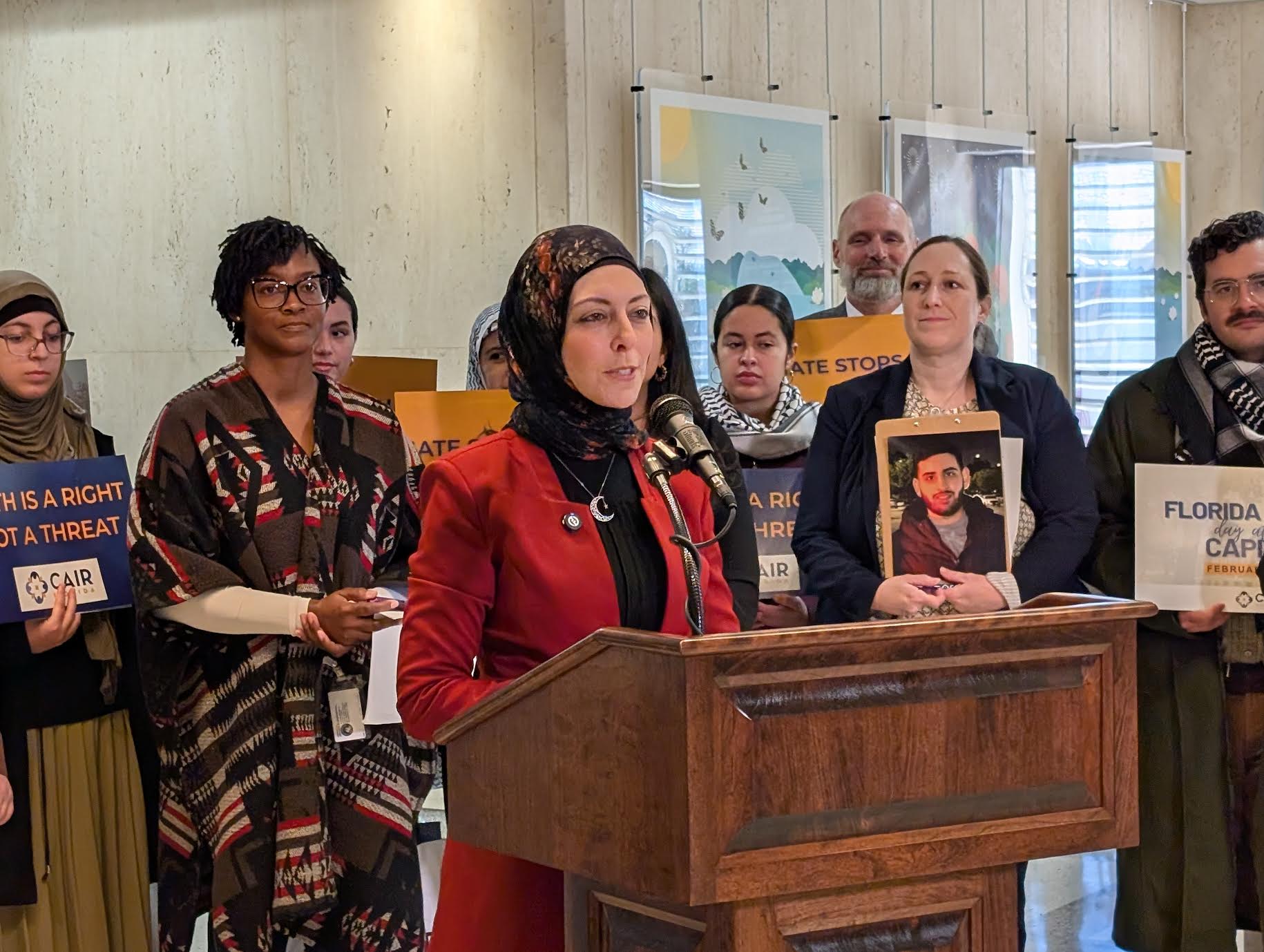
Educators joined the midweek protest at FIU, with members of its Union Faculty of Florida chapter displaying placards opposing the Ice agreement.
“Universities have usually been considered free spaces, open spaces,” Terrence Peterson, a history professor, told WLRN.
“ We want our students to show up. It’s hard enough to get them to show up anyways if they’re afraid to come because they might be arrested and deported.”
Rogelio Tovar, the chair of FIU’s board of trustees, defended the agreement to colleagues during their meeting on Tuesday, WLRN reported.
“No student should be fearful if they’re here legally and they’re in compliance with the law,” he said.
The university recently acceded to a request from DeSantis to appoint Jeanette Nuñez, a close political ally and his former lieutenant governor, as interim president, sparking allegations of cronyism.
The activist group Florida Student Power Network has also been helping organize campus resistance to Ice integration with university administrators, and lobbying Florida’s state legislators in Tallahassee.
“University campuses do not have to comply to these agreements,” the group said in a statement ahead of a protest at Boca Raton’s Florida Atlantic University (FAU).
“It is clear that schools are bowing down to a racist agenda rather than prioritizing the safety of their students. This won’t stop at FAU. We need to fight back.”



Florida
Gas prices rise in South Florida amid U.S. and Israel’s conflict with Iran, as the stock market also reports a dip

Four days into the Iranian conflict, gas prices are rising at many stations in South Florida.
“I’ve traveled all over the United States,” says Stacey Williams. CBS Miami spoke to him as he was gassing up on the turnpike. He paid $66 for 20 gallons of diesel to fill his pickup truck. Williams has noted the fluctuations in fuel as he drives to locations for his work on turbines. He just spent three weeks at the Turkey Point Nuclear Power Plant south of Miami.
“The salary we get paid per hour does not add up to what we pay for gas, housing, and food,” he says.
Mitchell Gershon is also dealing with the higher gas prices. He has to fill three vehicles constantly for his business—Thrifty Gypsy, a pop-up store at musical venues. He’s back and forth from Orlando to Miami and says fuel is costing him 20% more. When asked how he handles these fluctuations, he said, “Have a little backup cash so you are ready for it.”
The rise in oil prices contributed to a drop in the stock market on Tuesday, which means some retirement accounts dipped, too. CBS Miami talked to Chad NeSmith, director of investments at Tobias Financial Advisors in Plantation, for perspective on the drop.
“We are seeing most of the pullback today. Yesterday was a shock,” he says. He’s not expecting runaway oil prices but says investors should stay in the loop: “Pay attention to your portfolio. Stick to your goals. Have a plan because these things are completely unpredictable.”
That unpredictability has Williams adjusting his budget. “You just cut back, cut corners, all you can do,” he says.

STARKE, Fla. (AP) — A man convicted of fatally shooting a police officer with his own service weapon during a traffic stop is set to be executed Tuesday evening in Florida.
Billy Leon Kearse, 53, is scheduled to receive a three-drug injection starting at 6 p.m. at Florida State Prison near Starke. Kearse was initially sentenced to death in 1991 after being convicted of first-degree murder and robbery with a firearm.
The Florida Supreme Court found that the trial court failed to give jurors certain information about aggravating circumstances and ordered a new sentencing. Kearse was resentenced to death in 1997.
Kearse awoke at 6:30 a.m. He declined a last meal and has remained compliant throughout the day, corrections spokesman Jordan Kirkland said during a news conference. Kearse met with a spiritual adviser during the day but had no other visitors.
This is Florida’s third execution scheduled for 2026, following a record 19 executions last year. Republican Gov. Ron DeSantis oversaw more executions in a single year in 2025 than any other Florida governor since the death penalty was reinstated in 1976. The highest number before then was eight executions in both 1984 and 2014, under former governors Bob Graham and Rick Scott, respectively.
According to court records, Fort Pierce Police Officer Danny Parrish pulled over Kearse for driving the wrong way on a one-way street in January 1991. When Kearse couldn’t produce a valid driver’s license, Parrish ordered Kearse out of his vehicle and attempted to handcuff him.
A struggle ensued, and Kearse grabbed Parrish’s firearm, prosecutors said. Kearse fired 14 times, striking the officer nine times in the body and four times in his body armor. A nearby taxi driver heard the shots and used Parrish’s radio to call for help.
Parrish was rushed to a nearby hospital, where he died from the gunshot wounds, officials said. Meanwhile, police used license plate information that Parrish had called in before approaching Kearse to identify the attacker’s vehicle and home address, where Kearse was arrested.
Last week, the Florida Supreme Court denied appeals filed by Kearse. His attorneys had argued that he was unconstitutionally deprived of a fair penalty phase and that his intellectual disability makes his execution unconstitutional.
The U.S. Supreme Court rejected Kearse’s final appeals Tuesday afternoon without comment.
A total of 47 people were executed in the U.S. in 2025. Florida led the way with a flurry of death warrants signed by DeSantis, far outpacing Alabama, South Carolina and Texas which each held five executions.
Besides the two Florida executions this year, Texas and Oklahoma have each executed one person so far.
Two more Florida executions have already been scheduled for this month. Michael Lee King, 54, is scheduled to die on March 17, and the execution of James Aren Duckett, 68, is set for March 31.
All Florida executions are carried out via lethal injection using a sedative, a paralytic and a drug that stops the heart, according to the Department of Corrections.

Vermont high school playoff scores, results, stats for Thursday, March 5

Obama calls on voters to help Democrats’ Virginia redistricting ahead of midterm elections

Police finish DoorDash delivery after arresting driver in New Jersey

Wisconsin man accused of setting fire to congressman’s office over TikTok ban gets 7 years in prison

Why is Popular Bracketologist Still Considering West Virginia for NCAA Tournament?

Florida High School Football Rankings: Top 25 teams – Oct. 21

Cleary's 21 help Le Moyne down Central Connecticut State 69-64 in OT

How old is Bo Nix? What to know about Oregon quarterback ahead of 2024 NFL Draft

99th annual Pony Swim held in Virginia

Indiana Members Credit Union announced as new anchor tenant at Bottleworks District

Map: 4.9-Magnitude Earthquake Shakes Louisiana

Paxton vows he’s ‘staying in this race’ even if Trump backs Cornyn in Texas GOP clash

Which Kurdish groups is the US rallying to fight Iran?

Man accused of plot to assassinate Trump testifies Iran pressured him, says Biden and Haley were other possible targets

DHS defends McLaughlin against allegations husband’s company profited millions from ad contracts: ‘Baseless’
-

 World1 week ago
Exclusive: DeepSeek withholds latest AI model from US chipmakers including Nvidia, sources say
-

 Massachusetts1 week ago
Mother and daughter injured in Taunton house explosion
-

 Wisconsin4 days ago
Setting sail on iceboats across a frozen lake in Wisconsin
-

 Maryland4 days ago
AM showers Sunday in Maryland
-

 Florida4 days ago
Florida man rescued after being stuck in shoulder-deep mud for days
-

 Denver, CO1 week ago
10 acres charred, 5 injured in Thornton grass fire, evacuation orders lifted
-

 Massachusetts2 days ago
Massachusetts man awaits word from family in Iran after attacks
-

 Oregon6 days ago
2026 OSAA Oregon Wrestling State Championship Results And Brackets – FloWrestling