Austin, TX
Texas lawmakers react to arrests during pro-Palestinian protests at UT Austin


Dozens of people were arrested at the University of Texas at Austin during protests over the Israel-Hamas war and state lawmakers are divided on the university’s response. Jack sits down with both major candidates in the race for U.S. Senate in Texas. And a preview of the runoff for Dallas County Sheriff, in which the incumbent is facing a challenge from the predecessor who hand-picked her.
Jack Fink covers these stories and more in the latest edition of Eye on Politics (original air date: April 28).
Protests flare
Dozens of people have been arrested at college campuses across the country in pro-Palestinian protests. Among the locations of these protests: UT Austin, UT Dallas and Columbia University.
At UT’s flagship campus, 57 people were arrested after failing to disperse as ordered by police. Among those arrested, a news photographer for an Austin television station, who was knocked to the ground by officers. Travis County dropped the charges against the protesters.

UT Austin President Jay Hartzell released a statement to students and faculty that read, in part:
“Peaceful protests within our rules are acceptable. Breaking our rules and policies and disrupting others’ ability to learn are not allowed. The group that led this protest stated it was going to violate Institutional Rules. Our rules matter and they will be enforced. Our University will not be occupied.”
Republican State Sen. Brandon Creighton of Conroe told Jack the university did the best it could under the circumstances.
“What goes too far is showing up to occupy university space for the purpose of calling out Jewish students and the Jewish community on campus and chanting anti-Israel chants throughout the protest, and an effort to absolutely duplicate and repeat what happened at Columbia University just a few days before is just unacceptable,” Creighton said.
But not everyone agrees. Chair of the House Democratic Caucus, Democratic State Rep. Trey Martinez Fischer of San Antonio, said UT’s response was not its best work.
“My question would be, does that automatically require riot, police and riot gear with physical weapons,” Martinez Fischer said. “And does that require altercations that resulted in physical contact and potential injury? I’m not so sure that the the remedy met the response … President Hartzell has the absolute right to protect the students on campus, but I don’t believe you can justify that by letting other people get hurt in the process.”
On the second day of protests at UT Austin, there were more students and faculty who joined, but law enforcement did not step in.
The situation was more calm at UT Dallas in Richardson, where protesters led a sit-in at the administration building. They dispersed after the university’s President agreed to meet with them and with a group of Jewish students.
And at Columbia University, pro-Palestinian demonstrations ignited a storm of controversy. Some people called for “death to Jews” and made statements against Israel and the U.S. A rabbi at Columbia messaged nearly 300 Jewish students to go home until it is safe to return.

Jack spoke with both major candidates in the race for U.S. Senate in Texas about the issue.
“While folks have a right to protest, chanting things that are deeply anti-Semitic or are threatening is a line that, once that’s crossed, that’s no longer a protest, that’s an aggressive action,” said Democratic Congressman Colin Allred. “That’s what I’ve seen happening on these college campuses. To me, it’s gotten out of hand.”
Sen. Ted Cruz called the campus protests “disgraceful.”
“This vicious antisemitism is utterly unacceptable,” said Cruz. “We’re seeing radical activists who are pro-Hamas, who are chanting in favor of the Hamas terrorists that butchered 1,200 people on October 7.”
Marquee match-up
Jack also spoke with Allred and Cruz about their campaigns, border security and how they voted on a recent foreign aid package.
Watch Jack’s interview with Cruz below:
Watch Jack’s interview with Allred below:
The Real Clear Politics average of polls shows Cruz leads Allred by 7.2 percentage points, 46% to 38.8%. The Cook Political Report rates this seat likely “R”.
Squaring off
One of the closest races being watched in Dallas County is the Democratic primary runoff on May 28 between incumbent Sheriff Marian Brown and her former boss, former Sheriff Lupe Valdez. Valdez hand-picked Brown to succeed her.
Jack recently moderated a debate between them, sponsored by the Dallas Democratic Forum. During the debate, the candidates made their case to dozens of people on why they should win the Democratic primary runoff next month.
“Some people said she wants her old job back,” said Valdez. “I don’t want my old job back … Correctional officers will tell you things are not improving, it’s getting worse. So, I made the decision after three years of several folks asking.”
In response, Brown said she wouldn’t have been Valdez’s hand-picked successor and appointed by county leaders if she hadn’t done a good job as the number three person in the department.
“When I hear there are 30 people who’ve asked my opponent to return, I say to you there are 2,100 employees at the department,” Brown said. “What percentage of 2,100 is 30 … I’m okay with that because in the real world, if you have 2,100 employees, you’re not going to please everybody.”
Watch Jack’s full report on this race by watching this week’s full episode of Eye on Politics at the top of this page.
Every week, CBS News Texas political reporter Jack Fink breaks down some of the biggest political stories grabbing headlines in North Texas and beyond. Watch the latest episode of Eye on Politics in the video player above and watch new episodes every Sunday at 7:30 a.m. on air and online.




AUSTIN (KXAN) — Governor Greg Abbott and the Texas Society Sons of the American Revolution unveiled a new monument at the Texas State Cemetery on Saturday, dedicated to Texas Revolutionary War soldiers.
“We must educate every generation about why it is that America grew from a tenuous 13 colonies into the most powerful country in the history of the world,” said Governor Abbott. “This monument here is an enduring testament to the heroes who fought for the freedom that is unique to America.”
The monument was dedicated to 69 soldiers who fought in the American Revolutionary War and later settled in Texas, according to a press release.
Among those that were honored, Abbott recognized:
- José Santiago Seguín, grandfather of Texas Revolutionary hero Juan Seguín.
- Peter Sides, who fought in the 2nd Battalion of the North Carolina Regiment of the Colonial Army, and was later killed in the 1813 Battle of Medina, fighting for Mexican independence against Spain.
- Antonio Gil Y’Barbo, the founder of Nacogdoches.
- William Sparks, who fought as a mounted rifleman in the American Revolution and later settled in Texas. He had two sons and two grandsons who fought in the Texas Revolution.
“This year marks the 250th anniversary of the American Revolution, which not only gave freedom to the British colonies of North America, but inspired movements for freedom and liberty all over the world,” said TSSAR President Mel Oller. “Texans played a role in the war too, and it’s important to recognize them, and the sacrifices they made for our freedom.”
At the monument unveiling, Abbott was also inducted into the Sons of the American Revolution and received its Silver Good Citizenship Medal.
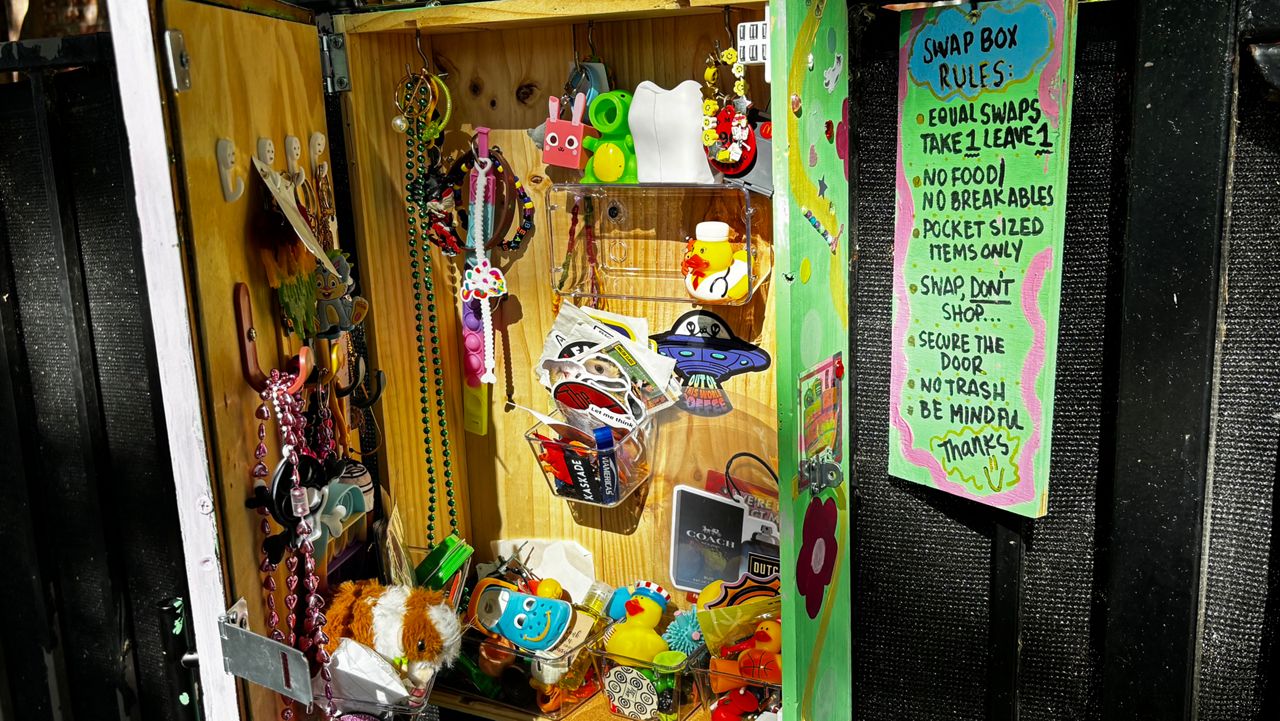
AUSTIN, Texas — Inside a green wooden box mounted to a steel fence, a treasure trove of trinkets awaits. Just a few miles north is another goodie box, this time covered in leopard print and inside a craft studio. Farther east, a simple white trinket box sits mounted on a wooden pole, decorated with stars and a crow saying, “Thanks for visiting!”
These boxes, filled to the brim with stickers, keychains, jewelry, collectibles and more, are known as trinket trade boxes. Austin has seen a sudden surge in these boxes over the last few months, and despite their varying locations, one sentiment ties them all together: trinket trading is a fun way to bring a bit of joy to the community.
“Little things that bring people joy is so important right now, which I think a lot of us can agree with, and I’ve seen all sorts of people use the box so far,” said Anna Arocha, whose trinket box is in The Triangle neighborhood downtown. “Little kids and all the way up to people in their 50s and 60s, I’ve seen stop by.”
Trinket trading operates on a simple system of take something, leave something. People can swap a toy car for a lanyard, a bracelet for a Sonny Angel, or a Pokémon card for a rubber duck.
“There was somebody who was just walking by with their kid in the stroller, and there was a finger puppet inside of the box, and I saw her swap something out and walk away with the little finger puppet,” Arocha said. “And it was just such a cute moment to see a mom and a kid enjoy something like that.”
Arocha put her crafting skills to work and made her green wooden box in just one day using craft wood and a wine crate last month. Amy Elms opted for a small, white junction box to ensure it could withstand harsh Texas weather. Ani’s Day & Night on East Riverside, which has a large outdoor space for picnic tables and food trucks, gave Elms permission to place her trinket box on their property in January.
Ally Chavez used her own property, Create! Studio ATX on West Anderson Lane, for her leopard-print box that opened in March.
“There wasn’t a ton up here in the north area, so we just kind of wanted to put it together and put it up for the studio just as a way to connect with the community in a way that no one has to spend money,” Chavez said.
Since their debuts, all three trinket boxes have garnered thousands of interactions on social media. When Arocha posted about the opening of her box in March, she racked up 100,000 views on TikTok. But with the excited comments came a bit of negative attention, and her cameras caught a thief trying to take all the trinkets. Arocha now locks the box at night.
“If somebody wants to do that, so be it,” Arocha said. “We can start over, and if the joy that it brings outweighs that every time, I think it’s worth doing.”
Arocha, Elms and Chavez’s boxes are now registered on a website called Worldwide Sidewalk Joy, alongside all the others in Austin and across the globe, as trinket trading grows to become a kind of new, modern geocaching.
“Honestly, it’s been I think even better than I expected so far,” Elms said. “I’ve had people… visiting Austin from out of town, and they’re making it a stop during their visit. I’ve also had multiple people reach out to me to ask how they can start their own trinket trade box, too, which I really love.”

AUSTIN (KXAN) — Forbes on Friday released its annual list of ‘New Ivies,’ and the University of Texas at Austin made it. This is not UT’s first time on the list; it was included in 2024 and 2025.
It’s important to note the Forbes designation does not make UT an Ivy League School. Schools currently designated as Ivy League are Brown University, Columbia University, Cornell University, Dartmouth College, Harvard University, Princeton University, the University of Pennsylvania, and Yale University.
Forbes argued its list was created because a growing number of employers have said they are less likely to hire an Ivy League grad today compared to five years ago. The list is curated by surveying over 100 C-Suite and hiring executives, as well as using data from the 2024 National Center for Education Statistics to gauge if a school fulfilled the criteria to be on the list.
One respondent said instead of prestige, employers are looking for graduates who have “complex emotional intelligence, radical adaptability and visionary creativity to orchestrate AI tools rather than compete with them.”
Forbes said colleges had to meet three criteria to be considered, which included:
- Size: Private schools must enroll at least 3,000 students, and public colleges must have at least 4,000 students enrolled.
- Selectivity: All but one private college had an admission rate of less than 15%; public college admission rates were 50% or less.
- Testing Requirements: At least half the entrants must have submitted either the SAT or the ACT scores
Forbes argued testing requirements indicated academic rigor, as a result. Schools such as the University of California and California State schools were not considered.
When it came to UT meeting the requirements for the list, UT had an undergrad enrollment of 44,663 students with a 27% acceptance rate. When it came to test scores, it had a median SAT score of 1390 and a median ACT score of 31.
For a full list of the public and private schools included in the Forbes 2026 New Ivies list, click here.
-

 Nebraska3 minutes ago
Gallery: Huskers Run-Rule No. 12 USC to Take Series
-

 Nevada9 minutes ago
IN RESPONSE: Cortez Masto lands bill would keep the proceeds in Nevada
-
 New Hampshire15 minutes ago
New Hampshire grapples with nuclear waste storage – Valley News
-

 New Jersey21 minutes ago
Nearby shooting interrupts 13-year-old’s birthday party in Paterson; 1 killed, 3 injured
-

 New Mexico27 minutes ago
Calm and warmer conditions move into New Mexico
-

 North Carolina33 minutes ago
Memorial service held for former Miss North Carolina Carrie Everett
-
North Dakota39 minutes ago
Richard D. Langowski Obituary April 16, 2026 – Tollefson Funeral Home
-

 Ohio45 minutes ago
Three Buckeyes Who Proved They Belong at Ohio State Spring Game

