Austin, TX
New Speakers Bureau Offers Access to Vast Community of UT Experts


AUSTIN, Texas — The University of Texas at Austin has launched its first-ever University-wide speakers bureau, a new program that makes it easier for organizations to learn about and hire experts and leaders from across the UT community as their event and conference speakers.
Powered by Texas Executive Education, the UT Speakers Bureau will provide exclusive access to perspectives from esteemed scholars, researchers, administrative leaders, coaches and other professionals. Organizations, professional conferences and anyone else looking for keynote speakers and subject matter experts will have only one entry point to learn about, select and hire the perfect speakers for their needs.
“At Texas Executive Education, we are often on the front lines of engagement with different companies looking to partner with the University,” said Gaylen Paulson, associate dean in the McCombs School of Business and executive director of Texas Executive Education. “One of the things we sometimes hear is how challenging it can be to navigate the University and find the right expert speakers for their events — or to know who is even available or interested in those opportunities. The new UT Speakers Bureau was designed specifically to address that challenge, and I am thrilled to provide a streamlined platform for this engagement while also shining a light on the experts and leaders in our colleges, schools and units.”
With an internationally renowned community of faculty experts, coaching legends, staff leaders, alumni executives and more, the University has provided prominent keynote speakers and other event participants to local and national organizations for decades. As Austin continues to draw more companies and host more national and international conferences, the demand for these local experts is higher than ever.
“The UT Speakers Bureau comes at a perfect time for Austin,” said Mary Kay Hackley, vice president for strategic alliances at Visit Austin and executive director of the Visit Austin Foundation. “Austin has become recognized as one of the top destinations in the U.S. for professional events and meetings, and our ability to leverage the incredible base of talent at The University of Texas makes us an even more competitive option. We’re thrilled to be working with UT to help take meetings to the next level.”
By centralizing the entry point for outside organizations, the UT Speakers Bureau will streamline the process of identifying and accessing talent from the vast roster of speakers and thought leaders across campus. Organizations can now enjoy customized speaking engagements, complete with experienced speakers, interactive presentations, seamless experiences and support in planning and logistics for corporate events, seminars or any other occasion.
As part of UT’s 10-year strategic plan, Change Starts Here, the University seeks to create stronger connections with community and industry partners and increase access for external organizations to engage with the world-class talent of the UT community. With the UT Speakers Bureau, the University established a one-stop access point to showcase more of the University’s world-class expertise across a wide range of fields and industries.
Please visit the UT Speakers Bureau website to learn more.



AUSTIN, Texas — With heavy rain expected across parts of Central Texas this week and flooding top of mind, the city of Austin is proposing to put more money toward flood mitigation improvements in next year’s budget.
The proposal would invest in new flood infrastructure, add staff, and help move flood mitigation projects forward, according to city leaders. Austin City Councilmember Ryan Alter said the investments are aimed at keeping the city prepared for future flooding.
Residents who live near waterways say they have seen how quickly conditions can change. David Haderspeck, who lives near Shoal Creek, said the creek “fills up pretty fast” and “gets a lot higher than you’d expect.” He said he has watched the water rise dramatically after rain.
“I’ve seen it come up probably 10 to 15 feet to the ordinary high-water mark,” he said.
This week, parts of Central Texas, including the Hill Country, are expected to get heavy downpours. While Austin is not expecting the same impacts as parts of the Hill Country, leaders said the city is using this year’s budget planning to continue investing in flood safety.
Alter said the city has the expertise to address flooding risks but needs to follow through on projects.
ALSO| Central Texas urged to prepare as heavy rainfall sits in forecast over next two days
“We have the experts. We just have to put the plans into practice, and that’s what we’re doing in this budget,” he said.
Under the budget proposal, the city would provide about $134.5 million for the Drainage Utility Fund, which helps pay for flood mitigation, drainage infrastructure and watershed protection efforts.
Alter said the proposal would shift more of the funding balance toward building new infrastructure.
“What we’re going to do is shift that balance a little bit more to building new infrastructure so that when we do have large flooding events, we’ve got that infrastructure in place to keep people safe,” he said.
The proposal also adds staff and invests in both new and existing flood mitigation projects across the city.
Asked whether the proposed investments would be enough moving forward, Alter said, “I do…I think we’re doing the right thing and just making sure that our residents have the infrastructure to stay safe.”
Alter said heavy rain cannot be prevented, but the city’s goal is to have infrastructure in place to help keep people safe when it happens.

FILE – LinkedIn logos are displayed on an iPhone and computer screen. (Photo by Carl Court/Getty Images)
AUSTIN, Texas – The Texas Attorney General’s office has opened an investigation into LinkedIn over allegations that the professional networking platform misleads consumers with advertising and profiting from misleading or fake job listings, otherwise known as “ghost jobs.”
LinkedIn investigation

In this photo illustration a Linkedin logo seen displayed on a mobile phone. (Photo Illustration by Stanislav Kogiku/SOPA Images/LightRocket via Getty Images)
What we know:
Texas announced on Tuesday it has issued a Civil Investigative Demand (CID) seeking documents, data and internal communications related to LinkedIn’s advertising, marketing, job listing verification practices and its Premium subscription services.
The investigation centers on whether LinkedIn violated Texas’ consumer protection laws by promoting paid subscription services while allegedly failing to disclose that some job listings on the platform may not actually be representative of hiring opportunities.
What is a ‘ghost job’?
An image of a woman holding a cell phone in front of a LinkedIn logo displayed on a computer screen. On Tuesday, January 12, 2021, in Edmonton, Alberta, Canada. (Photo by Artur Widak/NurPhoto via Getty Images)
Dig deeper:
LinkedIn is owned by Microsoft and the world’s largest professional networking platform, with more than 1 billion registered users worldwide.
A “ghost job” generally refers to a position advertised online that either is no longer available or that an employer has no immediate intention of filling. The attorney general’s office cited independent studies estimating that ghost jobs account for between one-fifth and one-third of online job postings.
Texas AG targets Premium Subscription Fees
Photographer: Mark Felix/Bloomberg via Getty Images
What they’re saying:
According to the office of the attorney general, LinkedIn does not independently verify the hiring status of most job listings on its platform. Ken Paxton’s office alleges that the company’s marketing for its Premium subscription services does not disclose that a significant number of postings could be inactive, unfilled or not reflect genuine employment opportunity.
“I will use every resource available to my office to help job-seeking Texans find and secure real employment opportunities,” Paxton said in a statement. “LinkedIn has a duty to provide the services it advertises and ensure that consumers paying for Premium subscriptions are receiving access to legitimate job postings.”
Texas officials said LinkedIn’s Premium Career and Premium Business subscriptions cost about $39.99 and $69.99 per month, respectively, and are marketed to jobseekers looking to improve their employment prospects.
What’s next:
The investigation does not include any formal allegations of wrongdoing, and no lawsuit has been filed.
The Source: Information in this article was provided by the Texas Attorney General’s Office.

Director Kristin Tièche says the seed for her new documentary, The Invisible Mammal, was planted back in 1999, when she was a film student in upstate New York.
“I was sitting at this pub on campus, and I looked up and the sky was just filled with bats,” said Tieche, a native Californian who had never seen a bat before.
“I just thought it was the coolest thing ever,” she said.
These days, such a sight is all but impossible to behold in New York and many other states. A deadly disease called white-nose syndrome is to blame.
The Invisible Mammal follows a team of researchers as they set out to protect bats from the disease, which has emptied entire caves and roosting spots once teaming with life. It’s being screened Tuesday night at AFS Cinema and will be followed by a Q&A.
White-nose syndrome is caused by an invasive fungus found in Europe, likely brought to America on the clothes of a visitor who came to see American bats up close. It kills by starving hibernating bats.
The disease causes bats to “wake up too often during winter and they burn up their fat reserves and die before spring,” said Winifred Frick, chief scientist at Bat Conservation International.
First detected in New York state in 2006, the disease steadily spread across the continent, inflicting catastrophic damage on bat colonies in the Northeast, mid-Atlantic and Midwest. In some parts of the U.S. and Canada, white-nose has wiped out over 90% of bat populations. While the disease exists in Texas, it has not proved as destructive so far.
When it appeared in California in 2019, Tièche thought back to that night decades before when she saw her first bat flight.
“I knew at that moment that it was time to launch this film project,” she said.
The result is a nonnarrated documentary that follows researchers and conservationists across the country, as they protect bats and study ways to battle white-nose syndrome.
Its primary focus is Frick and the team of scientists behind the Fat Bat Project, an initiative started in Michigan’s Upper Peninsula that aims to keep bats well fed around their winter hibernation.
“The idea was could we help bats get fat in the fall and also help them recover their body condition in the spring?” Frick said. “Because we had research that showed that the bats that were surviving tended to be fatter at the start of hibernation.”
Tièche said it was not until she arrived in Michigan to shoot that she realized the team of scientists working on the Fat Bat Project was comprised entirely of women.
“I knew at that point that I also was going to tell the story of women in science,” she said.
White-nose exists in Texas, but the colonies of Mexican free-tailed bats so celebrated in the Hill Country are at lower risk of death. That’s largely because they do not hibernate in the same way some other species do, and insect meals are available in Central Texas deeper into the winter months.
Still, Austin’s Congress Avenue bat bridge makes an appearance in the documentary. The film also opens and closes with immersive scenes — filmed by Austin wildlife cinematographer Skip Hobbie — of bats flying out of the Bracken Cave Preserve, home to the world’s largest bat colony.
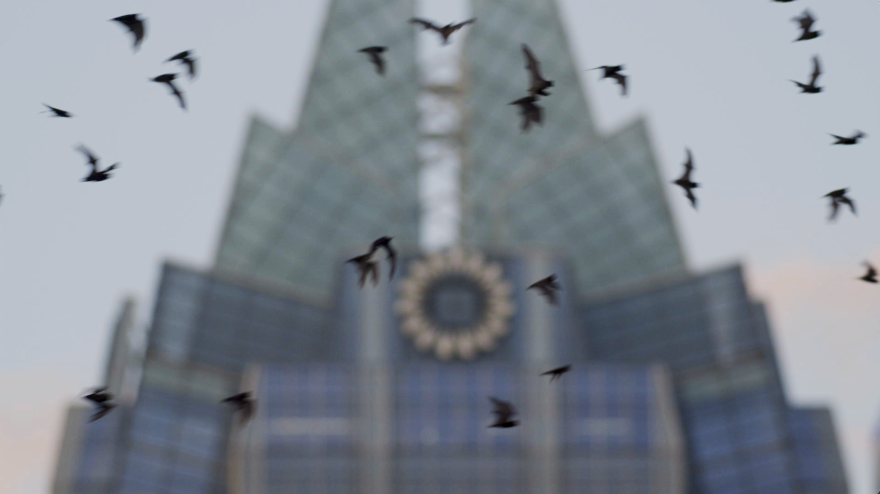
Courtesy of Kristin Tièchei
“I told him [Hobbie] I was hoping for people to fall in love with bats when they watch,” Tièche said. “You protect what you love.”
White-nose syndrome continues to decimate bats as it spreads, but there’s reason for cautious optimism. Some species that were nearly wiped out in the Northeastern states are beginning to show modest recovery, Frick said, though it is not fully clear why.
She said the Fat Bat Project, which has expanded across the Northeast and into Texas, is also showing promise as one tool of many that could stave off total population collapse in some areas.
The Invisible Mammal is screening at 6:30 p.m., Tuesday, July 14, at AFS Cinema. It will be followed by a Q&A with filmmaker Kristin Tièche, producer Matthew Podolsky, cinematographer Skip Hobbie and Winifred Frick of Bat Conservation International.
-

 Miami, FL4 minutes ago
Tokyo-style Neapolitan pizza is coming to Miami, led by legendary pizzaiolo chef Bun
-

 Boston, MA10 minutes ago
SEE THE GOOD: Roxbury center reminds young adults ‘You got this’ – Boston News, Weather, Sports | WHDH 7News
-
Denver, CO16 minutes ago
Five Points affordable housing building honors Dr. Justina Ford | Rocky Mountain PBS
-

 Seattle, WA22 minutes ago
Seattle weather: Hot and sunny day Wednesday, highs in the 80s
-

 San Diego, CA28 minutes ago
Gibraltar ushers in a new era as British territory’s border fence with Spain is removed
-

 Milwaukee, WI34 minutes ago
City funding awarded for redevelopment at 2618 N. Milwaukee
-

 Atlanta, GA40 minutes ago
Atlanta hosts its final FIFA World Cup match as tournament’s impact continues to grow
-

 Minneapolis, MN46 minutes ago
Walking All the Streets of Western Northeast Park


