Arkansas
Takeaways from No. 20 Arkansas' win over Pacific


The No. 20 Arkansas Razorbacks (3-1, 0-0 SEC) took care of business down the stretch in a 91-72 win over the Pacific Tigers (3-3, 0-0 WCC) on Monday night.
The final score doesn’t necessarily indicate how close the game was. With just under 13 minutes to go in the game, the Razorbacks were in the middle of a dogfight and only up 59-57 after Pacific had scored five straight points.
Arkansas’ defense was able to suffocate the Tigers down the stretch though, as Pacific only made two of its last 16 field goals in the game and the Hogs were able to pull away with the win.
Here’s some of HawgBeat’s takeaways from what ended up being a much tighter contest than expected on Monday night…



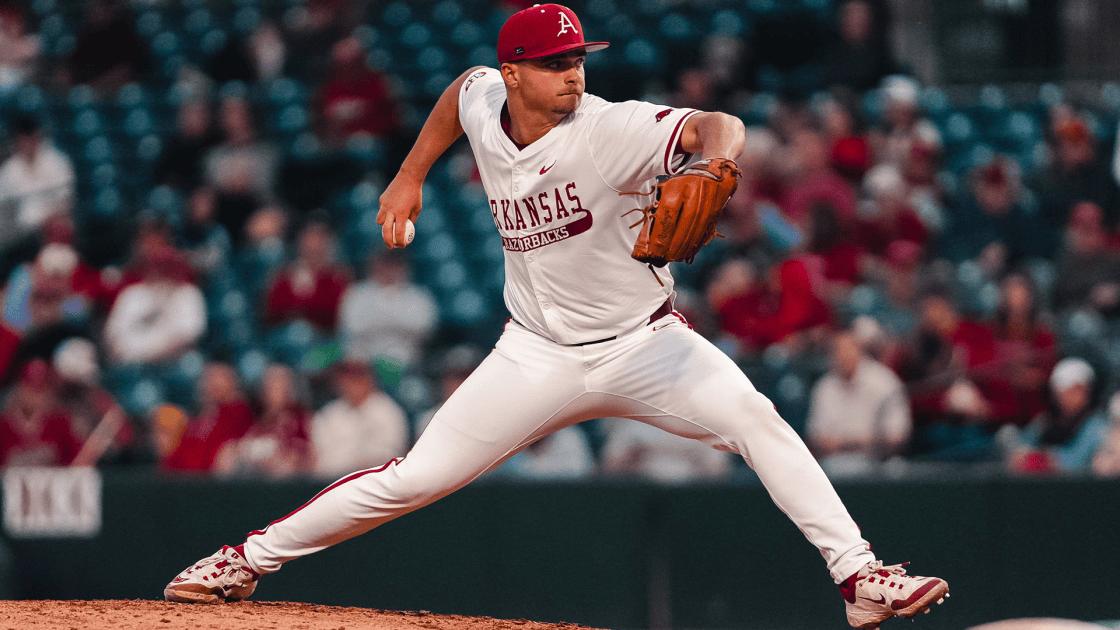
FAYETTEVILLE, Ark. – Six Razorback pitchers combined to shut out in-state opponent Little Rock (19-14) and lead No. 22 Arkansas (21-13) to a 7-0 win Tuesday night at Baum-Walker Stadium. With the triumph, the Hogs improved to 7-2 in midweek games this season and 31-7 overall against in-state foes, including an 8-2 mark against Little Rock, since 1947.
Making his first start of the season on the mound, Tate McGuire opened Tuesday night’s contest with three shutout frames for Arkansas. The right-hander struck out one while working around two hits and a walk before turning the game over to the bullpen, which combined for six scoreless innings with six strikeouts to secure the Razorbacks’ midweek win.
Parker Coil (1.0 IP, 2 SO), Steele Eaves (2.0 IP), Gabe Gaeckle (1.0 IP, 1 SO), Cooper Dossett (1.0 IP, 1 SO) and Ethan McElvain (1.0 IP, 2 SO) worked together in relief of McGuire to lock down Arkansas’ fourth shutout of the campaign.
The Trojans held the Razorback offense both scoreless and hitless until the bottom of the fifth. After TJ Pompey and Reese Robinett reached safely to lead off the inning and advanced on a double steal, Ryder Helfrick stepped up to the plate with one out and delivered the go-ahead sacrifice fly to left field, giving Arkansas its first run of the night.
A five-spot in the bottom half of the sixth inning broke the game open for the Hogs. Arkansas loaded the bases with no outs for Robinett, who ripped a bases-clearing double down the right field line to extend the advantage to 4-0.
Later in the inning, Helfrick collected his second RBI of the game with a two-out double to right center and advanced to third on a fielding error in the outfield. The Razorbacks’ star catcher would score on a wild pitch to grow the lead to six.
Zack Stewart tacked on the seventh and final run in the seventh inning, cranking his sixth home run of the season and 50th of his career to left center to give Arkansas a commanding seven-run cushion. The Hogs finished with just four hits, including a pair of doubles and a home run, but capitalized on seven walks, two hit batsmen and three stolen bases.
Up next, the Razorbacks will hit the road for their second consecutive SEC weekend series away from the friendly confines of Baum-Walker Stadium. First pitch in the series opener between No. 22 Arkansas and No. 8 Alabama is scheduled for 6 p.m. Friday, April 10, on SEC Network+ from inside Sewell–Thomas Stadium in Tuscaloosa, Ala.
For complete coverage of Arkansas baseball, follow the Hogs on Twitter (@RazorbackBSB), Instagram (@RazorbackBSB) and Facebook (Arkansas Razorback Baseball).

LITTLE ROCK, Ark. (KATV) — Arkansas law enforcement agencies are hosting their 16th-annual Drug Take Back Day this month.
The event is designed so that Arkansans can safely and anonymously dispose of any expired, unused or unwanted medications. Officials say they want to prevent opioid misuse, reduce accidental poisonings, protect waterways from contamination and keep communities safe.
Its set to take place on Saturday, April 25.
“Arkansas Drug Take Back Day continues to bring communities together in the fight against substance misuse, and we’re proud to play such a vital part in it,” said Kirk Lane, director of the Arkansas Opioid Recovery Partnership (ARORP). “We invite Arkansans to take a few minutes to clean out their medicine cabinets, drop off unneeded prescriptions and protect their families and neighbors.”
Arkansans destroyed 26,500 pounds of medication during the fall 2025 Drug Take Back Day. Since 2010, over 342 tons have been destroyed.
BE THE FIRST TO COMMENT
There are more than 300 drop boxes that Arkansans can use year-round. You can find your nearest drop box by CLICKING HERE.

FAYETTEVILLE, Ark. — With the transfer portal reshaping rosters overnight and elite freshmen arriving every summer, projecting the next college basketball season has become an exercise in controlled chaos.
Still, a handful of programs have positioned themselves early as national title contenders through roster continuity, program consistency and coaching stability.
Arkansas will once again be in the mix, but its true preseason forecast will come once the portal is mostly wrapped up. Coach John Calipari knows what type of player he needs to add for his team to advance past the NCAA Tournament Sweet 16 and probably won’t sleep a whole lot until he signs at least one major contributor in the paint.
No. 1 seed Michigan had a stellar run in its second season under coach Dusty May, who competes for a national championship against No. 2 seed UConn Monday night. He goes up against two-time championship coach Dan Hurley, who is looking to join elite company by winning his third trophy with the Huskies.
Which teams are best equipped already for next season? Here’s an early look at who can make a run in 2026-27.
1. Michigan
The Wolverines absolutely make sense regardless of if they win a national title Monday night. May added a commitment from 5-star guard Brandon McCoy Saturday who projects to be a lead guard at the next level.
Key big man Yaxel Lendeborg will be a huge loss after being a critical piece to Michigan’s championship game run. Power forward Morez Johnson should return after averaging over 13 points and seven rebounds per game.
Another likely returnee is Trey McKenney, who played well as a freshman averaging 11 points and 44% shooting in the month of March.
1B. UConn
Whether Hurley’s bid for a third title falls short, his brilliant coaching in the NCAA Tournament is worth keeping the Huskies near the top of all college basketball rankings.
Veterans such as Alex Karaban and Tarris Reed are seeing their eligibility expire while freshman Braylon Mullins could opt to enter the NBA Draft.
Veteran guard Silas Demary has been a nice addition from Georgia out of the portal this season and will likely return as the Huskies’ starting point guard.
3. Duke
The Blue Devils are set to lose the Boozer twins, but have signed capable replacements in true freshmen Cameron Williams and Deron Rippey, Jr.
Coach Jon Scheyer’s group will continue to run the ACC until anyone else decides to be up for the challenge. If he can find a way to keep Patrick Ngongba around for next season as his key big man, then there’s no reason to count out Duke as national title favorites once again.
4. Michigan State
No one will ever doubt coach Tom Izzo’s ability to assemble a championship contender and he did just that with Coen Carr, Jeremy Fears and company this season.
With a top high school recruiting class and a couple of key portal additions on the perimeter, the Spartans will be Big Ten title contenders and earn a Top 4 NCAA Tournament seed.
5. Illinois
Coach Brad Underwood has made the Fightin’ Illini a raging success and nearly led his team to the promised land this season.
He discovered freshman wing Keaton Wagler before anyone else, and became a household name and potential lottery pick after arriving to school as aTop 150 prospect.
Lightning might not strike twice next year, but he’ll probably have another solid team built for a deep NCAA Tournament run. Sharpshooter Andrej Stojakovic and forward David Mirkovic are both expected to return after playing key roles in Illinois’ first Final Four run in two decades.
6. Arizona
The Wildcats were no match for Michigan in the Final Four and are likely going to lose key freshmen Koa Peat and Brayden Burries to the NBA Draft. Keeping veteran big man Mo Krivas and key wing Ivan Kharchenkov in the rotation is key.
Adding McDonald’s All-American MVP Caleb Holt won’t hurt either as the next great freshman for the Wildcats.
7. Arkansas
Coach John Calipari knows his biggest assignment will be adding a big man or two to round out his rotation. He has a three 5-star freshmen in Jordan Smith, Jr. (No. 2 ranked prospect, JJ Andrews and Abdou Toure coming in with potential key returnee Billy Richmond to potentially lockdown the perimeter.
Arkansas fans are hungry to see their team get back to the Final Four and have been inching closer each of the previous five seasons.
8. Purdue
The Boilermakers are set to lose All-American guard Braden Smith, Fletcher Loyer and Trey Kaufman-Renn which will be hard to come back from for any team.
However, Matt Painter continues to reload with guys who often fly under the radar or lesser known on the recruiting trail out of high school. His next team may not be as talented, or veteran laden but should be fixtures in the Big Ten no matter what the offseason brings.
9. St. John’s
The Red Storm will find it tough to replace versatile big man Zury Ejifor, but if anyone can do so it’s hall of fame coach Rick Pitino. His team has been close to breaking into national title contention over the previous two seasons.
Pitino’s combination of Ian Jackson, Dylan Darling and Ruben Prey can give St. John’s a boost next season.
10. Alabama
Nate Oats has the Crimson Tide at a level never before seen in Tuscaloosa with at least a Sweet 16 or better finish in each of the previous four seasons.
Star guard Labaron Philon is probably headed to the league as a mid-first round prospect which leaves a gaping hole in Alabama’s rotation for next season.
Top 20 freshman guard Qadyden Samuels is potentially a solid replacement with a complete offensive skillset as a three-level scorer. If his length translates well to college, he can be an exceptional perimeter defender.
Oats will need to find a way to keep key big men such as Amari Allen and Aiden Sherrell around or pick up a couple out of the transfer portal to stay near the top of the SEC.
11. Iowa State
The Cyclones were on the verge of a breakthrough before falling short in the Sweet 16. Losing All-American Joshua Jefferson early in the tournament sidelined any hopes of coach T.J. Otzelberger leading his team to its first Final Four since 1944.
Iowa State will probably make a strong run in the portal to replace other key contributors. But one thing is sure that this program has staying power on the national scene.
12. Kansas
Each passing year it seems that the biggest question is whether or not coach Bill Self will return for another year.
He is, at least this year, but even with his exceptional recruiting skills and a deep portal budget, it seems like a slight nosedive has taken place since winning the national title in 2022.
Star freshman Darryn Peterson’s one-and-done stay in Lawrence certainly didn’t live up to the hype. Big man Flory Bidunga is currently evaluating his options, which shouldn’t give anyone a reason to rank the Jayhawks higher.
13. Iowa Hawkeyes
14. Gonzaga Bulldogs
15. Florida Gators
16. North Carolina Tar Heels
17. Louisville Cardinals
18. Wisconsin Badgers
19. Nebraska Cornhuskers
20. Houston Cougars
21. Providence Friars
22. St. Louis Billekins
23. Texas Longhorns
24. Auburn Tigers
25. LSU Tigers
HOGS FEED:

Another Minnesota city moves toward displaying old state flag

News and Events – Morgan Luebbering earns teaching award

Montana Woman Becomes First to Orbit the Moon – Livingston Today

Nebraska Humane Society asking for help after abandoned dog found severely starved in Omaha

High-profile Las Vegas attorney tapped to join Nevada Gaming Commission

Florida High School Football Rankings: Top 25 teams – Oct. 21

How old is Bo Nix? What to know about Oregon quarterback ahead of 2024 NFL Draft

Cleary's 21 help Le Moyne down Central Connecticut State 69-64 in OT

99th annual Pony Swim held in Virginia

Indiana Members Credit Union announced as new anchor tenant at Bottleworks District

AOC doubles down on call for Trump’s ouster even after ceasefire announcement

EU made ‘no diplomatic effort’ to end Iran war, says MEP Botenga

U.S. and Iran agree to 2-week ceasefire

Democrat swing candidate called Biden’s border handling ‘a huge misstep’ after backing his approach as mayor

‘Policy of abuse’: Women march in Cuba against US energy blockade
-

 Atlanta, GA3 days ago
1 teenage girl killed, another injured in shooting at Piedmont Park, police say
-

 Movie Reviews6 days ago
Vaazha 2 first half review: Hashir anchors a lively, chaos-filled teen tale
-

 Culture1 week ago
Do You Know Where These Famous Authors Are Buried?
-

 Atlanta, GA1 week ago
Fetishist ‘No Kings’ protester in mask drags ‘Trump’ and ‘JD Vance’ behind her wheelchair
-
 Entertainment6 days ago
Inside Ye’s first comeback show at SoFi Stadium
-
 Milwaukee, WI2 days ago
Potawatomi Casino Hotel evacuated after fire breaks out in rooftop HVAC system
-

 Pennsylvania2 days ago
Parents charged after toddler injured by wolf at Pennsylvania zoo
-

 Georgia23 hours ago
Georgia House Special Runoff Election 2026 Live Results