Arkansas
Casmir Chavis Inks with Razorbacks

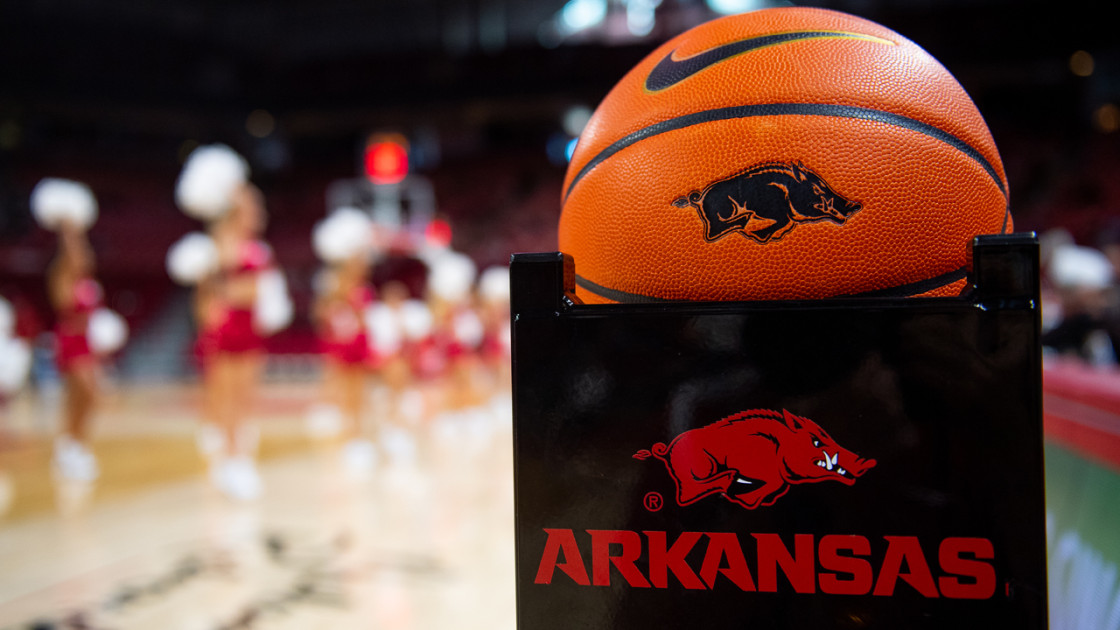
FAYETTEVILLE – Razorback head coach John Calipari announced that guard Casmir Chavis, the No. 4 overall prospect in Minnesota for the Class of 2024, has signed with the Razorback basketball program.
Chavis originally signed with the Washington Huskies last fall but was released from his National Letter of Intent. His name is pronounced CASH-mere CHAY-vis
Casmir Chavis
6-2, 180, G, Fr.
Minneapolis, Minn. / Park Center Senior HS
X – @CasmirChavis11 • Instagram @jiggy.cash11
On3 3 star 133 national 19 PG 4 Minn.
On3 Composite 3 star 172 national 27 PG 6 Minn.
247 Composite 3 star 177 national 22 CG 4 Minn.
247 3 star — national 22 CG 4 Minn.
ESPN 3 star — national 57 PG 7 Minn.
High School:
Rated a 3-star prospect and the fourth-best prospect from Minnesota … On3 ranks him the #19 point guard in the country while 247 has him as the #22 combo guard in the country … Was 1 of 5 finalists for the Minnesota Mr. Basketball … Named PrepHoops.com AAAA Player of the Year, AAAA first team All-State and overall Senior All-State team … Tabbed first team All-Metro by the Star Tribune for 2023-24 … Averaged 23.5 points, 6.9 rebounds, 6.4 assist and 2.5 steals as a senior … As a junior, named to the Star Tribune second team All-Metro team … Won a state championship as a sophomore and is a three-time conference champion … Also played wide receiver on the Park Center football team.
For more information on Arkansas Men’s Basketball, follow @RazorbackMBB on X.



Arkansas
Six charged with manslaughter after 2025 death of resident at Bradley County development center | Arkansas Democrat Gazette

Brett Barrouquere
Brett Barrouquere is a staff writer with the Arkansas Democrat-Gazette. A reporter and editor for more than 30 years, he’s worked a little bit of everywhere, mainly in the South. His most recent stop before Arkansas was in Baltimore, Maryland, as a night and breaking news editor. He’s a New Orleans native and has two daughters.

After a compelling two rounds, March Madness 2026 enters the Sweet 16 stage, and those looking to trade on college basketball games can use the Kalshi promo code NYPMAX.
The Kalshi promo code NYPMAX unlocks a trade $10, get $10 bonus offer geared toward any of the upcoming NCAA Tournament games, including No. 4 Arkansas taking on No. 1 Arizona this Thursday.
At the time of this writing, the Wildcats currently have a 76 percent chance against the Razorbacks in this contest, per Kalshi.
How to use the Kalshi referral code
Once you sign up and trade $10 on any March Madness market, an instant $10 is sent back to your account that you can use to make more predictions.
Just verify your account information and complete at least $10 in trades to qualify for the $10 bonus.
Kalshi is live in Alabama, Alaska, Arkansas, California, Colorado, Connecticut, Delaware, Florida, Georgia, Hawaii, Idaho, Indiana, Iowa, Kansas, Kentucky, Louisiana, Maine, Minnesota, Mississippi, Missouri, Nebraska, New Hampshire, New Mexico, New York, North Carolina, Nevada, North Dakota, Oklahoma, Oregon, Pennsylvania, Rhode Island, South Carolina, South Dakota, Tennessee, Texas, Utah, Vermont, Virginia, Washington, Washington DC, West Virginia, Wisconsin and Wyoming.
What our Post expert thinks about the Arkansas vs. Arizona
In a matchup of two potent offenses, can the Razorbacks SEC tournament title momentum propel them to a big-time upset of the Wildcats?
John Calipari and freshman standout Darius Acuff Jr. face their biggest challenge yet, opposite this juggernaut roster of Arizona. Tommy Lloyd’s starting five includes Big 12 Player of the Year Jaden Bradley, as well as two dynamic first-year players in Brayden Burries and Koa Peat.
If this game comes down to critical possessions in crunch time, Arkansas has its closer in Acuff Jr., but the Wildcats’ outstanding net margin of victory could make punching their ticket to the Elite Eight a lot easier.
Must be 18 years or older and have a legal, U.S. residential address within the applicable state, D.C., or U.S. territories. Not available in AZ, IL, MA, MD, MI, MT, NJ, and OH.
Why Trust New York Post Betting
Mike Turay is a sports journalist and editor who closely follows the NBA, NFL, college sports and UFC. He has demonstrated expertise in both NBA and NFL player prop bets for nearly three years. Mike is also highly knowledgeable about the sportsbook offer landscape, frequently trying and reviewing the latest apps and sites.
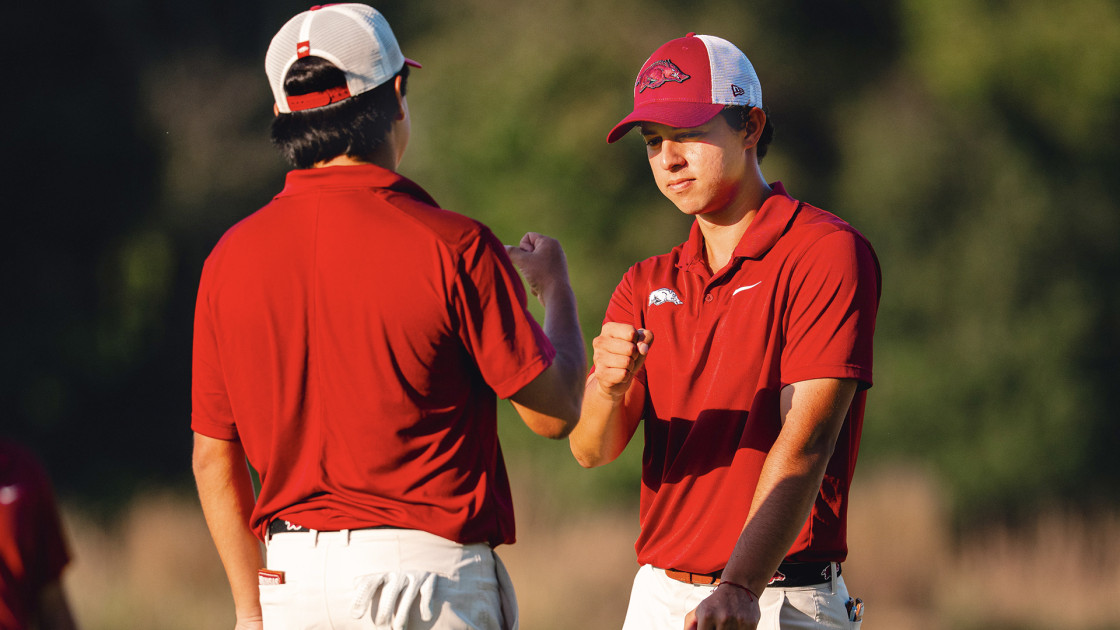
PALM CITY, Fla. – #7 Arkansas sits in fifth place after two rounds Monday in the stacked 16-team Valspar Collegiate Invitational with a 36-hole, 18-under-par score of 550 (270-280), played at the Floridian National Golf Club (par 71).
Top-ranked Auburn leads the way at 538 (-30), followed by #10 Texas Tech (-28), #6 Texas (-20), #30 Florida State (-19) and Arkansas.
Of the 10 rounds played by the Razorbacks on Monday, eight were under par.
Erich Fortlage and Gerardo Gomez are tied for 10th at -6 (136).
Fortlage shot a career-best, bogey-free 65 (-6) in the morning sessions, posting three birdies on each nine, and he was in second place. Fortlage had an even-par round in the afternoon session with three birdies, a bogey and a double.
Gomez had four birdies and a bogey for an opening-round 67, matching his best total for 18 holes for the third time this season. In round two, Gomez turned in a 3-under 69 and moved up two spots into a nine-way tie for 10th.
John Daly II offset a double bogey on the par-5 7th with an eagle on the par-5 15th to finish with a 68 after 18 holes. In round two, Daly was 1-under and is tied for 25th (138 / -4).
Niilo Maki-Petaja carded two rounds of 70 and is tied for 38th (140) while Thomas Curry is tied for 54th (143) with rounds of 70-73.
The Valspar concludes with 18 holes on Tuesday.
VALSPAR COLLEGIATE INVITATIONAL
Host: Houston
Floridian National Golf Club
Palm City, Fla.
Par: 71 • 7,088 yards
Format: 5 count 4 ||36 holes Monday / 18 Holes Tuesday
RESULTS THRU RD2:
1 #1 Auburn 264-274=538 / -30
2 #10 Texas Tech 273-267=540 / -28
3 #6 Texas 268-280=548 / -20
4 #30 Florida State 269-280=550 / -19
5 #7 Arkansas 270-280=550 / -18
6 Houston 271-282=553 / -15
7 #23 Duke 280-274=554 / -14
T8 #14 Oklahoma 274-282=556 / -12
T8 #32 Texas A&M 277-279=556 / -12
10 #24 Southern Cal 277-281=558 / -10
T11 #13 Pepperdine 279-281=560 / -8
T11 #29 Wake Forest 286-274=560 / -8
13 #8 Arizona State 278-283=561 / -7
14 #17 North Carolina 282-280=562 / -6
15 Rice 282-291=571 / +5
16 Augusta 286-294=580 / +12
For more information on Arkansas Men’s Golf, X and Instagram.

Video: LaGuardia Crash Survivors Recount Ordeal

Michigan ‘adventure seekers’ take flight at new experiential venues

Barricaded suspect in standoff with police in San Francisco’s Tenderloin neighborhood

Jack Hughes scores twice as Devils beat Stars 6-4, end Dallas streak with four-goal first period

Tommy Paul’s Fiancée Paige Lorenze Stuns in Pink Crop Top at Miami Open

Florida High School Football Rankings: Top 25 teams – Oct. 21

How old is Bo Nix? What to know about Oregon quarterback ahead of 2024 NFL Draft

Cleary's 21 help Le Moyne down Central Connecticut State 69-64 in OT

99th annual Pony Swim held in Virginia

Indiana Members Credit Union announced as new anchor tenant at Bottleworks District

Iran War: Pentagon set to send thousands of elite 82nd Airborne troops to region | BBC News

Video: Passengers Wait in Long Security Lines at LaGuardia After Deadly Crash

King Charles to address Congress in historic first state visit to Washington

Iran names successor to security chief killed in US-Israeli attack

See How the LaGuardia Plane Crash Unfolded
-

 Detroit, MI6 days ago
Drummer Brian Pastoria, longtime Detroit music advocate, dies at 68
-

 Georgia1 week ago
How ICE plans for a detention warehouse pushed a Georgia town to fight back | CNN Politics
-

 Movie Reviews6 days ago
‘Youth’ Twitter review: Ken Karunaas impresses audiences; Suraj Venjaramoodu adds charm; music wins praise | – The Times of India
-

 Alaska1 week ago
Police looking for man considered ‘armed and dangerous’
-

 Education1 week ago
Video: Turning Point USA Clubs Expand to High Schools Across America
-
 Science1 week ago
Long COVID leaves thousands of L.A. county residents sick, broke and ignored
-

 Sports3 days ago
IOC addresses execution of 19-year-old Iranian wrestler Saleh Mohammadi
-
 Science1 week ago
Industrial chemicals have reached the middle of the oceans, new study shows