Science
Video: NASA Astronauts Say They Would Fly on Boeing’s Starliner Again


new video loaded: NASA Astronauts Say They Would Fly on Boeing’s Starliner Again
transcript
transcript
NASA Astronauts Say They Would Fly on Boeing’s Starliner Again
Butch Wilmore and Suni Williams were brought back to Earth in a SpaceX capsule after problems with Boeing’s Starliner delayed their return by about nine months.
-
“We’re going to rectify all issues that we encountered. We’re going to fix them. We’re going to make it work. Boeing’s completely committed. NASA is completely committed. And with that, I’d get on in a heartbeat.” “Yeah, I would agree. The spacecraft is really capable. There were a couple of things that need to be fixed, like Butch mentioned, and folks are actively working on that. But it is a great spacecraft and it has a lot of capability that other spacecraft don’t have. And to see that thing successful and to be part of that program is an honor.” “Blame, that’s a term — I don’t like that term, but certainly there’s responsibility throughout all the programs. And certainly you can start with me. Responsibility with Boeing? Yes. Responsibility with NASA? Yes. All the way up and down the chain, we all are responsible. We all own this.”
Recent episodes in Science



Residents were supposed to get a respite from the ankle-nipping mosquitoes that fueled a recent surge in dengue fever in Los Angeles County.
Typically, the invasive mosquitoes — called Aedes aegypti — essentially disappear from winter until early May in the region.
Instead, complaints to local agencies tasked with controlling the pests spiked recently.
-
Share via
“We have not seen them go away altogether like they have in previous years,” said Susanne Kluh, general manager for the Greater Los Angeles County Vector Control District.
Their unusual presence adds to the urgency of work going on in a 40-foot shipping container tucked away in Pacoima. It’s about to transform into a bustling nursery for tens of thousands of mosquitoes.
This May, the district is set for the third year in a row to release legions of sterilized male mosquitoes — which don’t bite — into parts of Sunland-Tujunga.
The last two years were promising, with the female population in two treated neighborhoods plunging by an average of more than 80%.
Yet business owners have signaled they’re not willing to pay to expand it.
That’s thrown uncertainty into officials’ goal of eventually bringing the approach to their whole service area, spanning 36 cities and unincorporated communities.

Steve Vetrone, assistant general manager at the Greater L.A. district.
(Ronaldo Bolanos / Los Angeles Times)
“Unfortunately, that’s going to be a rather expensive endeavor,” said Steve Vetrone, an assistant general manager for the district. “I can tell you right now that’s not something that we can do with our current operating budget.”
A need, an ask and a disappointing answer
Aedes aegypti are a new-ish local fixture. Native to Africa, the black-and-white striped mosquitoes were first detected in California in 2013 and landed in L.A. County the following year.
“Despite our best efforts, they’ve been able to just outpace us, and they’re now in every city and community within our district,” and all of Southern California, Vetrone said. In fact, the low-flying, day-biting mosquitoes are present in nearly half of California’s counties, including Shasta in the far north.
Desperate to find a solution, many are trying the so-called sterile insect technique — including vector control districts serving Orange and San Bernardino counties, as well as the San Gabriel Valley — and “we kind of all hope that this is going to be our silver bullet,” Kluh said.
The idea is fairly simple: unleash sterile males so that they far outnumber wild ones — say, 10 to 1 or even 100 to 1. The goal is for the altered males to mate with females, producing eggs that don’t hatch.
Kluh’s district uses X-rays to sterilize males but there are other methods, such as using genetically modified insects or ones infected with bacteria.

Female mosquitoes are fed different types of blood — pig and cow — to see which leads to the most eggs.
(Ronaldo Bolanos / Los Angeles Times)
The technique, while promising, requires time and money.
In California, property owners foot the bill for local mosquito (and other pest) control, with some paying an annual fee called a benefit assessment.
Levying a new fee requires approval from home, apartment and business owners, in accordance with Proposition 218.
To unleash sterile male mosquitoes in a broader swath of the Greater L.A. district, officials are seeking up to $20 a year per single family home. That would be on top of $18.97 that homeowners now pay for the agency’s services.
Last April, the district sent out 50,000 sample ballots to property owners, asking if they’d support the increase.
Only 47% of those returned were in favor.
“Data showed that single family homeowners were pretty supportive, but fewer business owners with larger parcels and potentially higher dues did not see the benefit in the additional expense,” Kluh said in an email.
Business owners might not live in the area, but their vote — if their property spans several acres — is weighted more heavily.
Times readers, commenting on a story from last year about the proposal, responded favorably.
“I hate mosquitos because they love me so much,” one reader said. “I would happily spend $20 to reduce their populations! I probably spend more [than] that on repellent.”
Officials haven’t given up, and plan to send out another round of sample ballots next year.
Kluh already has talking points for businesses in her back pocket: Restaurant owners should have an interest in making outdoor dining more pleasant, while apartment owners could lose revenue if their renters are sickened by an outbreak of Zika, chikungunya or yellow fever — all diseases transmitted by Aedes aegypti, she said.
Making mosquitoes that can’t reproduce
On a recent tour of the Pacoima insectary, Nicolas Tremblay, a senior vector ecologist with the district, whipped out a small container filled with a handful of what looked like vitamins.
But the clear pill cases were filled with about 6,500 mosquito eggs and bovine liver powder.

Nicolas Tremblay, senior vector ecologist, tapes trays to indicate pill capsules filled with mosquito eggs were placed in water.
(Ronaldo Bolanos / Los Angeles Times)
The pills are dropped into trays of water, where the eggs hatch and the larvae feed on the powder. It takes about nine days to go from egg to buzzing adult.
The males are then chauffeured to Garden Grove, where they’re zapped with X-rays. Then they’re driven back and set free the next day.
“It’s crazier around August, September, is when we’ll probably reach our peak production” of up to 72,000 mosquitoes a week, he said. “All these [trays] would be full of water and mosquitoes.”
In 2024, the district launched its pilot, releasing nearly 600,000 sterilized males in two Sunland-Tujunga neighborhoods over about five months.
The population of Aedes aegypti females dropped by an average of 82% compared with a control area.
The stakes became clear that year, when California reported 18 locally acquired dengue cases — a sharp rise from the first-ever cases confirmed the year before.
Last year, the pilot saw similar success, though there was also a natural drop in activity districtwide.
On the recent visit to the insectary, several hundred mosquitoes flew around in white mesh cages, serving as participants in a study to see which blood they prefer — pig or cow.
“We haven’t completed the trials yet, but it seems like they didn’t care,” he said.
One thing scientists already know: Aedes aegypti love biting people.
A highly adaptive foe
The invasive mosquitoes can lay their eggs in tiny amounts of water. A bottle cap or crease in a potato chip bag is fair game.
What’s more, mosquitoes in the Greater L.A. district are resistant to a lot of pesticides.
Now, there might be a new concern. Typically, the invasive mosquitoes go into a type of hibernation every year.
Kluh said it appeared that they may have mutated in a way that allows them to stay active through the winter.
A warming climate has already expanded their season and allowed them to move into formerly inhospitable regions.
Releasing sterilized males involves no pesticides, and also leverages the insect’s biology: Males in lust are adept at finding females.
Many residents are thrilled by the promising tool, but others bristle at the idea of manipulating nature.
“There’s folks that are in favor and then there are folks that are just absolutely opposed because it’s like, ‘You’re playing God,’” Vetrone said.

At this point in a typical year, as the seasons officially turn from winter to spring, snowpack would still be accumulating across the Mountain West.
But this winter wasn’t typical, even before a heat wave this past week. It was the warmest on record for six Western states. Snow cover is the lowest level on record for the Colorado River Basin, and across much of the rest of the West, there are record or near-record low amounts of snow.
That alone would create a challenging year for water managers, who rely on slow and steady snowmelt to feed streams, rivers and reservoirs and meet spring and summer demand for irrigation and drinking water. While rainfall runs off quickly and can more readily evaporate from soil, snowpack serves as a valuable and lasting source of moisture and accounts for a majority of water supplies across the region, as much as 80 percent in some areas.
Current snowpack compared to historical averages
The intense heat wave threatens to make water management all the more challenging.
Much of the thin snowpack was already “ready to melt” before the heat set in, said Jon Meyer, assistant state climatologist at the Utah Climate Center. “This is the nail in the coffin.”
It’s unusual to see the whole West like this, said Leanne Lestak, an associate senior scientist at the University of Colorado Boulder who specializes in mapping snow and how much water it holds.
In early March, Ms. Lestak and her team found that vast majority of the Western United States had less than two-thirds of the amount of snow typical for this time of year, with few exceptions. In Arizona and parts of Nevada, New Mexico and Oregon, snowpack was less than a quarter of what it would usually be.
“The situation is pretty dire,” Dr. Meyer said.
The heat wave is also increasing the already-elevated fire risk across some drought-stricken areas. In Nebraska, drought set the stage for the largest wildfire in state history, which broke out last week and has not yet been contained.
The conditions that led to this year’s low snowpack are unusual, too. Snow droughts often develop from dry weather patterns that starve the West of any significant precipitation during the winter, said Dan McEvoy, a climatologist at the Desert Research Institute and Western Regional Climate Center.
But in many places, it wasn’t necessarily a dry year, he said. Instead, temperatures have been so warm that precipitation has fallen as rain, rather than snow, even at higher elevations.
Many of the mountaintops could still see some more snowfall. But as Cody Moser, a hydrologist with the Colorado Basin River Forecast Center in Salt Lake City, looks ahead to predicting how the spring will go, he doesn’t foresee any significant change in weather patterns. Now he’s expecting peak snowmelt flows to occur earlier than ever recorded in many locations, he said this week.
“I think it’s highly likely we’ve seen peak snowpack,” Mr. Moser said.
Snowpack feeding the Colorado River reaches historic lows
Even after a winter that was the warmest on record for Arizona, New Mexico, Colorado, Utah, Wyoming and Oregon, the heat that set in across much of the West this past week was extreme. Meteorologists said they were expecting to set record highs for the month of March in many locations, and the earliest arrivals of 100-degree temperatures in records that go back more than a century.
Across the Colorado River Basin, even at elevations as high as 10,000 feet, temperatures were forecast to surge into the 50s and 60s Fahrenheit on Friday and Saturday, Mr. Moser said, some 15 to 20 degrees warmer than average.
Relatively light winds and dry air over the region could limit snowmelt to some degree, he said, but the warmth and sunshine may prevent some moisture from ever reaching stream beds, said John Fleck, a water policy expert at the University of New Mexico.
“A lot of it is going to evaporate off before it even has a chance to hit the stream,” Mr. Fleck said.
This heat wave is so extreme that it would only be expected to occur once about every 500 years in the current climate, according to World Weather Attribution, a group of scientists who study links between extreme weather events and climate change.
“These temperatures are completely off the scale for March, and our data shows that they would be virtually impossible in a world without human-caused climate change,” said Ben Clarke, a research associate in extreme weather and climate change at Imperial College London.
In places like the Colorado Front Range, home to the majority of that state’s population, snowpack serves as the largest source of water. For the utility Denver Water, snowpack usually contains significantly more water than its largest surface reservoir, said Taylor Winchell, the agency’s climate adaptation program lead.
Denver Water has enough supply to handle a low-water year, but the snowpack conditions are creating “very high levels of concern,” Mr. Winchell said. The Denver Water Board is poised to officially declare Stage One drought restrictions, asking residents to significantly reduce their outdoor watering. If the snow drought were to repeat for multiple years, the problem could compound and worsen, he said.
The snow drought occurs at a critical time for the larger Colorado River Basin. An agreement among the basin’s seven states over how to divide its water expired at the end of last year, and negotiations to develop a new water plan fell apart last month. (The states are also obligated to share a small portion of the water with Mexico.)
The snow drought is complicating that work. Snowpack from the river’s Upper Basin, across mountains of Colorado, Utah, New Mexico and Wyoming, accounts for a majority of the river’s natural flow each year. Declining spring precipitation and rising temperatures have caused the Colorado’s flow to decrease by nearly 20 percent over the past quarter century.
Recent forecasts estimated that inflows to Lake Powell, a key reservoir that straddles the Utah-Arizona border, will be the third-smallest on record. The lake’s surface could drop to a critical level for hydroelectric power production by the end of this year, affecting a power grid that serves seven states.
Officials at the Bureau of Reclamation, the federal agency that oversees the Colorado River and its reservoirs, declined to be interviewed but said in a statement they were monitoring hydrologic conditions to guide decisions about how to manage the Colorado River system.
Mr. Fleck said a crisis without precedent could be brewing. While a drought that hit the basin in 2002 was worse, it was relatively more manageable than what the West now faces: “We’re having one of the worst years in many decades, but with no cushion of reservoir storage to fall back on to bail us out.”

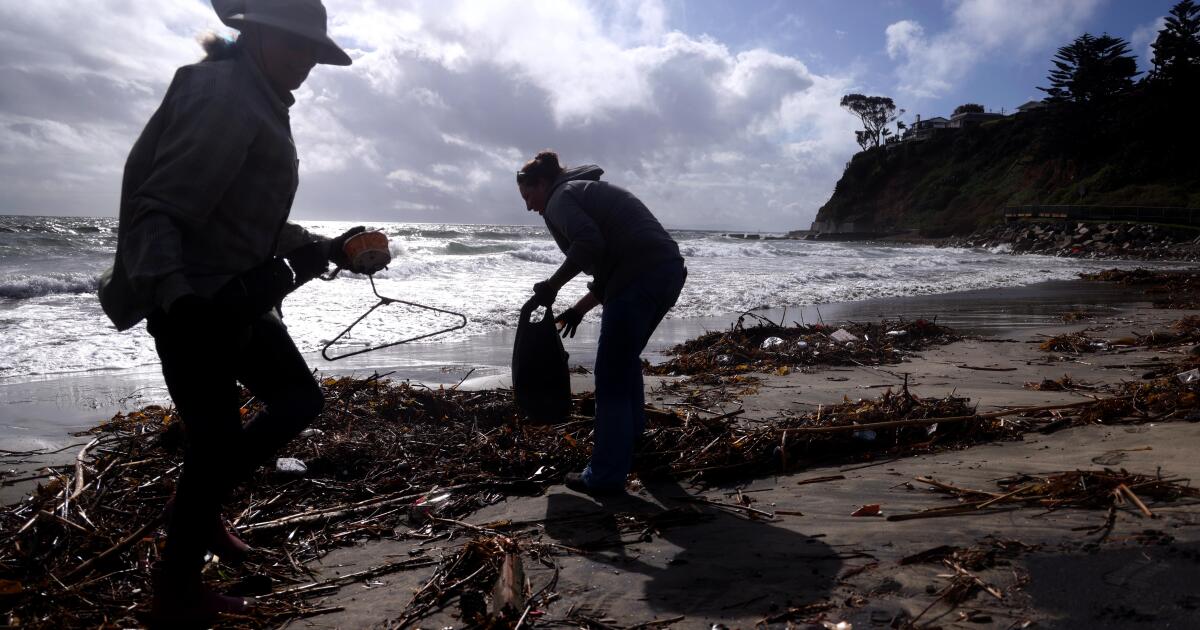
Researchers investigating the long-term effects of the 2025 firestorms on L.A.’s beaches have found that rarest of things: good news.
In the year following the Palisades and Eaton fires, levels of harmful metals like lead in coastal sand and seawater have remained far below California’s limits for safe drinking water and the U.S. Environmental Protection Agency’s safety thresholds for aquatic life.
“We’re not seeing any evidence for harm in the ecosystem or harm for human health,” said Noelle Held, a University of Southern California marine biogeochemist and principal investigator for the CLEAN Waters project, which is measuring post-fire water quality.
The Palisades and Eaton fires burned more than 40,000 acres and destroyed at least 12,000 buildings, blanketing the ocean in ash for up to 100 miles offshore. Heavy rains a few weeks later washed the charred remnants of plastics, batteries, cars, chemicals and other potentially toxic material into the sea and up onto beaches via the region’s massive network of storm drains and concrete-lined rivers.
Initial testing by the nonprofit environmental group Heal the Bay in the weeks after the fires documented a spike in lead, mercury and other heavy metals in coastal waters. Concentrations of beryllium, copper, chromium, nickel and lead in particular were significantly above established safety thresholds for marine life, prompting fears for the long-term health of fish, marine mammals and the marine food chain.
For their most recent study, Held’s team analyzed seawater samples collected along multiple locations on five different dates between Feb. 10 and Oct. 17 in 2025, along with sand collected in August.
Seawater lead concentrations were highest in the month after the fire and in October, when the season’s first major rain had just washed months’ worth of urban pollution into the ocean.
Even at their peak, lead levels barely surpassed 1 microgram per liter — well below the U.S. Environmental Protection Agency’s aquatic life safety threshold of 8.1 micrograms per liter.
While levels of iron, manganese and cobalt were higher in sampling locations near the Palisades burn scar than they were in other areas, even there they remain well below concentrations that could pose harm to human or marine life.
For beach sand collected in August, lead levels never topped 14 parts per million at any location, significantly below both the current California residential soil standard of 80 parts per million and the stricter 55 parts per million standard proposed by environmental health researchers.
“This isn’t something we would flag if we were testing your soil in your yard,” Held said.
The recent findings are consistent with water quality tests the State Water Resources Control Board conducted earlier in 2025. A board spokesperson said those found both higher relative concentrations of metals closest to the burn scars and no overall evidence that post-fire pollution poses an ongoing threat to human health.
Yet the need for continued testing remains. Officials struggled to answer questions about post-fire beach safety in part because of a lack of historical data on pollution levels, a pitfall researchers would like to forestall before another disaster arrives.
Future rainstorms could also continue to wash metals into Will Rogers Beach and the Rustic Creek outfall, both of which are near the Palisades burn scar, CLEAN Waters warned.
“Post-fire impacts can change over time, depending on rainfalls, runoffs and sediment movements,” said Eugenia Ermacora, manager of the nonprofit Surfrider Foundation’s L.A. chapter, which has partnered with Held’s team to collect samples. “It’s not just about the fires, but it’s about urbanization and how much our city needs to continue the work of doing testing in the water.”

The Fray to perform Friday night at 2026 South Dakota State Fair

Elon Musk’s Boring Co. will ‘try’ to build tunnel in this Tennessee town

TribCast: Inside Texas’ massive ICE detention facilities

How Big Was Jordan Clarkson’s Impact on Utah?

Northwest Vermont watershed organizations talk actions to prevent flooding

Florida High School Football Rankings: Top 25 teams – Oct. 21

How old is Bo Nix? What to know about Oregon quarterback ahead of 2024 NFL Draft

Cleary's 21 help Le Moyne down Central Connecticut State 69-64 in OT

99th annual Pony Swim held in Virginia

Indiana Members Credit Union announced as new anchor tenant at Bottleworks District

Video: Passengers Wait in Long Security Lines at LaGuardia After Deadly Crash

King Charles to address Congress in historic first state visit to Washington

Iran names successor to security chief killed in US-Israeli attack

See How the LaGuardia Plane Crash Unfolded

Mullin confirmed as DHS chief as lawmakers near solution on shutdown standoff
-

 Detroit, MI6 days ago
Drummer Brian Pastoria, longtime Detroit music advocate, dies at 68
-

 Georgia1 week ago
How ICE plans for a detention warehouse pushed a Georgia town to fight back | CNN Politics
-

 Movie Reviews6 days ago
‘Youth’ Twitter review: Ken Karunaas impresses audiences; Suraj Venjaramoodu adds charm; music wins praise | – The Times of India
-

 Alaska1 week ago
Police looking for man considered ‘armed and dangerous’
-

 Education1 week ago
Video: Turning Point USA Clubs Expand to High Schools Across America
-
 Science1 week ago
Long COVID leaves thousands of L.A. county residents sick, broke and ignored
-

 Sports3 days ago
IOC addresses execution of 19-year-old Iranian wrestler Saleh Mohammadi
-
 Science1 week ago
Industrial chemicals have reached the middle of the oceans, new study shows