Science
Upheaval in Washington Hinders Campaign Against Bird Flu


The campaign to curb bird flu on the nation’s farms has been slowed by the chaotic transition to a new administration that is determined to cut costs, reduce the federal work force and limit communications, according to interviews with more than a dozen scientists and federal officials.
On poultry farms, more than 168 million birds have been killed in an effort to curtail outbreaks. Since the virus first appeared on American dairy cattle about a year ago, it has spread to 17 states and infected more than 1,000 herds.
In its first months, the Trump administration has fired teams of scientists crucial to detecting the spread of the virus, canceled important meetings, and limited access to data even for federal scientists.
The Department of Health and Human Services has not held a public news briefing on bird flu since January, and did not respond to requests for comment.
Robert F. Kennedy Jr., the health secretary, has suggested allowing the virus to spread uncontrolled through poultry flocks to identify birds that might be immune, an idea that scientists called reckless and dangerous. His comments prompted Democratic lawmakers to open an investigation into the federal response.
The Trump administration has also eliminated funding for programs at the Food and Agriculture Organization, an agency at the United Nations, that monitor and contain bird flu in 49 countries.
“It’s just like watching this almost textbook story of how a virus spreads through animals, mixes in different types of animals and then is able to jump to humans,” said Linsey Marr, an expert in airborne viruses at Virginia Tech.
“We are getting strong warning signs from animals and people, and we are just watching and not doing a lot about it,” she added.
Bird flu has infected dozens of mammal species, including 150 domestic cats in 26 states and at least 70 people, leading to four hospitalizations and one death. After a lull this winter, the spring migratory season has renewed the pace of infections.
Over the past 30 days, the Department of Agriculture, which regulates the livestock industry, has confirmed new infections in 47 herds in three states.
The virus, called H5N1, does not yet seem to be able to spread from person to person. But with one recent mutation, it seems to have moved closer to becoming a human contagion, a worrisome development.
This week, an international group of virologists concluded that turning back bird flu would require continuous monitoring of milk from dairy farms, wastewater and people working with infected animals — a tall order when federal and state officials do not have the legal authority to compel farms to test animals or people.
Officials are testing bulk milk, which has helped to identify infected herds. But the Agriculture Department’s plan to combat bird flu is now focused on lowering egg prices and makes little mention of dairy cattle.
Brooke Rollins, the agriculture secretary, has proposed improving farm biosecurity, helping producers in 10 states prevent the virus’s spread on their premises.
“Our initial expansion of these ongoing efforts will focus on egg-laying facilities — as part of U.S.D.A.’s concerted effort to address egg prices — but we expect to include other poultry producers and dairy producers as well, as the programs are expanded and implemented,” the department said in a statement to The New York Times.
In an early wave of federal layoffs, some Agriculture Department veterinarians specializing in bird flu were fired and then hired back. Even now, many are working with government credit cards that have a $1 limit, making it difficult for them to travel or buy necessary supplies without lobbying to get extended credit — a “massive task” entailing multiple approvals and long delays, according to one official.
The Agriculture Department disagreed with that assessment. “Government-issued credit card limits automatically increase once staff are on an approved trip,” a department spokesman said in an email.
On April 1, the Trump administration fired veterinarians and other scientists at the Food and Drug Administration who were investigating raw pet food contaminated with H5N1 that was sickening cats, and who were helping to vet proposals to develop vaccines and treatments for infected animals.
And the C.D.C. has begun to withhold genetic analyses of viral samples gathered from people, according to one official who asked to remain anonymous for fear of retaliation. Even some internal teams are no longer allowed to review them.
On average, federal agencies are releasing the data 242 days after collection, according to one recent analysis. Ideally the task should not take more than a couple of weeks, scientists said. The delay makes it more difficult for scientists to track the spread of the virus and accurately assess its threat to people.
Important reports in agency publications, including the prestigious Mortality and Morbidity Weekly Report, have been delayed or stymied altogether, said one former official who spoke on the condition of anonymity for fear of retaliation.
In February, instead of a scheduled report on bird flu infections in household cats, agency scientists were ordered to produce and publish a paper on the effect of the Los Angeles wildfires on air quality.
The bird flu study did appear weeks later, but agency staff members said they were appalled that it had been delayed on orders from above.
The Biden administration held regular interagency calls about bird flu that included dozens of outside experts and state health officials, apprising them of the latest findings. Those calls have ended, as has much of the C.D.C.’s guidance on surveillance.
All communications from the C.D.C. now have to be cleared by federal health officials in Washington. The agency has not held a press briefing on bird flu since January.
“There’s not as much activity as there has been or should be, and what activity there is suffers from lack of coordination,” said Dr. Adam Lauring, a virologist and infectious disease physician at the University of Michigan.
The nation maintains a stockpile containing millions of doses of human vaccine against bird flu. But amid the paring down at the health department, the agency that oversaw the stockpile and specialized in rapid emergency distribution was moved into the C.D.C.
The reshuffle “adds layers of bureaucracy instead of removing it,” said Dawn O’Connell, who led the Administration for Strategic Preparedness and Response, the agency that had maintained the stockpile under the Biden administration.
In interviews, several employees at the C.D.C. and the Agriculture Department said morale was low and falling with every round of layoffs. At a town hall meeting on April 16, about a quarter of the veterinarians in attendance said they would sign on to the deferred resignation program that would offer them full pay and benefits till Sept. 30.
Last year, cows infected with H5N1 were tough to miss. They had fevers and produced viscous, yellow milk. Some cows had spontaneous abortions.
But cattle can be reinfected, it turns out, and the second round of symptoms can be subtler, making it harder to identify infected cows and protect the people who work with them. (A rapid test to detect the virus in cows or people is still not available.)
Reinfections suggest that the virus may become permanently entrenched in dairy cattle. At the same time, the virus continues to circulate in wild birds, evolving at about twice the rate in birds as in cattle.
A new version thought to cause more serious disease, called D1.1, appeared in September and quickly became the dominant variant. The government’s response has been no match for this speed.
In Nevada, milk samples collected on Jan. 6 and 7 tested positive for bird flu on Jan. 10. Ideally, the 12 farms that contributed to those samples would have been quarantined while the results were confirmed.
Instead, more samples were taken on Jan. 17, and the results were confirmed an additional week later.
The Agriculture Department said in a statement that the delay in testing results did not affect its response to the outbreak. “It is important to note that response activities are not dependent upon the sequence and are occurring in the interim,” the department said.
Michael Worobey, an evolutionary biologist at the University of Arizona, said he wasn’t so sure. “This does appear to be a case of closing the barn door after the cow is gone,” he said.
It might still be possible to extinguish the virus on American farms if the Agriculture Department were to step up containment efforts, he said.
For example, a rapid test that could quickly detect H5N1 in bulk milk would give officials more time to snuff out an outbreak, compared with a test that delivers results weeks later.
“I do think it’s still a goal that we should be driving for, until and unless it’s clear that it’s futile,” Dr. Worobey said of banishing the virus.
At the moment, keeping the virus off farms is not easy.
When an infected duck, for example, flies over a farm and defecates — not unlikely when millions of birds are infected — there are dozens of ways an outbreak may begin. A farmer may track the detritus into a poultry barn. An infected rodent may sneak in through a tiny gap.
Chickens are packed together, and they have weak immune systems. One bird sneezing out virus can quickly lead to hundreds or thousands of sick birds.
Over the past two years, the Agriculture Department has worked with egg producers in four states — Iowa, Minnesota, South Dakota and North Dakota — on biocontainment efforts to prevent the virus from spreading on farms.
Federal officials helped identify and remove nearby wildlife, including rats, and entry points for the virus that the farmers may easily miss. Only two of the 108 premises that participated in the pilot project had virus infections afterward.
The project is now set to expand this year to 10 states — including California, Texas, Ohio and Pennsylvania — and to all 50 states by 2027. Agriculture Department experts are expected to conduct free audits to help farmers identify even the smallest gaps in their defenses against bird flu.
The proposal has garnered praise from scientists, but some experts, including Agriculture Department veterinarians, were unsure how the programs might be carried out.
The staff at the department has worked intensely to turn back bird flu since early 2022. There are already not enough employees to help farms contain outbreaks, identify the flaws in their facilities and inspect the premises to ensure they are ready to reopen.
“We’re three years running without a break, so we’re starting to wear people out,” said a veterinarian who, without permission to speak to the news media, asked to remain anonymous.
Given how birds are currently raised on farms, even the most stringent measures may not be enough to keep the virus out, said Andrew deCoriolis, the executive director of the advocacy group Farm Forward.
“Until that industry changes radically, that outbreak is destined to continue,” he said.



new video loaded: Artemis Astronauts Splash Down After Historic Lunar Flyby
transcript
transcript
Artemis Astronauts Splash Down After Historic Lunar Flyby
The four astronauts aboard Artemis II splashed down at 8:07 p.m. Eastern time in the Pacific Ocean near San Diego on Friday, concluding their historic 10-day mission, the first to send humans to the moon in more than 50 years.
-
“Houston, Integrity splashdown. Sending post-landing command now.” “Splashdown confirmed.” “Copy splashdown. Waiting on V.L.D.R.” “Splashdown confirmed at 7:07 p.m. Central time.” “All four crew members now out of Integrity.”

By Jackeline Luna
April 10, 2026
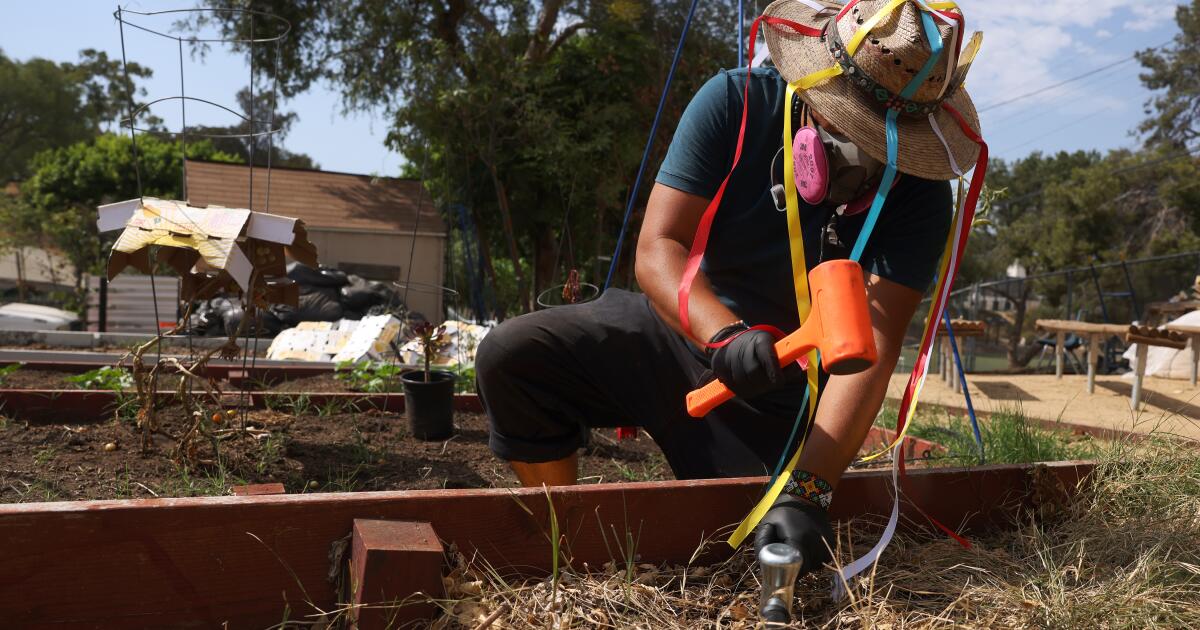
Homes near a former battery recycler in Southeast Los Angeles County still have excessive lead in their soil, even after the state spent hundreds of millions of dollars over a decade to remove it, according to a new study.
The former Exide Technologies plant in Vernon melted down pallets of lead-acid car batteries in blast furnaces for nearly a century, blanketing up to 10,000 nearby properties with toxic dust, according to state officials. They say the cleanup is the largest of its kind in the country.
The Exide plant was permanently closed in 2015 and later abandoned by the company. The California Department of Toxic Substances Control hired contractors to remove and replace heavily contaminated soil at nearby homes, schools and parks in seven communities, including Boyle Heights and unincorporated East L.A.
Now in a review of the state’s work, a team of university researchers and a local environmental health organization have tested more than 1,100 soil samples from 370 homes within and just outside the state-designated cleanup area. They found nearly three quarters of remediated homes still had lead levels above California’s standard for residential properties in at least one sample. Their study is published in Environmental Science & Technology.
Jill Johnston, lead author and associate professor of environmental and occupational health at UC Irvine, said the results suggest there were deep flaws with the cleanup. This leftover lead has the potential to stunt brain development in young children, leaving them with lifelong deficits if they inhale dust or ingest it playing in their yards.
“The state cleanup plan [said] surface soil was going to be removed or covered,” Johnston said. Instead, there is “potentially ongoing exposures to folks living there now, but also future generations.”
Exide Technologies, a former lead-acid battery recycling plant in Vernon, in October 2020.
(Al Seib/Los Angeles Times)
The cleanup started in 2016 and is ongoing. It aimed to excavate up to 18 inches of contaminated soil from each home and backfill with clean topsoil. So far, more than 6,100 properties have been remediated in Southeast L.A. County. The state has dedicated more than $700 million to the effort.
A 2023 Los Angeles Times investigation, which cited preliminary soil testing results, found that state-hired cleanup crews often did not remove contaminated soil from next to buildings, walkways and trees, where backhoes and other excavators can’t get in — areas that require a shovel.
In some cases, workers mishandled contaminated soil, spreading it onto neighboring properties. The state did not offer soil testing to confirm the properties met state standards after the cleanup, leaving many skeptical their homes were actually clean.
Mark! Lopez, a community organizer with East Yard Communities for Environmental Justice and a co-author of the study, had long heard complaints from residents and raised concerns about the cleanup. The findings, he said, substantiated many of those claims.
“The results are worse than we feared,” said Lopez, who led teams in collecting soil samples from 2021 to 2024.
When they released initial data, he said, “DTSC was trying to deny its validity … Now that can’t be denied.”
A DTSC spokesperson said the agency could not accept the study’s findings without more information.
“It is impossible to evaluate the conclusion of the UC Irvine study without the underlying data and methodology,” the agency spokesperson said. “That information has not been shared after multiple requests.”
No cleanup ever replaces every particle of soil, the agency said. “That said, DTSC has carried out an unprecedented cleanup near the former Exide facility, completing work at more than 6,000 homes, the largest residential cleanup of its kind in the nation. This work confirms DTSC’s commitment to protecting the health of residents.”
After the team shared results with state officials, DTSC committed to perform soil testing at 100 homes that had their work done early in the process, before procedures underwent an overhaul. The agency also has paid for post-cleanup testing at the most recently cleaned homes. None of that data has been published, and it’s unclear if DTSC intends to order crews to return to homes that have lead contamination above state standards.
In addition, DTSC now has third-party supervisors monitoring cleanup work.
Johnston and fellow researchers also tested more than 620 samples from 200 homes outside the official 1.7-mile cleanup area. Almost all, 89%, had lead levels above state standards, suggesting Exide’s pollution may have traveled farther than the cleanup zone designated by the state.
Some level of lead blankets many urban areas, because of lead paint, leaded jet fuel and tailpipe exhaust from leaded gasoline. But the researchers believe much of this pollution was attributable to Exide.
That’s because at the direction of state regulators, Exide sampled homes in Long Beach, about 14 miles south, in a similar neighborhood close to freeways, a rail yard and older homes — but without a lead smelter. Lead concentrations were far lower than in Southeast L.A. County.
“We essentially saw lead level patterns that mimicked lead levels in the community — before cleanup,” Johnston said. “So the vast majority of homes exceeded state thresholds.”
DTSC officials have said lead contamination also could have been from older homes with lead paint or leaded gasoline in cars.
Community leaders have pushed for extending the cleanup area to remove hidden threats in those areas, even as many still worry about residents whose properties already have been cleared. They don’t want residents to have a false sense of security that their property is clean when many still are laced with lead.
Johnston said some of the risks could’ve been avoided if the state committed to proper safeguards, such as post-cleanup sampling, sooner.
“If that process started early on and is done in a way where residents and the broader community had transparency to that data, we could have addressed” hot spots of contamination and other neighborhood concerns, she said.
Science
Did you feel it? As Artemis II nears reentry, scientists want to know how far the sonic boom travels

Southern Californians may hear a distinct “boom” around 5 p.m. Friday as NASA’s Artemis II moon flyby mission makes its energetic reentry off the coast of San Diego, the U.S. Geological Survey said.
USGS does not know how far up and down the coast — or how far inland — Californians will be able to hear this sonic boom, produced as the capsule breaks the sound barrier as it slows down, said John Bellini, a geophysicist with the agency.
For this reason, USGS is asking for the public’s help: Californians can report whether or not they heard the boom to the agency’s “Did You Feel It” survey.
This information, Bellini said, will help scientists better predict sonic booms in the future, which are dependent on a variety of atmospheric conditions.
“Since this is a known source with a relatively known location and time of occurrence, people reporting this can help us in the future to better characterize unknown sources of a similar type,” he said.
NASA astronaut and Artemis II Pilot Victor Glover in the Orion spacecraft during the Artemis II lunar flyby.
(NASA via Getty Images)
For example, meteorites and space debris piercing the atmosphere can produce sonic booms — as can supersonic tests from the military and private aerospace companies.
While Southern Californians might hear the intense reentry, NASA isn’t so confident they’ll be able to see it.
However, Aaron Rosengren, assistant professor of space systems at UC San Diego, is more optimistic.
“The weather is quite nice today,” he said. “If you have any view along the Southern Coast and you’re looking westward along the horizon, you should be able to see a faint light in the sky as it reenters.”
Rosengren expects that streak in the sky to last less than a minute.
The Artemis II crew, the first to reach the moon in a half-century, will slam into the atmosphere at 30 times the speed of sound, generating a fireball of nearly 5,000 degrees Fahrenheit around the capsule.
When Artemis II pilot and SoCal native Victor Glover was asked Wednesday evening about the moments from this mission he’ll carry with him for the rest of his life, he joked: “We’ve still got two more days, and riding a fireball through the atmosphere is profound as well.”

Report: Wisconsin transfer John Blackwell down to six schools, not two
Trump promised to cut electric costs in half. In energy-rich West Virginia, bills now top mortgages

Keenan Morgan to run for House District 58 seat

OKX Invests in Vietnam Exchange CAEX Ahead of Crypto Pilot

Opinion: Teaching kids how to manage money is now a reality in New Hampshire – Concord Monitor

Florida High School Football Rankings: Top 25 teams – Oct. 21

How old is Bo Nix? What to know about Oregon quarterback ahead of 2024 NFL Draft

Cleary's 21 help Le Moyne down Central Connecticut State 69-64 in OT

99th annual Pony Swim held in Virginia

Indiana Members Credit Union announced as new anchor tenant at Bottleworks District

Trump adversary running for Senate borrows his filibuster playbook

Russian propaganda unit targets Hungary’s elections

WATCH: Artemis II astronauts splash down on Earth

Swalwell’s former female staffer drops bombshell allegations of sexual assault, exposing himself: report

NASA’s Artemis II prepares for splashdown on Earth
-

 Atlanta, GA6 days ago
1 teenage girl killed, another injured in shooting at Piedmont Park, police say
-

 Education1 week ago
Video: Toy Testing with a Discerning Bodega Cat
-

 Movie Reviews1 week ago
Vaazha 2 first half review: Hashir anchors a lively, chaos-filled teen tale
-

 Georgia4 days ago
Georgia House Special Runoff Election 2026 Live Results
-

 Pennsylvania5 days ago
Parents charged after toddler injured by wolf at Pennsylvania zoo
-

 Arkansas20 hours ago
Arkansas TV meteorologist Melinda Mayo retires after nearly four decades on air
-
 Milwaukee, WI5 days ago
Potawatomi Casino Hotel evacuated after fire breaks out in rooftop HVAC system
-
 Entertainment1 week ago
Inside Ye’s first comeback show at SoFi Stadium