Science
Trump Has Cut Science Funding to Its Lowest Level in Decades


10-year average
$2 billion
National Science Foundation grant funding through May 21
The National Science Foundation, which funds much of the fundamental scientific research at American universities, is awarding new grants at the slowest pace in at least 35 years.
The funding decreases touch virtually every area of science — extending far beyond the diversity programs and other “woke” targets that the Trump administration says it wants to cut.
Grants funded by the National Science Foundation through May 21 ↓ 51%
Math, physics and chemistry
$432m
That means less support for early-stage research that underpins future technological advancements — and American competitiveness — in areas like computer science and engineering; physics and chemistry; climate science and weather forecasting; and materials and manufacturing innovations.
It also means less money for undergraduate and graduate students, postdoctoral researchers and early-career professors — potentially disrupting the nation’s future scientific work force.
Economists have warned that cutting federal funding for scientific research could, in the long run, damage the U.S. economy by an amount equivalent to a major recession.
“These cuts are the height of self-inflicted harm,” said Robert Atkinson, the president of the Information Technology and Innovation Foundation, a nonpartisan science and technology policy research institute. The foundation has argued that China probably already conducts more research and development than the United States.
“If they succeed in these cuts, the result will be slower economic growth, less innovation and new tech startups, and even more diminished competitiveness vis-à-vis China,” he added.
The lag in this year’s funding, more than $1 billion below the 10-year average, is for new research grants, but the Trump administration has gone further. It has also terminated more than 1,600 active grants for existing research projects, together worth roughly $1.5 billion (of which at least 40 percent has already been spent).
And it wants to eliminate nearly $5 billion of the agency’s $9 billion budget for next year, cutting spending on “climate; clean energy; woke social, behavioral and economic sciences,” and diversity, equity and inclusion programs.
Among the in-progress grants that have been terminated, those focused on education in science, technology, engineering and mathematics, or STEM, accounted for the vast majority of the canceled funding. Many of these grants focused on broadening participation in science and engineering among underrepresented student groups.
Canceled funding from in-progress grants
STEM education
-$656 mil.
Math, physics, chem.
-$61 mil.
Geosciences
-$53 mil.
Computer science
-$47 mil.
Social sciences
-$46 mil.
Technology
-$38 mil.
Engineering
-$36 mil.
Biology
-$28 mil.
But in contrast with the canceled grants, the slowdown in issuing new grants is broader, representing an across-the-board hit to American science.
Decline in new grant funding in 2025
Math, physics, chem.
-$289 mil.
STEM education
-$223 mil.
Biology
-$156 mil.
Engineering
-$127 mil.
Geosciences
-$101 mil.
Computer science
-$85 mil.
Technology
-$18 mil.
Social sciences
-$16 mil.
The N.S.F. said in a statement that while it will focus on the Trump administration’s priorities — like artificial intelligence, quantum information science, biotechnology and nuclear energy — it remains “committed to awarding grants and funding all areas of science and engineering.”
Yet the data shows the agency’s funding of new grants at its lowest level since at least 1990, around when the N.S.F. expanded into its modern structure. The funding has slowed even further since April 30, when agency employees were told to stop awarding funds entirely, according to an email reviewed by The New York Times.
Cumulative grant funding by the National Science Foundation, 1990-2025
Representative Zoe Lofgren of California, the top Democrat on the House science committee, said the Trump administration was denying funding that had already been approved by Congress.
“What they’re doing is not only illegal, but it’s also very damaging to the science enterprise and, ultimately, to the economy of the United States,” she said.
The N.S.F. has said it is canceling awards that are not in line with its priorities, including those focused on D.E.I., environmental justice, misinformation and disinformation. The cancellations have been cheered by Senator Ted Cruz, Republican of Texas, who in February published a list identifying more than a third of the grants that have been terminated.
“My Commerce Committee investigation exposed how the Biden administration corrupted the N.S.F. grantmaking process with a divisive fixation on identity politics,” Mr. Cruz said in a statement. “This kind of politicization erodes public trust in science. The N.S.F. must spend taxpayer dollars responsibly and prioritize objectivity and scientific rigor.”
House Democrats on the science committee have said the cancellations themselves are “based on hard-right political ideology and not scientific or research expertise,” and have noted flaws in Mr. Cruz’s report, like associating the term “biodiversity” with D.E.I.
N.S.F. officials interviewed for this article said many grants that have already gone through the agency’s rigorous review process and were recommended for funding have been in limbo for months. After the April 30 email freezing new awards, which was first reported by Nature, another email on May 13 allowed for some new funding but kept a freeze in place for higher education institutions.
A spokesman for the N.S.F. said it was still “making awards to higher education institutions.”
Either way, the N.S.F.’s directorate for STEM education has had one of the steepest shortfalls in new grants. Its award funding has declined by around 80 percent this year.
Funding through May 21 for …
STEM education ↓ 80%
Undergrad. education
$135m
Equity for excellence in STEM $46m
Research on learning
$77m
The N.S.F. says that it directly supported over 350,000 researchers, teachers and students last year alone. It supports over 20,000 graduate students, more than any other federal agency except the National Institutes of Health, which funds medical research and has also awarded far fewer grants this year.
Within its education branch, the N.S.F. has moved to eliminate the division of equity for excellence in STEM, which promotes D.E.I. and supports students who are underrepresented in science and engineering. The closure has been put on hold by a court order.
The N.S.F.’s division of graduate education, which funds graduate student research, typically approves $21 million in grants by this point of the year, but has awarded none so far. It announced 1,000 graduate research fellowships this year, down from over 2,000 in prior years, as reported last month by Nature.
Ms. Lofgren said these education programs are required by law and were adopted with bipartisan support.
“You can’t have science without scientists,” she said.
Here’s how the shortfall in grant awards this year has affected other areas of science:
Math, physics and chemistry ↓ 67%
N.S.F. grant funding for core scientific disciplines like math, physics, chemistry and material sciences has dropped by two-thirds this year.
The N.S.F. funds “basic” research in these areas: fundamental or unexpected discoveries that may be decades away from practical applications. That includes research on ultrafast lasers in the 1990s that eventually resulted in bladeless LASIK eye surgery, or radar technology in the 1960s that revolutionized weather prediction three decades later.
Curiosity-driven research lays the foundation for private sector investments and leads to breakthroughs that can be commercialized, said Deborah Wince-Smith, the president of the Council on Competitiveness, a nonpartisan organization composed of chief executives, university presidents and heads of national laboratories.
The N.S.F. has also funded major astronomical observatories that have made groundbreaking discoveries such as capturing the first images of black holes or detecting gravitational waves.
In 2023, the N.S.F. funded half of all federally supported basic research in math and statistics in American colleges. So far this year, math and statistics grant funding is lagging behind previous years by 72 percent.
Funding for physics grants this year has fallen by 85 percent, and funding for materials research grants has dropped by 63 percent.
Engineering ↓ 57%
N.S.F. grant funding for core engineering disciplines has dropped by 57 percent this year. These divisions fund areas like robotics, manufacturing innovations and semiconductor research.
Funding for grants related to chemical, bioengineering, environmental and transport systems has fallen by 71 percent this year, while funding for grants related to civil and mechanical engineering and manufacturing innovation has fallen by 48 percent.
Biology ↓ 52%
Biological infrastructure
$99m
Most federal funding for biology research comes from the National Institutes of Health, but the N.S.F. also supports the field. Its grant funding for biology is at half of its previous 10-year average. There were fewer funds awarded for research in biotechnology and environmental biology, and less money for the tools, facilities and people that support biological research.
Computer science ↓ 31%
Information & intelligent systems
$68m
Advanced cyberinfrastructure
$39m
Computing foundations
$74m
Computer science divisions that have supported research in topics like artificial intelligence, data science, computer security and emerging computing technologies have awarded fewer funds this year.
But the office of advanced cyberinfrastructure has awarded twice the funding that is typical by this time of year, including a $26 million grant for generative A.I. tools and a $20 million grant to “advance American leadership in artificial intelligence.”
In 2023, the N.S.F. provided 72 percent of federal funds for foundational computer science research at colleges and universities.
The agency provided early funding that led to recent developments in artificial intelligence. For example, the researchers who received the 2024 Nobel Prize in Physics for their work in artificial neural networks — technologies that underlie tools like ChatGPT — received N.S.F. funding in the 1980s, long before their work had widespread applications.
The funds also support the careers of graduate students, a large share of whom eventually work in the technology industry, said Greg Hager, the former head of the N.S.F.’s Computer and Information Science and Engineering Directorate, who resigned from the agency this month.
“It’s going to impact progress today, but it’s going to have profound impacts for years to come,” he said of the reductions in funding for computer science.
Geosciences ↓ 33%
In 2023, the N.S.F. supported over half of all federally funded basic geosciences research in American universities.
This year, the agency has fired workers at the Office of Polar Programs, which coordinates research in the Arctic and the Antarctic. The polar office has awarded 88 percent less money in grants this year.
But the ocean sciences division has awarded more funding than typical this year, including a $39 million grant to establish an office that will manage a deep-sea drilling program and an $18 million grant to Columbia University to support a research vessel.
Social and behavioral sciences ↓ 20%
Social science & economics
$31m
Behavioral & cognitive sciences
$32m
There has been a 96 percent decrease in grant funding for multidisciplinary research, which spans biology, physics and engineering. Previously funded projects have included using cells as sensors to monitor pollutants and diseases in wastewater, creating biodegradable robots, and engineering fungi to recover valuable metals from e-waste.
The behavioral and cognitive sciences division has awarded 30 percent more grant funding this year compared with the past decade’s average — despite the Trump administration’s targeting of “woke social, behavioral and economic sciences.” That included funding research on tracking changes in romantic relationships, how hand gestures can enhance learning and a database that lists the average rents in a neighborhood.
Technology, innovation and partnerships ↓ 17%
Translational impacts
$86m
The CHIPS and Science Act, a bipartisan law enacted during the Biden administration in 2022, created the N.S.F.’s Directorate of Technology, Innovation and Partnerships. Last year it funded projects for agricultural technology in North Dakota, climate resilience in Wyoming and semiconductor assembly in Central Florida.
This branch’s grant funding has decreased by 17 percent, a moderate reduction compared with the decreases in other areas.
Here are all the changes so far:
Changes in N.S.F. grant funding
Directorate
2015-2024 avg. funding
2025 funding
Change
Education
$280 mil.
$56 mil.
-80%
Graduate education
$21 mil.
$0
-100%
Equity for excellence in STEM
$46 mil.
$1 mil.
-97%
Research on learning in formal and informal settings
$77 mil.
$16 mil.
-79%
Undergraduate education
$135 mil.
$39 mil.
-71%
Math, physics and chemistry
$432 mil.
$143 mil.
-67%
Strategic initiatives
$6k
$0
-100%
Physics
$72 mil.
$11 mil.
-85%
Mathematical sciences
$113 mil.
$32 mil.
-72%
Materials research
$118 mil.
$43 mil.
-63%
Chemistry
$103 mil.
$44 mil.
-57%
Astronomical sciences
$26 mil.
$12 mil.
-53%
Engineering
$221 mil.
$94 mil.
-57%
Emerging frontiers in research and innovation
$2 mil.
$42k
-98%
Chemical, bioengineering, environmental and transport systems
$75 mil.
$22 mil.
-71%
Engineering education and centers
$27 mil.
$12 mil.
-56%
Civil, mechanical, and manufacturing innovation
$80 mil.
$42 mil.
-48%
Electrical, communications and cyber systems
$36 mil.
$19 mil.
-48%
Biology
$303 mil.
$147 mil.
-52%
Biological infrastructure
$99 mil.
$32 mil.
-68%
Integrative organismal systems
$88 mil.
$34 mil.
-61%
Environmental biology
$75 mil.
$39 mil.
-49%
Molecular and cellular biosciences
$40 mil.
$37 mil.
-9%
Emerging frontiers
$801k
$5 mil.
+521%
Geosciences
$305 mil.
$204 mil.
-33%
Office of polar programs
$51 mil.
$6 mil.
-88%
Earth sciences
$78 mil.
$16 mil.
-80%
Research, innovation, synergies and education (RISE)
$11 mil.
$6 mil.
-47%
Atmospheric and geospace sciences
$63 mil.
$40 mil.
-36%
Ocean sciences
$103 mil.
$136 mil.
+33%
Computer science
$277 mil.
$192 mil.
-31%
Information & intelligent systems
$68 mil.
$27 mil.
-60%
Computer and network systems
$96 mil.
$42 mil.
-57%
Computing and communication foundations
$74 mil.
$43 mil.
-41%
Office of advanced cyberinfrastructure
$39 mil.
$80 mil.
+102%
Social sciences
$78 mil.
$62 mil.
-20%
National Center for Science and Engineering Statistics
$2 mil.
$0
-100%
Multidisciplinary activities
$11 mil.
$401k
-96%
Social and economic sciences
$31 mil.
$20 mil.
-37%
Behavioral and cognitive sciences
$32 mil.
$42 mil.
+30%
Technology
$110 mil.
$92 mil.
-17%
Technology frontiers
$9k
$0
-100%
Translational impacts
$86 mil.
$44 mil.
-48%
Innovation and technology ecosystems
$24 mil.
$47 mil.
+95%
Other
$65 mil.
$47 mil.
-29%
Total
$2.1 bil.
$1 bil.
-50%
‘Total confusion’
The National Science Foundation has usually awarded half of its funds for the fiscal year by early July. In theory, this year’s funding levels could still catch up to former levels if the agency accelerates its pace of making awards over the summer.
But officials described an agency that has been thrown into chaos as it tries to navigate a new political landscape under President Trump. The agency is in the midst of a major restructuring to eliminate its 37 divisions. It has also conducted layoffs and placed pressure on its workers to resign or retire. (The restructuring and termination of employees has been paused by a court order until Friday.)
Many N.S.F. divisions do not know how much they can spend this fiscal year, which ends Sept. 30, and this uncertainty may also be contributing to this year’s funding lag.
“There’s total confusion,” said one employee who has worked at the N.S.F. for more than a decade and is involved in determining which grants are recommended for funding. The employee, who did not want to be named out of fear of retaliation for speaking to the news media, said that the N.S.F.’s rigorous review process had been disassembled, and that political mandates had taken precedence over scientific merits when assessing grant proposals.
“There’s confusion on how much money we can spend,” the employee said. “And then there’s confusion because the processes are basically paralyzed.”
About the data
Using the N.S.F.’s awards database, we tabulated the intended award amounts for all projects funded between Jan. 1 and May 21 of each year. The award date is determined by the initial amendment date, which typically precedes the start date of the project. Intended awards reflect the amount that the N.S.F. intends to fund over the entire life of a project, which may extend multiple years beyond the year the project was awarded. All award amounts are inflation-adjusted to March 2025 dollars by using the Personal Consumption Expenditures price index.



Most years, when thousands of psychiatrists gather for the annual meeting of the American Psychiatric Association, they walk past a scattering of protesters. There are Scientologists with megaphones; Falun Gong groups doing their exercises; and, often, former patients, saying they have been harmed by medications or electroconvulsive therapy.
This year, though, the profession is facing criticism from the highest levels of the federal government. The American Psychiatric Association gathered just 10 days after Health Secretary Robert F. Kennedy Jr. announced a set of policies to encourage doctors to deprescribe, or assist patients in stopping, the most widely prescribed class of antidepressants.
A current of anxiety ran through the meeting, held here this week. Many physicians in the crowd said they worried that Mr. Kennedy’s statements would prompt people to refuse medications, or to quit them and relapse. The plenary session erupted in applause when Dr. Marketa Wills, the organization’s chief executive, declared, “We will never support governmental interference in the practice of medicine.”
“We are standing tall for evidence-based care,” she continued. “We are standing tall against stigma, oversimplification, and anything that would move patients further away from the care that they need.”
But there were also signs that the field’s leaders are engaging, albeit cautiously, with Mr. Kennedy’s effort to curb overprescribing. Numerous sessions offered training in helping patients taper off medications. In July, the association’s president will take part in a panel convened by the Department of Health and Human Services to develop clinical guidance on tapering antidepressants.
In an interview, Dr. Wills said she had been “encouraged” by the invitation to participate in the panel, and she credited the administration with “putting mental health front and center.”
“It feels like the beginning of a conversation, one that we welcome,” Dr. Wills said. She added, “It would be odd to have that conversation without psychiatrists at the table.”
Outside in the corridors, some rank-and-file attendees were less diplomatic.
Many providers took issue with Mr. Kennedy’s negative characterization of selective serotonin reuptake inhibitors, or S.S.R.I. s, the most widely prescribed class of psychiatric medications. Clinical trials have found that most patients’ depressive symptoms improved with S.S.R.I.s, and they are considered safe enough to be prescribed by general practitioners.
A 2026 study found that 16.6 percent of U.S. adults, or roughly one in six, reported currently taking an antidepressant.
“He just doesn’t like S.S.R.I.s,” said Dr. Sung Hyon, a psychiatrist from Pasadena, referring to Mr. Kennedy. Dr. Hyon said S.S.R.I.s had been “foundational” in his practice — “boring drugs that are well established, have good safety evidence and have zero chance to cause addiction.” He called them “God’s gift to psychiatry.”
And patients know it, he added. “So many millions” of Americans already take S.S.R.I.s, he said, and the vast majority are fully aware of their downside, like sexual side effects and withdrawal symptoms.
“And they say, ‘You know what? It’s worth it,’” Dr. Hyon said. “Because there are so many of them, it would be a pretty big political firestorm if he really tried to restrict access. And there is very, very little medical evidence to do so.”
Mr. Kennedy has long signaled that curbing the use of psychiatric drugs was a goal of his. Earlier this month he began taking steps in that direction, announcing guidelines and regulatory changes meant to provide an incentive for clinicians to help patients taper off psychiatric medications. The steps would not affect patients’ access to antidepressants.
Andrew Nixon, a spokesman for the Department of Health and Human Services, said the agency had had no discussions about banning S.S.R.I.s., “and any claims suggesting otherwise are false.” The aim of the new initiative, he said, is to “promote appropriate psychiatric prescribing and drive deprescribing when clinically indicated.”
Some psychiatrists said they worried that Mr. Kennedy’s deprescribing initiative was the beginning of a wider effort that might, in later stages, discredit psychiatry more broadly and restrict access to care.
“I think it is actually putting more questions in people’s minds about whether psychiatric treatment is safe or effective,” said Dr. Eric Rafla-Yuan, who chairs the A.P.A.’s caucus on the social determinants of health. “The data has not changed on S.S.R.I.s. It’s the narrative that has changed.”
He said the A.P.A. should be pushing back forcefully against Mr. Kennedy’s claims about psychiatric treatments, and should steer clear of seeming to endorse any part of the initiative.
“It’s a fine line between having a seat at the table and being used as a tool to legitimize their agenda,” he said.
‘Much Too Medicated’
At the same time, deprescribing seemed, at the meeting, to be on everyone’s lips. A new book, “Stahl’s Deprescriber’s Guide,” was selling like hot cakes in the exhibition hall. There were panels titled, “Deprescribing Antipsychotics,” “The Much Too Medicated Patient” and “Stimulants for A.D.H.D.: Did We Get It Wrong?”
Dr. Chris Aiken, who delivered an address about multidrug cocktails, said a generational change is moving through the psychiatric association, as a younger cohort of physicians, in their 30s and 40s, take a more prominent role.
Millennials were part of the first generation to be prescribed stimulants and antidepressants as children and teens, he said, and physicians in that group are more conscious of poor outcomes years later. “Meds are not the answer, and they have seen this in their own lives,” he said.
Some senior physicians had a similar message.
“If I have any regrets about my recommendations as a physician, it’s about the medications that I did not withdraw sooner,” said Dr. Ronald Winchel, an assistant clinical professor of psychiatry at Columbia University’s medical school, at one panel.
He said a number of concerns had prevented him from doing so: Sometimes, patients were taking multiple medications and it was difficult to say which was effective. Sometimes, patients were doing well, and he was afraid of setting them back. And there was a dearth of research on how patients do after they quit medications.
“The fear of withdrawing medications has really complicated our work,” he said.
Dr. Winchel compared this year’s churning discussion to a watershed moment in the A.P.A.’s history: In 1973, sustained pressure from protesters caused the organization to reverse its century-old position and declare that homosexuality was not a mental disorder.
“Instead of getting into a defensive crouch, they looked at themselves and they made progress,” Dr. Winchel said. The same kind of advancement, he added, could result from a rigorous discussion about prescribing practices. “If some of this agitation is coming from outside,” he said, “what is wrong with that?”
In his presentation, Dr. Aiken urged colleagues not to dismiss the stories Mr. Kennedy has highlighted of patients who have encountered serious difficulties quitting antidepressants.
“I don’t really know how common it is, but I do know that when it does happen, it can be quite severe,” he said. “It may be rare, but let’s take it seriously, because it can really burn people when it happens.”
Others said working with Mr. Kennedy around mental health policies was a matter of simple pragmatism.
“There’s definitely a need for us to be talking to the people who are making decisions,” said Dr. Hammad Khan of Sacramento. “We can’t let Joe Rogan decide what the F.D.A. approves or doesn’t approve.”
An Inflection Point
Dr. Awais Aftab, the author of “Psychiatry at the Margins,” a popular mental health Substack, said he expects the H.H.S. effort to focus on raising awareness about tapering off medications. There are few pathways for the government to reduce the prescription of drugs like S.S.R.I.s, which have gone through F.D.A.-approval pathways and are widely used by the public, he said.
He described “a sense of alarm” among psychiatrists at the virulent critique of the field coming from Mr. Kennedy’s circle. Psychiatry, he said, has been late to acknowledge the complaints of patients like Laura Delano, an author and activist, who say they were overmedicated as children or teenagers and got little support from doctors when they wanted to reduce or stop the drugs.
“The mainstream psychiatric community has been fairly insulated, and suddenly they are hearing now about this issue,” said Dr. Aftab, a psychiatrist at Case Western Reserve University.
He added that he believes that the use of antidepressants in the United States may have reached a natural limit. “The demand is going to, at some point, go into an equilibrium with the reality of the lack of effectiveness and the reality of the tolerability issue,” he said.
But the experience of some other countries suggests that the demand for antidepressants may continue to rise, even amid warnings about overprescribing.
In 2017, Britain commissioned a major report on overprescribing and then followed up with a series of reforms, including updating clinical guidelines to require regular prescribing reviews and instituting a national audit program to monitor drug use.
But a study of prescribing in Britain found that the use of antidepressants continued its steady rise through 2023, the last year for which data was available. In contrast, recent years have seen a decline in the use of anxiety medications and hypnotics, which were also the subject of updated clinical guidelines.
The study’s authors said the rise was most likely driven by patient demand, reductions in stigma and the lower cost of antidepressant medications available in generic form.
Many psychiatrists at the conference in San Francisco said that they routinely urge patients to try therapy as an alternative or a complement to medications, but that many patients have no access to that care, because their insurance will not pay for it.
Dr. Michael Bostwick, a suicide researcher and professor of psychiatry at Mayo Medical School, in Rochester. Minn., said it remained unclear what alternative treatments Mr. Kennedy is recommending to patients who quit antidepressants.
“Toward what end?” he said. “Is he going to put more resources toward therapists? Is he going to tell us to eat more red meat, or work out more, or take psychedelics, like the president has advocated? There is no alternative plan.”

Spring is when honeybees are bringing in food, the hive is healthy and growing, and they simply … run out of space. That’s when they decide to split their overcrowded hives and send half swarming off in search of greener pastures.
But Southern California beekeepers saw that happen unusually early this year, which left many of them scrambling.
“Never before have I seen so many bees swarm in late February and March,” said Daniel Barkanov, a beekeeper with Bee Specialist who works primarily in the San Gabriel Valley. “Usually that happens between May and June,” he said.
“The shift this year was quite, quite dramatic in many areas, especially in Central and Southern California,” said Mateo Kaiser, a beekeeper and managing director at Swarmed, a network of 10,000 beekeepers focused on monitoring and safe hive relocation.
Beekeepers typically try to guide swarming so their their colonies can grow. They divide their own hives at the start of swarming season to prevent bees from flying off, and pick up unwanted ones that land in people’s attics and walls.
But this year, many were caught unprepared.
“They were scrambling to even just have the materials ready to catch the bees and get them into beehives,” Kaiser said.
Climate change is one likely culprit for the early takeoff.
“There’s substantive evidence that climate change alters bee reproductive cycles and colony dynamics,” said Boris Baer, co-director of the Center for Integrative Bee Research at UC Riverside.
Some beekeepers and scientists think the warm winter in the West and early flowering season this year led bees to go into their high-activity mode early, leading to earlier swarms.
That can pose a problem if they then run into food shortages with an unexpected cold snap or dry spring, like the one now in the West.
“If you give bees a kind of early signal here, like that spring has started, it’s warm, they jump into action,” Baer said. “Then you have drought, or you don’t have the normal amount of resources they can rely on, and the bees can run out of food during a very critical time of the year.”
Some bees are on the move at other times of year, but true swarm season kicks off when numbers cross a threshold after a period of warm, spring “growing degree days,” a term used by farmers to predict the growth of plants and insects.
Kaiser dated the start of Los Angeles County’s swarm season to March 12 this year, the earliest in the last five and probably the last 10 years. It’s also more than a month earlier than last year.
Barkanov thinks that one reason, besides the warm winter and spring, could be that the bees didn’t swarm enough last season. Air pollution and habitat loss are known to affect them, and last year was particularly difficult for hives here, with beekeepers reporting slow bee activity and losses from the January fires.
He said he was prepared for early swarms this year, but what he observed then was unexpected — a pause. “It doesn’t make sense why they started swarming, then stopped this year,” he said. “Bees are really, really confused on what’s going on.”
Many are reporting fewer bees on the move overall, which could mean fewer colonies are growing and splitting off this year in search of more space and food.
That could be a sign of poor health, said Barbara Baer-Imhoof, Baer’s co-director. “At this time of year, bees should be bringing in a lot of food, but we’ve been having to feed our bees constantly, throughout winter up until now,” she said.
U.S. honeybee declines have been making headlines since the early 2000s. Last year saw the largest die-off in recorded history, with beekeepers losing over 60% of their hives. Pesticides and environmental factors such as climate change and urban sprawl are known stressors. Research also links last year’s massive colony collapses to parasitic varroa mites that feed on bee larvae and transfer viruses to hives.
A shorter winter and earlier swarm can make bees more vulnerable to these pests.
Typically, bees stop laying eggs during the winter, or at least slow down activity, which represses mite activity. But warmer winters and “the spring season starting earlier means the mites have more prime time to reproduce and grow up in the colony,” Kaiser said.
San Fernando Valley-based beekeeper Nicole Palladino, who runs the relocation service Bee Catchers Inc, said she isn’t particularly concerned by a March start to swarming season.
“I think the bee population looks a lot better than it did last year,” she said. “Seeing the early swarm showed that a lot of the bees that we saw after the fires maybe became more stable and got stronger later in the season.
“If we were fully in peak swarm in January, that would terrify me,” she added.
Elina L. Niño, an apiculture professor at UC Davis, said many factors can contribute to earlier-than-usual swarm reports, as well as reports of fewer swarms, and an annual beekeeper survey out later in the year will provide a clearer picture of how the last year’s conditions have affected bees.
Kaiser agreed, but he said the survey will come out too late in the season for beekeepers to address shifts in swarming behavior and monitor for mites. “We chose to alert beekeepers to this now, and to have them keep an eye on this behavior,” he said.
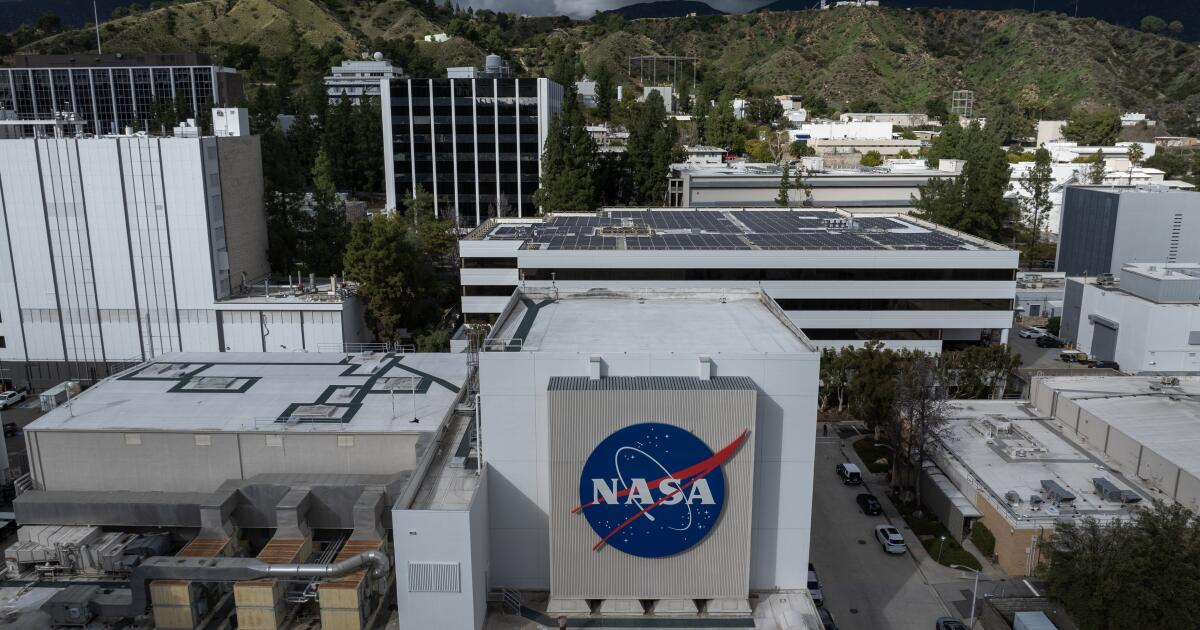
The contract for management and operation of NASA’s Jet Propulsion Laboratory will be opened up to a competitive bidding process for the first time in its history, the space agency announced on Friday.
The action forces Caltech to compete for control of the La Cañada Flintridge institution it has managed since NASA’s inception in 1958.
“The rapid growth of the U.S. space economy indicates there may now be a viable competitive market for programmatic and institutional elements,” NASA said in a statement. “This decision is part of a broader governmentwide and agency effort to find efficiencies, strengthen performance, and drive mission outcomes faster and more affordably.”
In a joint statement, Caltech President Thomas F. Rosenbaum and JPL Director Dave Gallagher said that the announcement came as “no surprise” and that it already had a team in place “to ensure we are positioned for success” in the bidding process.
“Over the course of our nearly seven-decade-long partnership with NASA, Caltech and JPL have led humanity’s exploration and understanding of the universe — and our place within it,” the Pasadena university said. “The ambitions ahead — no less bold than those we have already realized— are ones we are fully prepared to meet.”
The competition for the contract is part of a slate of changes NASA Administrator Jared Isaacman announced on Friday, including a massive reorganization of the space agency intended “to concentrate resources towards the highest priority objectives in the National Space Policy and liberate the best and brightest from needless bureaucracy and obstacles that impede progress,” Isaacman wrote in a letter to the agency’s roughly 18,000 employees.
JPL was founded by Caltech researchers in 1936, and became part of NASA when the space agency was formed in 1958. Its current 10-year contract with NASA, which is valued at up to $30 billion, runs through Sept. 30, 2028.
Times staff writer Noah Haggerty contributed to this report.
-

 Colorado3 minutes ago
Denver elementary school gets new upgrades through Target Bullseye Builds program
-

 Connecticut9 minutes ago
Milford honors veterans lost at Memorial Day event
-

 Delaware15 minutes ago
After fire destroys historic Delaware church, congregation finds temporary home
-
Georgia27 minutes ago
NCAA Regional Returns to The Flats
-

 Hawaii33 minutes ago
Honolulu police look for suspect in Kailua gas station robbery
-
 Idaho39 minutes ago
Three hospitalized after head-on crash on State Highway 45 in Owyhee County
-

 Illinois45 minutes ago
Stark County relay wins state title, leading Western Illinois girls track results
-

 Indiana51 minutes ago
Felix Rosenqvist wins 110th Running of Indianapolis 500 in thrilling fashion


