Science
SoCal officials unleash sterile mosquitoes in bid to curb disease — with promising results


A battle is underway against an invasive mosquito behind a recent surge in the local spread of dengue fever in Southern California — and officials may have unlocked a powerful tool to help win the day.
Two vector control districts — local agencies tasked with controlling disease-spreading organisms — released thousands of sterile male mosquitoes in select neighborhoods, with one district starting in 2023 and the other beginning the following year.
The idea was to drive down the mosquito population because eggs produced by a female after a romp with a sterile male don’t hatch. And only female mosquitoes bite, so unleashing males doesn’t lead to transmission of diseases such as dengue, a potentially fatal viral infection.
The data so far are encouraging.
One agency serving a large swath of Los Angeles County found a nearly 82% reduction in its invasive Aedes aegypti mosquito population in its release area in Sunland-Tujunga last year compared with a control area.
Another district, covering the southwestern corner of San Bernardino County, logged an average decrease of 44% across several heavily infested places where it unleashed the sterile males last year, compared with pre-intervention levels.
Overall invasive mosquito counts dropped 33% across the district — marking the first time in roughly eight years that the population went down instead of up.
“Not only were we out in the field and actually seeing good reductions, but we were getting a lot less calls — people calling in to complain,” said Brian Reisinger, community outreach coordinator for the Inland Empire’s West Valley Mosquito and Vector Control District.
But challenges remain. Scaling the intervention to the level needed to make a dent in the vast region served by the L.A. County district won’t happen overnight and would potentially require its homeowners to pay up to $20 in an annual property tax assessment to make it happen.
Climate change is allowing Aedes mosquitoes — and diseases they spread — to move into new areas and go gangbusters in places where they’re established.
Surging dengue abroad and the widespread presence of Aedes mosquitoes at home is “creating this perfect recipe for local transmission in our region,” said Dr. Aiman Halai, director of the vector-borne disease unit at the L.A. County Department of Public Health.
Tiny scourge, big threat
Aedes aegypti mosquitoes were first detected in California about a decade ago. Originally hailing from Africa, the species can transmit dengue, as well as yellow fever, Zika and chikungunya.
Another invasive mosquito, Aedes albopictus, arrived earlier, but its numbers have declined and it is less likely to spread diseases such as dengue.
Although the black-and-white striped Aedes aegypti can’t fly far — just about 150 to 200 yards — they manage to get around. The low-flying, day-biting mosquitoes are present in more than a third of California’s counties, including Shasta County in the far north.
An Aedes mosquito, known for nipping ankles, prefers to bite humans over animals. The insects, which arrived in California about a decade ago, can transmit diseases such as dengue and Zika.
(Orange County Mosquito and Vector Control District)
Aedes mosquitoes love to bite people — often multiple times in rapid succession. As the insects spread across the state, patios and backyards morphed from respites into risky territories.
But tamping down the bugs has proved difficult. They can lay their eggs in tiny water sources. And they might lay a few in a plant tray and others, perhaps, in a drain. Annihilating invaders isn’t easy when it can be hard to locate all the reproduction spots — or access all the yards where breeding is rampant.
That’s one of the reasons why releasing sterilized males is attractive: They’re naturally adept at finding their own kind.
Mosquito vs. mosquito
Releasing sterilized male insects to combat pests is a proven scientific technique that’s been around since the 1950s, but using it to control invasive mosquitoes is relatively new. The approach appears to be catching on in Southern California.
The West Valley district pioneered the release of sterilized male mosquitoes in California. In 2023, the Ontario-based agency rolled out a pilot program before expanding it the following year. This year it is increasing the number of sites being treated.
The Greater Los Angeles County Vector Control District launched its own pilot effort in 2024 and plans to target roughly the same area this year — with some improvements in technique and insect-rearing capacity.
Starting in late May, an Orange County district will follow suit with the planned release of 100,000 to 200,000 sterile male mosquitoes a week in Mission Viejo through November. A Coachella Valley district is plugging away at developing its own program, which could get off the ground next spring.
Vector officials in L.A. and San Bernardino counties said residents are asking them when they can bring a batch of zapped males to their neighborhood. But experts say for large population centers, it’s not that easy.
“I just responded this morning to one of our residents that says, ‘Why can’t we have this everywhere this year?’ And it’s, of course, because Rome wasn’t built in a day,” said Susanne Kluh, general manager for the Greater Los Angeles County Vector Control District.
Kluh’s district has a budget of nearly $24 million and is responsible for nearly 6 million residents across 36 cities and unincorporated areas. West Valley’s budget this fiscal year is roughly $4 million, and the district serves roughly 650,000 people in six cities and surrounding county areas.
Approaches between the two districts differ, in part due to the scale they’re working with.
West Valley targets what it calls hot spots — areas with particularly high mosquito counts. Last year, before peak mosquito season, it released about 1,000 sterile males biweekly per site. Then the district bumped it to up to 3,000 for certain sites for the peak period, which runs from August to November. The idea is to outnumber wild males by 100 to 1. Equipment for the program cost about $200,000 and the district hired a full-time staffer to assist with the efforts this year for $65,000.
Solomon Birhanie, scientific director for West Valley, said the district doesn’t have the resources to attack large tracts of land so it’s using the resources it does have efficiently. Focusing on problem sites has shown to be sufficient to affect the whole service area, he said.
“Many medium to smaller districts are now interested to use our approach,” he said, because there’s now evidence that it can be incorporated into abatement programs “without the need for hiring highly skilled personnel or demanding a larger amount of budget.”
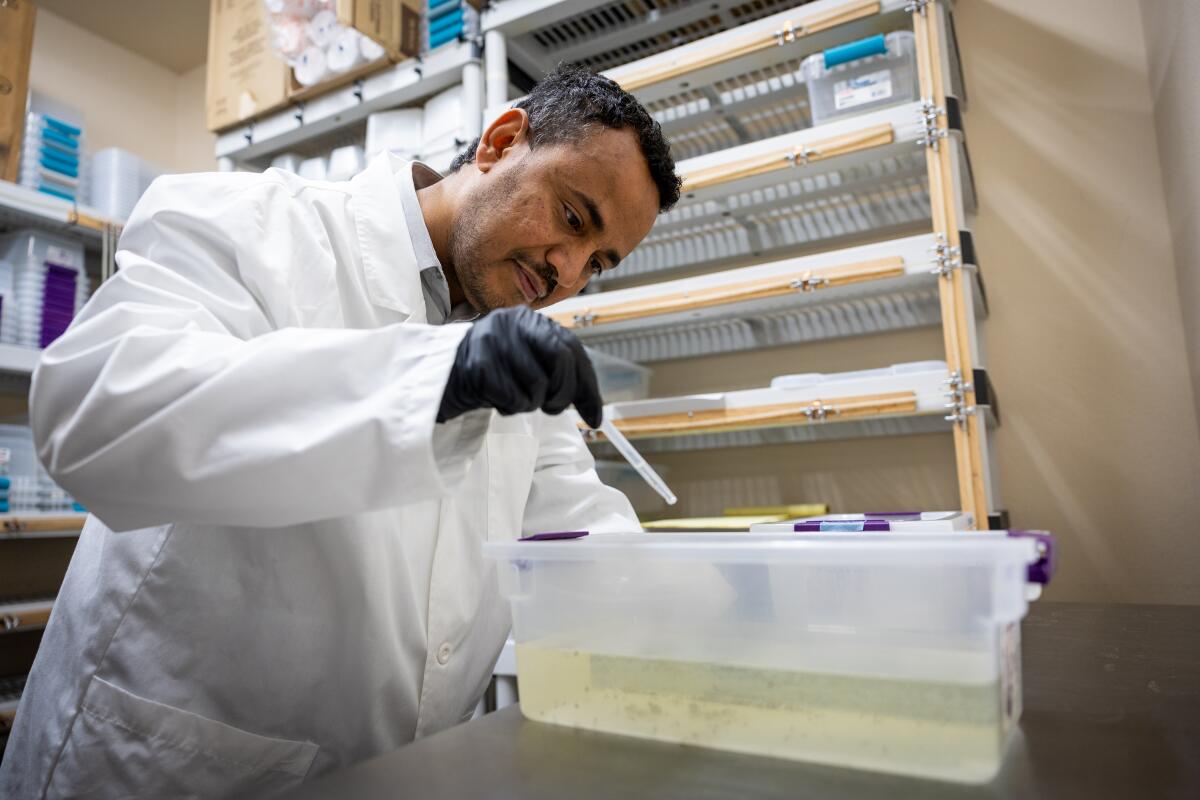
Solomon Birhanie, scientific director at the West Valley Mosquito and Vector Control District, views a container of mosquito larvae in the lab in March 2024. The Ontario-based district pioneered the release of sterilized male Aedes mosquitoes in California.
(Allen J. Schaben / Los Angeles Times)
In its inaugural study last year, the L.A. County district unleashed an average of 30,000 males per week in two Sunland-Tujunga neighborhoods between May and October — seeking to outperform wild males 10 to 1. Kluh anticipates this year’s pilot will cost about $350,000.
In order to bring the program to a larger area of the district, Kluh said more funding is needed — with officials proposing up to $20 annually per single-family home. That would be in addition to the $18.97 district homeowners now pay for the services the agency already provides.
If surveys sent to a sample of property owners favor the new charge, it’ll go to a vote in the fall, as required by Proposition 218, Kluh said.
There are five vector control districts that cover L.A. County. The Greater L.A. County district is the largest, stretching from San Pedro to Santa Clarita. It covers most of L.A. city except for coastal regions and doesn’t serve the San Gabriel or Antelope valleys.
Galvanized by disease
California last year had 18 locally acquired dengue cases, meaning people were infected with the viral disease in their communities, not while traveling.
Fourteen of those cases were in Los Angeles County, including at least seven tied to a small outbreak in Baldwin Park, a city east of L.A. Cases also cropped up in Panorama City, El Monte and the Hollywood Hills.
The year before that, the state confirmed its first locally acquired cases, in Long Beach and Pasadena.
Although most people with dengue have no symptoms, it can cause severe body aches and fever and, in rare cases, death. Its alias, “breakbone fever,” provides a grim glimpse into what it can feel like.
Over a third of L.A. County’s dengue cases last year required hospitalization, according to Halai.
Mosquitoes pick up the virus after they bite an infected person, then spread it by biting others.
Hope and hard truths
Mosquito control experts tout sterilization for being environmentally friendly because it doesn’t involve spraying chemicals and officials could potentially use it to target other disease spreaders — such as the region’s native Culex mosquito, a carrier of the deadly West Nile virus.
New technologies continue to come online. In the summer last year, the California Department of Pesticide Regulation approved the use of male mosquitoes infected with a particular strain of a bacteria called Wolbachia. Eggs fertilized by those males also don’t hatch.
Despite the promising innovations, some aspects of the scourge defy local control.
Since her start in mosquito control in California nearly 26 years ago, Kluh said, the season for the insects has lengthened as winters have become shorter. Back then, officials would get to work in late April or early May and wrap up around early October. Now the native mosquitoes emerge as early as March and the invasive insects can stick around into December.
“If things are going the way it is going now, we could just always have some dengue circulating,” she said.
Last year marked the worst year on record for dengue globally, with more than 13 million cases reported in the Americas and the Caribbean, according to the Centers for Disease Control.
Many countries are still reporting higher-than-average dengue numbers, meaning there’s more opportunity for travelers to bring it home.


new video loaded: NASA Announces Artemis III Crew
transcript
transcript
NASA Announces Artemis III Crew
NASA announced the crew of Artemis III mission, which will fly to low-Earth orbit to test rendezvous and docking maneuvers with one or two lunar landers.
-
“I am excited to welcome you as the next crew in the Artemis journey to successfully return to the moon — this time to stay.” “I’m honored by the role that I’ve been given. I’m also very humbled by the task in front of us. But first and foremost, I’m grateful.” “So with that, the Artemis II crew, comrade, hands you the baton. You got the controls.” “As you know, we had a significant anomaly at our Launch Complex 36A on May 28. We’ve redoubled our efforts and are moving forward.”
By Alisa Shodiyev Kaff
June 9, 2026
Science
Santa Monica Mountains’ last steelhead trout survived the Palisades fire — and even had babies

Scientists feared the Santa Monica Mountains’ last remaining steelhead trout were dead, smothered by debris flows unleashed by the Palisades fire.
But the endangered fish surprised them: A team of biologists recently spotted 30 of the rare trout — and 21 babies — in Topanga Creek.
“There was a lot of happy dancing in the creek,” said Rosi Dagit, principal conservation biologist for the Resource Conservation District of the Santa Monica Mountains, which works with public and private landowners to conserve natural resources.
That’s because the steelhead here are endangered, at both the state and federal levels. Once, they swam in most streams of the Santa Monicas, but their numbers plummeted amid overfishing and coastal development. Increasingly frequent wildfire has further stressed their habitat. Topanga Creek, a biodiversity hot spot, is home to their last known population in the mountains that stretch from the Hollywood Hills to Point Mugu in Ventura County.
The trout that were spotted, including this one, are part of a distinct Southern California population that’s listed as endangered at the state and federal levels.
(RCDSMM Stream Team)
The California Department of Fish and Wildlife spearheaded a complex mission to rescue trout threatened by the Palisades fire that sparked in January 2025.
Time was of the essence. The fire hadn’t yet been fully contained. But rain was on the way, which would sweep massive amounts of sediment from the denuded hillsides into the water. Fish are often killed this way.
Crews stunned the fish with electricity, scooped them up in buckets, trucked them to a hatchery and ultimately moved them to Arroyo Hondo Creek in Santa Barbara County.
Within days, Topanga Creek was choked with mud. Some assumed the fish left behind were goners.
But in March, the conservation district’s team found four. The following month, when water conditions were clearer, they saw more.
“These fish continue to amaze me,” said Kyle Evans, environmental program manager for the state Department of Fish and Wildlife, who had seen the damage to the creek. “I had seen populations get wiped out in similar situations. So when I heard, I was thrilled.”
Evans surmises the fish that survived were in an area of the creek where less charred material and sediment were swept in.
“These fish likely hunkered down, were hiding under some rocks or places to try to get away from the main concentration of flow,” he said. “And luckily they weren’t buried.”
The ones that were spotted were fairly small, around 6 to 14 inches. Rainbow trout and steelhead trout are the same species, but with different lifestyles. If the fish remain in freshwater, they’ll be considered rainbows. However, they can migrate to the ocean and become steelhead, where they typically grow larger before returning to their natal waters to spawn.
Topanga Creek hasn’t fully recovered from the damage it sustained, but scientists say it’s looking better. Surveys last year were “so depressing,” Dagit said, with very few animals, and stretches that were essentially transformed into flat roads from all the sediment buildup. Some of the riparian canopy burned right down to the creek.
Then came 32 inches of rain over the last nine months, scouring out and moving sediment, creating deeper pools. Dagit said they recently found newt egg masses for the first time in years, as well as a few adult newts and many frogs. Plants that provide cover are starting to recover.
She provided photos comparing certain pools last year and this year, some dramatically transformed. In September 2025, the Shrine Pool could have been an overgrown hiking trail. This April, it was filled with shallow water.

The Shrine Pool in September 2025, left, and the same location in April 2026, right, with RCDSMM’s Isaac Yelchin donning a wetsuit.
(RCDSMM Stream Team)
Topanga Creek is home to another endangered fish, the small but hardy northern tidewater goby, often described as cute. Not long before the trout operation, Dagit led a rescue of hundreds of these fish too. Many were repatriated to the lagoon at the mouth of the creek in a moving ceremony last June.
There’s still the matter of what to do with the trout that were moved to Santa Barbara County last year. Evans would like to bring them home to the Santa Monicas at some point, but isn’t sure if it will happen. On one hand, they could bolster the small, genetically isolated surviving population. On the other, they might inadvertently bring in a disease or bacteria. There is some time to decide. Evans estimates the creek still needs to recover for two to three more years.
For now, the fish are functioning fine in their adopted creek. Experts worried the trauma wrought by the move would disrupt their spawning process, but they had babies that spring. This year, they spawned again.

The Pacifica Municipal Pier was shut down and taped off Thursday after city workers noticed cracks running through the landmark structure and concrete chunks falling into the ocean.
It’s just one of many coastal California structures that have recently crumbled under pressure from a rising and relentless ocean.
Officials from the small, beach city south of San Francisco said the pier was closed due to “cracking, separation, and displacement of the concrete walkway and structural elements.”
It will stay closed while structural engineers asses its safety.
Photos taken by city employees show a wide crack that runs from top to bottom and across the structure as well. Other photos show a large horizontal crack under the foundation of a small restaurant on the pier, the Chit Chat Cafe.
The cafe was also shut down.
This is not the first time the 53-year-old pier has shown signs of stress. In 2021, part of it was shut down after handrails along the edge collapsed. And in 2023, after a series of storms pummeled the Central California coast, damaging parts of the pier, the structure was partially closed for more than year.
Those same storms caused extensive damage in Aptos and Capitola, 70 miles south, where piers and waterfront infrastructure were swept away or damaged.
In 2024, a 150- to 180- foot section of the Santa Cruz wharf was ripped off by powerful waves.
At least 10 of the state’s dozens of coastal public piers were closed for part or all of 2024 due to structural damage sustained in winter storms since 2022. At least five others have longer-term upgrades planned to address structural issues.
“These things are costly to maintain,” said Zach Plopper, senior environmental director at Surfrider. “They are a part of our California coastal culture in many ways, but we’re going to need to reckon with, one, the state that they’re in, and two, the continuous and worsening threats they’re going to experience,”
He said most of the piers were constructed in the early 1900s, and they weren’t built to withstand decades of rough seas, storms and rising sea level.
“With this incoming El Niño, which is forecasted to be significant, and this marine heat wave we’re in the midst of, we’re kind of in uncharted waters as far as what this winter could bring in terms of storms and swells to the California coast, and we’re likely going to see a lot more damage,” he said. “Not just piers, but roads and other coastal infrastructure up and down the state.”
There was no storm in Pacifica earlier this week, so no single event could be blamed for the destruction.
However, a 2025 report from an outside engineering firm, GHD, found that several sections of the pier were in “poor” or “serious” condition, and they recommended closure before anticipated storms or events that could “subject the piles to high winds, swells and large waves.”
The firm found several areas of the pier where concrete was missing and rebar was exposed and corroding.
“The pier has continued to experience high winds and large waves in a harsh marine environment,” the engineers wrote in the report, noting that continuous exposure to seawater or marine spray was “detrimental” to the structure.
A 2023 city report estimated it would cost $19 million to repair.
That same year, a state law was enacted to require local governments along the California coast to plan for sea level rise in the coming decades.
Sea level has risen some 8 inches, on average, along the coast in the past 150 years, Plopper said, and researchers anticipate another foot in the next 25 years.
“We’re going to see profound shifts on our coastline, none that we have ever experienced before, and building static structures on the coast just doesn’t work all that well,” he said. “We’re going to have to make some really hard decisions.”
-
 Sports1 minute ago
World Cup referee, denied entry to U.S. because of suspected ties to terrorists, hailed in return to Somalia
-

 World9 minutes ago
US military chief Hegseth warns Cuba against acquiring military arms
-
 News34 minutes ago
July 1 brings big student loan changes. Here’s what you need to know
-

 Los Angeles, Ca2 hours ago
Los Angeles High School locked down as police search for armed juvenile
-

 Detroit, MI2 hours ago
‘Diarra From Detroit’ sets date for second season on Paramount+
-

 San Francisco, CA3 hours ago
San Francisco police release video of shootout that critically wounded officer
-

 Dallas, TX3 hours ago
3 Dallas educators among FIFA World Cup volunteers
-

 Miami, FL3 hours ago
Miami Gardens man arrested after fleeing Florida Keys deputies at 125 mph, sheriff says

