Science
Lead Poisoning May Have Made Ancient Romans a Bit Less Intelligent


Roughly 2,000 years ago, the Roman Empire was flourishing. But something sinister was in the air. Literally.
Widespread pollution in the form of airborne lead was taking a toll on health and intelligence, researchers reported on Monday in the journal Proceedings of the National Academy of Sciences.
During the roughly two centuries starting in 27 B.C., a period of relative stability and prosperity known as the Pax Romana, the empire extended throughout Europe, the Middle East and North Africa. Its economy relied on silver coinage, which required huge mining operations.
But extracting silver from the Earth creates a whole lot of lead, said Joseph McConnell, an environmental scientist at the Desert Research Institute, a nonprofit group based in Nevada, and the lead author of the new research. “If you produce an ounce of silver, you’d have produced something like 10,000 ounces of lead.”
And lead has a host of negative effects on the human body. “There is no such thing as any safe level of lead exposure,” said Deborah Cory-Slechta, a neurotoxicologist at the University of Rochester Medical Center who was not involved in the research.
Dr. McConnell and his colleagues have now detected lead in layers of ice collected in Russia and Greenland that date to the time of the Roman Empire. Lead entered the atmosphere from Roman mining operations, hitched a ride on air currents and eventually fell out of the atmosphere as snow in the Arctic, the team surmised.
The levels of lead that Dr. McConnell and his collaborators measured were extremely low, roughly one lead-containing molecule per trillion molecules of water. But the ice samples were collected thousands of miles from southern Europe, and lead concentrations would have been highly dispersed after such a long journey.
In order to estimate the amount of lead originally emitted by Roman mining operations, the researchers worked backward: Using powerful computer models of the planet’s atmosphere and making assumptions about the location of the mining sites, the team varied the amount of lead emitted to match the concentrations they measured in the ice. In one case, they assumed that all silver production took place at a historically important mining site in southwestern Spain known as Rio Tinto. In another case, they presumed that silver mining was equally spread out across dozens of sites.
The team calculated that anywhere from 3,300 to 4,600 tons of lead were being emitted into the atmosphere each year by Roman silver-mining operations. The researchers then estimated how all that lead would be scattered across the Roman Empire.
“We ran the model in the forward direction to see how those emissions would be distributed,” Dr. McConnell said.
With those atmospheric-lead concentrations in hand, the researchers next used modern-day data to estimate how much lead would have entered the bloodstreams of people in ancient Rome.
Dr. McConnell and his colleagues focused on infants and children. Young people are particularly susceptible to taking up lead from their environment via ingestion and inhalation, said Dr. Bruce Lanphear, a public heath physician at Simon Fraser University in British Columbia who was not involved in the research. “Pound for pound, children, particularly infants, eat more and breathe more.”
In recent decades, lead levels in children’s blood have been correlated with a slew of physical and mental health metrics, including I.Q., Dr. Cory-Slechta said. “We have actual data on I.Q. scores in kids with different blood-lead concentrations.”
Using those modern-day relationships, Dr. McConnell and his team estimated that children across much of the Roman Empire would have had around 2 to 5 additional micrograms of lead, per deciliter of blood. Such levels correspond to I.Q. declines of roughly 2 or 3 points.
For comparison, American children in the 1970s had average blood-lead-level enhancements of around 15 micrograms more lead per deciliter of blood before the phasing out of leaded gasoline and leaded paints. Their corresponding average I.Q. decline was about 9 points.
But lead exposure would have had other negative effects on Romans as well. Higher levels of lead in the blood have also been linked to higher incidences of preterm births and reduced cognitive functioning in old age. “It follows you throughout life,” Dr. Lanphear said.
Some scholars have hypothesized that lead poisoning played an important role in the decline of the Roman Empire. But that idea has been called into question, at least when it comes to water contaminated by lead pipes. A 2014 study showed that, while the pipes used to distribute water in Rome increased lead levels, the water was unlikely to be truly harmful.
These new findings make sense, said Hugo Delile, a geoarchaeologist at the French National Centre for Scientific Research, who was not involved in the research. “They confirm the extent of lead pollution resulting from Roman mining and metallurgical activities.”
According to Dr. McConnell, the research also confers a dubious honor on Roman mining. “To my knowledge, it’s the earliest example of widespread industrial pollution,” he said.



California in 2026 has already seen its highest number of annual measles cases in seven years, health officials said, amid an ongoing resurgence of a notoriously infectious disease once considered effectively eliminated in the United States.
The looming new domestic beachhead for the disease comes as vaccination rates have tumbled nationwide in recent years — in some areas falling well below the herd immunity threshold experts say is necessary to keep it from spreading.
“There are pockets of vulnerability, like in communities, that can really lead to outbreaks going wild,” said Dr. Peter Chin-Hong, a UC San Francisco infectious diseases expert.
So far this year, there have been at least 40 confirmed measles cases in California. That’s well above the 25 recorded in all of 2025, according to Dr. Eric Sergienko, chief of the state Department of Public Health’s communicable disease control division. It’s also already the state’s highest single-year tally since 2019, when there were 73.
The latest measles case was announced Wednesday: an infant from San Francisco who was too young to be vaccinated and picked up the virus during an international trip. It was San Francisco’s first measles case since 2019. (The infant’s family was all vaccinated.)
The spread of the highly infectious virus is largely occurring among unvaccinated individuals, particularly children and younger adults, state health data show. Of the first 39 measles cases reported this year in California, 95% were among people who were unvaccinated or had an unknown immunization status, and 85% were in individuals under age 20, Sergienko said in a briefing to health professionals this week.
The measles vaccine — usually referred to as MMR, as it also conveys protection against two other once-common childhood illnesses, mumps and rubella — is considered to be 97% effective at preventing illness after getting the recommended two doses, and 93% effective after a single shot. There is a small chance that vaccinated people can still get measles, though they tend to have milder illness, according to the U.S. Centers for Disease Control and Prevention.
It was only a generation ago, in 2000, when the U.S. declared that ongoing transmission of measles had been eliminated — a public health success credited to a robust immunization effort following the disease’s resurgence from 1989 to 1991.

But some experts now fear the U.S. is in danger of allowing the virus to regain a foothold. Nationwide, there have been at least 1,714 confirmed measles cases so far this year, nearing the total of 2,287 reported in all of 2025, according to the CDC.
The number of cases recorded in 2025 was the highest single-year tally since 1991. An overwhelming majority of them, 90%, were linked to an outbreak.
Out of every 10,000 people who get measles, 500 children are statistically likely to get pneumonia, and up to 30 of them could die, Sergienko said.
Three measles deaths were reported nationally last year — two among unvaccinated school-age children in Texas and one in an unvaccinated adult in New Mexico.

Los Angeles County in September reported the death of a school-age child from a complication of measles. The child had been infected as an infant when they were too young to be vaccinated, and years later developed subacute sclerosing panencephalitis, or SSPE, a fatal disease that targets the brain.
Children typically receive their first MMR dose when they are 12 to 15 months old and the second when they are 4 to 6 years old, according to the CDC.
Babies age 6 months to 11 months and traveling internationally should get a dose, but should still get the standard two-dose series after their first birthday, the CDC says.
There have been three outbreaks fueling the spread of measles in California so far this year: one in Riverside County, involving three people infected in a single family; one in Shasta County, infecting nine people among a church group; and an ongoing outbreak in Sacramento County and neighboring Placer County, Sergienko said.
The outbreak in the Sacramento Valley was first identified in February, when officials reported that an unvaccinated toddler contracted measles after returning from South Carolina — where an outbreak centered in Spartanburg County has been linked to about 1,000 cases, health officials said. It is considered one of the largest outbreaks in the U.S. in more than 30 years.
Measles was then found in three siblings from a different household in Placer County who had contact with the traveling toddler.
Then, in early March, another measles case was identified in a child from the same community who attended what authorities described as an educational enrichment program, potentially exposing as many as 130 children to the virus, California health officials said. The organizers of the educational program agreed to close their facility temporarily.
L.A. County has reported four measles cases this year so far — all among those who recently traveled internationally. The most recent case involved someone aboard a Singapore Airlines flight that landed at Los Angeles International Airport on Feb. 9.
Orange County has reported a measles case in a young adult who potentially exposed people at a gym and urgent care center in Ladera Ranch, as well as a case in a toddler. They also reported two measles cases among travelers to Disneyland, one on Jan. 22 and the other on Jan. 28.
San Bernardino County reported a measles case in an unvaccinated child traveling from another state. San Diego County said an unvaccinated traveler who lives out of state potentially exposed people while visiting the emergency room of a local hospital in mid-March.
In the Bay Area, health officials reported a case of measles in a vaccinated Santa Clara County resident who recently returned from international travel, and potentially exposed people at a restaurant in Burlingame on Feb. 23 and Feb. 24.
Measles is one of the most contagious viruses known to humans. It can spread through coughing and sneezing, and remain infectious in the air up to two hours after an infected person has left a room. If infected, an individual will typically begin to show measles symptoms seven to 21 days after exposure.
Officials expect the Sacramento Valley measles outbreak to continue for at least the next few weeks.
“With four new cases coming up over the last week, we anticipate that this outbreak will be going on for at least another incubation period, for 21 days or so, as we look at potentially some undocumented transmission occurring within the impacted community,” Sergienko said Tuesday.
Nationally, measles vaccination rates among kindergartners have been declining. During the 2019-20 school year, 95.2% of children that age were fully vaccinated, but that slipped to 92.5% for the 2024-25 school year — below the herd-immunity target of 95%, according to the CDC.
The measles vaccination rate for California kindergartners was 96.1% in 2024-25, among the highest in the nation. Some of the states that have undergone big breakouts have rates for kindergartners below the 95% goal — Texas was 93.2%; New Mexico, 94.8%; and South Carolina, 91.2%.
California has sweeping vaccination requirements as a condition of enrollment in public and private schools, as well as daycare centers, with exceptions only for medical reasons. Parents who opt not to vaccinate due to their beliefs can homeschool their children and enroll them in independent study, provided they do not “receive classroom-based instruction.”
But, as a Times story last year noted, California’s laws don’t define what “classroom-based instruction” means, including whether students need to be vaccinated if they attend some in-person classes or school-sanctioned activities like field trips, soccer practice or prom. Opponents of school vaccination requirements are also working to pressure states like California to weaken them.
Anti-vaccine advocates have been emboldened in recent years with the rise of Health and Human Services Secretary Robert F. Kennedy Jr., a longtime vaccine skeptic.
In March 2025, Kennedy issued a statement that noted vaccines’ effectiveness in preventing measles’ spread, but stopped short of outright recommending that parents vaccinate their children.
Yet as the year went on, Kennedy and the agencies he leads upended the nation’s vaccine delivery system, while publicly sharing misleading and inaccurate information about immunizations.
As recent outbreaks show, measles can spread quickly if it gets into pockets of unimmunized communities, and babies too young to be vaccinated can be at risk for serious illness and death.
One such example was the Disneyland measles outbreak of December 2014 to April 2015, which resulted in 131 cases among Californians, and spread to people in six other states, as well as Canada and Mexico. Among the measles cases in California, at least 12 of those infected were infants too young to be vaccinated.
Measles symptoms don’t usually start with the telltale rash, Sergienko said. The disease begins with a mild-to-moderate fever, then a cough, runny nose and red, watery eyes. It takes two or three days later before tiny white lesions, known as Koplik spots, appear inside the mouth, and an additional fever may spike, with temperatures that can exceed 104 degrees.
A couple of days later, the red measles rash emerges, starting at the hairline and moving downward, Sergienko said.
Officials urge people who suspect they or their child have measles call their healthcare provider. Healthcare providers are advised to evaluate a suspected measles patient in a way that doesn’t expose other patients to the virus.
Health officials urged people to get up to date on the measles vaccine if they haven’t done so.
“We all need to work together to share the medical evidence, benefits, and safety of vaccines to provide families the information they need to protect children and our communities,” Dr. Erica Pan, director of the California Department of Public Health, said.
Science
A cracked heat shield rattled NASA after Artemis I. Now, Artemis II will put the fix to the test
EDWARDS, Calif. — The Artemis II astronauts are scheduled to return Friday from their trip to the moon. When they do, they will slam into Earth’s atmosphere at over 32 times the speed of sound — and will do so using a reentry technique that has yet to be tested in real-world scenarios.
In 2022, NASA sent the uncrewed Artemis I test mission to the moon. As it pierced through the Earth’s atmosphere on return, the capsule suffered unexpected damage to its heat shield, prompting NASA scientists to rethink what’s needed to keep the homeward-bound Artemis II astronauts safe.
There’s been a ton of work done to prepare for this moment — but the reality is, scientists won’t know exactly how the heat shield will behave until they test it in a bona fide reentry.
-
Share via
That’s why a team of NASA and Department of Defense scientists and test pilots stand at the ready to collect detailed data on how the heat shield performs as the capsule streaks through the sky, turning the atmosphere around it into a bright fireball about half as hot as the surface of the sun before splashing down off the coast of San Diego.
Test pilots stationed at Southern California military bases will take turns chasing the capsule in a complex, high-speed relay: first a NASA business jet, then a Navy surveillance aircraft, followed by another NASA jet, and finally a NASA weather research aircraft. Crews on the ground will monitor the Artemis II capsule and send those test pilots precise speeds and coordinates to hit as they follow the fireball in the sky. Meanwhile, researchers in the back of the planes will track the capsule with telescopes and sensors.

Center Director Bradley C. Flick, left, gives project manager Robert Navarro a high five at the NASA Armstrong Flight Research Center on Edwards Air Force Base on March 18.
(Genaro Molina / Los Angeles Times)
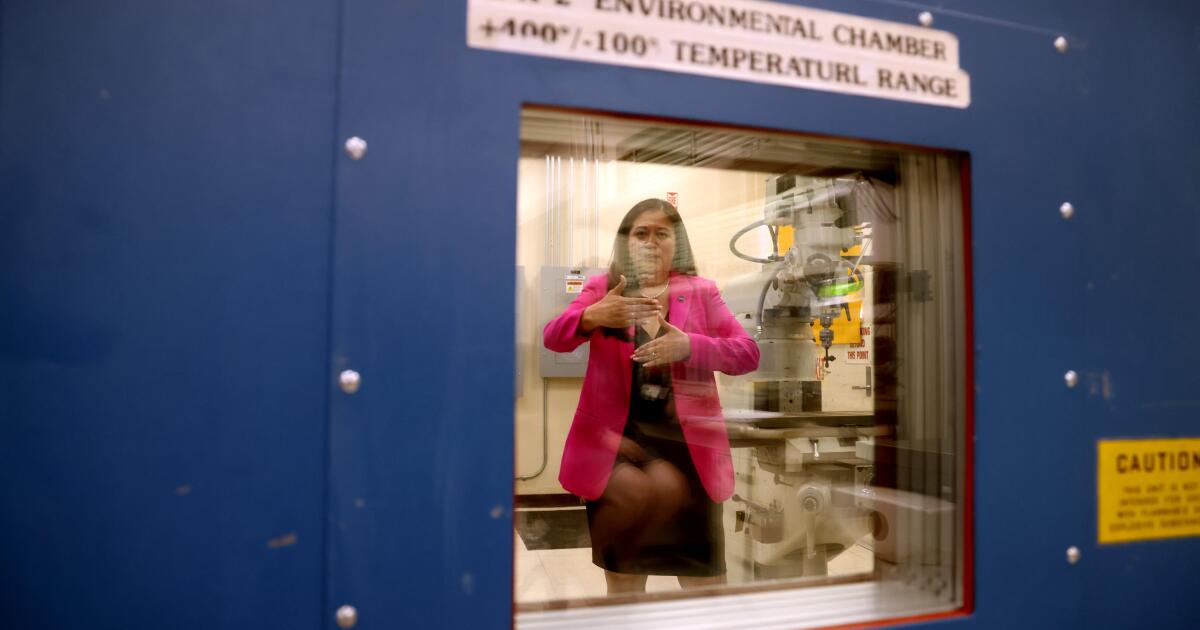
“It’s an exciting job threading the needle multiple times,” said Robert Navarro, project manager at NASA’s Armstrong Flight Research Center in Edwards, Calif., which is in charge of the critical third segment of the relay. “It has to be precise, simply because of the short window of time that they need to collect that data. They have to be exactly right on the mark.”
After splashdown, a separate Armstrong Flight Research Center team will collect a fortified sensor affixed to the exterior of the capsule that is designed to study the heat shield up close.
“I’m really excited that my team is a part of such an important mission,” said Patty Ortiz, deputy project manager for the capsule sensor project at the center. “Having worked on it since 2019, it’s definitely a full-circle moment for me.”
The center has pushed the limits of human flight for decades — and collected a lot of data doing so.
“We consider our airplanes flying labs — we’re going to go do things that maybe haven’t been done before,” said Brad Flick, who retired as director of the center March 20 after nearly four decades at the research facility.

Armstrong Flight Research Center project manager Robert Navarro walks past a Gulfstream III airplane that will be used in the Artemis II mission.
(Genaro Molina / Los Angeles Times)
In the 1960s, engineers at the Flight Research Center helped design and test a mock-up of the Apollo lunar landing vehicle that Neil Armstrong used for landing practice on Earth before he flew to the moon. (The center was later renamed after him, the first person to walk on the lunar surface.)
The center has been preparing to study the Artemis II reentry for years, but the work became even more important after NASA discovered issues with the heat shield after the Artemis I test mission.
NASA guided the Artemis I capsule to first only graze the Earth’s atmosphere before briefly popping back up into space, then completing the final reentry. This novel approach reduced the forces that astronauts would experience on reentry and helped NASA to more precisely maneuver the capsule to its landing point in the Pacific — regardless of where or when it comes back from the moon.
That mission seemed like a success, but when crews began inspecting the heat shield on the bottom of the uncrewed capsule after splashdown, they noticed a problem.

After NASA’s Orion spacecraft was recovered at the conclusion of the Artemis I test flight and transported to NASA’s Kennedy Space Center in Florida, its heat shield was removed from the crew module inside the Operations and Checkout Building and rotated for inspection.
(NASA)
The heat shield is designed to slowly erode (or “ablate,” in NASA parlance) away during reentry to keep conditions in the capsule livable while the air a few inches away can reach nearly 5,000 degrees Fahrenheit: The outside layer of the shield routinely heats up, then sloughs off in the form of gas and pieces of char, which carry that heat away from the capsule as they disperse into the atmosphere around the capsule.
The problem with Artemis I was that the new reentry approach NASA had attempted seemed to disrupt this ablation process.
Because Artemis I went back into space between the first dip into the atmosphere and the final reentry, there was a brief respite in its heat exposure — that meant that the hot interior of the heat shield kept producing gases, but the exterior was no longer shedding material fast enough to allow those gases to escape. Pressure built up, which cracked the heat shield and ultimately resulted in larger pieces chipping off during the final reentry.
NASA scientists determined that had a crew been onboard, they would have survived — but they didn’t want to expose the Artemis II astronauts to unnecessary risk.
That left two options: First, replace the already-built Artemis II heat shield with a new design in the works that could handle the reentry path attempted with Artemis I. Second, change the reentry path to skip the first dip into the atmosphere and just go straight in to eliminate the conditions that created the problem in the first place.
The agency ultimately deemed replacing the Artemis II heat shield too much of a logistical headache and opted for the latter, simpler approach. On Friday, NASA astronauts will put that decision to the test. Armstrong Flight Research Center scientists are standing by to watch.
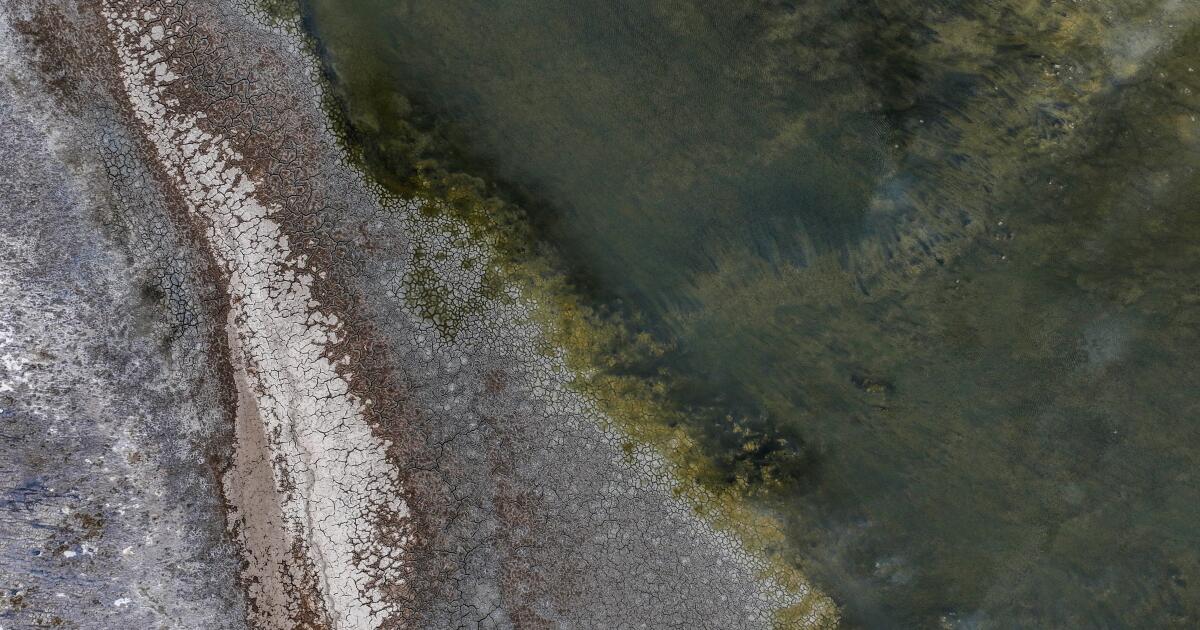
Along the shores of the shrinking Salton Sea, desert winds regularly kick up dust and send it drifting through nearby neighborhoods. New research indicates that living there may affect kids’ lungs.
Scientists from the University of Southern California tested the lung capacity of 369 children between the ages of 10 and 12 for about two years and found that those who live less than 6.8 miles from the Salton Sea have diminished lung development compared with kids farther away.
The slower pulmonary development in these children was similar to the development of those who live very close to freeways.
“Basically, their overall lung capacity isn’t developing at the same rate as kids that live further away,” said Shohreh Farzan, a co-author of the study and associate professor at the USC Keck School of Medicine. “We’re seeing the impacts of dust events and proximity to the sea as being detrimental to children’s lung development.”
When lung growth is hindered in adolescence, “that can lead to increased risk for respiratory, cardiovascular, and metabolic diseases later in life,” said Fangqi Guo, the study’s lead author.
The Salton Sea is California’s largest lake, covering about 300 square miles in Imperial and Riverside counties. It’s fed as Colorado River water drains off farm fields in the Imperial Valley.
The saline lake has been shrinking rapidly since the early 2000s, when the Imperial Irrigation District began selling some of its Colorado River water to growing urban areas under an agreement with agencies in San Diego County and the Coachella Valley.
The lake has gone down 14.5 feet since 2003, exposing more than 41,000 acres of lakebed. Researchers say years of agricultural chemicals and metals washing into the lake have made the dust toxic.
In low-income communities near the lake, children suffer from asthma at high rates. Researchers have previously found that about 1 in 5 children in the area have asthma, nearly triple the national average.
Other research has shown that dust collected near the Salton Sea triggers lung inflammation in mice.
For the latest study, published in JAMA Network Open, the USC researchers worked with the community group Comité Civico del Valle to recruit children to participate.
They measured how much air the children can push out after a deep breath.
They examined levels of fine particles in the air, as well as times when dust levels spike, often triggered by winds.
Dust around the Salton Sea has been recognized as a health problem for years.
To help control it and provide habitat for fish and birds, California agencies have been building berms and sending water flowing into man-made ponds along the shore, creating new wetlands. They’ve also been placing thousands of bales of straw on the exposed lakebed to block windblown dust.
“I think these efforts are not moving quickly enough,” Farzan said. “We need to have a renewed focus on making sure that we’re protecting children’s health.”
The dust doesn’t come only from the Salton Sea playa. It comes from the surrounding landscape, including farm fields, livestock operations, diesel exhaust and unpaved roads.
In a report last year, researchers with the Pacific Institute cited estimates that dust from the Salton Sea accounts for less than 1% of small particle pollution in the region.
Even though it may be a small percentage, Farzan said, “our results are clearly showing that there is something about proximity to the sea that is impactful for children’s health.”
The researchers did not differentiate between sources of dust in their latest study.
“It is possible that that small fraction may be more toxic, may contain different contaminants,” she said. “That’s something that we’re still really interested in learning more about.”
The dust could worsen if looming water cutbacks on the Colorado River accelerate the decline of the Salton Sea. The river flow has declined dramatically over the last quarter-century during a megadrought worsened by climate change.
There are similar issues at other drying lakes around the world, from Utah’s Great Salt Lake to the Aral Sea in Central Asia, Farzan noted, and this will require bigger efforts to contend with dust and its effects on people’s health.

Georgia Tech planning to buy North Avenue property from Coca-Cola for over $31 million

Judge rejects Trump DOJ’s bid to block Hawaii climate lawsuit

Idaho DMV offers new America 250 plate

OCC moves to block Illinois ban on swipe fees on taxes, tips

Indy restaurants have a chance for Michelin recognition as inspectors scour culinary scene

Florida High School Football Rankings: Top 25 teams – Oct. 21

How old is Bo Nix? What to know about Oregon quarterback ahead of 2024 NFL Draft

Cleary's 21 help Le Moyne down Central Connecticut State 69-64 in OT

99th annual Pony Swim held in Virginia

Indiana Members Credit Union announced as new anchor tenant at Bottleworks District

Video: A Look at the Plans for Trump’s ‘Triumphal Arch’

First-ever moratorium on AI data centers passes Maine legislature

Flights hit by Iran war? Europe’s handiest rail networks revealed

3 things to know about naval blockades as U.S. begins patrols in the Strait of Hormuz

Video: What the Iran War Means for China
-

 Ohio2 days ago
‘Little Rascals’ star Bug Hall arrested in Ohio
-

 Georgia1 week ago
Georgia House Special Runoff Election 2026 Live Results
-

 Arkansas6 days ago
Arkansas TV meteorologist Melinda Mayo retires after nearly four decades on air
-

 Pennsylvania1 week ago
Parents charged after toddler injured by wolf at Pennsylvania zoo
-

 Culture1 week ago
Can You Name These Novels Based on Their Characters?
-

 Austin, TX1 week ago
ABC Kite Fest Returns to Austin for Annual Celebration – Austin Today
-

 Austin, TX1 week ago
Aaliyah Crump plans to transfer from Texas: report
-

 Politics2 days ago
Dem fundraising giant in the hot seat as GOP lawmakers demand answers over dodged subpoena